
Hausner Ratio and Carr's Index: Measure, Read and Specify Powder Flow
The Hausner ratio is tapped density divided by bulk density; lower means better flow. USP calls 1.11 or less excellent and above 1.60 very, very poor, but sets no pass/fail limit. Labs agree only under a fixed method, so write the method and limit into the agreement.

By Sunil Kumar, Managing Director - Sales · Updated 16 Nov 2026

Key takeaways
One measurement, two scales. The Hausner ratio and Carr’s index both come from bulk and tapped density. USP and Ph. Eur. grade them from excellent (Hausner ratio 1.00 to 1.11) to very, very poor (above 1.60).
No compendial limit. Neither pharmacopeia sets a pass/fail value, and both say the results depend on the method. A limit means something only with the method fixed.
Small reading errors matter. In our illustrative example, a 2 mL difference on the cylinder moves the result from good (1.18) to fair (1.19). Write the sample mass, cylinder, taps, drop height, reading and rounding into the method.
Set limits from your own data. For direct-compression blends we recommend a Carr’s index of 15% or less (Hausner ratio 1.18 or less). For granules and capsule fill, set limits from lot data on the actual press or filler.
In this article
- 1What is the Hausner ratio, and how does it relate to Carr's index?
- 2How do you calculate the Hausner ratio and Carr's index?
- 3How is the Hausner ratio test run under USP <616> and Ph. Eur. 2.9.34?
- 4How do you read a Hausner ratio: what does each range mean?
- 5Why does the same powder give different Hausner ratios?
- 6What are the limits of the Hausner ratio as a flow measure?
- 7What causes a high Hausner ratio, and what should you check?
- 8What Hausner ratio acceptance criteria should a blend or granule specification use?
- 9What does a high Hausner ratio mean downstream?
- 10What should you agree with your CDMO before the first batch?
- 11Conclusion: lock the method, then set the limit
- 12Keep reading
- 13Frequently asked questions
Two laboratories can test the same granules and report Hausner ratios of 1.18 and 1.19. Neither has made a mistake. The flow scale puts those values in different bands, yet they are one graduation of a measuring cylinder apart.
That is why a Hausner ratio on a certificate means little until the method behind it is written down. If you are a formulation scientist, a quality control (QC) analyst, or a buyer outsourcing tablets or capsules to a contract development and manufacturing organization (CDMO), you need three things: how to calculate and read the ratio and Carr’s index, why results move between labs, and what limit to put in an agreement.
This guide takes them in that order. It covers the calculation, the test method in the United States Pharmacopeia (USP) and the European Pharmacopoeia (Ph. Eur.), the flow scale, the details a contract must fix, a specification structure, and the questions to settle with your CDMO before the first batch.
What is the Hausner ratio, and how does it relate to Carr's index?
The Hausner ratio is a powder's tapped density divided by its bulk density. It shows how far the powder packs down when tapped. The more it packs down, the more cohesive the powder is and the worse it tends to flow. Carr's index, which the pharmacopoeias call the compressibility index, is the same measurement as a percentage.
Ph. Eur. general chapter 2.9.36 says both indices may be used to predict flow as influenced by particle size and shape, material density, surface area, moisture content and cohesion. They are compressibility numbers used as a proxy for flow. They are not a direct measure of how powder leaves a hopper or fills a die.
The two convert into each other: Carr's index = 100 × (1 − 1 ÷ Hausner ratio). A Hausner ratio of 1.25 is a Carr's index of 20%. A Carr's index of 15% is a Hausner ratio of 1.18 (1.176 before rounding). We derived these conversions from the two definitions in USP <1174> and Ph. Eur. 2.9.36.
How do you calculate the Hausner ratio and Carr's index?
Measure the untapped volume (V0) and the final tapped volume (Vf) of the same powder mass (m). Then divide: Hausner ratio = V0 ÷ Vf. Carr's index = 100 × (V0 − Vf) ÷ V0. The definitions in Ph. Eur. 2.9.36 and USP <1174> also work from densities, as the table shows.
| Quantity | From volumes (same mass) | From densities |
|---|---|---|
| Bulk density | m ÷ V0 | n/a |
| Tapped density | m ÷ Vf | n/a |
| Hausner ratio formula | V0 ÷ Vf | tapped density ÷ bulk density |
| Carr's index (compressibility index) | 100 × (V0 − Vf) ÷ V0 | 100 × (tapped − bulk) ÷ tapped |
| Step | Value |
|---|---|
| Sample mass, m | 100 g |
| Untapped volume, V0 | 200 mL (250 mL cylinder) |
| Final tapped volume, Vf | 168 mL |
| Bulk density, m ÷ V0 | 0.50 g/mL |
| Tapped density, m ÷ Vf | 0.595 g/mL |
| Hausner ratio, V0 ÷ Vf | 1.19 (1.1905) |
| Carr's index, 100 × (200 − 168) ÷ 200 | 16% |
| Scale band | Fair |
| Reading sensitivity | Vf of 166 or 170 mL gives Hausner ratio 1.20 or 1.18, and Carr's index 17% or 15% |
A 200 mL untapped volume falls inside the 150 to 250 mL window the compendia set for the 250 mL cylinder, so 100 g is a valid sample mass for this setup. These numbers are our own arithmetic from the formulas above.
How is the Hausner ratio test run under USP <616> and Ph. Eur. 2.9.34?
Both compendia run Method 1 in a dry 250 mL graduated cylinder with about 100 g of powder. You read the untapped volume, then tap the cylinder 10, 500 and 1250 times and read the volume again, continuing until successive readings differ by 2 mL or less. USP <616> and Ph. Eur. 2.9.34 are harmonized with each other. USP <1174> Powder Flow and Ph. Eur. 2.9.36 then turn the volumes into the ratio.
- Sample preparation. Pass the powder through a sieve with apertures of 1.0 mm or larger, if needed, to break up agglomerates formed in storage. Do this gently so the material does not change.
- Cylinder and mass. Use a dry 250 mL graduated cylinder readable to 2 mL. Introduce about 100 g, weighed to 0.1% accuracy, without compacting. Level the powder if necessary, without compacting. Read V0 to the nearest graduated unit.
- Other masses and cylinders. If 100 g does not give a V0 between 150 and 250 mL, choose a mass that does, and state it in the results. For V0 between 50 and 100 mL, a 100 mL cylinder readable to 1 mL may be used, and its volume is stated in the results.
- Tapping apparatus. The settling apparatus delivers per minute either nominally 250 ± 15 taps from a height of 3 ± 0.2 mm, or nominally 300 ± 15 taps from 14 ± 2 mm. Rotating the cylinder during tapping is permitted and may be preferred, to limit separation of the powder.
- Tap schedule and stop rule. Carry out 10, 500 and 1250 taps on the same sample and read V10, V500 and V1250. If V500 and V1250 differ by 2 mL or less, V1250 is the tapped volume. If they differ by more than 2 mL, repeat in increments such as 1250 taps until successive readings differ by 2 mL or less. Fewer taps may be appropriate for some powders when validated.
- Reporting. Specify the drop height. USP <616> states that the way the determination was made must be specified when reporting. Replicate determinations are desirable.

How do you read a Hausner ratio: what does each range mean?
A Hausner ratio of 1.11 or below is excellent flow, 1.12 to 1.18 is good, and above 1.60 is very, very poor. USP <1174> and Ph. Eur. 2.9.36 print the same seven bands, with Carr's index alongside. The scale ranks flow character and does not define an acceptable value.
| Carr's index (%) | Hausner ratio | Flow character |
|---|---|---|
| 10 or less | 1.00 to 1.11 | Excellent |
| 11 to 15 | 1.12 to 1.18 | Good |
| 16 to 20 | 1.19 to 1.25 | Fair |
| 21 to 25 | 1.26 to 1.34 | Passable |
| 26 to 31 | 1.35 to 1.45 | Poor |
| 32 to 37 | 1.46 to 1.59 | Very poor |
| Above 38 | Above 1.60 | Very, very poor |
The printed scale leaves gaps: Carr's index between 37 and 38, and Hausner ratio between 1.59 and 1.60. A ratio of exactly 1.60 is not "above 1.60" either. For an in-between value, state the exact number and name the two nearest bands. For example, report "Carr's index 37.5%, between very poor and very, very poor".
Why does the same powder give different Hausner ratios?
Because the ratio is not a property of the powder alone. Both Ph. Eur. 2.9.36 and USP <1174> state that the compressibility index and Hausner ratio depend on the methodology used. Ph. Eur. lists the diameter and mass of the cylinder with its holder, the number of taps, the apparatus drop height, the mass of powder used and rotation of the sample during tapping as the factors that move the result.
The compendia permit choices within these factors, and they leave several other points unspecified. A contract has to fix each one. This is the method-lock checklist:
| Parameter | Write this in the method | Fails if |
|---|---|---|
| Sample mass and cylinder | Mass and cylinder volume (for example, 100 g in 250 mL, or the stated reduced mass and cylinder) | The method says "per USP" without a mass or cylinder |
| Tap count and stop rule | The schedule used and the stop rule (readings differ by 2 mL or less, as in USP <616>), or the validated shorter count | Labs stop at different tap counts, or one applies a shorter count that was never validated |
| Drop height and tapper | 3 mm or 14 mm drop, the tapper model, and whether the cylinder rotates | The drop height is not reported with the result |
| Operator reading | How an uneven powder surface is read, to the nearest graduated unit | Two analysts read the same cylinder differently |
| Rounding | Whether volumes or the ratio are rounded, and to how many decimals | One lab rounds volumes first and the other rounds the final ratio |
| Replicates | The number of determinations (USP <616> says replicate determinations are desirable; fix the number in the contract, for example three, as our recommendation) and whether the mean or each value is compared to the limit | The limit is applied to a single run |
| Lubricated or unlubricated | Which blend stage is tested | The tested sample is not the blend the press or filler sees |
| Conditioning | Hold time, container and storage conditions before testing | Sample age and humidity are not recorded |
The 2 mL effect. The cylinder reads to 2 mL, so one graduation is the smallest reading difference. In the worked example above, one graduation on Vf moves the Hausner ratio by about 0.014 (200 ÷ 166 = 1.205, 200 ÷ 168 = 1.190, 200 ÷ 170 = 1.176). It moves Carr's index by one percentage point. That is enough to cross the edge between the good and fair bands, where our direct-compression recommendation sits. A limit placed exactly on a band edge can therefore pass in one lab and fail in the other on reading resolution alone. Leave margin between your typical result and the limit, and write the reading and rounding rules into the method.
Lubricated versus unlubricated. In our view the tested sample should be the blend as it goes to the press or filler, which normally means after the final lubricant step. A result on an earlier blend stage describes a different material.
Conditioning. The compendia note that the bulking properties of a powder depend on how it was prepared, handled and stored. Fix the hold time and conditions so that the sample is tested in a repeatable state.
What are the limits of the Hausner ratio as a flow measure?
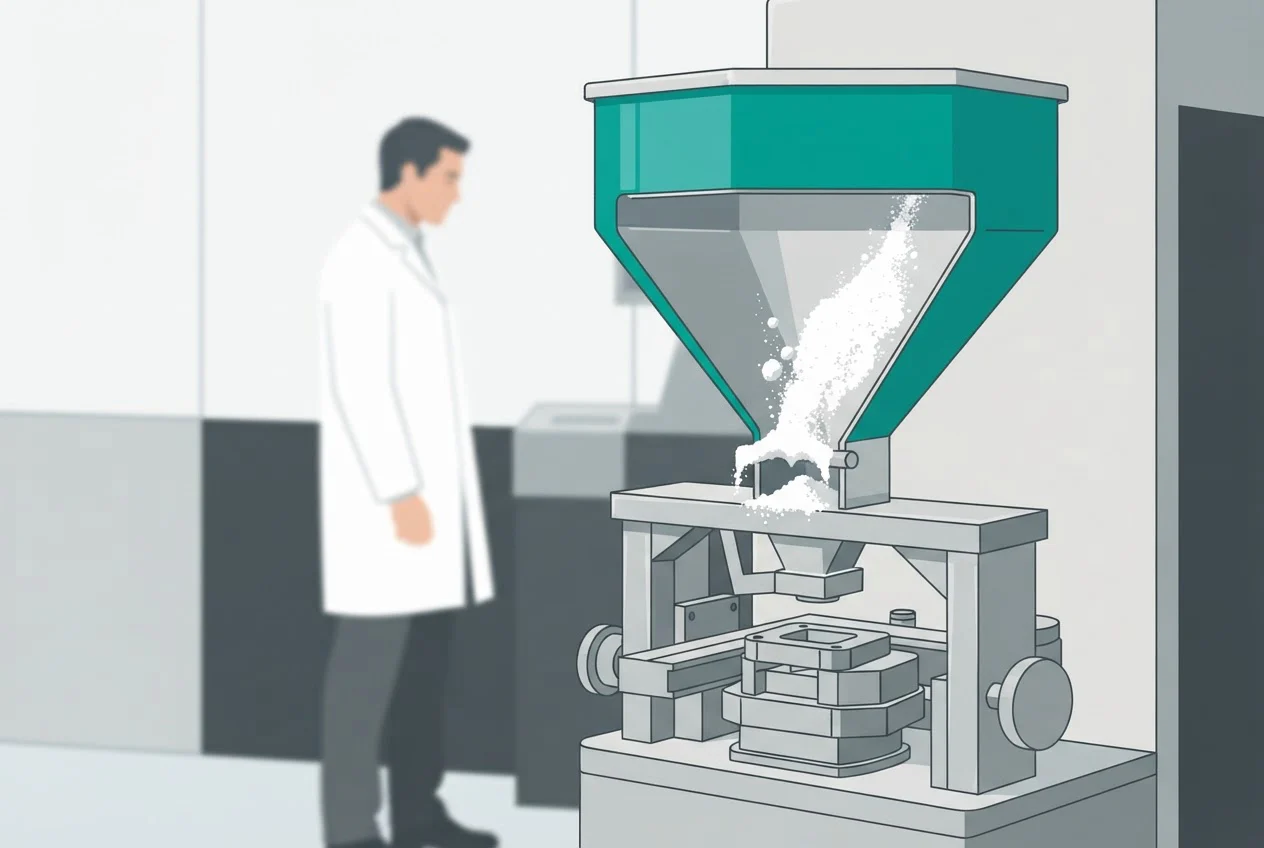
The Hausner ratio measures how much a powder compresses under tapping. It does not measure how the powder moves through a hopper, feeder or die. Ph. Eur. 2.9.36 states that no single, simple method adequately characterizes the flow of pharmaceutical powders. It suggests using several standardized methods for the different aspects of flow.
The chapter lists four commonly used methods. They are angle of repose, compressibility index or Hausner ratio, flow through an orifice, and shear cell.
- Angle of repose is also method-dependent, according to the same chapter.
- Flow through an orifice records the arching diameter, the smallest opening a powder will flow through without forming an arch that blocks it, which works for both cohesive and free-flowing powders. Flow rate through an orifice is useful only for free-flowing powders.
- A shear cell tests the powder under controlled consolidation.
In one 2023 feeder study (Hou et al., International Journal of Pharmaceutics), croscarmellose sodium and crospovidone both measured a Hausner ratio of 1.35, yet crospovidone fed significantly better at low flow rates.
Our recommendation is to use the ratio as a screen and a lot-to-lot trend, and to add a second method when a release or process decision depends on the result.
What causes a high Hausner ratio, and what should you check?
A high Hausner ratio can reflect particle size and shape, material density, surface area, moisture content or cohesion, the influences Ph. Eur. 2.9.36 names. The table gives four causes to check first and the test for each. It does not predict how much any change will lower the ratio.
| Likely cause | What to check |
|---|---|
| Fines (excess fine particles) | The particle size distribution of the API and the blend, especially the fine fraction. Compare the ratio of lots with different fine content. Upstream limits are covered in API particle size distribution. |
| Moisture | Loss on drying (LOD, the mass lost on heating) on the same sample you tested. Repeat the ratio after holding the sample under the agreed conditions. |
| Glidant (an excipient added to improve flow) | Whether the glidant is in the tested blend, at the master-formula level and blended for the specified time. The tablet excipients glossary lists glidants among excipient classes. |
| Granulation | Granule size distribution and fines after drying and milling, compared with a lot that ran well. Confirm the sample is granules and not a pre-granulation blend. |
If the checks point to a process question, such as whether the product should be granulated at all, that decision is covered in choosing between wet and direct compression.
What Hausner ratio acceptance criteria should a blend or granule specification use?
Hausner ratio acceptance criteria should come from lot data on the actual press or filler, because USP and Ph. Eur. publish a flow scale and no pass/fail limit. Our recommendation for blends intended for direct compression is a Carr's index of 15% or less (Hausner ratio 1.18 or less), the good band or better. That is a recommendation and not a USP requirement.
We do not apply that figure to granules or capsule fill. For those, start by reporting the value without a limit for the first lots. Then set limits from the range seen on lots that ran well on your equipment.
Write each specification with these elements:
| Element | What to write | Starting point |
|---|---|---|
| Method | The compendial chapter plus every parameter in the method-lock checklist | Reference a controlled method document, not "per USP" |
| Material and stage | Final blend, granule or capsule-fill blend; lubricated or not | The material as it goes to the press or filler |
| Sample point | Where in the process the sample is taken, the same for every lot | A fixed location, for example blender discharge |
| Lot count | Lots tested before limits are frozen, and testing frequency afterward | Three consecutive lots, then every lot |
| Alert limit | A value that triggers review while the lot continues | Set inside the range of good-running lots |
| Action limit | A value that holds the lot until an investigation closes | Set at the edge where processing problems appeared |
| Reporting | Hausner ratio and Carr's index, with V0, Vf, mass, cylinder and drop height | Both indices, to the stated decimals |
A clause template:
Hausner ratio of [material, stage] at [sample point], by [USP <616> Method 1 / Ph. Eur. 2.9.34] as locked in [method document]: [mass] g in [cylinder] mL, [taps per minute] from [drop height] mm, stop rule [rule], [n] replicates, reported to [two] decimals. Alert limit [ ]. Action limit [ ]. Applies to [lot count] lots, then [frequency].
What does a high Hausner ratio mean downstream?
Poor flow can show up where powder is metered into a die or a capsule. Uneven fill moves unit weight and, in low-dose products, can also move content uniformity. A high Hausner ratio is an early warning of that risk, not a measure of it, and a blend that fills well on the bench still has to be confirmed on the actual press or filler.
Capping, where a tablet's crown separates from its body, is a separate risk signal to watch for. It has its own causes, set out in the tablet capping glossary entry. A high ratio does not explain a capped tablet, and a low ratio does not rule capping out.
What should you agree with your CDMO before the first batch?
Agree the method, sample point, lot count, who tests, retest rules, out-of-range handling and lab comparison in writing before the first batch. When you outsource tablets or capsules under third-party manufacturing, these terms belong in the pharmaceutical quality agreement or the specification it references.
Each line below is a test you can run on the draft agreement:
- Method and sample point. Pass: the agreement cites the method document by number and states the sample location. Fail: it says only "Hausner ratio per USP".
- Lot count. Pass: it states how many lots are tested before limits are frozen and how often testing continues. Fail: limits are set from a single lot.
- Who tests. Pass: it names the laboratory that runs the release test and says whether your laboratory confirms. Fail: the testing party is left open.
- Retest rules. Pass: a retest is allowed only after a documented assignable cause, with the original result retained and the replicate count and reported value stated. Fail: retesting continues until a result passes.
- Out-of-range results. Pass: an alert result triggers review and notification, and an action result holds the lot before the press or filler, with your notification before use. Fail: the agreement does not say who decides whether a lot proceeds.
- Comparing your lab and the CDMO's lab. Pass: both laboratories test the same retained sample under the locked method before the first batch, and the agreement states the largest accepted difference and the investigation if it is exceeded. Fail: results are compared with no agreed difference.
- Method changes. Pass: a change to cylinder, tapper, drop height or rounding needs your approval under change control. Fail: the CDMO may change the method without notice.
For the records to request at each manufacturing step, see oral solid dosage manufacturing records.
Conclusion: lock the method, then set the limit
Use the Hausner ratio as a screen and a lot-to-lot trend, not as a stand-alone verdict. Before you accept any limit, ask whether two laboratories running your written method would get the same answer on the same retained sample. If they would, set the limit from lot data on your own press or filler and keep at least one cylinder graduation of margin.
If they would not, fix the method first, because a tighter limit will only measure reading differences. When the ratio drifts upward, check fines, moisture and glidant before changing the process, and add a second flow method if a release or process decision depends on the result. Before the first batch, have both laboratories test one retained sample under the locked method, and put the agreed difference in the quality agreement.
Keep reading
Frequently asked questions
Sources
- 1.USP <616> Bulk Density and Tapped Density of Powders (harmonized with Ph. Eur. 2.9.34), United States Pharmacopeial Convention
- 2.USP <1174> Powder Flow, United States Pharmacopeial Convention
- 3.European Pharmacopoeia, general chapter 2.9.34 Bulk density and tapped density of powders, European Directorate for the Quality of Medicines & HealthCare (EDQM), Council of Europe
- 4.European Pharmacopoeia, general chapter 2.9.36 Powder flow (11th edition text), EDQM, Council of Europe
- 5.Carr RL. Evaluating flow properties of solids. Chemical Engineering 1965; 72: 163–168 (the reference cited in Ph. Eur. 2.9.36 for the flow scales)
- 6.Hou P, Besenhard MO, Halbert G, Naftaly M, Markl D. Development and implementation of a pneumatic micro-feeder for poorly-flowing solid pharmaceutical materials. International Journal of Pharmaceutics 635 (2023) 122691