Wet Granulation vs Direct Compression: How to Choose
Wet granulation vs direct compression turns on whether the blend flows and compresses well. Direct compression suits blends that do, and either choice is hard to reverse after approval.

By Sunil Kumar, Managing Director - Sales · Updated 12 Nov 2026

Key takeaways
- Choose direct compression only when your blend flows well, compresses well and stays uniform. Otherwise granulate. The process you file on is difficult to change later.
- Switching between wet granulation and direct compression on an approved product is an FDA Level 3 change, so settle the process before you file.
- Run a bulk and tapped density test first. In our recommendation, a Carr index of 15% or less (Hausner ratio 1.18 or less, United States Pharmacopeia (USP) "good" or better) is the range where direct compression is realistic; USP sets no pass or fail line for direct compression.
- Ask every contract manufacturer to name the process, justify it in writing and quote blend uniformity data before you accept a price.
In this article
- 1Wet granulation vs direct compression: what is the real difference?
- 2What does FDA require to switch from wet granulation to direct compression after approval?
- 3How do you test whether a blend can be directly compressed?
- 4When does wet granulation win, and where does dry granulation fit?
- 5Which process should you choose? A decision table
- 6What should a tablet RFQ ask about the process?
- 7What should you send Aarise Pharmaceuticals when inquiring about a tablet?
- 8Frequently asked questions
A tablet process is chosen in formulation development and written into an RFQ (request for quotation). For an approved product, the U.S. Food and Drug Administration (FDA) treats a change in the type of process, such as wet granulation to direct compression, as a Level 3 change. That is the heaviest of three tiers in its Scale-Up and Postapproval Changes (SUPAC) guidance.
Cost and speed favor direct compression, and that is what makes it tempting. But the cheaper process only works when the powder blend is ready for it, and a blend that is nearly ready is the expensive mistake.
This page is written for formulators and sourcing teams preparing a tablet RFQ. A wrong choice shows up at the press as segregation (the blend separating by particle size), capping (the top of a tablet splitting off) or content-uniformity failures. It gives you a flow test you can run on your own blend, a decision table, and a set of RFQ questions with pass and fail lines.
Wet granulation vs direct compression: what is the real difference?
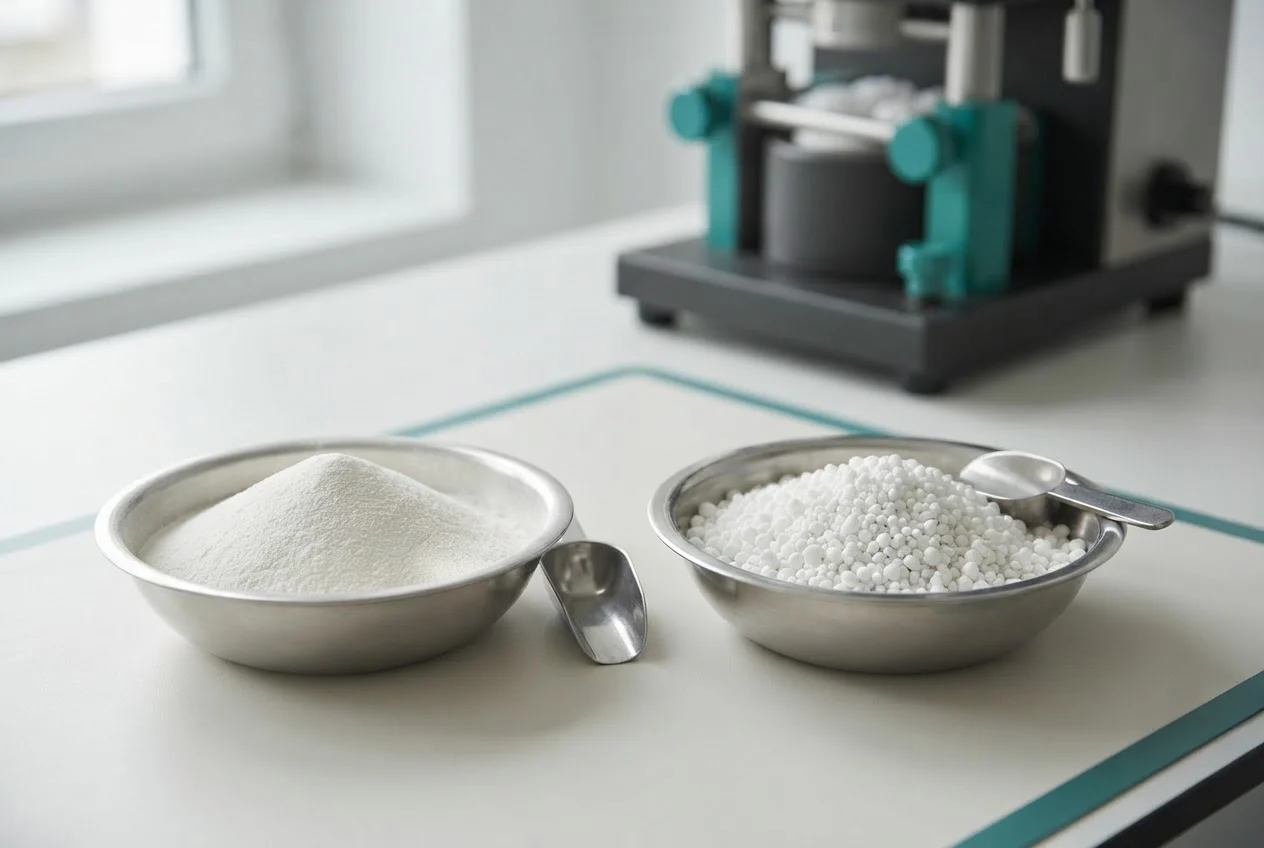
The difference is whether the powders are turned into granules before the tablet press. Wet granulation mixes the active pharmaceutical ingredient (API) and excipients (the non-active ingredients), adds a liquid binder, dries the wet mass, mills it and then compresses it. Direct compression blends the powders, adds a lubricant and compresses them.
That one difference drives everything else:
- Steps and equipment. Wet granulation adds wetting, drying and milling steps, each with its own equipment, controls and batch records. Direct compression has far fewer. In general this makes direct compression faster and cheaper to run.
- Moisture and heat. Wet granulation exposes the API to water and heat. Direct compression does not. For an API that degrades in either, this can decide the question on its own.
- Powder behavior. Granules flow and pack better than loose powder. Direct compression asks the raw blend to do that job itself.
- Uniformity. Granules hold fine API particles in place, so they enhance the uniformity of the API in the final product, according to a peer-reviewed review of granulation technologies. A loose blend can separate by particle size during handling.
FDA's oral solid dosage inspection guide calls blending of the final granulation "a critical step". It adds that particle size, shape and bulk density affect uniformity, "particularly" in products made by direct compression. Our guide to oral solid dosage manufacturing lists the records to ask for at each step.
What does FDA require to switch from wet granulation to direct compression after approval?
FDA classes a change in process type as a Level 3 change, the heaviest documentation tier of the three levels (set by risk) in its Scale-Up and Postapproval Changes (SUPAC) guidance. The guidance defines it as a "change in the type of process used in the manufacture of the product, such as a change from wet granulation to direct compression of dry powder."
For an immediate-release tablet, SUPAC-IR, FDA's immediate-release guidance (November 1995), asks for the following:
| Requirement | Level 3 process change |
|---|---|
| Filing | Prior approval supplement (a filing submitted to FDA for approval of the change) with justification, plus an annual report for long-term stability data |
| Release testing | Application or compendial release requirements |
| Batch records | Notification of the change and updated batch records |
| Stability | With a significant body of data: one batch with three months of accelerated data and one batch on long-term stability. Without it: up to three of each |
| Dissolution | Case B dissolution profile (a multi-point profile compared with the pre-change product) |
| Bioequivalence | In vivo bioequivalence study, which may be waived if a suitable in vivo/in vitro correlation has been verified |
SUPAC-MR (September 1997), the modified-release guidance, uses the same Level 3 definition and also requires a prior approval supplement.
As of November 2026, SUPAC-IR and SUPAC-MR remain in force, but FDA opened a docket on 3 March 2026 to review the SUPAC guidances and may revise them; check FDA's current guidance before filing.
Two readings follow.
- The guidance reaches approved products. It applies to holders of approved applications changing their process after approval. Before approval, the process is a development decision, and the cost is a re-run of development batches. Either way, the process you file on is the one you will be quoted on for years.
- The saving from a cheaper process has to clear that bar. In our judgment, a move to direct compression that saves cents per tablet rarely pays back a bioequivalence study and a multi-batch stability program. Run your own numbers, and settle the process before the filing batch.
The dissolution comparison is where most process changes are tested. Our glossary entry on dissolution testing explains what a profile shows.
How do you test whether a blend can be directly compressed?
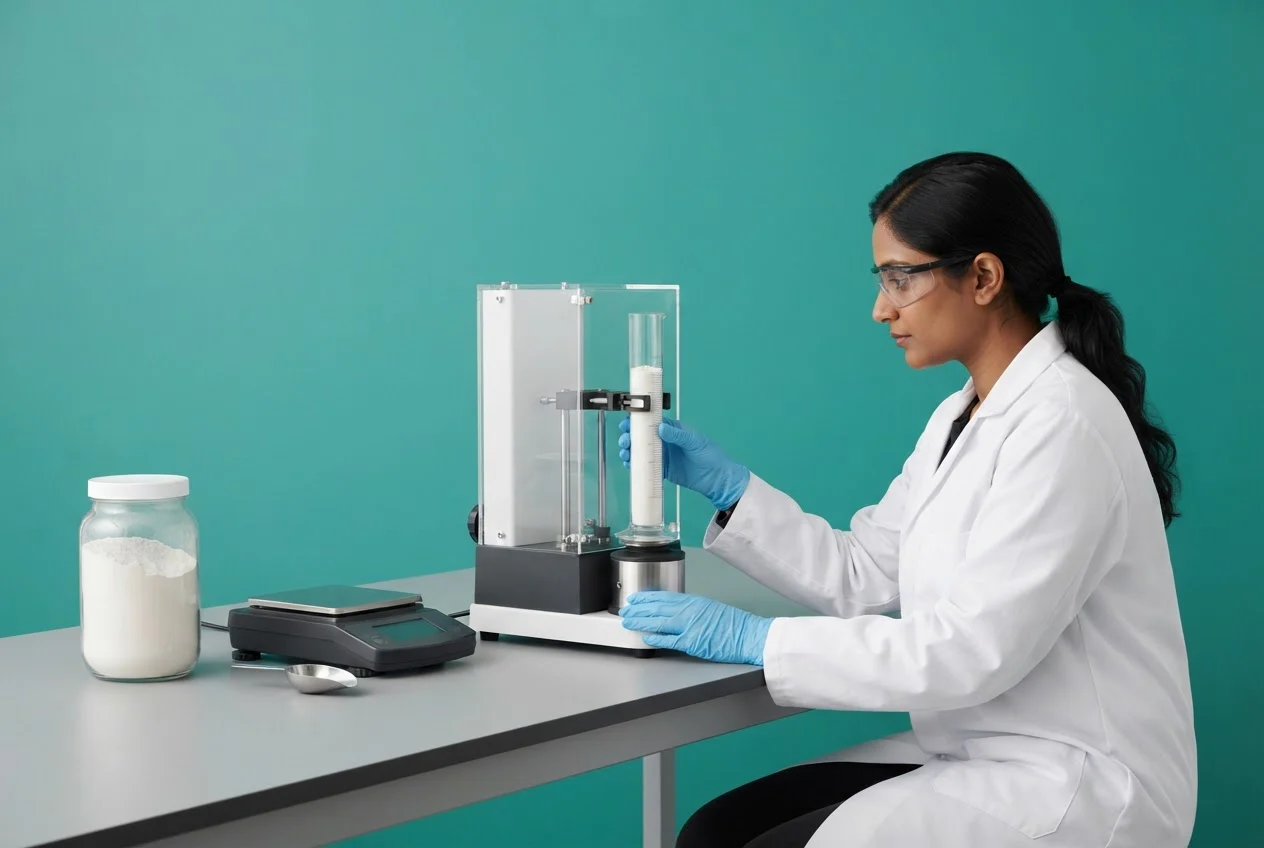
Measure the blend's bulk and tapped density, then calculate the Hausner ratio and the Carr index (also called the compressibility index). Read the result on the flowability scale in USP general chapter <1174>. In our recommendation, a Carr index of 15% or less (Hausner ratio 1.18 or less, USP "good" or better) is the range where direct compression is realistic; USP sets no pass or fail line for direct compression.
Step by step
- Take a representative sample of the final blend, with the lubricant included if that is what will reach the press.
- Record the unsettled (bulk) volume or density, then tap until the volume stops changing and record the tapped volume or density.
- Calculate: Hausner ratio = tapped density ÷ bulk density, and Carr index (%) = (tapped − bulk) ÷ tapped × 100.
- Read the result on the scale below.
- Repeat on three lots. A blend that flows once but not consistently is a granulation candidate.
The USP flowability scale (USP <1174> Powder Flow, 2004 harmonization text):
| Carr index (%) | Flow character | Hausner ratio |
|---|---|---|
| 10 or less | Excellent | 1.00 to 1.11 |
| 11 to 15 | Good | 1.12 to 1.18 |
| 16 to 20 | Fair | 1.19 to 1.25 |
| 21 to 25 | Passable | 1.26 to 1.34 |
| 26 to 31 | Poor | 1.35 to 1.45 |
| 32 to 37 | Very poor | 1.46 to 1.59 |
| Above 38 | Very, very poor | Above 1.60 |
Worked examples. These use made-up densities to show the arithmetic. They are not measurements of any product.
- Bulk 0.55 g/mL, tapped 0.60 g/mL. Hausner = 0.60 ÷ 0.55 = 1.09. Carr = 0.05 ÷ 0.60 × 100 = 8.3%. Excellent. Direct compression is a realistic option.
- Bulk 0.50 g/mL, tapped 0.60 g/mL. Hausner = 1.20. Carr = 0.10 ÷ 0.60 × 100 = 16.7%. Fair. Borderline: test feeding on the press before committing.
- Bulk 0.40 g/mL, tapped 0.58 g/mL. Hausner = 1.45. Carr = 0.18 ÷ 0.58 × 100 = 31.0%. Poor. Granulate.
What the test cannot tell you. USP states that these indices are "not intrinsic properties of the powder". They depend on the cylinder diameter, tapping frequency and sample mass, so fix the method and use it everywhere you compare results. A good score also does not prove the blend is uniform or that the tablets will hold together. USP does not set a pass or fail line for direct compression. The 15% and 25% lines in the decision table below are our working lines, based on the USP bands.
When does wet granulation win, and where does dry granulation fit?
Wet granulation wins when the blend fails the flow test, when the API is a large share of the tablet and compresses poorly, or when a low-dose API needs to be locked into granules for uniformity. It is the most widespread granulation technique, and the usual fallback when direct compression cannot be made to work.
Dry granulation, in which roller compaction forms granules without a liquid, is the usual alternative when the API cannot take water or heat. The granulation review lists pneumatic dry granulation for thermolabile and moisture-sensitive drugs, and melt granulation for water-sensitive materials. A simple way to decide between wet and dry is to run a small wet trial and watch for two things: a rise in related substances in stability, and a moisture level (measured as loss on drying) that cannot be brought under control. If either appears, move to dry granulation or direct compression.
Particle size matters as much as the process. A fine API with a wide size spread segregates from the excipients in a loose blend, which is the direct compression weakness FDA's guide points to. Our page on API particle size distribution covers whether you need a limit.
Which process should you choose? A decision table
Use the table as a first screen. This table is our recommendation, based on the USP flow bands and FDA's blend-uniformity guidance.
| Your situation | Lean toward | What to check |
|---|---|---|
| Blend Carr index 15% or less on three lots | Direct compression | Content uniformity at dosage-unit sample size; tablet strength |
| Blend Carr index 16 to 25% | Undecided | Feeding on the press; blend uniformity; try a flow-aid or different filler before giving up |
| Blend Carr index above 25% | Wet or dry granulation | Whether the API tolerates water and heat |
| API degrades with water or heat | Direct compression or dry granulation | Impurity trend and moisture level in stability |
| Low-dose API, fine particles | Granulation, unless direct compression proves uniform | Blend uniformity across the batch |
| High-dose API with poor compressibility | Granulation | Tablet size, hardness and dissolution |
| Approved product, cost-driven switch | Stay with the current process unless the saving clears the Level 3 bar | The SUPAC table above |
What should a tablet RFQ ask about the process?
A tablet RFQ should make the supplier name the process, justify it and show uniformity data before quoting. Each item below is a test with a pass and a fail.
- Is the process named and justified in writing?Pass: the quote states wet, dry or direct compression and gives a technical reason tied to your API. Fail: "standard process" with no reason.
- Is there flow data on the actual blend?Pass: bulk and tapped density, with the method stated. Fail: only supplier claims about the excipients.
- Is blend uniformity measured at dosage-unit size?FDA's guide says sample size should be roughly the weight of one dosage unit. Pass: results are given for that sample size. Fail: results are given only for much larger samples.
- Is the drying endpoint defined (wet granulation only)?Pass: a loss on drying limit set before, during and after drying. Fail: drying by time alone.
- Which batch records come with each stage?Pass: a master record and an executed record for blending, granulation (if used) and compression. Fail: summaries only.
- What is the price of changing the process later?Pass: the supplier states what a change involves for your filing. Fail: no answer.
- Is dissolution shown on the process you are filing?Pass: profiles from the same process as the registration batch. Fail: profiles from a different development process.
What should you send Aarise Pharmaceuticals when inquiring about a tablet?
Send your API name, your flow results (bulk and tapped density), your dose and any stability data, and use the RFQ questions above as the checklist for what you expect back.
We are a technology-driven contract development and manufacturing organization (CDMO) for oral dosage forms, working from product development through commercial manufacturing out of Haridwar, Uttarakhand. Our catalogue lists tablets including dispersible, mouth dissolving, effervescent, extended release, sugar-coated and gastro-resistant, alongside capsules and oral liquids.
Our buying route runs from inquiry to feasibility review, then commercial quotation, development or technical transfer, production and quality control, packaging and dispatch. Prices are given by quotation, not a price list. Our page on third-party manufacturing in Haridwar outlines the contract manufacturing service.
To start, contact us, email sunil@aarisepharma.com, or message us on WhatsApp at +91 9899783330.
Frequently asked questions
Sources
- 1.FDA CDER, Guidance for Industry: Immediate Release Solid Oral Dosage Forms, Scale-Up and Postapproval Changes (SUPAC-IR), November 1995
- 2.FDA CDER, Guidance for Industry: SUPAC-MR, Modified Release Solid Oral Dosage Forms, September 1997
- 3.FDA, Recommendations on Scale-Up and Postapproval Changes Guidances for Industry; Request for Comments, Federal Register, 3 March 2026
- 4.FDA, Oral Solid Dosage Forms Pre/Post Approval Issues inspection guide, January 1994
- 5.USP, General Chapter <1174> Powder Flow, 2004 harmonization text (Pharmacopeial Forum 30(6))
- 6.Shanmugam S., Granulation techniques and technologies: recent progresses, BioImpacts, 2015 (PubMed Central)