
Glossary
Dissolution Testing
Dissolution testing measures what percentage of a tablet's drug dissolves by set times. Q is the required percentage, and pharmacopeial stage rules build on it, so agree method and Q in writing.

By Sunil Kumar, Managing Director - Sales · Updated 24 Oct 2026
Also called Dissolution test
On this page
- 01Definition
- 02Quick facts
- 03What is dissolution testing, and what does Q mean?
- 04How does USP <711> decide whether a batch passes?
- 05How often do batches clear each stage?
- 06How is a dissolution specification set for a tablet?
- 07Where do dissolution results break when a tablet moves to a CDMO?
- 08What should a formulator agree with a CDMO before the first batch?
- 09How Aarise Pharmaceuticals handles it
- 10Example
- 11Related terms
- 12Frequently asked
What is dissolution testing?
Dissolution testing is a laboratory test that measures how much of a tablet's labeled drug dissolves in a specified liquid at set times, as described in USP general chapter <711>. Q is the percentage the specification requires at the stated time.
Key takeaways
- Specifications come from clinical or bioequivalence batches, and for generics they generally match the reference product.
- FDA's standard of Q=80% in 30 minutes applies only to eligible high-solubility IR tablets.
- Variability decides workload: in a simulation, a batch averaging 85% with a 5% relative standard deviation passes stage 1 only about 1.5% of the time.
- Put the method, specification, calibration, transfer and out-of-specification ownership in writing with your CDMO before the first batch.
Quick facts
- Governing text
- USP–NF general chapter <711> Dissolution
- Applies to
- Immediate-release (IR) tablets in this entry
- Medium temperature
- 37 ± 0.5°C
- Sampling tolerance
- Within ±2% of the stated time
- Stage 1 rule
- Six tablets, each at least Q+5%
- Apparatus
- Basket (USP Apparatus 1) or paddle (Apparatus 2)
A tablet can pass assay, hardness and friability and still release its drug too slowly to work. Dissolution testing is the check that catches this. A 2022 industry consortium paper reports it is the quality control (QC) test most likely to end in a laboratory investigation.
For a formulator handing a product to a contract development and manufacturing organization (CDMO), the risk is rarely the apparatus itself. It is an unwritten method, a specification nobody tied to a batch, or a second laboratory that reads the same tablet differently.
This entry covers what the person who signs the method and the specification needs to know. It deals with immediate-release (IR) tablets only; extended-release tablets and enteric-coated tablets follow different rules. A batch that fails stage 1 means testing six more tablets, and twelve more if stage 2 also fails. It ends with a ten-line term sheet to settle before the first batch.
What is dissolution testing, and what does Q mean?
Dissolution testing places one tablet in a vessel of liquid at 37 ± 0.5°C, stirs it with a basket (United States Pharmacopeia, USP, Apparatus 1) or a paddle (Apparatus 2), and measures how much drug is in solution at set times. Q is the amount dissolved at the stated time, expressed as a percentage of the labeled content, per USP general chapter <711>. Sampling must fall within ±2% of the stated time, per the same USP–NF <711> chapter.
FDA's 1997 guidance describes typical IR conditions:
- Basket at 50 to 100 revolutions per minute (rpm), or paddle at 50 to 75 rpm.
- 500, 900 or 1000 mL of medium between pH 1.2 and 6.8.
- A surfactant such as sodium lauryl sulfate for poorly soluble drugs, with the amount justified.
As of October 2026, FDA's 1997 dissolution guidance and its August 2018 high-solubility guidance are the agency's current published recommendations for IR tablets.
Two confusions matter. Disintegration only checks that the tablet breaks apart; dissolution measures drug in solution. And dissolution is a laboratory (in vitro) test. FDA describes its specifications as a way to ensure batch-to-batch consistency and to signal potential problems with bioavailability, not as proof of absorption.
How does USP <711> decide whether a batch passes?
USP <711> tests IR tablets in up to three stages. With Q=80%, all six stage 1 tablets must reach 85%, which is Q+5%. "Plus 5%" means five percentage points, not 5% of 80. The table below applies the staged rule as published in the USP text. As of October 2026, USP–NF <711> uses the S1, S2 and S3 limits shown.
Stage 1 pass rule for an IR tablet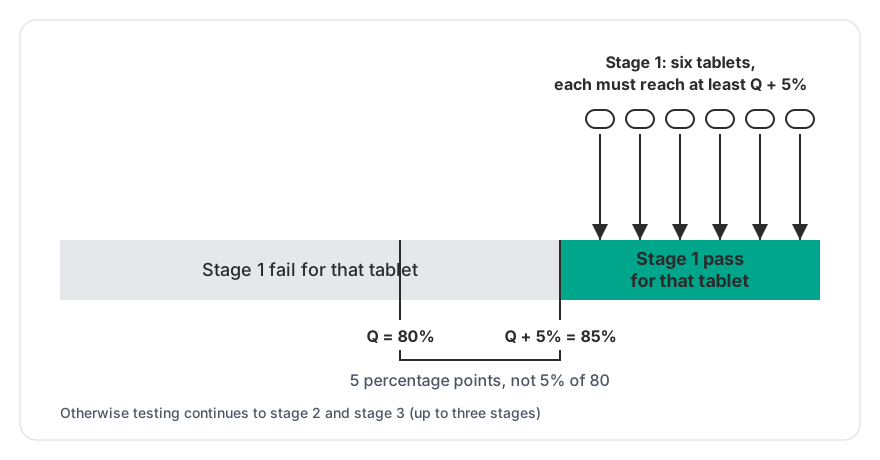
- Stage
- S1
- Tablets tested
- 6
- Pass rule (Q = 80%)
- Each tablet at least 85%
- Stage
- S2
- Tablets tested
- 12 in total
- Pass rule (Q = 80%)
- Average at least 80%, no tablet below 65%
- Stage
- S3
- Tablets tested
- 24 in total
- Pass rule (Q = 80%)
- Average at least 80%, no more than two below 65%, none below 55%
How often do batches clear each stage?
Q+5% is the first hurdle, not the specification. The pass rates below come from a simulation of 200,000 batches per row, run in October 2026, in which each tablet was drawn from a normal distribution around the batch mean with a fixed relative standard deviation (RSD, spread as a percentage of the mean), then scored with the three rules above. Values were not capped at 100%. Real batches are less tidy, so read this as a model, not a measurement.
A batch that meets Q on average can still run 12 tablets every time, and at 12% spread about 4 in 100 such batches fail outright. The recommended approach is to cut spread before chasing a higher average.
- Batch mean
- 85%
- RSD
- 5%
- Pass at S1
- 1.5%
- Pass by S2 / Pass by S3
- about 100% / about 100%
- Average tablets tested
- 11.9
- Batch mean
- 90%
- RSD
- 3%
- Pass at S1
- 82%
- Pass by S2 / Pass by S3
- about 100% / about 100%
- Average tablets tested
- 7.1
- Batch mean
- 90%
- RSD
- 8%
- Pass at S1
- 19%
- Pass by S2 / Pass by S3
- 99.7% / about 100%
- Average tablets tested
- 10.9
- Batch mean
- 95%
- RSD
- 8%
- Pass at S1
- 55%
- Pass by S2 / Pass by S3
- about 100% / about 100%
- Average tablets tested
- 8.7
- Batch mean
- 85%
- RSD
- 12%
- Pass at S1
- 1.6%
- Pass by S2 / Pass by S3
- 72.5% / 95.6%
- Average tablets tested
- 15.2
How is a dissolution specification set for a tablet?
FDA bases the specification on the batches that proved the product: clinical, bioavailability or bioequivalence batches (FDA 1997). Three routes follow.
- New product: the method follows the drug's pH-solubility profile. For fast, highly soluble drugs (Biopharmaceutics Classification System, BCS, classes 1 and 3), a single point of at least 85% (Q=80%) in 60 minutes or less is enough. For poorly soluble drugs (class 2), FDA recommends two points: one at 15 minutes, one at 30, 45 or 60.
- Generic: the specification is generally the reference listed drug's, confirmed on the bioequivalence batch.
- High-solubility IR tablet: FDA's August 2018 guidance offers a standard test: basket at 100 rpm or paddle at 50 rpm, 500 mL of 0.1N hydrochloric acid, no surfactant, 37 ± 0.5°C, criterion Q=80% in 30 minutes. This guidance is nonbinding. A product is eligible only if its highest strength dissolves in 250 mL or less across pH 1 to 6.8; it is not a narrow therapeutic index product, not one where time to peak plasma concentration is critical (rapid-onset or rescue labels), and not an orally disintegrating or sublingual tablet; its excipients are in amounts consistent with their function; and its manufacturing and stability history shows it meets Q=80% in 30 minutes.
Whichever route applies, the product should comply throughout its shelf life (FDA 1997).
Where do dissolution results break when a tablet moves to a CDMO?
They break on small, undocumented details. The industry consortium paper records cases such as:
- A buffer concentrate diluted twice, which produced an out-of-specification (OOS) result.
- A paddle slipped below its 25 mm height onto the sinker (the wire coil that holds a tablet down).
- Two autosamplers of the same model that gave profiles nearly 40 points apart at 5 minutes on 12-month stability samples.
- Six non-compliant five-coil sinkers mixed into a box of 36 compliant seven-coil sinkers, which gave random fast tablets.
SUPAC-IR (FDA's 1995 scale-up and postapproval changes guidance) treats a move to a different campus (a site not on the same contiguous property or in adjacent city blocks) as a Level 3 change. It asks for a multi-point profile (SUPAC-IR's "Case B") at 15, 30, 45, 60 and 120 minutes, or until a plateau, on at least 12 units. It also expects a satisfactory current Good Manufacturing Practice (CGMP) inspection of the new site and a changes-being-effected supplement filing, with long-term stability data in the annual report. The profiles at both sites should be similar, meaning f2, FDA's similarity factor for comparing two dissolution profiles, is between 50 and 100. FDA's 1997 guidance adds two conditions: use only one point after 85% dissolved, and keep the coefficient of variation (CV) within 20% at the earliest point and 10% after.
What should a formulator agree with a CDMO before the first batch?
Agree ten items in writing before the first batch. This term sheet is built from the sources below. Each line passes only if the condition is met. Line 7 follows FDA 1997. Lines 8 and 9 are recommended practice rather than regulatory text. Line 10 reflects 21 CFR 211.165, which requires each batch to be tested against its final specifications before release. For line 6, see pharmaceutical technology transfer.
- #
- 1
- Item
- Specification route
- Pass if
- The document names one: FDA 2018 standard method, USP monograph or a product-specific profile, with eligibility checked
- #
- 2
- Item
- Method card
- Pass if
- Apparatus, rpm, medium, volume, temperature, deaeration (removing dissolved gas from the medium), sinker part number, sampling times, filter and analytical finish are written down
- #
- 3
- Item
- Specification
- Pass if
- Q and the time or times are stated for release and for shelf life
- #
- 4
- Item
- Batch basis
- Pass if
- The batches that justify the specification are named
- #
- 5
- Item
- Stage rules
- Pass if
- The document states that S2 and S3 testing needs quality assurance (QA) approval and applies the same USP stage rule to release and stability
- #
- 6
- Item
- Method transfer
- Pass if
- Both laboratories run 12 units of one batch and meet f2 of 50 to 100 and the CV limits
- #
- 7
- Item
- Calibration
- Pass if
- Apparatus suitability runs at least twice a year and after any significant move or equipment change
- #
- 8
- Item
- OOS ownership
- Pass if
- The owner's name and a number of working days for notification (for example, 2 working days) are written in
- #
- 9
- Item
- Change control
- Pass if
- Any change of sinker, filter, vessel or autosampler needs your written approval
- #
- 10
- Item
- Batch report
- Pass if
- It shows vessel-by-vessel data and the stage reached, and each batch is tested against its final specifications before release
How Aarise Pharmaceuticals handles it
We are a technology-driven CDMO for oral dosage forms, and tablets are one of our finished-dose categories. Our process runs from inquiry through development or technical transfer to production and quality control; see third-party manufacturing and pharmaceutical technology transfer for how those stages work. Send the method card and specification (items 2 and 3 of the term sheet) with your inquiry so the feasibility review can address them.
Reach us through our contact form, by email to sunil@aarisepharma.com, or by WhatsApp on +91 9899783330. Pricing is quoted per project.
Example
Worked f2 check with illustrative numbers, not a real product: the reference tablet shows 48, 65, 78 and 90% dissolved at 10, 15, 20 and 30 minutes. The formula is f2 = 50 × log10{[1 + (1/n) Σ(R_t − T_t)²]^−0.5 × 100}, where R_t and T_t are the reference and test percentages dissolved at each time and n is the number of time points. A second site's tablet showing 45, 62, 75 and 88% differs by 3, 3, 3 and 2 points, giving a mean squared difference of 7.75 and an f2 of about 76 (similar). A third showing 30, 45, 58 and 76% differs by 18, 20, 20 and 14 points, giving 330 and an f2 of about 37 (not similar). The calculation stops at 30 minutes under the one-point-after-85% rule.
Frequently asked
Sources
- 1.FDA, Dissolution Testing and Acceptance Criteria for IR Solid Oral Dosage Form Drug Products Containing High Solubility Drug Substances (August 2018), FDA, 2018-08
- 2.FDA, Dissolution Testing of Immediate Release Solid Oral Dosage Forms (August 1997), FDA, 1997-08
- 3.FDA, Immediate Release Solid Oral Dosage Forms: Scale-Up and Postapproval Changes, SUPAC-IR (November 1995), FDA, 1995-11
- 4.USP–NF general chapter <711> Dissolution, USP
- 5.Mann et al., Dissolution Method Troubleshooting: An Industry Perspective, Dissolution Technologies, 2022-11
- 6.21 CFR 211.165, Testing and release for distribution, Legal Information Institute, Cornell Law School