
Extended Release Tablets: What They Are, Can You Split One?
Extended release tablets release medicine over hours, so doses are fewer. Swallow them whole unless the label allows splitting or chewing. Never crush a standard one. The label, not the brand name, tells you which.

By Sunil Kumar, Managing Director - Sales · Updated 23 Oct 2026

Key takeaways
- Swallow ER tablets whole unless the label says the tablet may be split or chewed. Do not crush a standard ER tablet.
- The brand name is not a reliable guide, because many ER tablets carry no ER, XR or XL code. Read the dosage form in the product title of the label.
- An empty tablet shell in your stool is expected with some ER products, including metformin ER. Ask your pharmacist before stopping the medicine or changing how you take it.
- If you have crushed or chewed a standard ER tablet, call Poison Control at 1-800-222-1222 now. Call 911 if the person collapses, has a seizure, has trouble breathing or cannot be woken.
In this article
- 1What are extended release tablets, and how do they differ from delayed release?
- 2How do extended release tablets control the release of a drug?
- 3How do extended release tablets compare with immediate release tablets?
- 4Does the brand name show whether a tablet is extended release?
- 5Can I split, crush or chew an ER tablet?
- 6How do I check my own ER tablet before I split it or worry?
- 7Is it normal to see an extended release tablet shell in my stool?
- 8What should I do if I crushed, chewed or doubled a slow-release tablet?
- 9How can we help if you need extended release tablets developed or made under contract?
- 10Frequently asked questions
Toprol XL is an extended release tablet. Concerta and Intuniv are too, yet neither name carries ER (extended release), XR or XL. In our October 2026 count of 91 brand names in FDA’s National Drug Code directory, 56 carry no such suffix. The name on the box will not tell you what the tablet is.
That matters because these tablets are built to release medicine slowly over hours, and the design is easy to break. People ask whether they can cut one in half to save money, whether the pill they saw in the toilet means the drug failed, and what to do after chewing one.
This page explains how extended release tablets differ from immediate release and delayed release. It then shows where the label answers each question: the product title and the Dosage and Administration section. It also covers what to do after a mistake, and ends with a short section for formulation buyers who need these tablets made under contract.
What are extended release tablets, and how do they differ from delayed release?
Extended release (ER) tablets are formulated so the drug becomes available over an extended period, which allows fewer doses than a conventional tablet. FDA's September 1997 guidance defines an extended release dosage form as one that "allows a reduction in dosing frequency as compared to that presented by a conventional dosage form" (FDA, Extended Release Oral Dosage Forms). Delayed release is a different design: it holds the drug back and releases it later in the gut.
| Type | What it does | Label phrase |
|---|---|---|
| Immediate release | Releases the drug promptly | "tablets" |
| Extended release | Releases the drug gradually over hours | "extended-release tablets" |
| Extended release, chewable | Gradual release, made to be chewed | "extended-release chewable tablets" |
| Extended release, orally disintegrating | Gradual release, made to break down in the mouth | "extended-release orally disintegrating tablets" |
| Delayed release | Releases the drug later, not right away | "delayed-release tablets" |
FDA's product-title examples show each phrase in use: Intuniv (guanfacine) is an extended-release tablet, Aciphex (rabeprazole) is a delayed-release tablet, and Cotempla XR-ODT is an extended-release orally disintegrating tablet. These types are not interchangeable. Do not swap one for another without your prescriber.
FDA's directory uses the words "extended release" and "delayed release" for its dosage forms. As of its 9 October 2026 update, the National Drug Code (NDC) directory lists 142 dosage forms, and none is named sustained release or controlled release. It holds 3,629 listings across four ER tablet forms: 2,316 plain, 1,241 film coated, 67 multilayer and 5 chewable.
How do extended release tablets control the release of a drug?
The structure of the tablet, not the drug itself, sets how fast the medicine is released. Four designs are common, and a formulator picks one based on the drug's properties and the release profile the product needs (Lubrizol).
- Matrix tablet. The drug is mixed through a polymer that swells or erodes slowly, so the drug leaves the tablet gradually as the polymer changes.
- Reservoir (coated) tablet. A polymer membrane surrounds the drug, and the drug diffuses out through it at a controlled rate.
- Multiple-unit tablet. One tablet holds many tiny coated pellets, each acting as its own small release unit. The Toprol-XL label describes its tablet as containing "a multitude of controlled release pellets" (DailyMed, Toprol-XL).
- Osmotic tablet. Water enters through a semipermeable membrane and builds pressure that pushes the drug out through a small opening, so release depends little on stomach acidity or movement (Colorcon).
All four share one weakness: a tablet that is cut, crushed or chewed loses the structure that controls release. That is why the label, not habit, decides whether a tablet can be split, as the sections below explain.
How do extended release tablets compare with immediate release tablets?
Extended release tablets trade a faster start for fewer doses and steadier drug levels. Immediate release tablets release the drug promptly, which suits quick relief and easier dose changes. Extended release does not mean a stronger drug: by FDA's definition it changes how often the dose is needed, not what the drug is.
| Comparison | Immediate release | Extended release |
|---|---|---|
| Doses per day | More frequent | Fewer, often once daily |
| Drug levels | Peak after each dose, then fall | Steadier between doses |
| Start of effect | Usually faster | Often more gradual, though some products include a fast-acting portion |
| Pills to remember | More a day | Fewer, which can make a regimen easier to follow |
| Side effects | Can peak with each dose | Lower peaks may reduce some side effects, but the label for your product governs |
| Splitting or crushing | Allowed more often, but the label decides | Usually not allowed, and the label decides |
| Changing the dose | Easier to adjust | Needs a prescriber, because dose and timing are set for the product |
Two points from the label data are worth knowing. First, "more gradual" is not universal. The QuilliChew ER label states that the product contains approximately 30% immediate-release and 70% extended-release methylphenidate, so part of the dose acts quickly (FDA label, revised June 2021). Second, a once-daily ER dose and several immediate release doses are different products with different strengths and timing. A tablet that is "the same drug" is not a like-for-like swap, so never exchange one for the other on your own.
The same label advises patients to avoid alcohol and explains why: drinking alcohol while taking QuilliChew ER "may result in a more rapid release of the dose of methylphenidate." Check your own label for any alcohol warning, since release can depend on the product design.
Does the brand name show whether a tablet is extended release?
No. Suffixes such as ER, XR, XL, CR and LA are the manufacturers' own choices, and many ER tablets have none. XR and ER both abbreviate extended release. The reliable signal is the dosage form named in the product title of the prescribing information, for example "Intuniv (guanfacine) extended-release tablets".
The letters are not a single standard, but they fall into three groups:
| Code on the label | Usually means | What to do |
|---|---|---|
| ER, XR, XL | Extended release | Swallow whole unless the label says it may be split or chewed |
| SR, CR, LA | Sustained release, controlled release, long-acting | Treat the same way as extended release, and confirm the dosage form in the product title |
| DR, EC | Delayed release, enteric coated | A different design that releases the drug later in the gut. Still check the label before splitting or crushing |
Sustained release and controlled release are not dosage-form names in FDA's directory. Colorcon describes sustained release as an informal industry term and controlled release as a broad formulation concept, while extended release is the term used in labeling and approval (Colorcon). That is why a box marked SR or CR still needs its label read. In our count below, only ER-family codes plus CR and LA turned up on brand names; SR, DR and EC did not appear among them. Our guide to the release code on a pill shows why these letters matter more than whether a medicine is a tablet or a capsule.

How we counted: in October 2026 we pulled all 3,629 NDC listings for the four ER tablet forms above through openFDA. We kept the listings whose marketing category is NDA, meaning approved through a New Drug Application, the route used for brand-name drugs. A few such products are named for their ingredient, such as Potassium Chloride. That left 91 distinct name spellings, with variants such as Mucinex and Mucinex DM counted separately. We split each name into whole words and compared them, ignoring case, with ER, XR, XL, SR, CR, LA, XT, PR, MR, TR, OSM and CD.
- 35 of the 91 carry at least one code. Only XR (20), XL (8), ER (5), CR (2) and LA (1) turned up. Examples: Toprol XL, Wellbutrin XL, Seroquel XR, Glucotrol XL, QuilliChew ER.
- 56 of the 91 (about 62%) carry none. Examples: Concerta, Intuniv, Invega, Rinvoq, Uceris, Mucinex. Two of the 56, Pristiq Extended-Release and Contrave Extended-Release, spell the words out instead.
This counts name spellings in the directory, not drugs or prescriptions. Generic versions are named for the drug and give no hint either.
Can I split, crush or chew an ER tablet?
Swallow a standard ER tablet whole. Split it only when the label says the tablet may be divided. Chew it only when the product is a chewable ER tablet. Do not crush a standard ER tablet. FDA states that "most sustained, controlled, or timed release medications are not meant for splitting", and that a tablet approved for splitting says so in the "How Supplied" section and is scored, meaning it has a mark showing where to split (FDA, Tablet Splitting).
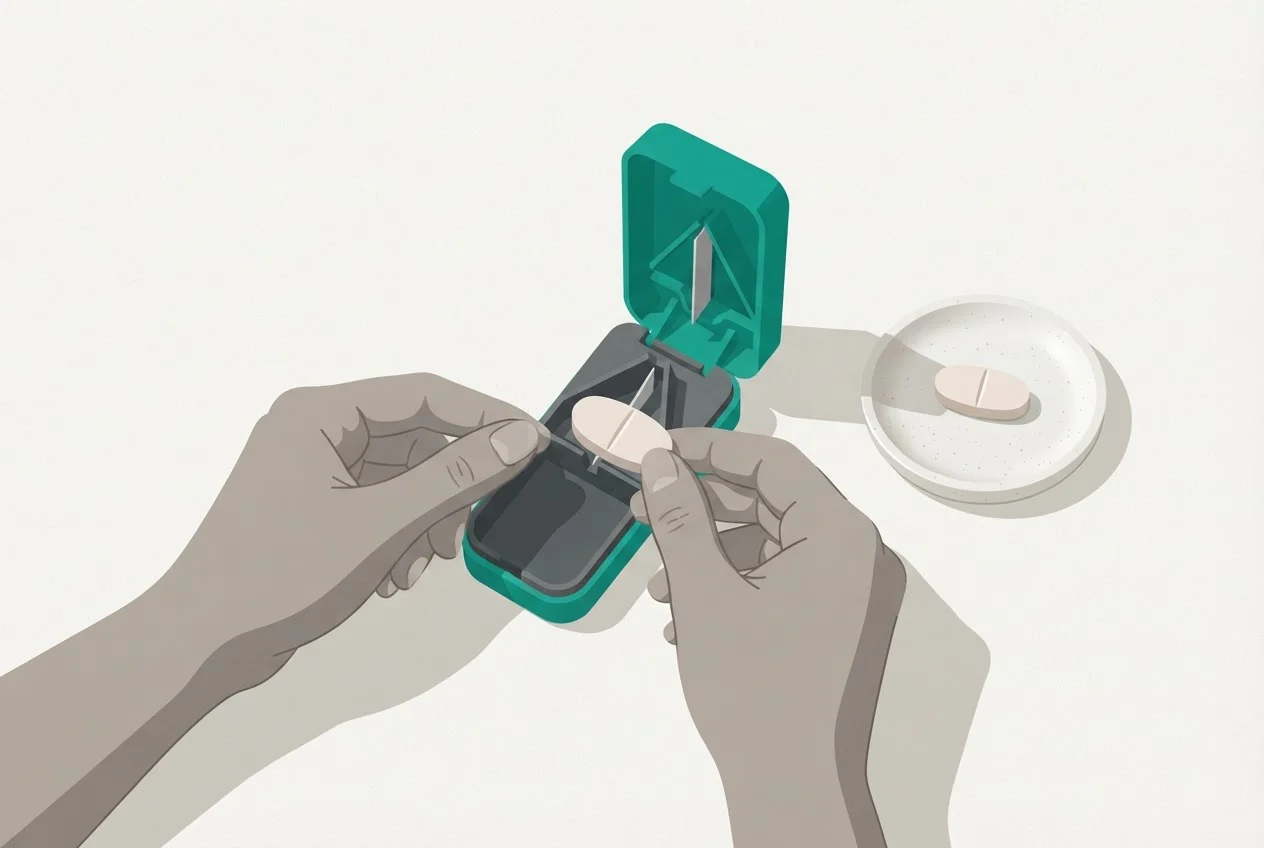
The reason is how the tablet is built. A coating, a matrix (a substance the drug is mixed through that dissolves or swells slowly) or a set of tiny coated pellets controls how fast the drug leaves the tablet. Damaging that structure risks dose dumping, the release of a large part of the dose at once. The labels say so plainly. The Concerta label says not to split, crush or chew the tablets "because doing so will compromise the extended-release characteristics" (DailyMed, Concerta, label effective April 2026). The OxyContin label states that cutting, breaking, crushing, chewing or dissolving the tablets "will result in uncontrolled delivery of oxycodone and can lead to overdose or death" (DailyMed, OxyContin, label effective June 2026).
Three products show the exceptions:
- Toprol-XL (metoprolol succinate): "tablets are scored and can be divided; however, do not crush or chew the whole or half tablet" (DailyMed, Toprol-XL, label effective March 2026).
- Amoxicillin and clavulanate potassium extended-release tablets "can be split in half along the score line for patients with difficulty swallowing the tablets whole", and both halves must be taken immediately (DailyMed, Sandoz label, effective May 2025).
- QuilliChew ER (methylphenidate) is supplied as an extended-release chewable tablet. Its 20 mg and 30 mg tablets are scored and can be cut in half. The 40 mg tablet is not scored and cannot be divided (FDA label, revised June 2021).
If cost is why you want to split, ask your pharmacist about a lower-strength tablet before cutting anything. FDA also advises confirming again whether a tablet can be split whenever the brand changes.
If the reason is trouble swallowing a large tablet, do not crush it. Ask your pharmacist or prescriber whether the same drug comes in another form, or whether a different medicine fits better. The amoxicillin and clavulanate label above is one case where splitting is allowed for exactly this reason, but most ER labels do not allow it.
How do I check my own ER tablet before I split it or worry?
Run these five checks on the label for your exact product. DailyMed publishes the prescribing information for each. Each check has a result you can read off the page.
- What does the product title say?Find the product title or the Dosage Forms and Strengths line. Pass: it contains "extended-release" and you can read the word. Fail: it says "tablets" only, or you cannot find it. Ask the pharmacist before changing how you take it.
- Does it match what was prescribed?Compare the title with your prescription and the pharmacy label. Pass: both say extended release, or the pharmacist confirms the match. Fail: the prescription says ER and the label title says plain "tablets", or the reverse. Call the pharmacist before your next dose.
- Is it standard, chewable or orally disintegrating?Pass: you can say which of the three the title names. Fail: you are unsure. Ask. A standard ER tablet is swallowed whole. A chewable or orally disintegrating one follows its own label instructions.
- What do the Dosage and Administration instructions say?Search that section for "swallow", "crush", "chew", "split" and "divide". Note the food instruction there too. Pass: you find a statement and can repeat it. Fail: you find nothing. Treat that as "do not split, crush or chew" and ask.
- May this tablet be split?Pass requires both: the label says the tablet may be split or divided, and the tablet has a visible score line. Fail: either is missing, so do not split. Even when splitting is allowed, never crush or chew a standard ER tablet.
Questions to ask at the counter: "Is this the extended-release version? Is it a standard, chewable or orally disintegrating tablet? Does the label allow splitting?"
Is it normal to see an extended release tablet shell in my stool?
For some ER products, yes. Metformin ER labels tell prescribers to inform patients that "the inactive ingredients may occasionally be eliminated in the feces as a soft mass that may resemble the original tablet" (DailyMed, metformin ER, label effective April 2023). Another metformin ER label puts it in patient wording: "An empty tablet shell may appear in your stool. This effect is harmless because your body has already absorbed the medication" (DailyMed, metformin ER, label effective February 2023).
Not knowing this can lead to harm. A 2016 case report in Diabetes In Control describes a patient who stopped metformin ER after seeing a pill-like object in her stool. Her A1C (a blood test showing average blood sugar over about three months) and her weight returned to the levels they were at before stopping after three months back on the medicine.
Our advice: do not stop the medicine, double a dose or crush the next tablet because of a shell. Judge the treatment by how you are doing, such as your blood sugar readings on metformin, and tell your pharmacist if you see shells often and your symptoms return. For metformin ER, the patient information says stomach symptoms that begin after the first days of treatment may be signs of lactic acidosis and should be reported to your doctor immediately. Check the label for your own product for symptoms that need urgent care.
What should I do if I crushed, chewed or doubled a slow-release tablet?
Call Poison Control at 1-800-222-1222 right away, with the drug name and strength to hand. The service is free and available 24 hours a day (Poison Control, contact page). Call 911 if the person collapses, has a seizure, has trouble breathing or cannot be woken (Poison Control, immediate assistance).
This applies to standard ER tablets, whose labels warn that damage can release the dose at once. It does not apply to a chewable ER tablet taken as the label directs. Do not wait for symptoms to appear. For a missed dose, follow your label's missed-dose instruction, and do not take an extra tablet to catch up unless it tells you to. Do not move between immediate release and extended release on your own, because the dose and timing are set for each.
How can we help if you need extended release tablets developed or made under contract?
We offer contract development and manufacturing of oral dosage forms from our Haridwar, Uttarakhand office (KH No. 32, Shrivas Green, Bahadarabad, SIDCUL, the State Infrastructure and Industrial Development Corporation of Uttarakhand Limited industrial area). Our site lists extended release tablets among the forms we work on. The manufacturing source is confirmed product by product at the feasibility review.
An extended release project starts from the release profile, not the tablet press. These inputs decide whether a project is feasible and how it is quoted:
- Reference product and target profile. A generic developer has to match how the innovator product performs, which Colorcon lists as one of four main challenges in extended release development (Colorcon).
- Dissolution method. A reliable dissolution test is the main quality tool for a release profile. FDA's guidance covers setting dissolution specifications for extended release products (FDA, Extended Release Oral Dosage Forms).
- In vivo evidence. Where an in vitro-in vivo correlation (IVIVC, a model linking the dissolution profile to blood levels) is established, the same guidance describes how dissolution can stand in for some bioequivalence studies, including for certain scale-up and post-approval changes.
- Scale-up and change control. The FDA guidance known as SUPAC-MR, which the 1997 document names, is the reference for scale-up and post-approval changes to modified release products.
Our guide to third party manufacturing in pharma explains how contract quotes differ and how to vet a manufacturer before a first batch. Our guide to what a WHO GMP certificate proves shows what that certificate does and does not cover. A project follows this route:
- Inquiry.
- Feasibility review.
- Commercial quotation.
- Development or technical transfer.
- Production and quality control.
- Packaging and dispatch.
To start, send us the drug, the strength, the release profile you are aiming for, any reference product and your target market. If a product already runs at another site, our guide on pharmaceutical technology transfer covers the handover. Prices are set per project on quotation, so ask us. Confirming the regulatory path in your target market, including the US, stays with the product owner before you commit. To begin a feasibility review, contact us.
Frequently asked questions
Mostly yes in practice. Sustained release (SR) and controlled release (CR) are informal industry terms, while extended release is the term used in labeling and in FDA's dosage-form names (Colorcon). Check the product title on the label, and treat SR and CR tablets like ER: swallow them whole unless the label says otherwise.
Sources
- 1.FDA, Tablet Splitting
- 2.FDA, Guidance for Industry: Extended Release Oral Dosage Forms: Development, Evaluation, and Application of In Vitro/In Vivo Correlations (September 1997)
- 3.FDA, Product Titles in Highlights of Prescribing Information
- 4.openFDA, National Drug Code directory, dosage-form counts (data updated 9 October 2026)
- 5.DailyMed, Concerta prescribing information
- 6.DailyMed, OxyContin prescribing information
- 7.DailyMed, Toprol-XL prescribing information
- 8.DailyMed, amoxicillin and clavulanate potassium extended-release tablets (Sandoz)
- 9.FDA, QuilliChew ER prescribing information (revised June 2021)
- 10.DailyMed, metformin hydrochloride extended-release tablets (Ascend)
- 11.DailyMed, metformin hydrochloride extended-release 500 mg (Calvin Scott)
- 12.Diabetes In Control, Ghost Pills (2016)
- 13.Poison Control, contact page
- 14.Poison Control, need immediate assistance
- 15.Colorcon, Extended-Release Tablet Formulation: Challenges & Best Practices (updated May 26, 2026), Colorcon, May 26, 2026
- 16.Lubrizol, The Guide to Formulating Oral Extended-Release Tablets (August 2023), Lubrizol, August 2023
- 17.Drugs.com, Is it safe to split my pill in half?, Drugs.com
- 18.Doctronic, Extended Release vs Immediate Release (2026), Doctronic, 2026
- 19.Colorcon, Controlled Release vs. Sustained Release vs. Extended Release