Film Coating vs Sugar Coating: What to Specify in a Tablet RFQ
Film coating vs sugar coating differs in added weight: film coating adds about 2% to 3% and sugar coating roughly 30% to 100%, so a quote request should name the coating.

By Sunil Kumar, Managing Director - Sales · Updated 28 Oct 2026

Key takeaways
- Film coating is a thin polymer layer applied in one stage; sugar coating is a multi-step sugar build-up that adds far more weight. For a new tablet, film coating is the default choice.
- In the FDA's NDC directory, film-coated tablets outnumber sugar-coated ones about 197 to 1 as of October 2026.
- Coating changes how a tablet swallows and how closely it can match a reference product, so state the coating type, target weight gain and tablet dimensions in writing.
- In the label records we checked for drugs sold as sugar-coated tablets, sucrose was listed among the inactive ingredients, so read that list before you rely on a coating name.
In this article
- 1What is the difference between film coating and sugar coating?
- 2How common is sugar coating in US tablets today?
- 3How much weight does each coating add to a tablet?
- 4Why does coating matter for swallowing and for matching a reference tablet?
- 5Does a sugar-coated tablet list sucrose on the label, and what about colorants?
- 6How do you choose between film coating and sugar coating?
- 7What should a tablet RFQ say about coating?
- 8Frequently asked questions
As of October 27, 2026, the US Food and Drug Administration's National Drug Code (NDC) directory lists 12,191 tablet products as film coated and 62 as sugar coated, a ratio of about 197 to 1 (counts from the NDC directory via openFDA, the FDA's public data interface: film coated, sugar coated).
That gap answers most of the question. Sugar coating survives on a short list of older products such as chlorpromazine, while film coating covers the great majority of the listings that name a coating type. What still needs a decision is how you write the coating into a specification, because the word "coated" on its own leaves the type open.
This page gives the difference between the two coatings in two sentences, then weight gain, swallowing and label effects with their sources, a decision table, and request-for-quotation (RFQ) lines to copy into an inquiry to a manufacturer.
What is the difference between film coating and sugar coating?
Film coating is a thin polymer layer applied in a single stage that adds about 2% to 3% to a tablet's weight (Salawi, Polymers 2022). Sugar coating is a multi-step build-up that adds roughly 30% to 100% (Salawi; Zaid, 2020). Film coating is the modern default.
Sugar coating works in stages: sealing, sub-coating, smoothing, coloring, polishing and printing (Zaid). That sequence makes it time-consuming and raises the final cost of the tablet (Zaid).
Film coating is also where function lives. The polymer layer can improve physical and chemical stability and change how the drug is released (Zaid). A delayed-release version of the idea is covered in our guide to enteric coated tablets.
How common is sugar coating in US tablets today?
Sugar coating is rare. Among listings whose dosage form is exactly "tablet, film coated" or "tablet, sugar coated", 62 of 12,253 (about 0.5%) are sugar coated. A further 1,240 listings are film coated, extended release.
| Dosage form named in the listing | NDC product listings |
|---|---|
| Tablet, film coated | 12,191 |
| Tablet, coated (type not named) | 1,527 |
| Tablet, film coated, extended release | 1,240 |
| Tablet, sugar coated | 62 |
How we counted: on October 28, 2026 we queried the FDA NDC directory through openFDA (data last updated October 27, 2026) for each exact dosage-form value and read the total. The 197 to 1 ratio is 12,191 divided by 62. We then pulled all 62 sugar-coated records and tallied them by generic name.
The 62 sugar-coated listings are concentrated:
- chlorpromazine hydrochloride: 24
- conjugated estrogens with medroxyprogesterone acetate: 8
- sirolimus: 6
- desipramine hydrochloride: 6
- sennosides: 6
- tiopronin: 4
- ibuprofen with pseudoephedrine: 3
- bisacodyl and other laxatives: 4
- exemestane: 1
Four limits apply. The directory counts product listings, not drugs or tablets sold. Listings include repackagers' package entries, so the 24 chlorpromazine listings are not 24 distinct products. Labelers choose their own dosage-form term, which is why 1,527 listings say only "coated". And openFDA describes its data as unvalidated. Our reading is that sugar coating is a legacy finish on older products, not a live competitor to film coating for new development.
How much weight does each coating add to a tablet?
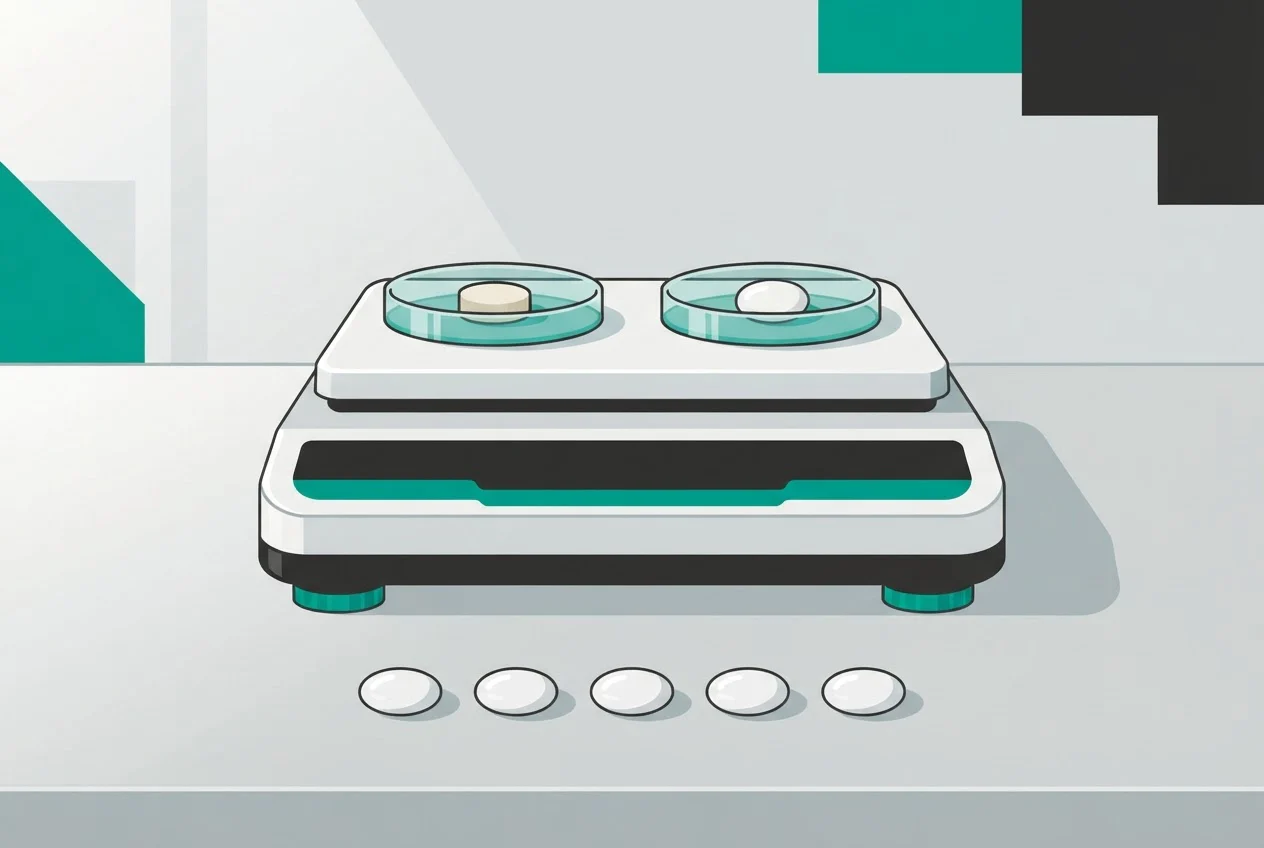
A film coat adds about 2% to 3% of the core weight, while published sugar-coating figures run from 30% to 100%, so a sugar-coated tablet can weigh far more than its core.
| Coating | Weight added to the core | Source |
|---|---|---|
| Film | 2% to 3% | |
| Sugar | 30% to 50% | |
| Sugar | 50% to 100% |
The reviews give adjacent ranges, so treat 30% to 100% as the planning range and let the product decide where it falls.
Worked example (our arithmetic on those percentages) for a 500 mg core:
- Film coating at 2% to 3% adds 10 to 15 mg, giving a tablet of 510 to 515 mg.
- Sugar coating at 30% to 100% adds 150 to 500 mg, giving 650 to 1,000 mg.
Time moves the same way. Dissolving polymers in volatile solvents can cut coating duration "from days to a few hours" (Salawi). Weight gain is not the same as added diameter, so we recommend asking for finished-tablet dimensions in the quote, not inferring them from the percentage.
Why does coating matter for swallowing and for matching a reference tablet?
Coating changes how easily a tablet is swallowed, and the FDA tells generic developers to weigh it when setting a product's quality target. The FDA's June 2015 guidance, Size, Shape, and Other Physical Attributes of Generic Tablets and Capsules, is non-binding and applies to ANDAs submitted to its Office of Generic Drugs.
The guidance states:
- "The presence and composition of a coating can also potentially affect the ease of swallowing tablets or capsules."
- The lack of a film coating can decrease tablet mobility compared with a coated tablet of the same size and shape.
- Coating also affects palatability and smell.
- Swallowing complaints increase at tablet sizes above approximately 8 mm in diameter.
- More than 16 million people in the US have some difficulty swallowing, and a survey it cites suggests as many as 40 percent of Americans may have trouble with tablets and capsules.
- A generic tablet intended to be swallowed whole should be of similar size to its reference listed drug (RLD), the product the generic is measured against.
- Coating and weight belong in the quality target product profile (QTPP), the summary of the characteristics a product must meet.
Our inference: because sugar coating adds 30% or more to weight, it works against matching a reference tablet's size, and film coating gives the most room to stay close to it. Film coating is not free of faults, though; those are in the RFQ section below.
Does a sugar-coated tablet list sucrose on the label, and what about colorants?
Yes in the records checked, so confirm sucrose in the inactive-ingredient list. In October 2026 we read the first three openFDA label records returned for each generic name and searched the inactive-ingredient text for sucrose. It appeared in two of three sirolimus records, in the Norpramin record of three desipramine records, and in one sennosides tablet record. These drugs all appear among the sugar-coated listings.
If a product must be sucrose-free, check the inactive-ingredient list in its label.
Colorants need the same check. Titanium dioxide, a white pigment, is permitted "for coloring ingested and externally applied drugs generally, in amounts consistent with good manufacturing practice," and is exempt from batch certification under 21 CFR 73.1575. Whether your customers or other markets accept a given pigment is a separate question, so list it in the specification.
How do you choose between film coating and sugar coating?
Start with film coating and move to sugar coating only when an existing product's finish is the reason. Our recommendation rests on the evidence above, and each row below is a test you can answer yes or no.
| Question | If yes | How to test it |
|---|---|---|
| Must the tablet match a reference product's size and shape? | Film coating | Compare finished dimensions to the reference; pass if the manufacturer commits to a tolerance in writing |
| Is the uncoated core already near 8 mm across? | Film coating | Measure the finished coated tablet. Pass if it is under about 8 mm; over that, plan for swallowing complaints (FDA guidance) |
| Does it need delayed or modified release? | Film-coating polymers, which is a release question first; see enteric coated tablets | Pass if the release profile is specified and tested |
| Must the label be sucrose-free? | Film coating | Fail any sugar-coated product, and check every film-coated one for sucrose in its inactive-ingredient list |
| Does the active need protection from moisture or light? | Film coating, backed by stability data | Pass if stability results at your storage condition are provided |
| Are you transferring an existing sugar-coated product? | Hold the current coating until a formulation change is assessed | Pass: the manufacturer supplies a written comparability plan with dissolution and stability data. Fail: the coating is changed without data |
For a bitter active, whichever coating is chosen, ask the manufacturer to show taste-masking results on the proposed coat.
What should a tablet RFQ say about coating?
A tablet RFQ should name the coating type, the target weight gain, the finished dimensions, the colorants, sucrose status and dissolution limits, so no quote can be built on "coated" alone. Copy these lines, each with a pass and a fail:

- Coating typefilm, sugar or uncoated, in those words. Pass: the quote repeats the term. Fail: it says only "coated".
- Target weight gain, with limits, as a percentage of core weight.Pass: a figure and range are given and batch data comes within them. Fail: no figure.
- Finished tablet dimensions compared with the reference product.Pass: measured values within the agreed tolerance. Fail: dimensions are not reported.
- Colorants, each named with its regulatory basis.Pass: every pigment is listed, with titanium dioxide acceptability stated. Fail: "color system" with no names.
- Sucrose status against the inactive-ingredient list.Pass or fail on whether sucrose is listed.
- Dissolution method and limits for the coated tablet.
See dissolution testing. Pass: method, medium and limits stated.
- Control of film-coating defects.
The review literature lists blistering (film lifting off the surface), chipping (dented or broken edges), picking (coating pulled off by the tablet face or logo), pitting (small craters), orange-peel roughness (a dimpled surface) and color variation (Salawi). Pass: acceptance criteria for each are in the batch records.
We are a technology-driven contract development and manufacturing organization (CDMO) for oral dosage forms, providing product development through commercial manufacturing. Our buying route runs from inquiry to feasibility review, commercial quotation, development or technical transfer, production and quality control, packaging and dispatch. Put the lines above into your inquiry. Our oral solid dosage manufacturing guide (oral solid dosage manufacturing) and our third-party manufacturing guide (third-party manufacturing) cover the later steps.
To start, use our contact form.
Frequently asked questions
Three coating processes are usually named: sugar coating, film coating and press coating, where the coating is compressed around the core (Seo K-S et al., 2020, Pharmaceutical Application of Tablet Film Coating). Enteric coating is a film coating designed to delay release until the intestine.
Film coating lets a manufacturer tune a tablet's protection, taste and release behavior without adding much weight (Zaid). It is the layer that carries the tablet's function, not just its color.
Sources
- 1.FDA NDC directory via openFDA, tablet, film coated (queried October 28, 2026; data last updated October 27, 2026)
- 2.FDA NDC directory via openFDA, tablet, sugar coated
- 3.openFDA drug label records, sirolimus
- 4.openFDA drug label records, desipramine
- 5.openFDA drug label records, sennosides
- 6.Salawi A. Pharmaceutical Coating and Its Different Approaches, a Review. Polymers, 2022
- 7.Zaid AN. A Comprehensive Review on Pharmaceutical Film Coating: Past, Present, and Future. Drug Design, Development and Therapy, 2020
- 8.Seo K-S et al. Pharmaceutical Application of Tablet Film Coating, 2020
- 9.FDA, Size, Shape, and Other Physical Attributes of Generic Tablets and Capsules, guidance for industry, June 2015
- 10.21 CFR 73.1575, Titanium dioxide (color additives for drugs), eCFR