Enteric Coated Tablets: What the Label Lets You Do
Enteric coated tablets have an acid-resistant coating that delays drug release until the intestine. Swallow them whole, never crushed, split or chewed, unless the label for your exact product says otherwise, and check food timing.

By Sunil Kumar, Managing Director - Sales · Updated 23 Oct 2026

Key takeaways
- Swallow an enteric coated tablet whole unless the label for that exact product gives another method. Of the eleven products reviewed, only pantoprazole (two 20 mg tablets for one 40 mg) and doxycycline (break and sprinkle the pellets) did, and none allowed crushing.
- Before changing how you take any delayed-release tablet, check four things on the bottle: the form name, the swallowing sentence, any alternative the label gives, and the food or antacid timing.
- A randomized-trial meta-analysis and a case-control study found no evidence that enteric coating lowers the risk of serious stomach and intestinal bleeding from aspirin, and over-the-counter enteric coated aspirin labels carry a stomach bleeding warning.
- Buyers and formulators should ask for dissolution data from both test stages: the acid stage, where no more than 10% of the drug should release, and the buffer stage, where it should.
In this article
- 1What are enteric coated tablets and why does the coating exist?
- 2How do enteric coatings work, and where do they dissolve?
- 3Enteric coated vs delayed-release, extended-release and film-coated tablets
- 4What are the pros and cons of enteric coated tablets?
- 5Can enteric coated tablets be crushed, split or chewed?
- 6What do the labels of delayed-release tablets actually instruct?
- 7Is an enteric coated aspirin easier on the stomach?
- 8What do formulators control to make an enteric coating hold?
- 9How is an enteric coating tested, and what goes wrong when it fails?
- 10Frequently asked questions
The swallow-whole rule holds for most products, but the details around it change from drug to drug, and only the label for your tablet lists them.
As of 9 October 2026, an openFDA query of the FDA's National Drug Code directory lists 920 products under the dosage form "tablet, delayed release", and their labels do not all give the same instructions. The pantoprazole label allows two 20 mg tablets in place of one 40 mg tablet, each swallowed whole. A doxycycline delayed-release tablet may be broken so its intact pellets can be sprinkled on applesauce. Bisacodyl must not be taken within an hour after an antacid or milk.
The bottle check below works for any prescription or over-the-counter product, and a label table shows how the wording differs. Later sections cover whether the coating protects your stomach and how manufacturers prove that a coating holds.
What are enteric coated tablets and why does the coating exist?
Enteric coated tablets are tablets wrapped in a polymer layer that stays intact in stomach acid and dissolves as the surrounding acidity falls, so the drug is released in the small intestine. Many such products are named delayed-release tablets on their labels, as pantoprazole is. The coating on that product is a methacrylic acid copolymer.
There are three reasons to coat a tablet this way:
- The drug is damaged by stomach acid. Pantoprazole, a proton pump inhibitor (PPI, a drug that reduces stomach acid), is made so that absorption starts only after the tablet leaves the stomach.
- The drug irritates the stomach lining on direct contact, as aspirin and naproxen can.
- The drug needs to act lower in the gut, as bisacodyl does.
Enteric coating is not limited to tablets or to the drugs above. The erythromycin delayed-release tablet label describes a specially enteric-coated tablet whose coating protects the antibiotic from gastric acid. Sulfasalazine and mycophenolic acid are also sold as enteric-coated or delayed-release tablets. Pancrelipase (a digestive enzyme product) and budesonide come as delayed-release capsules, and the pancrelipase label says to swallow the capsules whole and never crush or chew the capsules or their contents. Some supplements are coated too: the NIH Dietary Supplement Label Database lists an enteric-coated fish oil product.
How do enteric coatings work, and where do they dissolve?
An enteric coating works because the stomach and the small intestine differ sharply in acidity. Acidity is measured on the pH scale, where lower numbers are more acidic. Enteric polymers stay solid in the strong acid of the stomach and dissolve as the pH rises in the small intestine, so the tablet core is exposed only after the dosage form has left the stomach.
| Stage | Acidity | What the coating does |
|---|---|---|
| Stomach | Strongly acidic. The USP test models it with 0.1 N hydrochloric acid, a pH of about 1. | The polymer film stays intact and shields the core. |
| Small intestine | Close to neutral. The USP test models it with a phosphate buffer at pH 6.8. | The film dissolves, the core disintegrates and the drug is released for absorption. |
The trigger depends on the polymer. The pantoprazole label lists a methacrylic acid copolymer, and the sulfasalazine label says its tablets are film coated with cellulose acetate phthalate to retard disintegration in the stomach. Because the film is the only barrier, a crack, a thin spot or a crushed edge can let acid reach the core, which is why crushing defeats the design. Dissolution of such coatings depends on pH, and the Uceris (budesonide) label warns that release and uptake may be altered after treatment with gastric acid reducing agents, so tell your pharmacist about any acid reducer you take.
The United States Pharmacopeia (USP) tests a delayed-release product in two stages, described in General Chapter 711, Dissolution (2011 harmonization text). The first stage is two hours in 0.1 N hydrochloric acid. N (normality) expresses the concentration of the acid, and this solution has a pH of about 1, similar to the stomach. The second stage is a phosphate buffer at pH 6.8, close to neutral and similar to the small intestine. A sound coating releases little drug in the acid stage and the drug in the buffer stage. The specification cited in a 2023 laboratory study allows no more than 10% of the drug to release in acid.
Enteric coated vs delayed-release, extended-release and film-coated tablets
The terms overlap on labels, but they are not interchangeable. In US labeling, "delayed-release" describes the release behavior, and an enteric coating is the usual way to achieve it. Some manufacturers and markets call the same kind of product a gastro-resistant tablet, as we do on our site and as a 2023 study of pantoprazole tablets does. Extended-release is different: it spreads release over hours so one dose lasts longer, rather than holding the drug back until the intestine.
The difference has consequences for dosing. The Depakote ER label describes an extended-release divalproex product for once-a-day use, and says its doses must be 8 to 20% higher than the total daily dose of Depakote (the delayed-release form) for the two formulations to be bioequivalent. They cannot be swapped milligram for milligram.
| Tablet type | Where the drug is released | Label wording to look for |
|---|---|---|
| Enteric coated or gastro-resistant | Small intestine, after the coating dissolves as the pH rises | Enteric coated, EC, gastro-resistant, delayed-release |
| Delayed-release | After a delay, most often through an enteric coating | Delayed-release, DR |
| Extended-release | Gradually over several hours | Extended-release, ER, XR |
| Film-coated | The term alone does not say. It is a broad description of a polymer film, and enteric coatings are one kind. | Film-coated, coated |
Only a label that says delayed-release, enteric coated or gastro-resistant promises delayed release. "Film-coated" is a broader term, as the sulfasalazine label shows: its film is a cellulose acetate phthalate coating meant to retard disintegration in the stomach. A tablet described only as film coated or coated makes no such promise. An extended-release tablet is not the same product as a delayed-release one even when both carry the same drug name. If the wording on your bottle changes after a refill, ask the pharmacist before taking it.
What are the pros and cons of enteric coated tablets?
Enteric coating solves specific problems, and it adds trade-offs for patients and manufacturers.
Advantages
- Protects acid-sensitive drugs, such as PPIs, from degradation in the stomach
- Limits direct contact between an irritating drug and the stomach lining
- Lets a drug act lower in the gut, as bisacodyl does
Trade-offs
- Slower onset, because the tablet must leave the stomach before the drug is released. The Bayer low-dose aspirin label says its delayed action will not give fast relief of headaches.
- Cannot be crushed or chewed, and usually not split, without losing the protection. The FDA says most timed-release medicines are not meant for splitting.
- Absorption can vary with food and stomach emptying. The diclofenac label notes that food usually delays the start of absorption by 1 to 4.5 hours.
- A coating that does not hold can release the drug early, as the recalled generic pantoprazole did in the 2023 study described later in this article.
- Adds a coating step and two-stage dissolution testing to each batch, so there is more process control and, in our view, usually more cost than for an uncoated tablet.
Limiting contact with the stomach lining is not the same as preventing bleeding, as the aspirin section below explains.
Can enteric coated tablets be crushed, split or chewed?
No, unless the label for that exact product says otherwise. Crushing or chewing breaks the coating, so the drug meets stomach acid at once. An acid-sensitive drug can be degraded, an irritating drug touches the stomach lining, and the delay you were prescribed is lost. The FDA states that most timed-release medicines are not meant for splitting, and that the label says when splitting is acceptable.
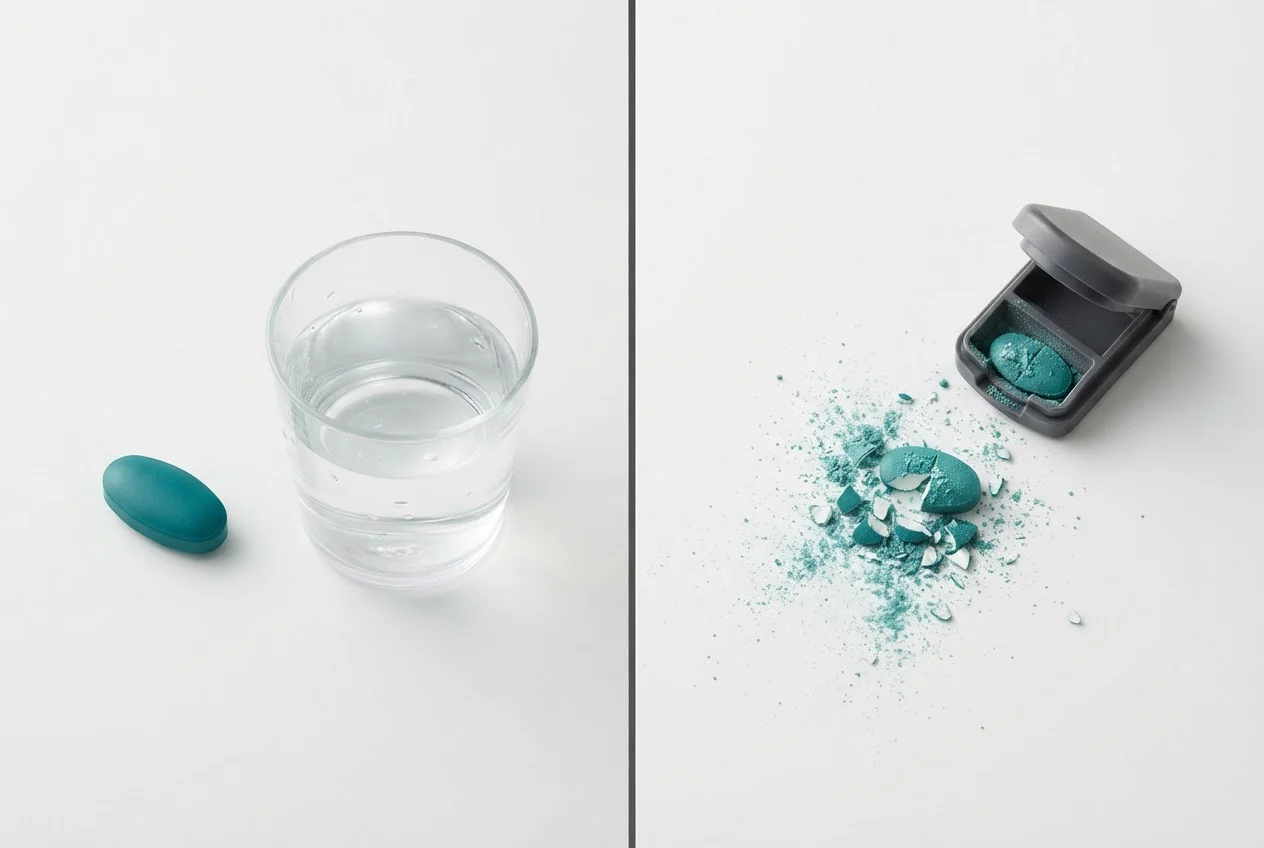
Run this bottle check on any DR (delayed-release) or EC (enteric coated) tablet:
- Find the form name
Pass: the label or carton says delayed-release, DR, EC or enteric coated, so treat the tablet as coated. Fail: it says chewable, dispersible or orally disintegrating. Those are made to be broken down and are a different product.
- Find the swallowing sentencePass: you can point to the words "swallow whole" or "do not crush, chew or split". Follow them. Fail: you cannot find a sentence. Ask a pharmacist before changing how you take it.
- Find any alternative the label offersPass: the label gives a method, such as two 20 mg tablets in place of one 40 mg pantoprazole tablet. Use only that method. Fail: you are improvising, such as crushing into yogurt. Stop and ask.
- Find the timing rulePass: you can quote the label's food, antacid or time-of-day sentence, or a pharmacist has confirmed it has none. Fail: you are relying on the rule for a different drug.
Repeat the check when the pharmacy changes manufacturer, because each manufacturer's label is its own.
If swallowing tablets is difficult, ask the prescriber or pharmacist whether the same drug comes as a delayed-release capsule, granules or a liquid. Open a capsule only if its label allows it. The omeprazole delayed-release capsule label describes opening the capsule onto applesauce. Of the tablet labels below, only doxycycline describes a comparable method, and it applies to that product alone. Our tablet vs capsule comparison covers how the two dosage forms differ in release.
What do the labels of delayed-release tablets actually instruct?
Most delayed-release labels say to swallow the tablet whole and not crush, chew or split it. Of the ten drug labels reviewed, nine say so. Only pantoprazole and doxycycline describe an alternative, and timing rules differ by drug.
We read one current label for each of ten drugs in openFDA's drug label data on 9 October 2026, and each product name below links to an example DailyMed label from one manufacturer. The aspirin row is the exception: it comes from a Cleveland Clinic drug page and an over-the-counter package label, so it is a drug page rather than a prescribing label. This is a sample of eleven products, not a survey of all 920 listings. Labels vary by manufacturer, so check the one on your own bottle.
| Product | What the label or drug page instructs |
|---|---|
| Do not split, chew or crush. Swallow whole, with or without food. If a 40 mg tablet cannot be swallowed, two 20 mg tablets may be taken. | |
| Swallow whole. Do not chew, crush or split. | |
| Swallow whole. Do not crush or chew. | |
| Do not crush, chew or cut. Swallow whole to maintain the integrity of the enteric coating. | |
| Do not break, crush or chew, to maintain the integrity of the enteric coating. | |
| Swallow whole. Do not cut, break or chew. | |
| Do not chew or crush. Do not use within 1 hour after an antacid or milk. | |
| Swallow one tablet with water before eating in the morning, for a 14-day course. Swallow whole. Do not chew or crush. | |
| Food does not significantly change how much is absorbed but usually delays the start of absorption by 1 to 4.5 hours. | |
| Do not chew or crush. Alternatively, break the tablet carefully and sprinkle the pellets on applesauce without crushing or damaging them. Swallow immediately without chewing. | |
| Aspirin 81 mg, enteric coated (Cleveland Clinic page) | Do not chew, crush or cut. Take with or without food; with food if it upsets your stomach. |
No label in the sample permits crushing. Timing rules vary the most: before eating, with or without food, or apart from antacids. A rule from one product should never be borrowed for another.
The same directory shows how common these products are. On 9 October 2026, four groups accounted for 667 of the 920 delayed-release tablet listings (72.5%): PPIs (331, including omeprazole 128 and pantoprazole 131), diclofenac alone or with misoprostol (133), aspirin (110) and divalproex (93). The counts include repackagers, so they measure listings, not manufacturers, and they miss enteric coated tablets filed under another form. The directory also lists 12,142 products as "film coated" tablets, about 13 times the delayed-release count, so "coated" on a label does not mean delayed release.
Is an enteric coated aspirin easier on the stomach?
Not reliably when it comes to serious bleeding. Enteric coating is meant to limit direct irritation of the stomach lining, but it has not reliably lowered the risk of major bleeding. A case-control study, which compares people who had a bleed with people who did not, included 550 hospitalized upper gastrointestinal bleeding cases and 1,202 controls. At 325 mg a day or less, the relative risk of major upper gastrointestinal bleeding was 2.6 for plain aspirin, 2.7 for enteric-coated and 3.1 for buffered aspirin. Relative risk compares the risk with that of people who do not take aspirin. The authors concluded that the assumption that coated forms are less harmful may be mistaken.
The study is observational and dates from 1996, so it shows association, not proof. It also measured major bleeding, while the package claim concerns stomach upset, which is a different outcome. Our reading is that the coating changes where the tablet dissolves but not what aspirin does once absorbed.
Trial evidence points the same way. A 2000 BMJ meta-analysis, which pools the results of several studies, combined 24 randomized trials with almost 66,000 participants who took aspirin or placebo for at least a year. Gastrointestinal bleeding occurred in 2.47% of those taking aspirin and 1.42% of those taking placebo, over an average of 28 months. For modified-release aspirin, a broader category than enteric coating, the odds ratio was 1.93 (95% confidence interval 1.15 to 3.23). An odds ratio above 1 means higher odds of bleeding than with placebo. The authors found no evidence that modified-release forms reduce the risk. Those trials excluded people with a history of peptic ulcer or previous gastrointestinal bleeding, so the results describe average-risk patients, not everyone. The meta-analysis is also 26 years old.
Current labels point the same way. The December 2025 label for Bayer enteric coated low-dose aspirin carries a stomach bleeding warning, with higher chance if you are age 60 or older, have had stomach ulcers or bleeding problems, or take a blood thinner.
For anyone considering daily low-dose aspirin, the US Preventive Services Task Force grades how strongly it recommends a service. It gives Grade D, a recommendation against, to starting aspirin for primary prevention of cardiovascular disease at age 60 or older. For ages 40 to 59 with a 10-year cardiovascular risk of 10% or more, it gives Grade C, an individual decision. Do not start or stop aspirin without your clinician.
What do formulators control to make an enteric coating hold?
A coating that fails in the acid stage usually traces to a design or process choice that the formulator can control. Peer-reviewed work points to five control points. Where the evidence covers film coating in general rather than enteric coating specifically, we say so.
- Polymer and plasticizer. The polymer sets the pH at which the film opens. A 2022 review of pharmaceutical coating notes that cellulose acetate phthalate disintegrates above pH 6 and is hygroscopic, meaning it takes up moisture. The labels above show other choices: a methacrylic acid copolymer on pantoprazole and cellulose acetate phthalate on sulfasalazine. A plasticizer is an ingredient that makes the film more flexible, and the same review says plasticizers reduce the brittleness of films. The 2023 pantoprazole study discussed below suggests coating excipients may explain one failure.
- Coating thickness and integrity. A 2025 study using optical coherence tomography, a non-destructive way to measure film thickness, states that a coating's effectiveness depends on its thickness and integrity. For three commercial enteric coating systems on the study's test tablets, it found critical thicknesses of 65 to 69 micrometers (µm) for meeting the pharmacopeial acid-protection criteria. Those values belong to those systems and that test, not to enteric coatings in general.
- Tablet core. The 2022 review lists hardness and friability tests as the checks that a tablet's mechanical strength persists through handling, transport and storage. Friability measures how easily a tablet chips or crumbles. In our view, a core that fails these checks should be caught before coating, not after.
- Coating process. The same review ties film defects to process settings: blistering when the process overheats and traps gas in the film, chipping at tablet edges when pan rotation or airflow drops or tablets are over-dried and brittle, and picking when tablets are too wet. It also notes that spray rate and atomization depend on the nozzle orifice, fluid pressure and the viscosity of the coating liquid.
- Shelf life. A companion 2025 stability study followed the same three coating systems for 6 months of accelerated and 12 months of long-term storage under ICH Q1A(R2), the international guideline for stability testing. All three met the USP acid-stage criterion, but two showed significant variability in coating thickness, which the authors said would need strategic assessment in a regulatory submission.
Each of these can show up later as a result in the dissolution test, which is why the specification and method should travel unchanged with the product.
How is an enteric coating tested, and what goes wrong when it fails?
A coating is tested by the USP two-stage dissolution method, and a product passes only if it holds in acid and releases in buffer. A 2023 laboratory comparison (Arafat et al., F1000Research) found that a generic pantoprazole tablet later recalled from the market released more than 10% of its drug in acid, failing the USP limit, while the brand product complied. The authors suggested the generic's coating excipients (inactive ingredients) may be responsible. It tested one product, so it shows a coating can fail, not how often.
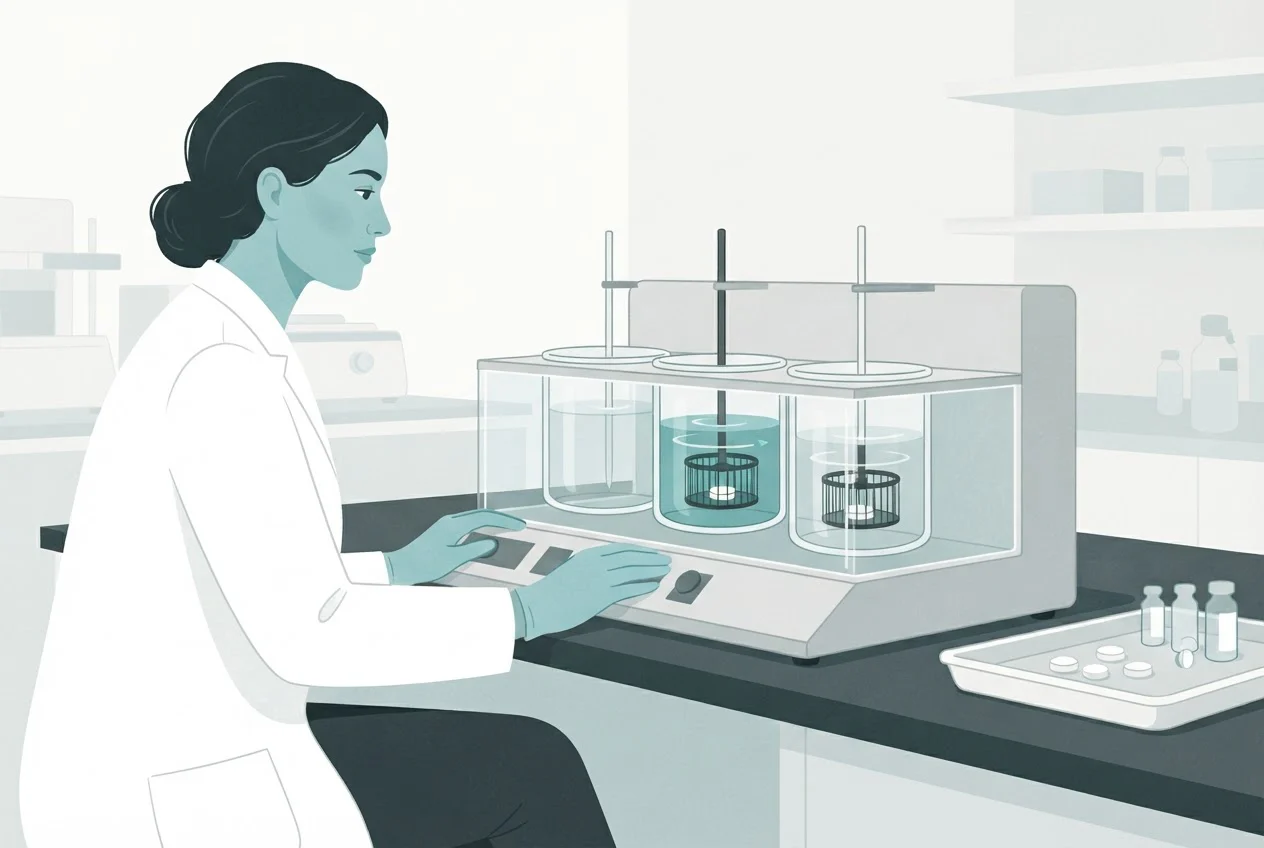
If you source or develop delayed-release tablets, our recommendation for buyers is to do three things:
- Ask for dissolution results for both stages, per batch, not only a certificate of analysis summary.
- Ask which coating polymer and what coating level the specification fixes, so the batch record can be compared against it.
- Treat a quality certificate as evidence about the site's quality system, not about one product's release, and ask for the product's own dissolution data. Our explainer on what a WHO GMP certificate proves for US buyers sets out that distinction.
Whoever runs the handover from development to production should carry the coating specification and dissolution method across unchanged. Our guide to pharmaceutical technology transfer covers the handover pack and FDA filings.
We are a technology-driven contract development and manufacturing organization (CDMO) for oral dosage forms, from product development through commercial manufacturing, and gastro-resistant (enteric coated) tablets are among the specialized technologies listed on our site. Our process runs from inquiry, with a confidentiality agreement if required, to a feasibility study, commercial quotation, technical transfer or development, regulatory support, production and quality control, and packaging and dispatch. Our third-party manufacturing page sets out each step, including formulation optimization where it is needed.
Frequently asked questions
Chewing or crushing removes the coating's protection, so an acid-sensitive drug may be partly destroyed or an irritating drug may upset the stomach. The effect depends on the drug, so do not double up, and check with a pharmacist. Call Poison Help at 1-800-222-1222 if you took extra or feel unwell.
A tablet whose coating did not break down can pass through intact, which may mean the drug was not absorbed as intended. Undigested tablets in stool have been reported in the medical literature. Do not repeat the dose. Tell your pharmacist or prescriber.
Sources
- 1.openFDA National Drug Code directory, delayed-release tablet listings
- 2.openFDA drug label data
- 3.openFDA, omeprazole delayed-release capsule label
- 4.DailyMed, pantoprazole sodium delayed-release tablets label
- 5.DailyMed, rabeprazole sodium delayed-release tablets label
- 6.DailyMed, divalproex sodium delayed-release tablets label
- 7.DailyMed, mycophenolic acid delayed-release tablets label
- 8.DailyMed, naproxen delayed-release tablets label
- 9.DailyMed, mesalamine delayed-release tablets label
- 10.DailyMed, bisacodyl enteric coated tablets label
- 11.DailyMed, omeprazole delayed-release tablets (over the counter) label
- 12.DailyMed, diclofenac sodium delayed-release tablets label
- 13.DailyMed, doxycycline hyclate delayed-release tablets label
- 14.DailyMed, erythromycin delayed-release tablets label
- 15.DailyMed, sulfasalazine delayed-release tablets label
- 16.DailyMed, Creon (pancrelipase) delayed-release capsules label
- 17.DailyMed, Uceris (budesonide) extended-release tablets label
- 18.DailyMed, Depakote ER (divalproex sodium) extended-release tablets label
- 19.NIH Dietary Supplement Label Database, enteric-coated fish oil product
- 20.DailyMed, Bayer Low Dose enteric coated aspirin label, December 2025
- 21.FDA, Tablet Splitting
- 22.USP, General Chapter 711 Dissolution, 2011 harmonization text
- 23.Kelly et al., Lancet 1996, aspirin-associated major upper gastrointestinal bleeding with enteric-coated or buffered product
- 24.Derry and Loke, BMJ 2000, risk of gastrointestinal haemorrhage with long term use of aspirin: meta-analysis
- 25.Salawi, Polymers 2022, Pharmaceutical Coating and Its Different Approaches, a Review
- 26.Afonso Urich et al., International Journal of Pharmaceutics 2025, acid stage dissolution assessed via optical coherence tomography (Part 1: Release Scenario)
- 27.Afonso Urich et al., International Journal of Pharmaceutics 2025, acid stage dissolution assessed via optical coherence tomography (Part 2: Stability Scenario)
- 28.Arafat et al., F1000Research 2023, enteric-coating film effect on pantoprazole generic tablets
- 29.US Preventive Services Task Force, Aspirin Use to Prevent Cardiovascular Disease
- 30.Cleveland Clinic, enteric-coated aspirin
- 31.HRSA, Poison Help
- 32.Mir et al., Case Reports in Gastrointestinal Medicine 2017, undigested pills in stool