Tablet vs Capsule: Which Works Better? Read the Release Code
Tablet vs capsule does not decide how well a medicine works. With the same drug and release type neither is stronger, and the release code on the label decides what is safe.

By Sunil Kumar, Managing Director - Sales · Updated 9 Oct 2026
Key takeaways
- For the same drug, strength and release type, neither a tablet nor a capsule is better, and a capsule is not faster by default.
- Extended- and delayed-release products come as both tablets and capsules, so the release code, not the shape, tells you whether you can crush, split or open the pill.
- Before you open, split, crush or switch a pill, read the full product name and ask a pharmacist about that exact product. The one-minute check is below.
- A 10 mg tablet and a 10 mg capsule of the same drug are different products. Do not swap them without a pharmacist or prescriber.
In this article
- 1In a tablet vs capsule choice, which is better and which works faster?
- 2Can you open a capsule, split a tablet or swap one for the other?
- 3What is the one-minute label check?
- 4Why does the release code matter more than the shape of the pill?
- 5Is a capsule or a tablet easier to swallow?
- 6What are caplets, softgels and veggie capsules, and do they change the choice?
- 7How do formulators choose between a tablet and a capsule?
- 8Frequently asked questions
Nearly one in four solid oral doses given to residents of 82 Italian long-term care facilities had been crushed or opened before dosing. More than a third of those changes were judged inappropriate or likely inappropriate, according to a 2024 nationwide point survey published in European Geriatric Medicine.
Changes like these are risky because of how a product is designed to release its drug, not because it is a tablet or a capsule. A release code is the group of letters after a drug's name, such as XR (extended-release) or EC (enteric-coated), that shows how the product releases the drug.
Crush an extended-release tablet and a drug meant to enter the body over many hours can reach it much faster than intended. That is why the bupropion XL label says to swallow the tablets whole. For a plain immediate-release product the same step can be harmless, and a few capsules are even labeled for opening. The difference is on the label, and it takes about a minute to read.
In a tablet vs capsule choice, which is better and which works faster?
For the same drug at the same strength and release type, neither a tablet nor a capsule is better, and a capsule does not work faster by default. How quickly a medicine acts depends on how the product was formulated: whether it releases at once, slowly, or only after it leaves the stomach.
Our explanation: in an immediate-release product, a capsule shell opens and a tablet disintegrates within a short time. Any real difference in speed comes from the formulation inside (particle size, solubility, coating, release design), not from the container.
Regulators test the result, not the shape. Bioequivalence means a generic delivers the same drug into the blood at the same rate and to the same extent as its brand-name reference. The rate is shown by the peak blood concentration (Cmax) and the extent by the total exposure over time (area under the curve, or AUC). A 90% confidence interval is the range in which the true ratio between the two products lies with 90% confidence. For human generics, FDA expects the 90% confidence interval of the test-to-reference ratio for Cmax and AUC to fall within 80.00% to 125.00% (FDA, Statistical Approaches to Establishing Bioequivalence).
That testing is done product by product. A 10 mg capsule from one maker and a 10 mg tablet from another have not been compared with each other unless a study did so. Treat them as different products until a prescriber or pharmacist says otherwise.
Can you open a capsule, split a tablet or swap one for the other?
You can open, split or crush a pill only when the label or a pharmacist confirms that exact product allows it. A release code in the name means the answer is no unless the label says otherwise. The table turns this into a decision.
The letters mean: XR, ER and XL, extended-release (over many hours); SR, sustained-release; CR, controlled-release; LA, long-acting; DR and EC, delayed-release or enteric-coated, built to open in the intestine rather than the stomach. No code usually means immediate-release, which starts releasing at once.
| What the label shows | What to do | Why |
|---|---|---|
| A release code in the name (tablet or capsule) | Do not crush, chew or split. Open a capsule only if the label says so. | FDA states that most sustained, controlled or timed release medications are not meant for splitting. The bupropion extended-release (XL) label reads: "should be swallowed whole and not crushed, divided, or chewed." |
| A tablet with a score line | It may be split, with a pharmacist's or prescriber's guidance. Split one dose at a time. | FDA says scored tablets carry a mark showing where to split, that splitting should be supervised by a healthcare professional, and that you should not split your whole supply in advance because heat, humidity and moisture affect split tablets. |
| A plain capsule with no release code | Open it only if the label or a pharmacist says that capsule can be opened. | CDC advises that if a child's provider prescribes oseltamivir capsules and the child cannot swallow them, they may be opened and mixed with a thick sweetened liquid. The liquid form is seasonal and may be unavailable. Other capsules carry no such instruction. |
| Chewable or orally disintegrating (dissolves on the tongue) | Take it as labeled. | These forms are designed to be chewed or dissolved in the mouth. |
| Same drug and strength, but a different release code or a different form | Do not swap on your own. | They are separate products, each tested on its own. |
A few capsules are labeled for opening and sprinkling on soft food. That instruction comes from the label of that exact product, and the beads inside are still swallowed whole, never crushed or chewed. Labels are revised, so a pharmacist should check the current one for your product.
What is the one-minute label check?
Run these four tests before you open, split, crush or switch.
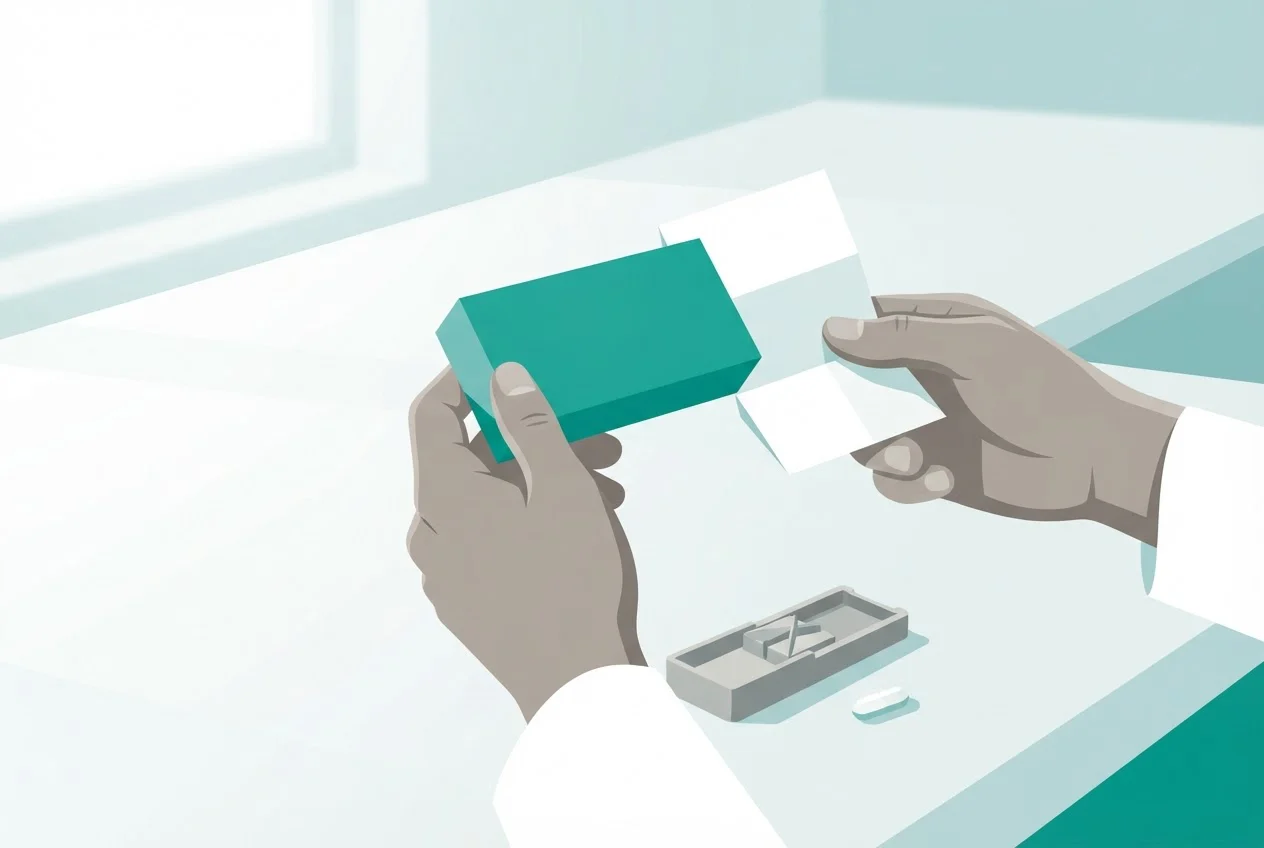
- Read the full product nameOn the bottle or pharmacy label, not just the drug name. Pass: you can see every word and letter after the drug name. Fail: you only have the drug name from a note or memory. Ask for the label.
- Look for a release code or the words "swallow whole" or "do not crush or chew"Pass: none appear. Fail: any appear. Do not alter the pill.
- If a refill looks different, compare it with the old bottlePass: same drug, same strength, same letters. Fail: different letters, strength or form. Call the pharmacist before the first dose.
- Ask the pharmacist about that exact productPass: they confirm by name. Fail: you get a general answer. Ask again with the product name.
What to say at the counter: "I take [name on the label, strength]. I can't swallow it whole. Can this exact product be opened, split or crushed? If not, is there a liquid, chewable or dissolving form of the same drug?"
Why does the release code matter more than the shape of the pill?
The release code matters more than the shape because modified-release products exist in both forms, and in our count of US generic listings they are more common among capsules. In October 2026, 22.5% of capsule listings and 12.8% of tablet listings named an extended- or delayed-release form.
"Modified-release" here means any product built to release its drug over hours or at a set point in the gut.
| Form | Modified-release terms and listings | Modified-release total | All listings | Share |
|---|---|---|---|---|
| Tablet | TABLET, EXTENDED RELEASE 2,046; TABLET, FILM COATED, EXTENDED RELEASE 1,055; TABLET, DELAYED RELEASE 631; TABLET, MULTILAYER, EXTENDED RELEASE 61; TABLET, ORALLY DISINTEGRATING, DELAYED RELEASE 10 | 3,803 | 29,746 | 12.8% |
| Capsule | CAPSULE, EXTENDED RELEASE 971; CAPSULE, DELAYED RELEASE 708; CAPSULE, DELAYED RELEASE PELLETS 75; CAPSULE, COATED, EXTENDED RELEASE 18 | 1,772 | 7,888 | 22.5% |
How we counted. On 9 October 2026 we queried the openFDA National Drug Code directory (data updated 8 October 2026). The query covered finished drugs under the abbreviated new drug application (ANDA) category, which is the route for US generics, counted by dosage-form term. The 29,746 tablet listings are the sum of all 13 terms beginning "TABLET", and the 7,888 capsule listings the sum of all 9 terms beginning "CAPSULE". The other 25,943 tablet listings are plain, film-coated, sugar-coated, chewable, orally disintegrating or for-suspension forms. The other 6,116 capsule listings are plain, liquid-filled, gelatin-coated or coated-pellet forms. Overall, tablets are 79.0% of the 37,634 listings and capsules 21.0%. Only terms that name the release type are counted as modified-release, so the shares are minimums. Listings are one per product entry, not distinct drugs or prescriptions. A capsule listing is about 1.8 times as likely as a tablet listing (22.5 ÷ 12.8) to be modified-release. That ratio is our reading of the count, not an FDA statement.
Two same-molecule examples show why "tablet" or "capsule" alone tells you little. In the same directory (all marketing categories, queried 9 October 2026), bupropion has 352 finished-drug listings, all tablets or kits. Of these, 265 (75%) are extended-release tablets (160 + 103 + 2), and the rest include 56 film-coated and 29 plain tablets. "Bupropion tablet" alone does not say how a product releases. Omeprazole appears as 205 delayed-release capsule listings and 144 delayed-release tablet listings (126 plus 18 orally disintegrating). In both forms the product is built to release further down the digestive tract, so the instruction follows the design and the label, not the shell.
Is a capsule or a tablet easier to swallow?
Neither form is consistently easier to swallow, and technique helps more than the form. In a 2014 Heidelberg University study of 151 adults, 55.6% of whom reported trouble swallowing solid doses, the pop-bottle method made 59.7% (169 of 283) of the hardest-to-swallow tablets easier to swallow. The lean-forward method did so for 88.6% (31 of 35) of the hardest capsules (Schiele et al., Annals of Family Medicine).
The capsule figure rests on only 35 swallows, and each method was tested on one form, so the study does not show that capsules are easier than tablets.
- Tablets, pop-bottle method: fill a plastic water bottle, put the tablet on your tongue, seal your lips around the opening and swallow with a sucking motion.
- Capsules, lean-forward method: put the capsule on your tongue, take a sip of water without swallowing, tilt your chin toward your chest, then swallow.
If a pill is still too hard to swallow, tell your pharmacist or prescriber and ask whether the same drug comes as a liquid, a chewable or an orally disintegrating tablet. Do not crush or open it yourself until you have checked the table above.
What are caplets, softgels and veggie capsules, and do they change the choice?
A caplet is a tablet shaped like a capsule, a softgel is a capsule with a soft, sealed shell, and a veggie capsule has a shell made from plant-based material instead of animal gelatin. None of them changes the rule: the release code and the label decide.
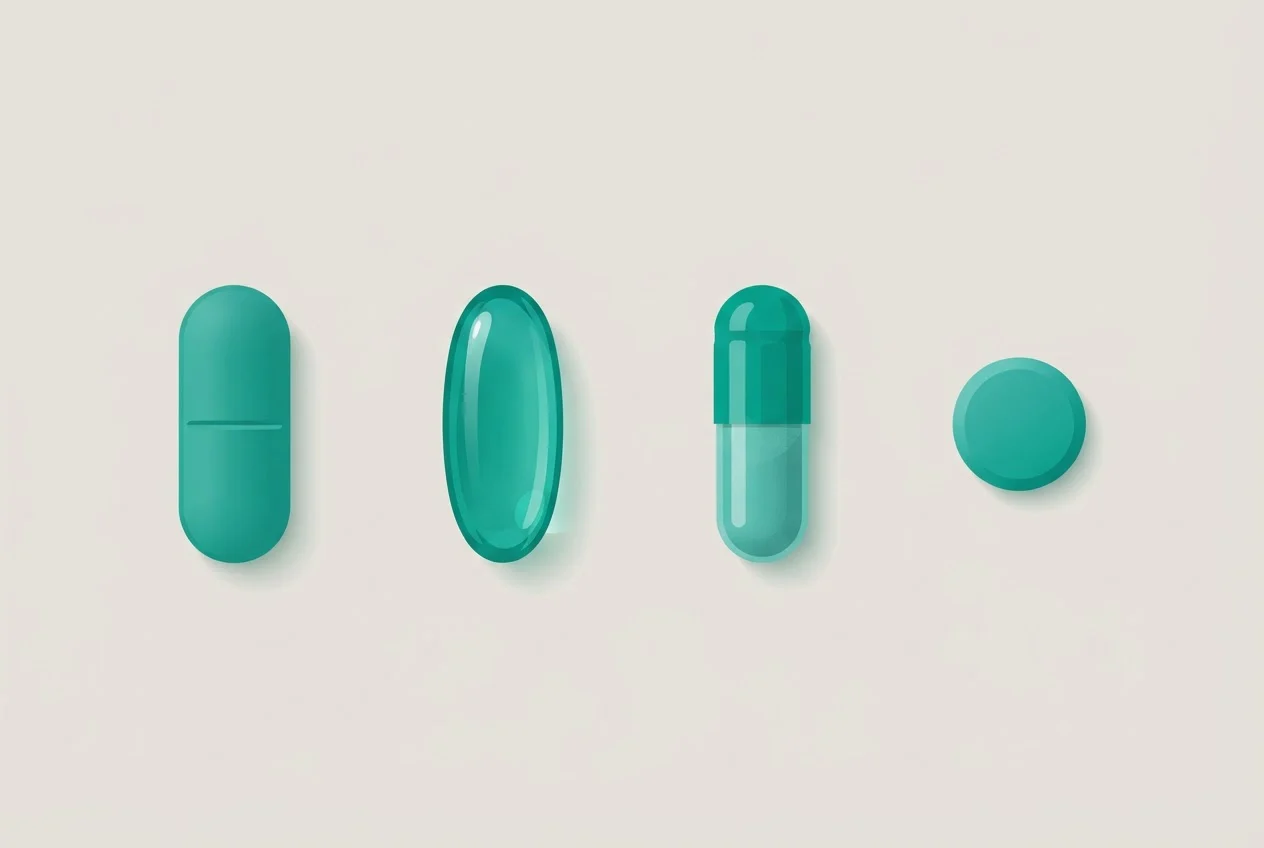
A caplet is still a compressed tablet, so tablet rules apply. A softgel or a veggie capsule is a capsule, so capsule rules apply. If you avoid animal products, the shell material is the practical difference between a veggie capsule and a gelatin one, and the label lists it.
For vitamin D, the NIH Office of Dietary Supplements says it is best absorbed when taken with a meal or snack that includes some fat. Our recommendation for any supplement is to choose the form you will actually take every day and compare the amount per serving, not the shape.
How do formulators choose between a tablet and a capsule?
A formulator chooses between a tablet and a capsule by what the active ingredient and the patient need: dose size, taste, release profile and who will swallow it. The active pharmaceutical ingredient (API) is the substance that produces the therapeutic effect. These factors are our view, drawn from formulation practice.
- Dose size. A high-dose ingredient is often easier to compress into a tablet than to fit into a capsule a patient can swallow.
- Taste and handling. A bitter, odorous or oily ingredient often suits a capsule, and a soft capsule suits a liquid or oil fill.
- Patients who cannot swallow a whole tablet. Dispersible tablets, which disintegrate in water before being taken, are designed for this, as we explain in our dispersible tablets guide.
- Release profile. Either form can carry extended or delayed release, so the target is set in development, not by the shell.
We are Aarise Pharmaceuticals, a pharmaceutical company in Haridwar, India. As a technology-driven contract development and manufacturing organization (CDMO) for oral dosage forms, we develop and manufacture finished products for generic-drug manufacturers, contract formulators and pharmaceutical distributors, including tablets and capsules. Our route runs from inquiry through feasibility review, commercial quotation, development or technical transfer (moving an existing product's process to a new site), production and quality control, packaging, and dispatch. We supply businesses, not individual patients, and we do not give personal medical advice. For your own medicine, ask your pharmacist.
If you are developing an oral product and want to settle the form early, request a feasibility review for a tablet or capsule product. We quote after the review.
Frequently asked questions
Sources
- 1.Tablet Splitting, FDA
- 2.Statistical Approaches to Establishing Bioequivalence: Guidance for Industry, FDA
- 3.FDA prescribing information for bupropion hydrochloride extended-release tablets (XL), via openFDA drug label data, openFDA, queried 9 October 2026
- 4.DailyMed (current labels)
- 5.National Drug Code directory: generic (ANDA) finished-drug listings by dosage form, openFDA, queried 9 October 2026
- 6.National Drug Code directory: bupropion listings by dosage form, openFDA, queried 9 October 2026
- 7.National Drug Code directory: omeprazole listings by dosage form, openFDA, queried 9 October 2026
- 8.Two techniques to make swallowing pills easier (Schiele JT, Schneider H, Quinzler R, Reich G, Haefeli WE), Annals of Family Medicine, 2014
- 9.Prevalence and appropriateness of solid oral dosage form manipulation in long-term care facilities (Malara A, Zucchelli A, Trevisan C, et al.), European Geriatric Medicine (Prescription Day LTCFs project)
- 10.Mixing oseltamivir capsules with thick sweetened liquid, CDC
- 11.Vitamin D: Health Professional Fact Sheet, NIH Office of Dietary Supplements
- 12.Dispersible Tablets Manufacturing Guide, Aarise Pharmaceuticals
- 13.Third-Party Pharma Manufacturing, Haridwar, Aarise Pharmaceuticals