Dry Syrup Formulation: How to Spec the In-Use Window
Dry syrup formulation is specified by the reconstituted window: days of use at a stated storage temperature. Write it into the request for quotation, matched to the reference label and stability data.

By Sunil Kumar, Managing Director - Sales · Updated 29 Oct 2026
Key takeaways
- Specify the reconstituted window (days at a stated storage temperature) before excipients, fill size or flavor. Across 15 common actives on current US labels, windows run from 10 to 35 days, 9 of the 15 print 14 days, and some other actives, such as mycophenolate mofetil at 60 days, are longer.
- Copying 14 days by habit would be wrong for 6 of those 15 actives. Amoxicillin/clavulanate and cefdinir print 10 days, and erythromycin ethylsuccinate prints 35.
- The spec sheet below turns the window into testable RFQ lines: water content, particle size, three-bottle uniformity, redispersion on the last day, preservative evidence and facility segregation.
Penicillin and cephalosporin dry syrups need a written facility-segregation statement from the manufacturer (21 CFR 211.42(d); FDA's non-penicillin beta-lactam guidance).
In this article
- 1What is dry syrup formulation, and which part decides everything else?
- 2How long does a reconstituted dry syrup last? What US labels print for 15 actives
- 3Why do buyers get the dry syrup window wrong?
- 4What goes into a dry syrup RFQ? A spec sheet with pass and fail tests
- 5Why does facility segregation matter for a dry syrup?
- 6How do we handle a dry syrup request at Aarise Pharmaceuticals?
- 7Frequently asked questions
Writing 14 days into a dry syrup specification out of habit is an easy mistake. Of the 15 actives reviewed below, 9 print 14 days after mixing and 6 print something else.
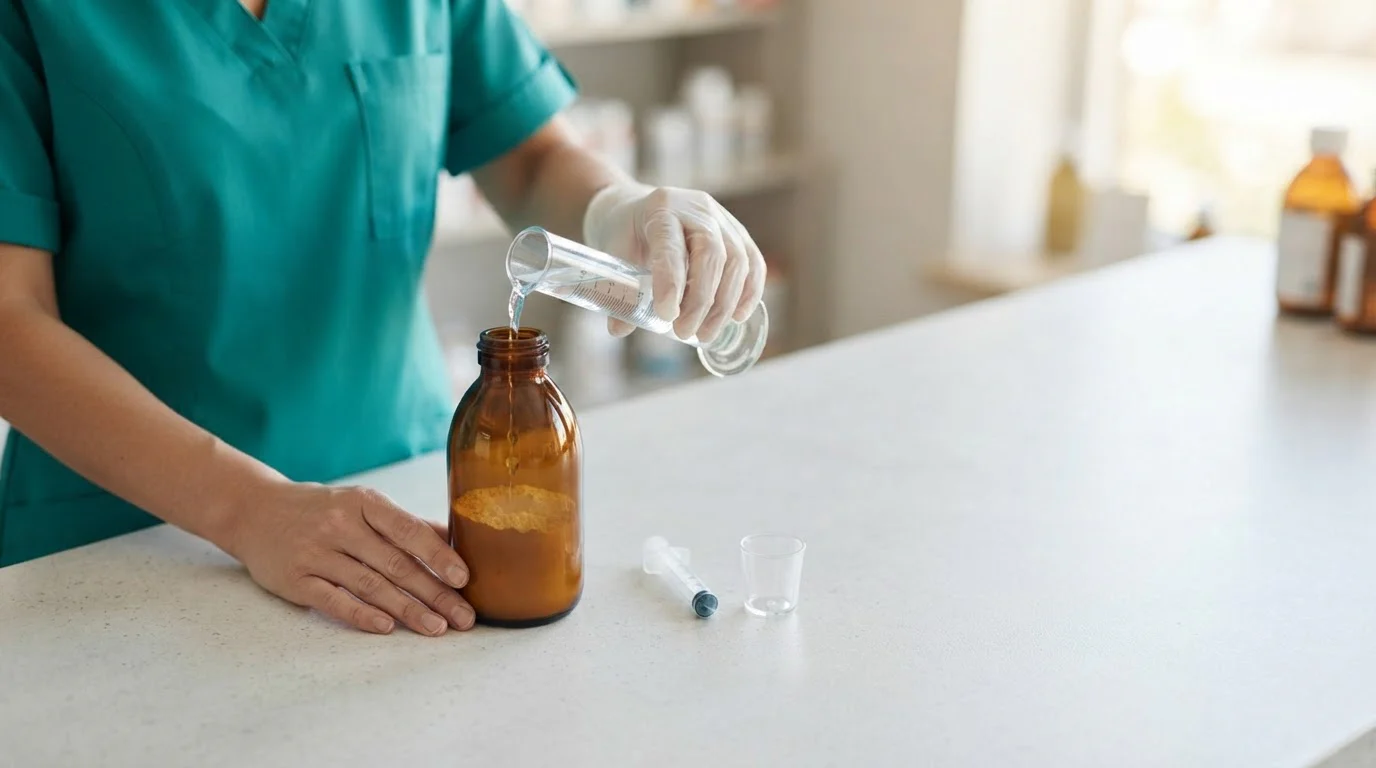
A dry syrup is a powder that becomes a liquid medicine only when water is added, and from that moment a clock starts. The formulation exists to keep the dose accurate for as long as that clock runs.
Excipient lists are the easy part: a sugar base, a suspending agent, flavor and a preservative. The decision that changes the rest of the work is the reconstituted window, the number of days after mixing that the label allows. It drives preservative, packaging and stability design, and it belongs at the top of a request for quotation (RFQ).
This page gives the window for 15 actives, read from US labels in October 2026, a spec sheet to copy into an RFQ, and the tests that separate a manufacturer who can hold a window from one who can only describe it.
What is dry syrup formulation, and which part decides everything else?
A dry syrup is powder or granules that a pharmacist or caregiver mixes with water to make an oral suspension. US labels name these products "for suspension" (see the DailyMed listing for azithromycin). The reconstituted window decides the rest, because every other choice has to hold up for that many days.
The formulation has five parts:
- Active pharmaceutical ingredient (API): the drug itself.
- Bulking base: such as powdered sucrose.
- Suspending agent: keeps undissolved drug evenly spread after mixing.
- Flavor and sweetener.
- Preservative.
One US patent for powders of beta-lactam antibiotics (the class that includes penicillins and cephalosporins) shows the scale. It claims 80 to 95 wt% (percent by weight) powdered sugar, a d50 (the median particle diameter; half the particles are smaller) of 50 to 150 µm, a d90 (90% of the particles are smaller) below 200 µm, and water of at most 3 wt%. Its description prefers a d50 of 40 to 150 µm, water below 0.7 wt% and 0.5 to 1.5 wt% colloidal silicon dioxide. The examples are cefixime and amoxicillin (US9566337B2). Treat these as one patent's ranges for one drug family, not a standard.
How long does a reconstituted dry syrup last? What US labels print for 15 actives
Across 15 common actives on current US labels, reconstituted windows run from 10 to 35 days, and some other actives, such as mycophenolate mofetil at 60 days, are longer. Nine of the 15 print 14 days. The window depends on the active and, for some, on refrigeration.
Selection: the 15 actives are the common antibacterial, antifungal, antiviral and acid-suppressant for-suspension products in DailyMed whose manufacturer label prints a discard window in its reconstitution text. We searched 11 further actives and left them out. Linezolid was left out because we read its window only on a repackager label. Other for-suspension products, such as mycophenolate mofetil, were not searched.
Method: for each active we recorded the discard time from the reconstitution text of the linked label, read in October 2026. Labels differ by manufacturer, so check your reference product.
| Active | Days after mixing | Condition printed with it | Label |
|---|---|---|---|
| Amoxicillin/clavulanate | 10 | refrigerated | |
| Cefdinir | 10 | room temperature | |
| Azithromycin | 10 | 5 to 25 °C | |
| Oseltamivir | 10 at room temperature, 17 refrigerated | by temperature | |
| Amoxicillin | 14 | refrigeration preferable, not required | |
| Cefixime | 14 | room temperature or refrigerated | |
| Cefpodoxime | 14 | refrigerated, 2 to 8 °C | |
| Cefprozil | 14 | refrigerated, 2 to 8 °C | |
| Cefadroxil | 14 | refrigerated | |
| Cephalexin | 14 | refrigerated | |
| Clarithromycin | 14 | 20 to 25 °C | |
| Fluconazole | 14 ("2 weeks") | 5 to 30 °C | |
| Voriconazole | 14 | room temperature, 15 to 30 °C | |
| Famotidine | 30 | 25 °C, excursions permitted to 15 to 30 °C | |
| Erythromycin ethylsuccinate | 35 | at or below 25 °C, refrigeration not required |
The count: 3 actives at 10 days, oseltamivir at 10 to 17, 9 at 14, famotidine at 30 and erythromycin ethylsuccinate at 35, which makes 15. Where the same labels print dry-powder storage (cephalexin, azithromycin and fluconazole), it is 20 to 25 °C.
Why do buyers get the dry syrup window wrong?
Buyers get the window wrong by assuming one number fits the whole dosage form. Because 9 of the 15 actives in the table print 14 days, 14 feels standard. For the other 6 it is wrong. In our recommendation, never write a window into an RFQ that is not tied to the specific active and its storage condition.
The reason is chemistry. The study shows why temperature matters for this pair: in a peer-reviewed study of commercial amoxicillin/clavulanic acid suspensions, clavulanic acid degraded by up to 12.9% at 8 °C and up to 72.3% at 28 °C over 7 days (Mack et al., Antibiotics 2021). It did not test the label's 10-day window, so the window itself must come from stability data on your own product. The study measured suspensions sold in Switzerland, so it shows the mechanism, not a limit for your product. Erythromycin ethylsuccinate sits at the other end: its label allows 35 days with no refrigeration.
Two further mistakes to avoid:
- Setting the window from the formulation alone. The window has to be demonstrated by stability data on the finished powder in its final bottle, stored as the label will say.
- Ignoring facility. Penicillin actives must be made in separate facilities under 21 CFR 211.42(d).
What goes into a dry syrup RFQ? A spec sheet with pass and fail tests
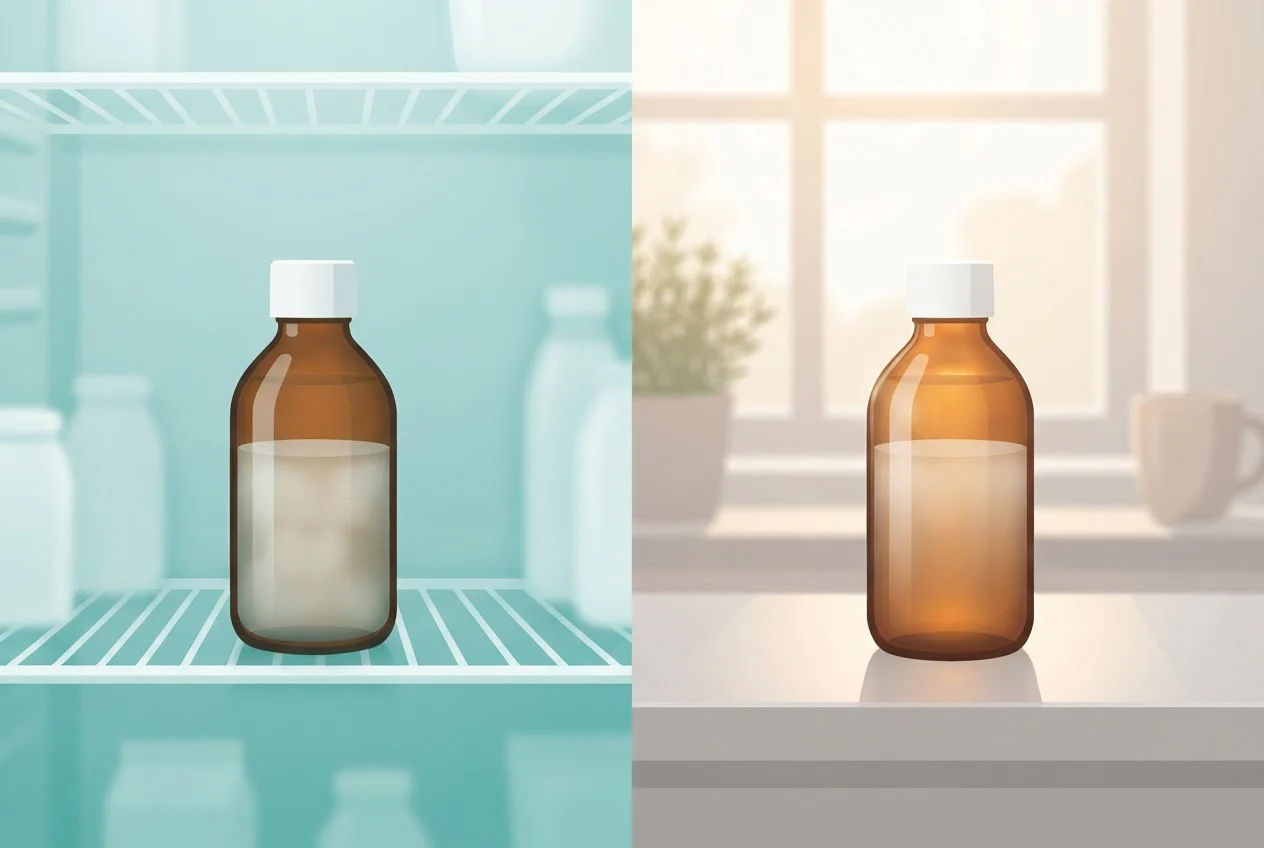
A dry syrup RFQ should state the reconstituted window first, then nine further tested attributes, each with a pass condition. Copy the table into your RFQ and replace the bracketed items. The numbers in brackets are for you to set from your active's stability data. Our recommendation is not to accept a supplier's defaults.
Terms used below: excipient is any non-drug ingredient. Redispersion is how easily settled powder returns to an even suspension on shaking.

| # | Attribute | Write in the RFQ | Pass | Fail |
|---|---|---|---|---|
| 1 | Reconstituted window | [] days at [ °C] after mixing, matched to the reference label | Stability report on the final bottle supports the full window at that storage | Window quoted with no data, or taken from another product |
| 2 | Dry-powder water content | Method and limit, measured by Karl Fischer titration (a method that measures water directly) | Every batch result at or below the limit | Limit missing, or results given without the method |
| 3 | Particle size | d50 and d90 limits [__ µm] | Batch results inside limits | Particle size reported only as "fine" |
| 4 | Dose uniformity | Three bottles from start, middle and end of the fill, tested separately | Each bottle within assay limits (the permitted range of drug content) | Results from a composited sample |
| 5 | Redispersion on the last day | Shake count or time [__] after storage to the end of the window | Uniform suspension, no hard cake, within the set shake count | Cake that does not break up |
| 6 | Preservative effectiveness | Test at the end of the window; see antimicrobial effectiveness testing | Passes at day [__] | Tested on fresh product only |
| 7 | Objectionable organisms | Raw materials and water tested | Absent | Not tested |
| 8 | Stability zone and closure | Long-term condition for your market (International Council for Harmonisation, ICH, stability zones); some bottles stored on their side or inverted to test the closure (the cap and liner) | Data at your zone, including the inverted arm | Room-temperature data only |
| 9 | Facility segregation | Written statement for penicillin and cephalosporin actives | Dedicated facility stated | Shared equipment |
| 10 | Label text | Water volume per bottle size, storage, discard date counted from mixing | Matches the reference label | Window in days without a starting point |
Checks 4, 7 and 8 and the particle-size limit follow FDA's inspection guide; the other checks are our recommendation. The guide says bottles from the beginning, middle and end of filling should not be composited. It also calls for continuous or periodic agitation during filling, particle-size specifications, and testing for objectionable organisms, with particular concern for infants and immunocompromised patients. It also says stability bottles should be stored on their side or inverted to test the closure (FDA, Oral Solutions and Suspensions, 1994, content reviewed 2014).
For the pass criteria, the independent references are USP <51> Antimicrobial Effectiveness Testing for check 6, the USP <61> and <62> microbial limits for check 7, and ICH Q1A(R2) for check 8 and the stability data behind check 1.
Why does facility segregation matter for a dry syrup?
Penicillin work must be done in separate facilities. The rule says penicillin operations "shall be performed in facilities separate from those used for other drug products for human use" (21 CFR 211.42(d)). FDA's 2013 guidance, which the June 2022 draft revises, recommends complete separation of cephalosporins and other non-penicillin beta-lactams from other drugs. It is guidance, not a regulation, unlike the penicillin rule in 21 CFR 211.42(d). Of the 15 actives in the table, amoxicillin, amoxicillin/clavulanate, cefdinir, cefixime, cefpodoxime, cefprozil, cefadroxil and cephalexin are beta-lactams: 8 of 15.
How do we handle a dry syrup request at Aarise Pharmaceuticals?
We list dry syrup among our finished-dose categories and run oral-dose development through commercial manufacturing as a contract development and manufacturing organization (CDMO). A request follows our buying route: inquiry, feasibility review, commercial quotation, development or technical transfer, production and quality control, packaging, and dispatch.
For a feasibility review, send us the filled spec sheet above with:
- the active and strength per 5 mL;
- the target window and storage condition;
- the destination market.
We quote product by product, so pricing comes with the quotation. Buyers confirm local registration and import requirements for their market before commercial supply.
To discuss your product, use our contact form. For how a contract manufacturing quote is assembled, see Third Party Manufacturing Pharma.
Frequently asked questions
Sources
- 1.US9566337B2, Powder mixtures for antibiotic dry syrup formulations, Google Patents
- 2.Mack et al., Insufficient Stability of Clavulanic Acid in Widely Used Child-Appropriate Formulations, Antibiotics 2021;10(2):225 (doi 10.3390/antibiotics10020225)
- 3.FDA, Oral Solutions and Suspensions inspection guide (8/94)
- 4.21 CFR 211.42, Design and construction features (eCFR)
- 5.FDA guidance, Non-Penicillin Beta-Lactam Drugs: A CGMP Framework for Preventing Cross-Contamination (Federal Register, April 17, 2013)
- 6.FDA draft guidance revising the 2013 guidance (Federal Register, June 24, 2022)
- 7.USP <51> Antimicrobial Effectiveness Testing
- 8.USP, Microbial Examination of Nonsterile Products: Microbial Enumeration Tests (<61>, with <62>)
- 9.ICH Q1A(R2), Stability Testing of New Drug Substances and Products (FDA, November 2003)
- 10.DailyMed label, mycophenolate mofetil for oral suspension
- 11.DailyMed labels used in the table, read October 2026 (linked in the table): amoxicillin/clavulanate (Chartwell), cefdinir (Teva), azithromycin (Teva), oseltamivir (Teva), amoxicillin (Sandoz), cefixime (Lupin), cefpodoxime (Rising), cefprozil (Northstar), cefadroxil (Lupin), cephalexin (Teva), clarithromycin (Ranbaxy), fluconazole (Zhejiang Poly), voriconazole (Mylan), famotidine (Northstar), erythromycin ethylsuccinate (ANI)