Oral Solid Dosage Manufacturing: Records to Ask For at Each Step
Oral solid dosage manufacturing turns an active ingredient and excipients into tablets and capsules, and quality shows up in batch records. Buyers should ask first for dissolution, impurity and line-clearance records.

By Sunil Kumar, Managing Director - Sales · Updated 27 Oct 2026

Key takeaways
- Oral solid dosage manufacturing makes tablets and capsules in a chain of steps, and a buyer verifies it through records. The records tied to dissolution, impurities and foreign matter matter most.
- In openFDA, the US Food and Drug Administration's (FDA) public data service, tablet and capsule terms are 74.1% of the 50,955 generic-drug (ANDA) listings as of 27 October 2026, and at least 31% carry a coating or modified-release term that adds steps to check.
- Of 481 tablet and capsule recall events from 1 January 2023 to 27 October 2026, 63.6% were impurity, dissolution or foreign-matter and mix-up events by our count. Potency failures were 6.9%.
- Ask every manufacturer for the nine records in the sheet below. To start a tablet or capsule project with us, send the product details listed in the last section.
In this article
- 1What is oral solid dosage manufacturing, and what does it make?
- 2Which steps turn powder into a tablet or capsule?
- 3Which failures reach recalls, and which step causes them?
- 4What records should a buyer ask a manufacturer for at each step?
- 5What do FDA regulations and guidance expect behind these records?
- 6How do you start a tablet or capsule project with us?
- 7Frequently asked questions
Every oral solid dosage plant draws the same flow chart: weigh, blend, compress or fill, coat, pack. The chart cannot tell a buyer which plant will ship a tablet that dissolves on specification, because that evidence sits in records the chart never shows.
This page is for people who commission or buy tablets and capsules. It ties each production step to the record that proves the step was done well. The recall data suggests which records deserve the closest look, based on what recalled US tablets and capsules actually failed on since 2023.
The sheet below gives a pass and a fail condition for each record, so a buyer can decide, record by record, whether a manufacturer's answer is good enough or needs follow-up before an order is placed. A fail is a reason to ask for a corrected record or to look elsewhere. We publish this page, and we are a technology-driven CDMO (contract development and manufacturing organization) for oral dosage forms.
What is oral solid dosage manufacturing, and what does it make?
Oral solid dosage (OSD) manufacturing is the production of swallowed solid medicines, mainly tablets and capsules, from an active pharmaceutical ingredient (API, the component that produces the therapeutic effect) and excipients (the non-active materials that give the dose its bulk, flow, binding, disintegration and coating). Tablets and capsules account for 74.1% of the generic-drug (ANDA) listings in the openFDA National Drug Code directory as of 27 October 2026.
We counted listings in the openFDA National Drug Code (NDC) directory with marketing category ANDA (abbreviated new drug application, the US route for generic drugs), grouped by dosage-form term, on 27 October 2026. There were 50,955 listings.
| Dosage-form terms | Listings | Share of 50,955 |
|---|---|---|
| Any tablet term | 29,850 | 58.6% |
| Any capsule term | 7,910 | 15.5% |
| Tablet or capsule combined | 37,760 | 74.1% |
| Plain tablet or plain capsule (exact terms "TABLET" and "CAPSULE") | 20,634 | 40.5% |
| Coated tablet (exact terms "TABLET, FILM COATED" and "TABLET, COATED") | 10,260 | 20.1% |
| Extended- or delayed-release tablet or capsule (any term containing those words) | 5,578 | 10.9% |
These count listings, not unique drugs. The coated and release rows do not overlap, so at least 31% of listings (15,838 of 50,955) carry a coating or release-modifying term, counting only the exact terms in the table. Other coating terms in the same data, such as sugar-coated tablets and coated pellets, are not counted. Those products need extra steps and extra checks beyond a plain tablet or capsule.
Which steps turn powder into a tablet or capsule?
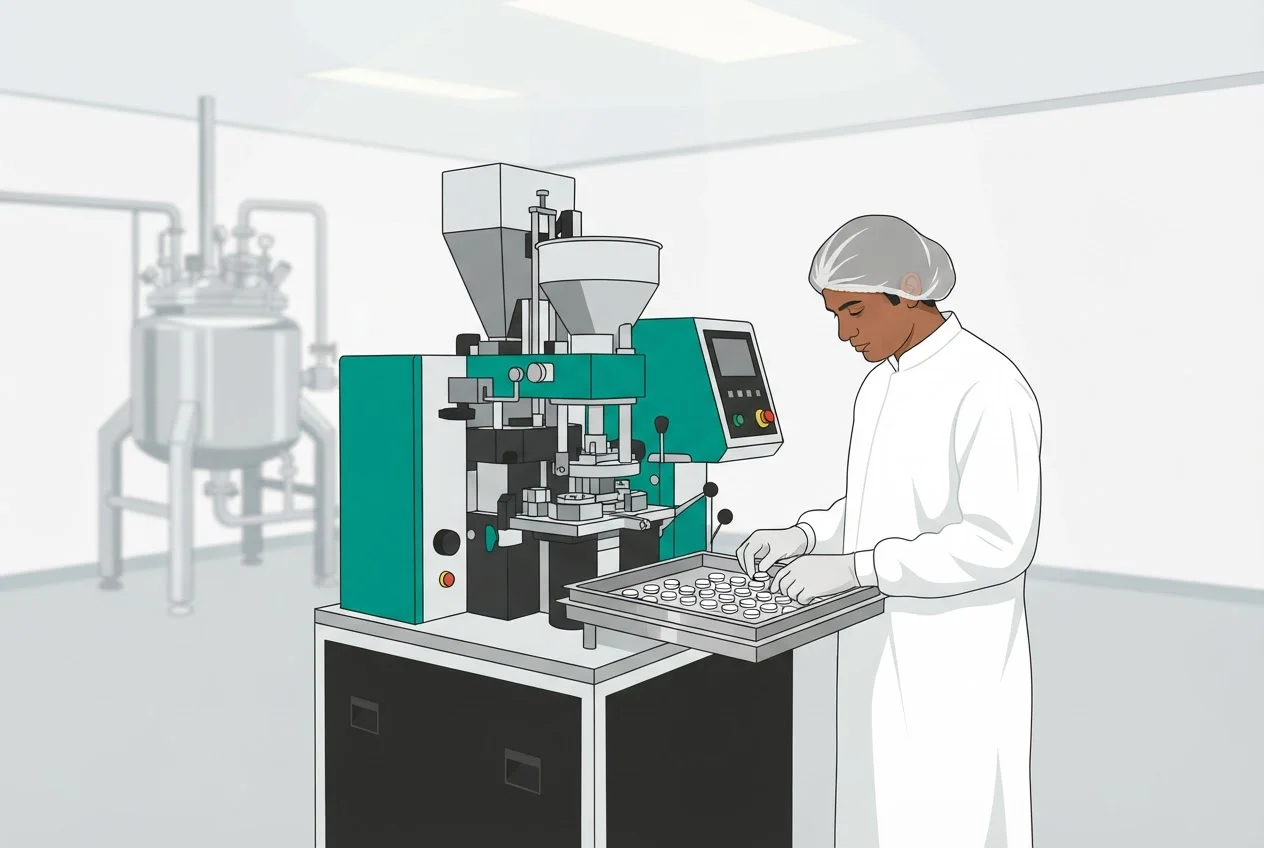
Seven steps turn raw materials into a finished tablet or capsule: dispensing, blending, granulating (when needed), compressing or filling, coating (when needed), testing, and packaging. Each step hands a defined output to the next, and each leaves a record.
- Dispensing and weighingEach material is weighed against the batch manufacturing record, the written instruction and log for one batch.
- BlendingThe API is spread through the excipients so every tablet or capsule carries the same dose.
- Granulating, drying and milling, when usedWet granulation binds powder with liquid and then dries it. Dry granulation compacts it. Both improve flow and compressibility. A blend that already flows and compresses well can go straight to direct compression.
- Compressing or encapsulating
Powder becomes tablets, or fills capsule shells. Whether a capsule or tablet suits the product is a separate decision, covered in tablet vs capsule.
- Coating, when usedA coat can protect, mask taste, or control where and when the drug is released.
- TestingIn-process checks run through the batch, and release tests run on the finished product.
- PackagingUnits are counted, inspected, labeled and sealed.
Which failures reach recalls, and which step causes them?
Impurities, dissolution failures and foreign matter or mix-ups cause most tablet and capsule recalls, not potency.
How we counted: we pulled openFDA drug enforcement records reported between 1 January 2023 and 27 October 2026 whose product description contained "tablet", "tablets", "capsule" or "capsules". That took four queries: tablet, tablets, capsule and capsules, each paged until exhausted. After removing duplicate records, that gave 968 product records in 481 distinct recall events (de-duplicated by event ID).
The labeling is our own classification, not FDA's. We labeled each event from the reason-for-recall text of the first product record collected for that event. We matched these keywords, not case-sensitive, in this order, and the first match won:
- Dissolution: "dissolution".
- Impurity, nitrosamine or degradant: "nitrosamine", "NDMA", "NDEA", "impurit", "degradat".
- Potency or content uniformity: "content uniformity", "subpotent", "sub-potent", "superpotent", "super-potent", "potency", "assay".
- Microbial: "microb", "bacteri", "yeast", "mold", "burkholderia".
- Stability or out-of-specification: "stability", "out of spec", "OOS", "failed".
- Labeling or packaging: "label", "packag", "carton", "blister", "bottle", "child-resistant".
- CGMP: "cgmp", "gmp". CGMP means current good manufacturing practice, FDA's manufacturing quality rules.
Events matching none of these are "Other reasons", the residual group. Percentages are shares of 481.
| Category (checked in this order) | Events | Share | Steps most likely involved (our inference) |
|---|---|---|---|
| Dissolution failure | 89 | 18.5% | Blending, compression, coating, test method |
| Impurity, nitrosamine or degradant | 132 | 27.4% | Material sourcing, process conditions, storage |
| Potency or content uniformity (whether each unit holds the intended amount of drug) | 33 | 6.9% | Blending, compression |
| Foreign matter, mix-up, wrong tablet or cross-contamination | 85 | 17.7% | Dispensing, line clearance, equipment, packaging |
| Microbial | 3 | 0.6% | Equipment, water, environment |
| Stability or out-of-specification, cause unspecified | 27 | 5.6% | Varies |
| Labeling or packaging | 32 | 6.7% | Packaging |
| "CGMP deviations" with no specific cause stated | 39 | 8.1% | Quality system |
| Other reasons (residual) | 41 | 8.5% | Varies |
Read the shares as a rough ranking, not as failure rates: they count recall events, not batches made, openFDA labels its data unvalidated, and keyword matching can misfile an event, for example a "blister packs not properly sealed" reason lands under packaging even though it could be read another way.
Nitrosamines are a class of impurity for which FDA sets acceptable intake limits, and FDA's Control of Nitrosamine Impurities in Human Drugs guidance was revised in September 2024. As of October 2026, the revised guidance expects manufacturers to have completed risk assessments and confirmatory testing; the 1 August 2025 date for confirmatory testing for nitrosamine drug substance-related impurities (NDSRIs) has passed. Our page on nitrosamine impurities turns intake limits into specifications.
What records should a buyer ask a manufacturer for at each step?
A buyer should ask for nine records, one for each stage of production, and judge each against a stated pass condition. The recall data suggests dissolution, impurity and line-clearance records deserve the closest look (our inference). The sheet below is our recommendation. It applies to any OSD manufacturer; we confirm which of these records are available for your product during the feasibility review.
The nine checkpoints cover the seven production steps above, with testing shown as dissolution and release testing, plus impurity control and batch release.

| Checkpoint | Ask for | Pass | Fail |
|---|---|---|---|
| 1. Dispensing and weighing | Dispensing record signed by the operator and a second person, plus the identity-test result for each material lot | Every lot in the batch record has a released identity result dated before use | Any material used before its result is recorded |
| 2. Blending | Blend uniformity results, blend time and sampling locations | Acceptance limits and a written sampling plan, both dated before the run, with every result from the planned locations inside the limits | One pooled sample, limits that appear only after results, or locations that differ from the plan |
| 3. Granulating, drying, milling (if used) | Endpoint moisture or loss on drying result, mill and sieve settings | Endpoint recorded as a number against a written range | Endpoint judged by eye with no number |
| 4. Compression or capsule filling | Weight variation, hardness (tablets) and disintegration time readings across the run | Readings at the start, middle and end, all inside written limits | Readings only at the start, or limits changed mid-batch |
| 5. Coating (if used) | Coating weight gain and spray records | Weight gain recorded for the batch and inside a written range | No weight-gain figure |
| 6. Dissolution and release testing | Test method, stage-by-stage results, and the specification | Method and limits match your specification, with results per unit | A result that only says "complies" |
| 7. Impurity and nitrosamine control | Written nitrosamine risk assessment and the supplier controls it relies on | Dated assessment that names the API and excipient suppliers and states the test or the justification | No assessment, or one that names no materials |
| 8. Line clearance, inspection, packaging | Line-clearance record (confirmation that the line is free of the previous product and labels) and unit reconciliation (units produced against materials issued) | Clearance signed before each batch and counts reconciled | Missing signature or unreconciled counts |
| 9. Batch release | Quality-unit review of the complete record, and written investigations of every deviation | Signed review, and every deviation has a closed written investigation | Deviations still open at release |
For checkpoint 6, dissolution testing is the test that measures how fast the active ingredient leaves the dosage form. It was the second most common recall category above.
What do FDA regulations and guidance expect behind these records?
FDA regulations require the in-process controls and quality review (21 CFR 211.110 and 211.192). FDA's process validation guidance, which is non-binding, sets out the expected approach to validation. The regulations sit in 21 CFR, Title 21 of the Code of Federal Regulations (the US drug regulations), and apply to drug products for the US market.
- 21 CFR 211.100 requires written procedures for production and process control.
- 21 CFR 211.110 requires written in-process control procedures. Its examples include "tablet or capsule weight variation", "disintegration time", "adequacy of mixing to assure uniformity and homogeneity" and "dissolution time and rate". In-process specifications must be consistent with the finished product's specifications.
- 21 CFR 211.192 requires that production and control records, including packaging and labeling, be reviewed and approved by the quality control unit. Unexplained discrepancies and specification failures must be investigated, with the conclusions written down.
- FDA's Process Validation guidance (January 2011), which is non-binding, defines process validation as collecting and evaluating data that establish scientific evidence a process "is capable of consistently delivering quality product". It describes three stages: process design, process qualification and continued process verification. It expects process performance qualification (PPQ, commercial-scale batches that confirm the process performs as expected) to be completed before commercial distribution.
FDA's inspection guide for oral solid dosage forms, dated January 1994 and so older than the 2011 process validation guidance, lists eight areas an investigator evaluates: biobatch relationship (the link to the batch used in the studies that support approval), raw materials, manufacturing procedures and equipment, granulation and mix analysis, in-process controls, validated test methods, investigations of failures, and site review. Our sheet touches five of them: raw materials, granulation and mix analysis, in-process controls, validated test methods and investigations of failures. The mapping is our own.
How do you start a tablet or capsule project with us?
We are a technology-driven CDMO focused on oral dosage forms, from product development through commercial manufacturing. As of October 2026, our regulatory standing is with Uttarakhand drug control. Tablets and capsules are among the finished-dose categories on our products page. We serve generic-drug manufacturers, contract formulators and pharmaceutical distributors.
Our buying route runs in this order: inquiry, feasibility review, commercial quotation, development or technical transfer, production and quality control, packaging, and dispatch. Before choosing any contract manufacturer, our quote and vetting pack for third-party manufacturing covers the commercial side.
In your inquiry, we recommend you include the product, strength, dosage form, batch size, target market, specifications, packaging format and the documents you need. Those details let a manufacturer judge feasibility properly.
To begin, use our contact form, call or WhatsApp +91 9899783330, or email sunil@aarisepharma.com. We send a commercial quotation after the feasibility review.
Frequently asked questions
Sources
- 1.openFDA National Drug Code directory, ANDA listings by dosage form, 27 October 2026
- 2.openFDA drug enforcement (recall) reports: tablet, 27 October 2026
- 3.openFDA drug enforcement (recall) reports: tablets, 27 October 2026
- 4.openFDA drug enforcement (recall) reports: capsule, 27 October 2026
- 5.openFDA drug enforcement (recall) reports: capsules, 27 October 2026
- 6.21 CFR 211.100, Written procedures; deviations
- 7.21 CFR 211.110, Sampling and testing of in-process materials and drug products
- 8.21 CFR 211.192, Production record review
- 9.FDA, Process Validation: General Principles and Practices, January 2011
- 10.FDA, Control of Nitrosamine Impurities in Human Drugs, guidance for industry (revised September 2024), Federal Register notice of availability
- 11.FDA, Inspection Guide: Oral Solid Dosage Forms Pre/Post Approval Issues for Development and Validation, January 1994