Nitrosamine Impurities: Turn Intake Limits Into ppm Specs
Nitrosamine impurities are controlled by converting each acceptable daily intake in nanograms into a parts-per-million limit using the maximum daily dose, then asking suppliers for evidence that meets that limit.

By Sunil Kumar, Managing Director - Sales · Updated 12 Oct 2026

Key takeaways
- Nitrosamine impurities are limited by an acceptable intake (AI) in nanograms per day for each compound; divide it by the product's maximum daily dose in milligrams to get the ppm limit for a specification.
- The same intake gives very different limits by dose: 26.5 ng/day is 2.65 ppm at a 10 mg daily dose but about 0.013 ppm at 2,000 mg (our calculation, below).
- Where more than one nitrosamine is present, set the specification on the total as well as on each compound, because every compound can pass its own limit while the total fails.
- A clean API certificate covers only the API's share of the risk; ask suppliers for a dated risk assessment, a method with its quantitation limit in ppm, and batch results by compound.
In this article
- 1What are the acceptable intake limits for nitrosamine impurities?
- 2How do you convert a nitrosamine acceptable intake into a ppm limit?
- 3Why does a clean API certificate not guarantee a clean finished tablet?
- 4Who owns the nitrosamine risk, the API supplier or the finished-dose maker?
- 5What should an RFQ ask an API supplier about nitrosamines?
- 6How do we handle nitrosamine questions in an RFQ at Aarise?
- 7Frequently asked questions
A nitrosamine limit on paper is a daily intake, and a buyer needs a concentration. FDA's acceptable intake page, updated September 2026, lists 26.5 nanograms per day for N-nitrosodiethylamine (NDEA); a nanogram is a billionth of a gram.
That figure is not a specification. The limit a laboratory must meet depends on how much of the drug a patient takes in a day, so the same intake becomes a loose limit for a low-dose tablet and a very tight one for a high-dose product. Dose also decides which test methods are sensitive enough.
Asking an active pharmaceutical ingredient (API) supplier whether a material is nitrosamine-free produces an answer nobody can test. A better request states the limit, the sensitivity the method must reach, and the process questions that show where a nitrosamine could come from.
Put them in the request for quotation (RFQ), the document a buyer sends to ask a supplier for price and terms; an addendum to paste in follows below.
What are the acceptable intake limits for nitrosamine impurities?
An acceptable intake (AI) limit is the daily exposure to a nitrosamine that approximates one additional cancer case in 100,000 people over a lifetime, set per compound. FDA's guidance cites this definition from the International Council for Harmonisation (ICH) M7(R2). The FDA values include 96 nanograms per day (ng/day) for N-nitrosodimethylamine (NDMA) and 26.5 ng/day for NDEA.
Which rule applies depends on the impurity:
- FDA publishes a value for the compound. Use it. The FDA acceptable intake page is the list, and FDA changes it as its understanding evolves.
- No published value, and the impurity is a nitrosamine drug substance-related impurity (NDSRI). An NDSRI shares the API's structure and is generally unique to that API. Assign a potency category under the Carcinogenic Potency Categorization Approach (CPCA) and use that category's AI, then confirm it with FDA. Section IV.A of the guidance sets this out.
- The AI cannot be determined by the approaches in Section IV.A. Only then does FDA recommend 26.5 ng/day as the default.
| CPCA category | AI limit |
|---|---|
| 1 | 26.5 ng/day |
| 2 | 100 ng/day |
| 3 | 400 ng/day |
| 4 | 1,500 ng/day |
| 5 | 1,500 ng/day |
Small-molecule nitrosamines, which do not resemble the API, are the other class in FDA's guidance, revised in September 2024. The values above are FDA's. The European Medicines Agency (EMA) keeps its own list, so use the agency of the market where your product is approved.
How do you convert a nitrosamine acceptable intake into a ppm limit?
Divide the AI in nanograms by the maximum daily dose (MDD) in milligrams as shown on the product label. The result is in ppm (parts per million, here nanograms per milligram). EMA's worked example for a 300 mg/day product gives 0.088 ppm for NDEA (26.5 ÷ 300) and 0.32 ppm for NDMA (96 ÷ 300).
The divisor is the dose of the active substance, not the weight of the whole tablet. EMA's answer (Q&A 10) says the ppm limit is usually expressed per active moiety in the finished product and, for a control point in the API only, per drug substance. FDA's guidance uses the same formula, ppm = AI (ng/day) ÷ MDD (mg), with the MDD typically taken from the labeling.
| AI (ng/day) | 10 mg/day | 40 mg/day | 500 mg/day | 1,000 mg/day | 2,000 mg/day |
|---|---|---|---|---|---|
| 26.5 | 2.65 ppm | 0.66 ppm | 0.053 ppm | 0.0265 ppm | 0.0133 ppm |
| 96 | 9.6 ppm | 2.4 ppm | 0.19 ppm | 0.096 ppm | 0.048 ppm |
| 100 | 10 ppm | 2.5 ppm | 0.2 ppm | 0.1 ppm | 0.05 ppm |
| 400 | 40 ppm | 10 ppm | 0.8 ppm | 0.4 ppm | 0.2 ppm |
| 1,500 | 150 ppm | 37.5 ppm | 3 ppm | 1.5 ppm | 0.75 ppm |
Read the corners. At 2,000 mg/day, a 26.5 ng/day impurity needs a method that reliably measures about 13 parts per billion. At 10 mg/day the limit is 2.65 ppm, about 200 times looser. A flat "below 1 ppm" result tells a buyer little until it is set against the product's dose and the compound named.
The per-compound AI values apply only if a product contains a single nitrosamine. FDA recommends that when more than one is identified, the total should not exceed the AI of the most potent one, or the total can be set with the flexible approach in Appendix C: express each nitrosamine as a percentage of its own AI limit and keep the sum at or below 100%. In FDA's own example for an 80 mg/day product, three nitrosamines at 0.15, 0.20 and 3.00 ppm each sit below their individual limits (0.33, 0.46 and 18.75 ppm) yet total 104.93% of their AI limits, a fail. Set the specification on the total as well as on each compound.
The API does not get the whole budget. FDA's guidance says the overall cancer risk estimate should consider all sources, from drug substance and drug product, including container closure. Our recommendation is to set the API limit below the grid value and leave headroom for excipients and process water.
Why does a clean API certificate not guarantee a clean finished tablet?
Nitrosamines can form after the API leaves its manufacturer, through reactions with excipients, solvents and the atmosphere, so an API result covers only the API. In a 2020 study of 105 metformin tablet samples from 13 manufacturers, NDMA was not detected in the API tested but was found in 64 of 75 finished-product samples (85.3%).
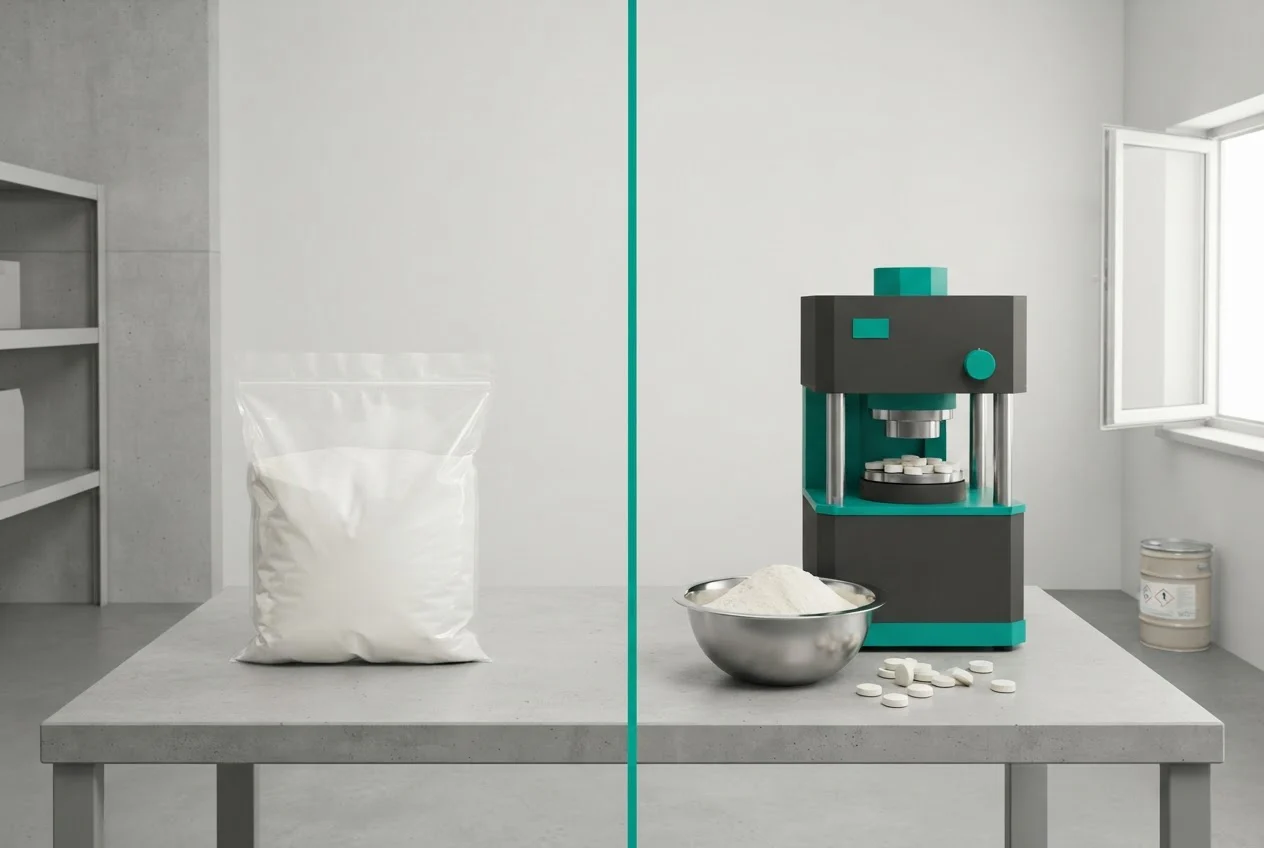
That study shows the route exists, not how common it is across products. Proposed causes for metformin include dimethylamine in the API reacting with nitrite from excipients during wet granulation, and atmospheric nitrogen dioxide reacting with dimethylamine. FDA's guidance also names recovered solvents, reagents and catalysts, and quenching steps that use nitrous acid, as sources, and notes that nitrite is found in commonly used excipients.
For NDSRIs in approved products, FDA had set August 1, 2025 for confirmatory testing and for submitting required changes. As of 10 October 2026, FDA's page (updated 24 September 2026) says applicants who could not meet that date should provide a progress update by August 1, 2025, and that FDA intends to share further details on targeted timelines. No revised dates are listed.
Who owns the nitrosamine risk, the API supplier or the finished-dose maker?
Both own part of it, split by who controls the source. FDA's guidance says API manufacturers should control nitrosamine impurities so that the drug products made from their APIs can meet the AI limits. The finished-dose maker controls what happens after the API arrives. This split is our reading of those root causes.
| Risk source | Who controls it | What to ask or do |
|---|---|---|
| Nitrite or other nitrosating agents in the API route | API supplier | Written process review; reagents and solvents listed |
| Recovered or recycled solvents | API supplier | Reuse and testing of recovered batches described |
| Shared equipment with amine or nitrite processes | API supplier | Cleaning procedure and last prior use |
| Nitrite in excipients | Finished-dose maker | Excipient data; compare with the API's amine content |
| Process water | Finished-dose maker | Check nitrite and amine content |
| NDSRI formation in the finished dose | Finished-dose maker | Confirmatory testing of the finished product |
What should an RFQ ask an API supplier about nitrosamines?
An RFQ should ask for seven things: a dated risk assessment, a list of nitrosating agents and amines, recovered-solvent controls, shared-equipment controls, a validated method with its quantitation limit in ppm, batch results by compound and in total, and a change-notification commitment. Paste the addendum below next to your product name or Chemical Abstracts Service (CAS) number, quantity and destination.
Nitrosamine addendum

- Dated risk assessmentPass: a document with date and version covering route, raw materials, solvents, water and equipment, stating what triggers a review. Fail: a one-line statement.
- Nitrosating agents and aminesPass: a list of every step using nitrite or other nitrosating agents, and of amines or amide solvents used or generated, or an explicit "none" backed by the reviewed route. Fail: "nitrosamine-free" with no route review.
- Recovered solvents and reagentsPass: names the solvent, states whether recovered solvent is reused, and gives the test or limit applied to recovered batches for nitrite and amine contaminants. Fail: reuse not stated.
- Shared equipmentPass: a written cleaning procedure that names the shared equipment and the amine or nitrite process it was last used for. Fail: no procedure.
- Method and sensitivityPass: a validated method naming the nitrosamines tested, with a quantitation limit (LOQ) in ppm at or below one-third of your limit from the grid. The one-third is our recommendation, so that "not detected" means something; FDA's guidance requires the LOQ to be commensurate with the level at which the impurity must be controlled. Fail: no stated LOQ.
- Batch resultsPass: lot numbers with results in ppm for each named nitrosamine and the sum of all detected nitrosamines, in ppm. Fail: "complies" without numbers.
- Change notificationPass: a written commitment to tell you before any change of route, solvent or manufacturing source. Fail: no commitment.
A supplier also needs a quality system to stand on; the ICH Q7 guideline on good manufacturing practice for active pharmaceutical ingredients is the benchmark to check against. Our steroid API RFQ checklist lists what else an RFQ should carry, and how to read a steroid API COA explains the result lines. The same logic applies to other API classes.
How do we handle nitrosamine questions in an RFQ at Aarise?
Send the addendum with your RFQ. We confirm, product by product, which items the approved manufacturing source can answer and which documents we can supply for your API and destination market. Available documents may include the certificate of analysis (COA), specifications and safety data sheet (SDS, formerly MSDS) where applicable.
We supply steroid, hormone, peptide and general pharmaceutical APIs to business buyers, including generic manufacturers, contract formulators, importers and distributors. We prepare a quotation once you give us the API name and CAS number. Our RFQ also asks for quantity, destination, grade or purity and the documents you need, so the addendum belongs on the documents line.
We support sample and evaluation quantities for qualified buyers, with quantity, price and documentation confirmed per product. Pricing depends on the API and current market conditions, so ask us for a quotation. Our guide to API quality testing explains the methods behind a COA, and API suppliers for US importers maps what importers should qualify.
To start, send your RFQ and addendum through our contact page, or write to sunil@aarisepharma.com or WhatsApp +91 9899783330.
Frequently asked questions
Regulators do not prescribe one template for the risk assessment itself; FDA's guidance points to ICH Q9(R1), the quality risk management guideline. Map the route, reagents, solvents, equipment and water, then record the conclusion with a date and version. For excipients, the International Pharmaceutical Excipients Council (IPEC) publishes a nitrosamine questionnaire, and the ICH Q9(R1) text is public.
No. FDA's advice is that patients taking prescription medicines with potential nitrosamine impurities should not stop taking them without consulting a healthcare provider, as stated on FDA's nitrosamine information page.
Sources
- 1.FDA, CDER Nitrosamine Impurity Acceptable Intake Limits (updated 24 September 2026)
- 2.FDA, Control of Nitrosamine Impurities in Human Drugs, Guidance for Industry, Revision 2 (September 2024)
- 3.FDA, Information about Nitrosamine Impurities in Medications
- 4.EMA, Questions and answers for marketing authorisation holders/applicants on the CHMP Opinion for the Article 5(3) referral on nitrosamine impurities (EMA/409815/2020 Rev.23)
- 5.N-Nitrosodimethylamine Contamination in the Metformin Finished Products, Molecules, 2020
- 6.N-Nitrosodimethylamine Formation in Metformin Drug Products by the Reaction of Dimethylamine and Atmospheric NO2, Organic Process Research & Development
- 7.ICH Q9(R1) Quality Risk Management, Step 4
- 8.ICH Q7 Good Manufacturing Practice Guide for Active Pharmaceutical Ingredients
- 9.IPEC Federation, Questionnaire for Excipient Nitrosamines Risk Evaluation