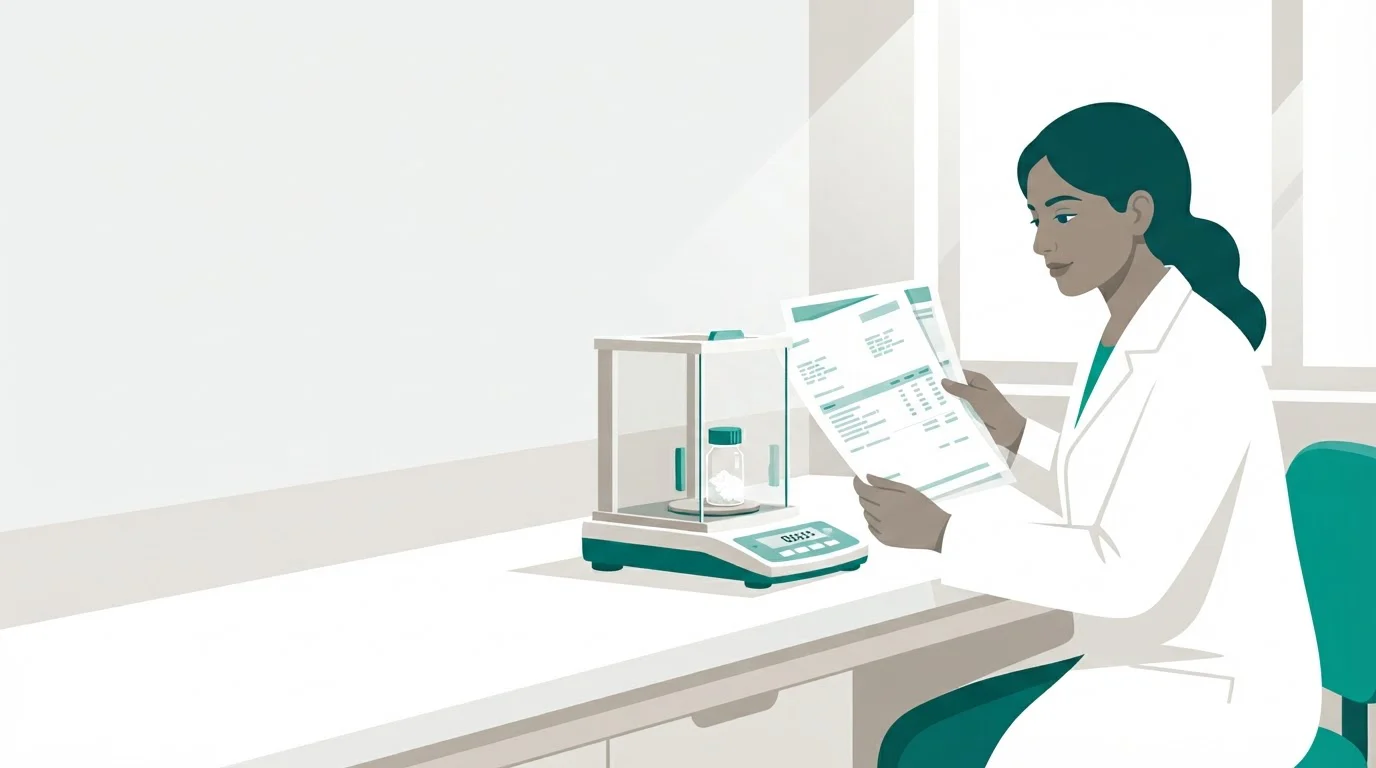
Pharmaceutical Technology Transfer: Handover Pack and FDA Filings
Pharmaceutical technology transfer is the documented handover of a product's process and test methods to a new site, finished when that site reproducibly meets agreed specifications set before it starts.

By Sunil Kumar, Managing Director - Sales · Updated 4 Oct 2026

Key takeaways
- A technology transfer is complete when the receiving site shows, against acceptance criteria written before it starts, that it can routinely reproduce the product and its tests.
- A site FDA has never inspected for that operation, or a move of manufacturing or processing for a modified-release product, needs a prior approval supplement. Most other moves need a supplement or an annual report.
- A single batch rarely gives enough evidence of between-batch consistency, so justify the number of batches in the protocol. Our recommendation is to start at three.
- The handover checklist below turns the items that decide whether the receiving site can run, test and troubleshoot the product into pass or fail tests.
In this article
- 1What is pharmaceutical technology transfer, and when is it finished?
- 2Does moving a product to a new site require an FDA filing?
- 3How many batches must the receiving site run?
- 4What should the sending site hand over to the receiving site?
- 5How do you check that the starting materials match?
- 6How do you check that the development history is complete?
- 7How do you check the master batch record and process map?
- 8How do you check the control strategy?
- 9How do you check the analytical transfer?
- 10How do you check stability?
- 11How do you check cleaning?
- 12How do you check packaging?
- 13How do you check agreements and training?
- 14How do you find equipment and batch-size gaps before the first batch?
- 15How long does a technology transfer take?
- 16How does Aarise Pharmaceuticals run a technology transfer?
- 17Frequently asked questions
A site move is judged on what the sending site hands over, what the receiving site must prove, and which regulator is told. All three can be settled before a single batch is made.
The regulator question has a precise answer for products with an approved US application. FDA sorts a manufacturing site move into a prior approval supplement, a 30-day supplement or an annual report, depending on the site and the operation. Two moves of the same tablet can therefore reach the market on different dates.
The batch question has no fixed answer. FDA's process validation guidance and the World Health Organization's technology transfer guideline both leave the number of batches to a justified protocol. The number is a decision you document, not a rule you inherit.
This page gives the US filing table, the batch decision, a handover checklist where every item has a pass and a fail, and a formula for building your own timeline.
What is pharmaceutical technology transfer, and when is it finished?
WHO's technology transfer guideline (TRS 1044, Annex 4) defines technology transfer as a logical procedure that controls the transfer of any product or process, together with its documentation and professional expertise (glossary). The guideline is non-binding. This page calls the origin the sending site and the destination the receiving site; WHO calls them the sending unit and receiving unit.
The transfer is finished when the receiving site has documented evidence that it can routinely reproduce the product or procedure against a predefined set of specifications agreed with the sending site (WHO 1.7).
The guideline covers moves from research and development to production and between two production sites, for new and marketed products (2.1). It applies to active pharmaceutical ingredients (APIs), isolated intermediates, bulk drug product and finished product (2.2). For APIs, the International Council for Harmonisation's Q7 guideline sets the good manufacturing practice (GMP) baseline (FDA copy of ICH Q7).
For a product sold in the US, the first practical question is the filing.
Does moving a product to a new site require an FDA filing?
For a product with an approved New Drug Application (NDA) or Abbreviated New Drug Application (ANDA, the generic route), a move to a different manufacturing site must be reported to FDA. The category depends on the site and the operation, as set out in section VI of FDA's guidance on changes to an approved NDA or ANDA (April 2004).
| Site move | Category | Section |
|---|---|---|
| New site never inspected by FDA for that operation, or without a satisfactory current good manufacturing practice (CGMP) inspection for it, or an operation restarted after more than two years (drug substance intermediate sites excluded) | Prior approval supplement | VI.B.1 and 2 |
| Manufacture or processing of a modified-release solid oral, transdermal, inhaler, depot or liposomal product, or primary packaging where the packaging controls the dose delivered (primary packaging of modified-release solid oral forms is a CBE-30) | Prior approval supplement | VI.B.3 |
| Aseptic product moved to a new or dissimilar aseptic area | Prior approval supplement | VI.B.4 |
| Terminal-sterilized finished product moved to a newly constructed facility at a different site | Prior approval supplement | VI.B.5 |
| Other manufacturing or processing site not listed as major (for example, an immediate-release tablet moving to a site with a satisfactory CGMP inspection for that operation) | Changes being effected in 30 days (CBE-30) | VI.C.1.a |
| Primary packaging site not listed as major, including modified-release solid oral forms | CBE-30 | VI.C.1.c |
| Testing site using the approved methods, with commitments fulfilled and capability shown | CBE-30 | VI.C.1.d |
| Secondary packaging, labeling, or ink imprinting of solid oral forms | Annual report | VI.D |
If the new site lacks a satisfactory CGMP inspection for the operation, FDA recommends that the CBE-30 and annual report changes in this table also go as prior approval supplements. A move combined with a process or equipment change is assessed as a multiple related change (section XII). Moving production between buildings under the same establishment registration and inspecting office is not reported (Attachment A).
The legal consequence is in 21 Code of Federal Regulations (CFR) 314.70. A prior approval supplement requires FDA approval before distribution of product made with the change. A CBE-30 allows distribution not less than 30 days after FDA receives it. A minor change is documented in the next annual report.
As of October 2026, FDA's April 2004 guidance remains the current text for site-change reporting categories. FDA opened a 2026 docket seeking comment on its scale-up and postapproval changes (SUPAC) guidances (Federal Register notice, Docket FDA-2026-N-0809) but has not revised these categories. This table does not cover investigational products or other markets.
The filing route sets how much evidence the receiving site must generate, and that starts with batches.
How many batches must the receiving site run?
The protocol must justify the number; neither FDA nor WHO sets one. Validation batches are those the receiving site makes to demonstrate it can manufacture the product to specification. FDA's process validation guidance (January 2011) calls the commercial-scale version process performance qualification (PPQ). It asks for a written protocol whose sampling plan gives "sufficient statistical confidence of quality both within a batch and between batches."
The guidance contains no batch count. It notes that "previous credible experience with sufficiently similar products and processes can also be helpful." WHO recommends that acceptance criteria be documented before execution, in the transfer protocol (5.16).
Our recommendation: start at three consecutive batches, since three gives more spread than two to judge between-batch variability. This is our inference; FDA and WHO set no number. Write the reason into the protocol. Argue for more when the process is complex or development showed wide variability. Argue for fewer only with data from similar products at that site. Set pass and fail limits before the first batch, never after results arrive.
Whether those batches pass depends on what the receiving site was given.
What should the sending site hand over to the receiving site?
The sending site hands over a package that lets the receiving site run, test and troubleshoot the product. WHO's Appendix 1 gives 51 example documents under 12 headings (our count of the rows in its Table 1). They are examples, not requirements. We test the nine items below, each with a pass and a fail.
How do you check that the starting materials match?
Pass: API and excipient specifications match the sending site's, or a planned change is approved (WHO 12.11), the open part of the drug master file (DMF) is in hand (12.12), and the API certificate of analysis lists the test, method, specification and result for every attribute in the sending site's API specification. Fail: any attribute is missing or has no method. Our API quality testing guide explains the usual tests.
How do you check that the development history is complete?
Pass: a report explains why each critical parameter range was chosen and what changed during development (12.14). Fail: only the current batch record is supplied.
How do you check the master batch record and process map?
Pass: the record and the process map (a flowchart of steps, people and material flow) state hold times, order of material addition and transfers between steps (12.16). Fail: any hold time or addition order is undefined.
How do you check the control strategy?
The control strategy is the planned set of controls, derived from product and process understanding, that assures quality. Pass: it lists critical quality attributes (properties that must stay within a limit), critical process parameters (parameters whose variability affects those attributes), in-process controls, sampling plans and limits (12.10). Fail: limits are given without reasons.
How do you check the analytical transfer?
Pass: validation reports are supplied, and the route (confirmation testing, comparability testing, co-validation, or paper-based transfer) and acceptance criteria are agreed in writing and completed before the receiving laboratory tests process validation samples (12.24, 12.27). Fail: the standard operating procedure (SOP) alone is sent.
How do you check stability?
Pass: existing stability data is supplied and site-specific stability is planned where needed (12.21). Fail: no plan to start stability on the first receiving-site batches.
How do you check cleaning?
Pass: solubility, health-based exposure limits and residue limits with their rationale are supplied (12.38 to 12.40). Fail: residue limits are copied without a rationale.
How do you check packaging?
Pass: container-closure specifications, artwork and tamper-evident features are supplied (12.17). Fail: components are identified only by supplier name.
How do you check agreements and training?
Pass: signed agreements set responsibilities before, during and after transfer, and training effectiveness is evaluated and recorded (5.2, 5.14). Fail: training is recorded as attendance only.
One check is not on that list because it needs the receiving site's own data.

How do you find equipment and batch-size gaps before the first batch?
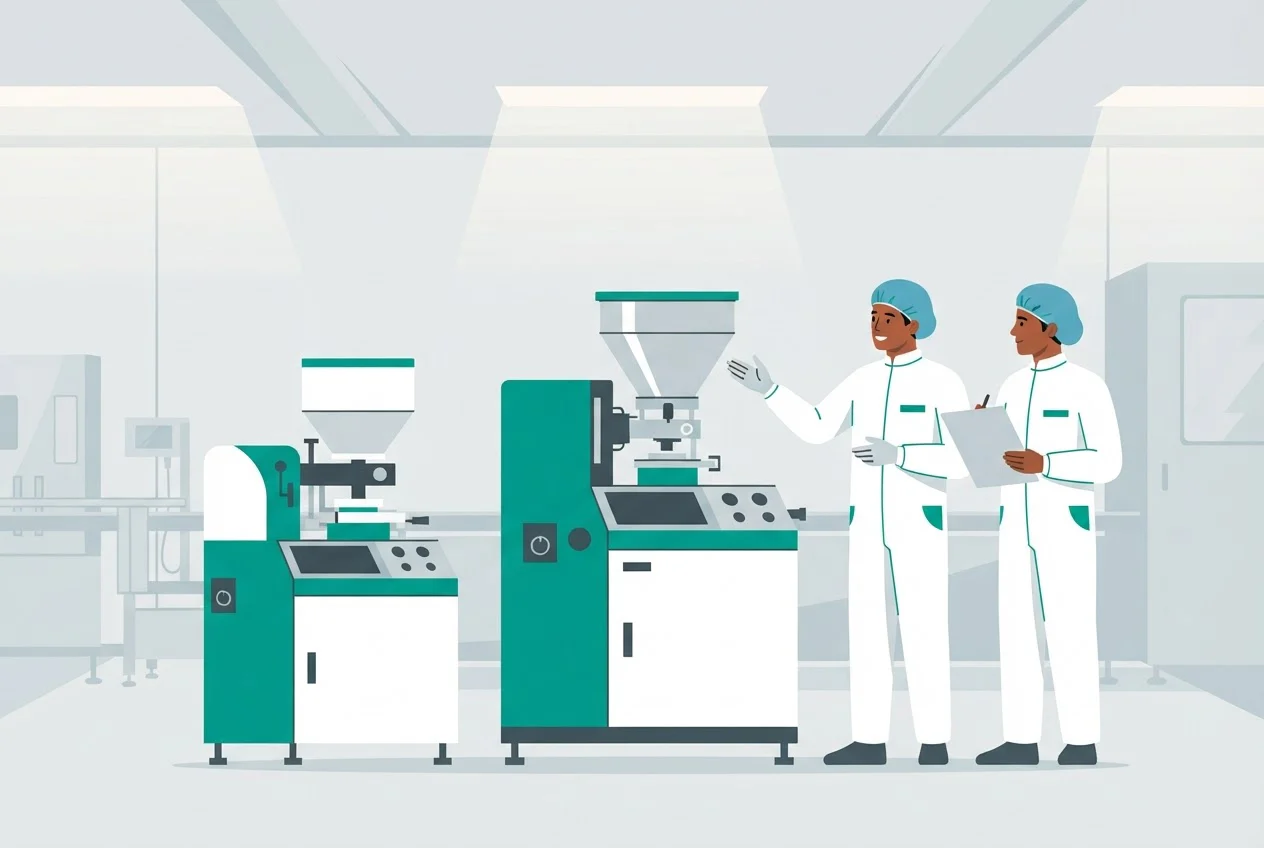
Compare the two sites' equipment and batch sizes side by side before any batch. WHO recommends a review of working principle, capacity, make and model (9.2), a batch-size impact assessment (9.5), and documented adaptation or purchase where gaps appear (9.4). Equipment must be qualified and calibrated before it supports the transfer (10.2).
Pass: every unit operation has a row comparing make, model, minimum and maximum load, and contact materials. Fail: the comparison lists equipment names only.
Our worked example, with assumed figures: the sending site makes 100 kg batches and the receiving site's blender has a working range of 120 to 400 kg. Scale factor = receiving batch size / sending batch size = 300 / 100 = 3, and 300 kg fits the range. The 100 kg batch falls below the 120 kg minimum, so it cannot run in this blender. The batch size becomes a decision, and blend uniformity (whether the active ingredient is evenly spread through the powder blend) needs assessment at the new size.
How long does a technology transfer take?
Build the timeline from five inputs, because neither WHO nor FDA sets a duration. Our model:
Total weeks = gap analysis and protocol + max(analytical transfer, equipment qualification) + batch execution + (report and the stability data your filing needs) + filing wait.
The max() holds because analytical transfer and equipment work can run in parallel, but both must finish before validation batches. Our assumed inputs, not data: 3 + max(4, 6) + 6 + 8 + 5 = 28 weeks, about 6.5 months. For a CBE-30 the filing wait is at least 30 days, about 4.3 weeks, which we rounded up to 5. For a prior approval supplement the wait runs until FDA approves, so take that input from your regulatory lead.
Shorten the total by starting analytical transfer first and starting stability studies on the first receiving-site batches, which WHO expects at close-out (12.42).
How does Aarise Pharmaceuticals run a technology transfer?
Aarise Pharmaceuticals is a Haridwar, India-based technology-driven contract development and manufacturing organization (CDMO) for oral dosage forms, from product development through commercial manufacturing. We run a transfer in the order of our buying route: inquiry, feasibility review, commercial quotation, development or technical transfer, production and quality control, packaging, and dispatch. Our finished-dose categories are tablets, capsules, oral liquids, ointments, injections, dry syrup and external applications.
As of October 2026, we have not published an FDA inspection record for our site. If the product is US-approved, confirm the site's FDA inspection status with us and your regulatory lead, because that status sets whether the move is a prior approval supplement or a CBE-30.
Complete the checklist above before the feasibility review. We need the product name and strength, dosage form, batch size, destination market, whether it holds an approved NDA or ANDA, and the documents you hold. Quotations are prepared per project; ask us for yours at sunil@aarisepharma.com or on WhatsApp at +91 9899783330, or start from our third-party manufacturing page.
Frequently asked questions
Sources
- 1.WHO Technical Report Series 1044, Annex 4: guidelines on technology transfer in pharmaceutical manufacturing (2022)
- 2.FDA, Guidance for Industry: Changes to an Approved NDA or ANDA (April 2004)
- 3.FDA, Guidance for Industry: Process Validation, General Principles and Practices (January 2011)
- 4.FDA copy of ICH Q10, Pharmaceutical Quality System
- 5.FDA copy of ICH Q7, Good Manufacturing Practice Guidance for Active Pharmaceutical Ingredients
- 6.21 CFR 314.70, supplements and other changes to an approved application
- 7.Federal Register notice, Recommendations on Scale-Up and Postapproval Changes Guidances for Industry; Request for Comments (Docket FDA-2026-N-0809)