
Glossary
Pharmaceutical Quality Agreement
A pharmaceutical quality agreement assigns each quality duty between a drug owner and its supplier. In the US, FDA recommends one but does not require it, and it never moves legal responsibility.

By Sunil Kumar, Managing Director - Sales · Updated 23 Oct 2026
On this page
- 01Definition
- 02Quick facts
- 03What is a pharmaceutical quality agreement, and is it required?
- 04What goes into a quality agreement?
- 05Who signs a quality agreement when a distributor sits between you and the manufacturer?
- 06How do you check that a quality agreement clause is actually true?
- 07How is a quality agreement different from a supply agreement?
- 08How Aarise Pharmaceuticals handles it
- 09Example
- 10Related terms
- 11Frequently asked
What is a pharmaceutical quality agreement?
A pharmaceutical quality agreement is a comprehensive written agreement that defines each party's manufacturing activities in terms of how each will comply with current good manufacturing practice (CGMP). FDA recommends one but does not require it.
Key takeaways
- A quality agreement states which party performs each current good manufacturing practice (CGMP) activity. FDA recommends one and does not require one, but ICH Q7 section 16.12 and EU GMP Chapter 7 expect or require a written contract, so check the rules in your market. It cannot delegate CGMP responsibility.
- Keep price, delivery terms and liability limits out of it. FDA wants the quality agreement separate from the commercial contract.
- When a distributor is in the chain, decide who signs with whom before you draft. The structure decides who can audit the manufacturer.
- A clause counts only when you hold evidence for it. Test each one with the pass and fail checks below.
Quick facts
- Governing guidance
- FDA, Contract Manufacturing Arrangements for Drugs: Quality Agreements (November 2016)
- Required by FDA
- No, recommended only; the guidance is nonbinding
- Sections FDA expects
- Five: purpose and scope, definitions, resolution of disagreements, manufacturing activities, and life cycle and revisions
- API template
- APIC Quality Agreement Guideline and Template, version 3 (January 2024), with 25 topics
- Kept out of it
- Confidentiality, pricing, delivery terms and limits on liability
A quality agreement can fail in two places: the wording and the checking. In a December 2025 FDA warning letter, a Florida active pharmaceutical ingredient (API) distributor held an agreement that required its supplier to provide ongoing stability data. FDA investigators then found no stability chambers and no stability or reserve samples at that supplier.
The clause existed. Nobody had tested it.
This entry defines the term as FDA does. It sets out the three ways to structure the agreement when a distributor sits between manufacturer and buyer, because that structure decides who can audit the manufacturer. It also gives a clause-by-clause test you can run before you sign or re-qualify a supplier, with a clear pass and fail for each clause, so you can judge a draft in one sitting.
It is written for owners, formulators and importers who are asked to sign a quality agreement or want to request one from a supplier.
What is a pharmaceutical quality agreement, and is it required?
FDA recommends a quality agreement but does not require it. Its 2016 guidance is nonbinding, and "should" there means recommended (FDA, Quality Agreements guidance, November 2016). ICH Q7 section 16.12 says there "should be a written and approved contract or formal agreement" for contract manufacturers. EU GMP Chapter 7, in EudraLex Volume 4, makes a written contract mandatory. Check the rules in your market.
Four points from the FDA guidance carry the weight:
- The owner's quality unit (the group that approves or rejects product) is legally responsible for approving or rejecting contract-made product, including final release.
- A quality agreement "cannot be used to delegate" CGMP responsibilities. In FDA's own examples, a contract facility whose batch records were inaccurate stayed in violation even though they matched the agreement, and an owner that never audited its testing lab was exposed to citation despite a written two-year audit procedure.
- Confidentiality, pricing, delivery terms and limits on liability stay out.
- Inspectors may review the agreement.
What goes into a quality agreement?
FDA says most quality agreements contain five sections: purpose and scope, definitions, resolution of disagreements, manufacturing activities, and the agreement's life cycle and revisions. The manufacturing section covers six areas: quality unit activities, facilities and equipment, materials management, product-specific considerations, laboratory controls, and documentation (FDA guidance, section IV.B).
Change control gets its own list of 11 change types to report and approve. They include components and their suppliers, establishment locations, manufacturing processes, testing procedures and container closure systems.
For APIs, the Active Pharmaceutical Ingredients Committee (APIC), an industry body that publishes voluntary guidance, offers a ready template. Version 3 (January 2024) divides responsibilities into 25 topics. The template's responsibilities table has about 150 numbered clauses, counting distinct clause numbers in the January 2024 version. As of October 2026, FDA's November 2016 guidance and APIC version 3 (January 2024) are the current versions. The parent standard is ICH Q7, the International Council for Harmonisation guideline on good manufacturing practice for APIs. Section 16.12 calls for a written, approved agreement that defines each party's GMP responsibilities in detail (ICH Q7).
Who signs a quality agreement when a distributor sits between you and the manufacturer?
APIC recommends a three-way agreement among the API manufacturer, the distributor and each end customer. The alternative is one agreement between manufacturer and distributor and another between distributor and customer. A direct manufacturer-to-customer agreement is not recommended, because the two share no business relationship (APIC v3, section 3.2).
Two ways to sign with a distributor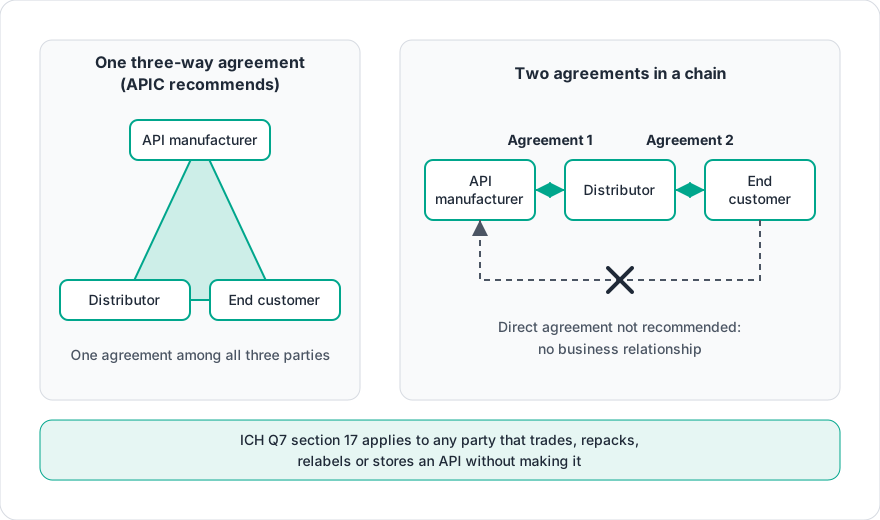
Whatever the structure, ICH Q7 section 17 applies to any party that trades, repacks, relabels or stores an API without having made it. That party must keep the original manufacturer's name and address, the manufacturer's batch number, and every authentic certificate of analysis (COA) from the original manufacturer. It must also pass quality and regulatory information both ways. The comparison of API manufacturers, distributors and contract development and manufacturing organizations (CDMOs) shows how those roles differ.
- Structure
- Three-way (recommended)
- Who can audit the manufacturer
- The end customer
- Limit
- The manufacturer must know every end customer
- Structure
- Two agreements in a chain
- Who can audit the manufacturer
- Mainly the distributor, or joint audits if all agree
- Limit
- Not permitted in some markets, such as Japan
- Structure
- Direct, no business tie
- Who can audit the manufacturer
- The end customer
- Limit
- Not recommended in practice
How do you check that a quality agreement clause is actually true?
Treat each clause as a claim and collect the evidence behind it. The December 2025 letter shows why. The distributor's vendor survey recorded a "satisfactory" FDA inspection of its supplier that never took place. The agreement's stability clause had no data behind it. FDA called this a failure of the distributor's system for evaluating suppliers (FDA warning letter).
The checks below are a working test built from FDA, ICH Q7 and APIC. For COA review, see how to read an API COA.
How do you test the named-site clause?
Pass: manufacturer name, address and batch number on the COA and shipping papers match the manufacturer named in the agreement (records required by ICH Q7 17.20; matching them to the agreement is a recommended practice). Fail: the manufacturer is unnamed or differs on the documents.
How do you test the change-notice clause?
Pass: a stated number of days before implementation, for example 30 or 60, agreed with your quality unit (a recommended practice). Fail: wording left descriptive. APIC states only "a reasonable time, prior to implementation".
How do you test the audit clause?
Pass: on-site access at the manufacturer, or an agreed third-party report, with audit frequency set by risk. APIC 4.05 defaults to no more than once every three years absent critical incidents, and APIC note 4.3 says shorter intervals, every one or two years, are common for single-source or exclusive APIs (APIC 4.01, 4.05). Fail: audit limited to a trader's office.
How do you test the release clause?
Pass: deviations and out-of-specification (OOS) results are closed before release (APIC 9.02). Fail: a COA is issued with open investigations.
How do you test the stability clause?
Pass: you hold the stability report the clause promises. Fail: the clause is present and the data are missing.
How do you test the recall clause?
Pass: recall information within two business days of a request (APIC 25.03), with named contacts. Fail: no contacts or timeframe.
How do you test the subcontracting clause?
Pass: no work passed to a third party without your prior approval (ICH Q7 16.14). Fail: the agreement is silent on subcontractors.
How do you test supplier statements?
Pass: questionnaire answers, such as inspection history, are checked against public records. Fail: answers are accepted unchecked.
How is a quality agreement different from a supply agreement?
A quality agreement assigns CGMP duties, while the supply agreement holds price, volume and delivery. A quality agreement is also not an audit, a supplier questionnaire or a COA. Those are evidence you collect against it. A third-party manufacturing quote and vetting pack shows how the commercial and quality documents sit together.
How Aarise Pharmaceuticals handles it
We are an API supplier, sourcing partner, distributor and exporter of steroid, peptide, hormone and general pharmaceutical APIs. Supply depends on the approved manufacturing source for each product. As a supplier and distributor, we are the kind of party ICH Q7 section 17 covers, so the checks above apply to us as they do to any distributor.
Our quotation asks for product or CAS number (Chemical Abstracts Service registry number), quantity, destination, grade or purity, documents, payment terms and Incoterms (international shipping terms). Available documentation may include COA, specifications and SDS/MSDS (safety data sheet) where applicable. Evaluation quantities are available to qualified B2B buyers. State whether you need a quality agreement in your inquiry. Whether one can be signed, and with which approved manufacturing source as a party, is confirmed product by product at quotation. See also our qualification map for US importers.
Send your inquiry through our contact form, by email at sunil@aarisepharma.com, or by WhatsApp or phone at +91 9899783330.
Example
An importer buys a single-source API through a distributor under a three-way agreement with the manufacturer. The template default in APIC 4.05 is an audit no more than once every three years, but note 4.3 says every one or two years is common for single-source APIs, so the importer sets the shorter interval. It also checks that the recall clause promises recall information within two business days of a request (APIC 25.03), with named contacts.
Frequently asked
Sources
- 1.FDA, Contract Manufacturing Arrangements for Drugs: Quality Agreements, November 2016
- 2.ICH Q7, Good Manufacturing Practice Guide for Active Pharmaceutical Ingredients, Step 4, 10 November 2000
- 3.European Commission, EudraLex Volume 4: EU Guidelines for Good Manufacturing Practice, including Chapter 7
- 4.APIC Quality Agreement Guideline and Template, version 3, January 2024
- 5.FDA warning letter to Darmerica, LLC, 8 December 2025
- 6.21 CFR 211.22, Responsibilities of quality control unit