
Glossary
Drug Substance vs Drug Product
Drug substance vs drug product is the split between the active ingredient and the finished dosage form that contains it. The line decides which rules, tests and documents apply.

By Sunil Kumar, Managing Director - Sales · Updated 23 Oct 2026
Also called Active ingredient vs finished dosage form or API vs finished dose
On this page
- 01Definition
- 02Quick facts
- 03Overview
- 04What is the difference between a drug substance and a drug product?
- 05Which side does each common term fall on?
- 06Which rules and tests change at the line between active ingredient and finished dose?
- 07How does one metformin tablet show both sides?
- 08What should you ask for when you order a drug substance or a drug product?
- 09How Aarise Pharmaceuticals handles it
- 10Example
- 11Related terms
- 12Frequently asked
What is the difference between a drug substance and a drug product?
A drug substance is the active ingredient that furnishes the drug's effect; a drug product is the finished dosage form, such as a tablet, capsule or solution, that contains it. The U.S. FDA defines both in 21 CFR 314.3.
Key takeaways
- The line decides which rulebook (ICH Q7 or 21 CFR (Code of Federal Regulations) Part 211) and which tests apply, so name the side whenever you order or quote.
- Dissolution and dosage-unit uniformity (each tablet holds close to the labeled amount) belong to the drug product, while particle size and crystal form are drug-substance checks.
- Tablets or capsules in a bulk container are drug product, not API.
- A "500 mg" metformin hydrochloride tablet holds about 390 mg of metformin base, by a calculation shown below.
Quick facts
- Also known as
- Drug substance is the same term as API (active pharmaceutical ingredient) in ICH Q7
- Defined in
- 21 CFR 314.3
- Drug substance rulebook
- ICH Q7
- Drug product rulebook
- 21 CFR Part 211
- Specification guideline
- ICH Q6A
Overview
An order that mixes the two terms up asks the wrong supplier for the wrong paperwork. In metformin's case, the powder is the drug substance and the tablet pressed from it is the drug product.
The mix-up is common because the word "bulk" covers both. A drum of metformin powder and a drum of loose metformin tablets are both called bulk, yet they sit on opposite sides of the line. The Good Manufacturing Practice (GMP) rules that apply to them come from different documents.
Dissolution, which measures release of the drug substance from the tablet, is a drug product test, and particle size and crystal form are drug substance checks. A quote that names the wrong side therefore asks for the wrong tests, and the error surfaces late, when the certificate arrives and does not match the item you meant to buy.
What is the difference between a drug substance and a drug product?
A drug substance is the active ingredient, and a drug product is the finished dosage form that contains it. 21 CFR 314.3 defines a drug substance as "an active ingredient that is intended to furnish pharmacological activity or other direct effect in the diagnosis, cure, mitigation, treatment, or prevention of disease or to affect the structure or any function of the human body, but does not include intermediates used in the synthesis of such ingredient." It defines a drug product as "a finished dosage form, e.g., tablet, capsule, or solution, that contains a drug substance, generally, but not necessarily, in association with one or more other ingredients."
ICH Q7 (the International Council for Harmonisation guideline on API manufacturing) titles its definition "Active Pharmaceutical Ingredient (API) (or Drug Substance)". So the two names are not two manufacturing stages.
Which side does each common term fall on?
An API is a drug substance. An excipient and a finished tablet, capsule or solution belong to the drug product. An intermediate is neither. Tablets or capsules in bulk containers are drug product. The trade term "bulk drug" does not say which side it means, so ask. The table below is read from 21 CFR 314.3, 21 CFR 210.3 and ICH Q7.
Where the drug substance and drug product line falls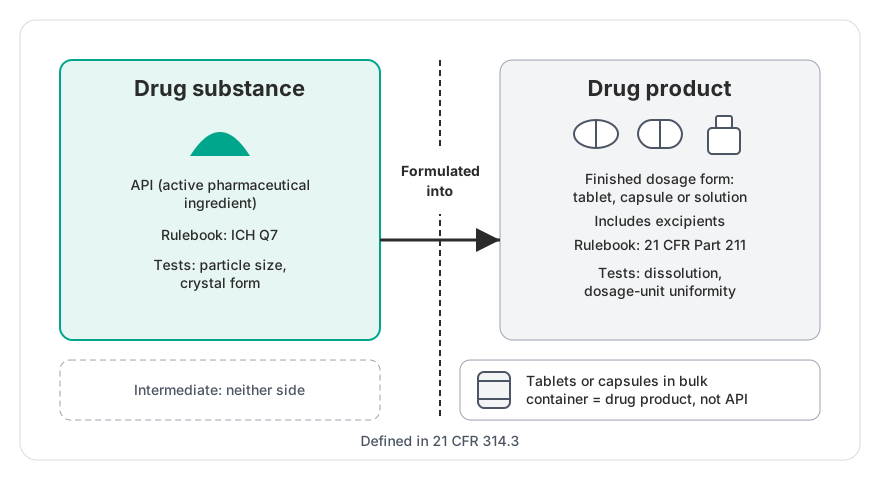
21 CFR 210.3 does not define "drug substance". It uses "active ingredient" and defines an inactive ingredient (an excipient) as "any component other than an active ingredient." As of 23 October 2026, the U.S. Food and Drug Administration (FDA) direct final rule published 22 September 2026 (91 FR 60003, Docket FDA-2026-N-5347) adds a definition of "nonclinical study" to 21 CFR 314.3(b), effective 4 February 2027 unless FDA withdraws it after the comment period closes on 7 December 2026. The drug substance and drug product definitions are unchanged.
- Term
- API, active ingredient
- Side
- Drug substance
- Basis
- Q7 lists API and drug substance as one entry
- Term
- Intermediate
- Side
- Neither
- Basis
- 314.3 excludes intermediates from "drug substance"
- Term
- Excipient (inactive ingredient)
- Side
- Part of the drug product
- Basis
- 210.3: any component other than an active ingredient
- Term
- Tablet, capsule, solution
- Side
- Drug product
- Basis
- 314.3
- Term
- Tablets or capsules in bulk containers
- Side
- Drug product
- Basis
- Q7 names them as outside its scope
- Term
- "Bulk drug"
- Side
- Ask which
- Basis
- Trade shorthand; confirm whether powder or dosage form is meant
Which rules and tests change at the line between active ingredient and finished dose?
Drug substance manufacturing follows ICH Q7, while drug product manufacturing follows 21 CFR Part 211. Specification tests also differ: particle size and crystal form are drug substance checks, and dissolution and dosage-unit uniformity are drug product checks.
ICH Q7 covers APIs for human drug products from the point the API starting material (the raw material where Q7 GMP begins) enters the process, and it includes milling and micronizing. 21 CFR Part 211, titled "Current Good Manufacturing Practice for Finished Pharmaceuticals", covers preparation of drug products. Q7 excludes bulk-packaged tablets and capsules, so by reading, those follow the finished-pharmaceutical rules.
Specification tests split the same way, per ICH Q6A, which is written for new chemical drug substances and products. For scale, an FDA training deck gives an example drug substance specification: assay at 98 to 102% by HPLC (high-performance liquid chromatography), related substances (impurities related to the active) at not more than 0.10%, residual solvents at 5000 ppm (parts per million), and water at not more than 2% by Karl Fischer titration (FDA, December 2023). These are illustrative values, not a rule.
- Test group
- Tests for every item
- Drug substance
- Description, identification, assay, impurities
- Drug product
- The same four; assay measures strength, and impurities include degradation products
- Test group
- Tests on one side only
- Drug substance
- Particle size, polymorphic (crystal) form, case by case
- Drug product
- Dissolution and uniformity of dosage units for tablets and capsules
- Test group
- Process impurities
- Drug substance
- Controlled here
- Drug product
- Not counted again in the product total
How does one metformin tablet show both sides?
A 500 mg metformin hydrochloride tablet is a drug product whose strength is stated on the salt, so it carries about 390 mg of metformin base. A DailyMed label (Cadila Healthcare, dated 2010) opens with the drug substance: metformin hydrochloride, C4H11N5·HCl, molecular weight 165.63. It then describes the drug product: 500 mg film-coated tablets with hypromellose, magnesium stearate, microcrystalline cellulose, polyethylene glycol and povidone. Check the current label for your product, since excipients and coating can change.
The calculation, which can be rerun: the base C4H11N5 weighs 4×12.011 + 11×1.008 + 5×14.007 = 129.17 using standard atomic weights. Then 129.17 ÷ 165.63 = 78.0%, and 500 mg × 0.780 ≈ 390 mg.
The practical consequence is that you should confirm the salt form and assay basis before you convert kilograms of powder into tablets.
What should you ask for when you order a drug substance or a drug product?
Ask for the document that matches the side of the line, and accept it only if it passes the test in the Pass column of the table.
A DMF is never approved or disapproved by FDA. A Type II DMF (the DMF type for drug substances and drug products) covers a drug substance, a drug substance intermediate or a drug product, and the Letter of Authorization lets FDA refer to it for another party's submission (FDA DMF guideline).
- Order
- Drug substance
- Ask for
- Name and CAS (Chemical Abstracts Service) number
- Pass
- Salt form named in the quote and on the certificate of analysis (COA)
- Fail
- Base or salt left unstated
- Order
- Drug substance
- Ask for
- Batch COA
- Pass
- Numeric limits and a method for each test
- Fail
- "Conforms" with no figures
- Order
- Drug substance
- Ask for
- GMP statement
- Pass
- Names ICH Q7 and the API starting material point
- Fail
- Silent on both
- Order
- Drug substance
- Ask for
- DMF reference, if you file with FDA
- Pass
- Drug Master File (DMF) number plus a Letter of Authorization naming your application
- Fail
- A claim of holding a DMF with no letter
- Order
- Drug product
- Ask for
- Strength basis
- Pass
- Label states salt or base
- Fail
- Ambiguous "500 mg"
- Order
- Drug product
- Ask for
- Specification
- Pass
- Numeric dissolution and uniformity limits
- Fail
- Test names only
- Order
- Drug product
- Ask for
- Composition
- Pass
- Every inactive ingredient named, including coating and colorants
- Fail
- Excipients not named, or named only as "excipients q.s." (quantity sufficient)
How Aarise Pharmaceuticals handles it
Aarise supplies APIs in steroid, peptide, hormone and general pharmaceutical categories, which are drug substances when intended for use in a drug product, and Supplement APIs, which are supplement raw materials rather than drug substances. Peptide APIs come as bulk API powder, not finished vials. On the drug product side, its catalogue covers tablets, capsules, oral liquids, ointments, injections, dry syrup and external applications, and it offers oral-dose contract development and manufacturing from product development through commercial manufacturing. Its AariMet 500 page lists Metformin Hydrochloride IP (Indian Pharmacopoeia) 500 mg per uncoated tablet.
Aarise quotes each API after receiving its name and CAS number, with quantity, destination, grade or purity, documents, payment terms and Incoterms (international shipping terms). Evaluation samples are available to qualified business buyers, with COA, specifications and safety data sheets where applicable. For steroid APIs it does not provide DMF support. Its pharma raw material catalog lists the range, and its guides on choosing between API manufacturer, distributor and CDMO and third-party manufacturing explain how to pick.
Example
Take 1 kg of metformin hydrochloride powder, which is the drug substance. At the 78.0% base fraction worked out above, it holds about 780 g of metformin base. Measured by salt strength, 1 kg of the powder corresponds to 2,000 tablets of 500 mg, before any excipients are added to make the drug product.
Frequently asked
Sources
- 1.21 CFR 314.3, Definitions (Cornell Legal Information Institute)
- 2.21 CFR 210.3, Definitions (Cornell Legal Information Institute)
- 3.21 CFR 211.1, Scope (Cornell Legal Information Institute)
- 4.Federal Register, 22 September 2026 (91 FR 60003, Docket FDA-2026-N-5347)
- 5.ICH Q7, Good Manufacturing Practice for APIs (FDA copy, September 2016)
- 6.ICH Q6A, Specifications (Step 4, 6 October 1999)
- 7.ICH Q11, Development and Manufacture of Drug Substances (Step 4, 1 May 2012)
- 8.FDA CDER, CMC Regulatory Considerations Through Clinical Development (December 2023)
- 9.FDA, Guideline for Drug Master Files
- 10.DailyMed, Metformin Hydrochloride tablets label (Cadila Healthcare)