
Capsule Manufacturing Process: Steps and In-Process Checks
The capsule manufacturing process runs from material receipt through blending, filling, locking and inspection to release testing, with a defined check at each stage that a buyer can request in writing.

By Sunil Kumar, Managing Director - Sales · Updated 23 Nov 2026

Key takeaways
- Capsule manufacturing runs in five stages, then packaging: receiving and qualifying materials and shells, blending, filling and locking, polishing and inspection, and finished-capsule testing and release. Each stage needs a written check, a limit and a record.
Title 21 of the Code of Federal Regulations (21 CFR) section 211.110 requires written in-process controls for US drugs, including capsule weight variation, disintegration time and adequacy of mixing, "where appropriate", with in-process specifications that are consistent with final specifications and derived from the site's own process data where possible.
- The WHO draft adds moisture of the mix and shells, granule size, flow of the final mixture, capsule size and seal integrity. It is a pharmacopoeial draft, not a GMP rule.
- What separates one capsule site from another is its deviation handling, shell supplier control and validation status. The request list near the end covers each.
In this article
- 1The capsule manufacturing process at a glance
- 2Before filling: incoming materials and empty shells
- 3Testing the API and excipients on receipt
- 4Qualifying empty capsule shells
- 5Blending and preparing the fill
- 6Blend uniformity
- 7When powder flow needs granulation
- 8Capsule filling process: separating, filling and locking
- 9Dosator and tamping-pin filling
- 10Fill types
- 11After filling: polishing, sorting and inspection
- 12In-process checks during capsule manufacturing
- 13Fill weight and weight variation
- 14Locking length and capsule appearance
- 15Disintegration
- 16Environmental conditions
- 17Finished-capsule testing and release
- 18Common capsule defects and what to check
- 19What contract buyers should ask a capsule manufacturer
- 20Conclusion
- 21Frequently asked questions
A capsule can look correct and still be wrong inside. Fill weight, cap closure and disintegration cannot be judged by eye, so the quality of a capsule depends on how each stage is checked and recorded.
How are capsules made? Prefabricated two-piece empty shells are filled with a blended powder, granule or pellet fill, closed and locked, then polished and inspected. That sequence is common to hard-capsule filling. The capsule manufacturing process differs between sites in the written limits, sampling plans and records behind each step.
US current good manufacturing practice (cGMP) rules for drugs require written in-process controls. A 2024 World Health Organization (WHO) consultation draft of its Capsules monograph lists a different set of checks for hard capsules. This guide sets the two side by side for in-process checks and ends with a request list that quality assurance (QA) and procurement leads can send to any capsule manufacturer.
The capsule manufacturing process at a glance
The capsule manufacturing process has five stages, followed by packaging: receiving and qualifying materials and empty shells, blending, filling and locking, polishing and inspection, and finished-capsule testing and release. The table lists these capsule manufacturing steps with the check at each. In-process checks run alongside the middle stages, while the batch can still be adjusted.
| Stage | What happens | What is checked |
|---|---|---|
| 1. Incoming materials and shells | The active pharmaceutical ingredient (API), excipients and empty shells are received and held until released | Identity and quality of API and excipients; empty shells against a specification covering size, weight, moisture, appearance and disintegration |
| 2. Blending | API and excipients are mixed, and granulated first if the powder does not flow | Adequacy of mixing, moisture of the mix, flow of the final mixture |
| 3. Filling and locking | Shells are separated, bodies filled, caps rejoined and locked | Fill weight, weight variation, locking length, appearance |
| 4. Polishing, sorting, inspection | Surface powder is removed and defective capsules are rejected | Surface cleanliness, damaged or mis-closed capsules, metal detection |
| 5. Finished-capsule testing and release | Samples are tested against the approved specification | Visual inspection, uniformity of mass or content, disintegration or dissolution; check whether the release specification also includes assay and a moisture test such as loss on drying |
Incoming API, excipients and empty shells
              |
              v
   Blending (granulation if needed)
              |
              v
 Separating -> Filling -> Locking
              |
              v
 Polishing, sorting and inspection
              |
              v
 Finished-capsule testing and release
              |
              v
          Packaging
Capsule manufacturing process flow chart: five stages from incoming materials to release testing, then packaging, with in-process checks running through blending, filling and inspection.
Before filling: incoming materials and empty shells
Before filling, a capsule site must show that the API, the excipients and the empty shells are what they claim to be and are fit for use. Excipients are the inactive ingredients in the fill. A problem found at receipt costs a delay. A problem found after filling can cost the batch.
Testing the API and excipients on receipt
Each API and excipient lot should stay in quarantine until identity is established and quality control releases it. A buyer should expect two things: review of the supplier's certificate of analysis, and the site's own identity testing. 21 CFR 211.84(a) sets the rule for components: each lot is withheld from use until it has been sampled, tested or examined as appropriate and released by the quality control unit.
Physical properties matter as much as purity. The WHO draft Capsules monograph says manufacturers should make sure the API has appropriate solid-state properties, such as particle-size distribution and polymorphic form (the crystal arrangement). It adds that particle size can govern the rate and extent of dissolution, especially for poorly soluble substances, and that it affects the uniformity of the finished product.
Ask whether the incoming specification includes particle size where it is relevant to your product. A lot used before release is a failure, whatever the later results show.
Qualifying empty capsule shells
Qualifying empty capsule shells means testing each received lot against an approved shell specification before it reaches the filling line, and controlling which supplier and method of manufacture the shells come from.
A buyer should expect the shell specification to cover size, weight, moisture, appearance and disintegration. The WHO draft names shell moisture among its in-process controls, and its visual inspection of finished capsules looks for hardening, softening, cracking, swelling, mottling or discoloration of the shell.
Ask how the site approves shell suppliers and what revalidation follows a change in supplier or shell manufacturing method.
Blending and preparing the fill
Blending combines the API and excipients into a homogeneous fill whose moisture, flow and particle size suit the filling machine. The WHO draft names three measures for hard capsules: the moisture content of the mixture or granulate, the flow of the final mixture, and avoiding excessive lubricant because too much can harm capsule performance. Each should have a written control before the first batch.
Blend uniformity
Blend uniformity is the evenness of API distribution through the mixed powder, and 21 CFR 211.110 lists adequacy of mixing, to assure uniformity and homogeneity, among its in-process controls. The WHO draft similarly says mixing with excipients should be carried out in a way that ensures homogeneity.
Expect a fixed, written mixing procedure, a sampling plan for the blend, and results compared against a specification derived from process data. The regulation requires in-process specifications to be consistent with final specifications and, where possible, derived from previous acceptable process averages and variability estimates, using suitable statistical procedures where appropriate.
A blend can pass and still produce uneven fills if it separates on its way to the filler. That is why fill weight and finished-capsule testing are separate checks and not duplicates.
When powder flow needs granulation
Granulation is needed when the powder mix cannot be metered evenly into the shell. The WHO draft says some mixtures can be filled directly, but it may occasionally be necessary to granulate before filling, and that the granulate is then normally mixed with lubricants or disintegrating agents. Poor flow shows up as fill-weight variation, so a site should measure it. The Hausner ratio and Carr's index are two common calculations from bulk and tapped density. A site should set the flow limit from lot data on the actual filler, not from a generic table.
Capsule filling process: separating, filling and locking
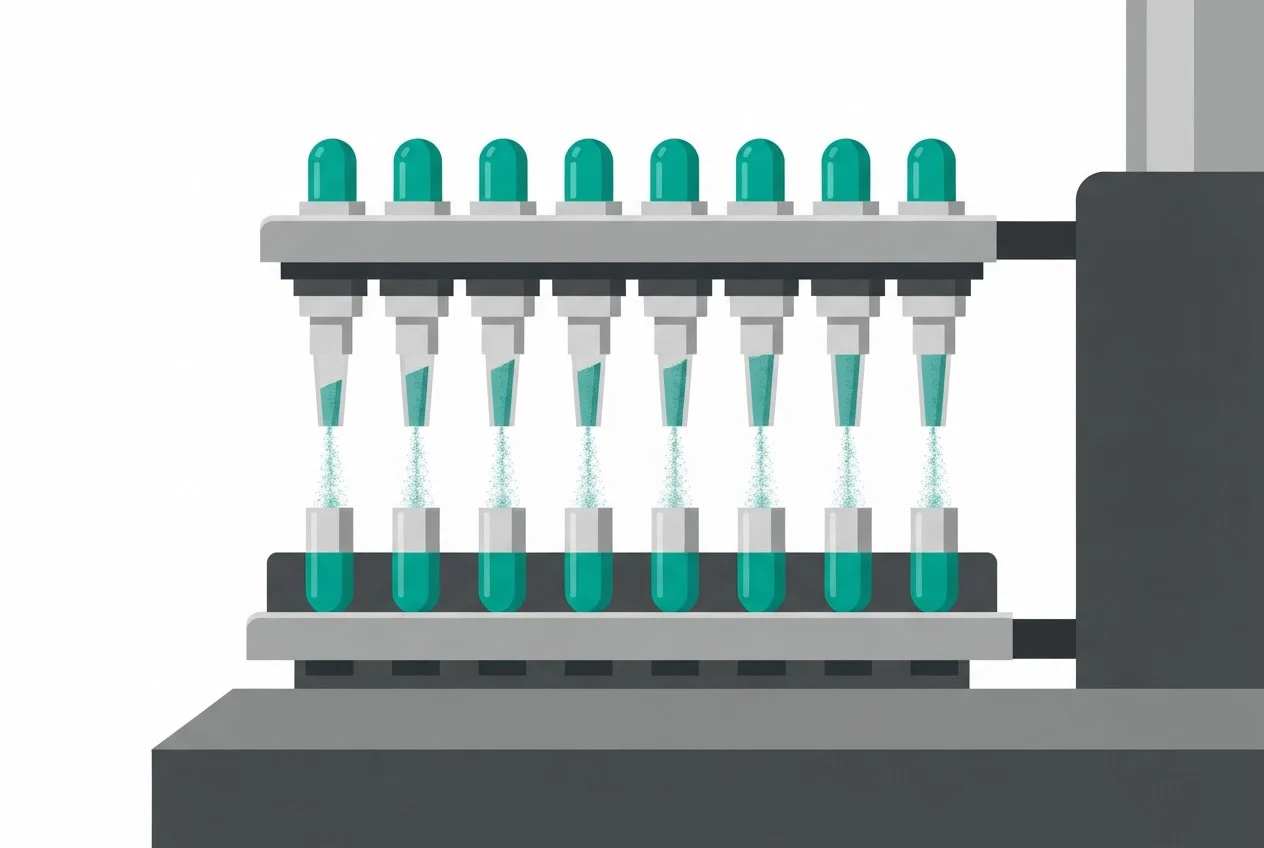
The capsule filling process has four mechanical actions: separating caps from bodies, filling the bodies, rejoining cap and body, and locking the capsule closed. A hard capsule has two prefabricated sections that fit together, so every capsule must pass through each action correctly. Fill metering and closure are where most of the in-process checks apply.
Dosator and tamping-pin filling
A dosator is a hollow tube with an adjustable piston. It dips into a powder bed, forms a plug of powder and ejects it into the capsule body. A tamping-pin machine instead compresses powder in stages into a dosing disc, then pushes the finished plug into the body. Both meter by volume, not by weight, so fill weight depends on how the powder flows and compacts. Uneven flow, or a lubricant level that changes how the plug forms, appears as fill-weight variation.
Fill types
The fill is a powder, a granulate or pellets. A powder is the simplest fill but depends most on flow and bulk density. A granulate usually flows better, which helps even metering. Pellets are small, free-flowing spheres that need metering matched to their size. In each case the check is the same: the fill must be consistent from capsule to capsule. Our finished capsule products are listed under Aarise capsule products.
After filling: polishing, sorting and inspection
After filling, capsules are polished to remove surface powder, sorted, inspected and passed through metal detection, and defective capsules are rejected. Polishing matters because loose powder on the shell can mask defects and contaminate packaging. Sorting removes capsules that are dented, split, mis-closed or visibly under- or over-filled. Metal detection catches foreign metal introduced by equipment wear. A buyer should ask where rejects are recorded, because the reject count is a direct view of how the filling run behaved.

In-process checks during capsule manufacturing
| Control area | US drug cGMP regulation (21 CFR 211.110) | WHO draft Capsules monograph (2024 consultation text) |
|---|---|---|
| Weight | Tablet or capsule weight variation | Uniformity of mass |
| Disintegration and dissolution | Disintegration time; dissolution time and rate | Disintegration or dissolution rate of the finished dosage form (for example, modified-release capsules) |
| Mixing | Adequacy of mixing to assure uniformity and homogeneity | Homogeneity of the mix with excipients, stated as a manufacturing measure |
| Moisture | Not itemized in the listed controls; may apply where appropriate | Moisture content of the mixture or granulate, and of the shells |
| Flow and granule size | Not itemized in the listed controls; may apply where appropriate | Flow of the final mixture; size of granules |
| Closure and size | Not itemized in the listed controls; may apply where appropriate | Capsule size; integrity of the seals |
In-process quality control for capsules means sampling and testing during the run, while the batch can still be adjusted. 21 CFR 211.110 requires written procedures for these controls. They include, "where appropriate", capsule weight variation, disintegration time, adequacy of mixing and dissolution time and rate. The list is not exclusive. The WHO draft gives its own list for hard capsules.
211.110 lists its checks "where appropriate" and not exclusively. The WHO text is a pharmacopoeial draft, not a GMP rule, and neither text sets the same frequency or limits. Limits come from each manufacturer's approved specification.
Fill weight and weight variation
The capsule weight variation test during a run is a sampled check. Capsules are pulled at set intervals and weighed individually, and the fill weight is found by subtracting the empty shell weight. Results are compared with an in-process specification. 21 CFR 211.110(b) requires that specification to be consistent with the final specification and, where possible, derived from previous process average and variability estimates. A buyer should expect results to be trended, not only passed or failed. A drift toward the edge of the range is the earliest warning that powder flow, lubricant level or machine setup is changing.
Locking length and capsule appearance
Capsule locking length is the overall length of a closed capsule once the cap has seated fully. A reading outside the site's limit signals a cap that is not fully seated or a setup that is drifting. Neither 211.110 nor the WHO draft names locking length. The draft's controls for capsule size and seal integrity cover the same risk. This makes it a site-defined control, so ask for the written limit, the sampling interval and where the readings are recorded. Appearance checks look for dents, splits, cracks, stains and surface powder.
Disintegration
The capsule disintegration test places capsules in a fluid in an apparatus and records whether they have broken up by the end of the run. The 2024 WHO consultation draft of the Capsules monograph describes a 30-minute run in water for hard capsules, unless otherwise justified and authorized. It allows another medium where the individual monograph specifies one. That text is a draft. The 30 minutes is the test time it describes, not an in-process acceptance limit and not a WHO requirement. As of November 2026, the text described here is the July 2024 consultation draft (QAS/23.927); check the current edition of The International Pharmacopoeia before relying on it.
The pass criterion for a product sits in its approved specification. Under the draft, where a monograph requires a dissolution test, the disintegration requirement does not apply. Ask which test the specification uses for your product, in which medium, and what result counts as a pass.
Environmental conditions
Humidity changes shell behavior. High humidity softens shells, and low humidity makes gelatin shells brittle (Al-Tabakha, 2010). The WHO draft treats moisture of the mix and of the shells as in-process controls. A buyer should ask for temperature and humidity records for the filling room and for shell and powder storage. A good answer shows a documented range, continuous or scheduled monitoring, and a written response when a reading falls outside the range.
Finished-capsule testing and release
Finished-capsule testing confirms that a batch meets its approved specification before release. The WHO draft names visual inspection, uniformity of mass or content, and disintegration or dissolution.
- Dissolution measures how much drug is released over time in a defined medium.
- Uniformity of mass or content shows consistency across individual capsules. The WHO draft applies uniformity of mass unless the product's monograph requires uniformity of content, in which case the mass test is not required.
- Visual inspection: the draft calls for inspecting at least 20 capsules, which should be smooth and undamaged, with no hardening, softening, cracking, swelling, mottling or discoloration of the shell.
Check whether the approved specification also includes assay and a moisture test such as loss on drying, and ask the manufacturer to list every test in its release specification.
The quality unit, the group that approves or rejects materials and batches, then reviews the test results with the batch record before release. Packaging must protect capsules from light when required and from moisture and transit damage, according to the WHO draft.
Common capsule defects and what to check
The table gives each defect, the cause commonly attributed to it, and the record to check. Causes named in the WHO draft or Al-Tabakha (2010) are cited. The other causes are stated in general terms.
| Defect | Commonly attributed cause | What to check |
|---|---|---|
| Fill weight drift or high weight variation | Flow of the final mixture and lubricant level (the WHO draft names both as controls) | Blend flow data, lubricant level in the formula, run-sheet weight trend |
| Brittle or cracked shells | Low humidity acting on gelatin shells (Al-Tabakha, 2010) | Humidity records, shell moisture on receipt |
| Soft, deformed or sticking shells | High humidity softening the shell (Al-Tabakha, 2010) | Humidity records for storage and the filling room |
| Loose, split or mis-closed capsules | Machine setup or tooling condition | Locking-length readings, seal integrity checks, tooling and setup records |
| Slow or failed disintegration | Formulation or process factors; the WHO draft cautions that excess lubricant can harm capsule performance | Disintegration results against the specification, lubricant level in the batch record |
Treat a repeated defect as a trend that points to a process cause. A site that only sorts defective capsules out has not fixed the process.
What contract buyers should ask a capsule manufacturer
A capsule manufacturer should answer seven requests in writing before a contract is signed: the executed batch record, in-process limits, deviation handling, shell supplier control, blend uniformity evidence, process validation and equipment qualification, and environmental records. The list below states what a complete answer includes. Note the manufacturer's own stated limits next to each item, so you can compare sites on the same terms.
| What to ask for | Why it matters | What a complete answer includes |
|---|---|---|
| Executed batch record for a representative batch, with the capsule run sheet | 21 CFR 211.110 requires written in-process controls followed batch by batch | Every in-process result recorded with time, sample size and operator, matched to the written procedure |
| In-process limits and sampling frequency for each check | Specifications should be derived from process data (211.110(b)) | Each check listed with its limit, interval, sample size and how the limit was derived |
| Deviation and out-of-specification handling | Results outside the range need a documented, approved response | A written procedure and a closed example showing investigation, quality unit approval of corrective action and effect on the batch |
| Shell supplier qualification and change control | A change in shell source or method can alter capsule performance, so it needs a documented assessment. | An approved supplier list, the incoming shell specification with results, and a written rule for revalidation after a change |
| Blend uniformity evidence | Mixing adequacy is a named control and feeds fill uniformity | The sampling plan, results against the specification, and the link to fill-weight results |
| Process validation and equipment qualification status | Controls must monitor and validate process performance; the WHO draft calls for validated, monitored steps | Validation protocol and report for the product or a comparable one, qualification records for filling and inspection equipment, and balance calibration status |
| Environmental monitoring records | Humidity affects shell behavior | Temperature and humidity logs with a documented range and a response to excursions |
The reason to ask for the deviation record is concrete. In December 2022, the US Food and Drug Administration (FDA) issued a warning letter to a dietary supplement maker under 21 CFR Part 111. Capsule fill weights on the run sheet fell outside the specified range. Notes recorded adjustments, yet no corrective action approved by the quality unit was documented. Drug capsules fall under 21 CFR Part 211 and dietary supplement capsules under Part 111, but the lesson applies to both: an out-of-range result needs a documented, approved response.
FDA's own data point the same way. According to the FDA Office of Pharmaceutical Quality's FY2025 Report on the State of Pharmaceutical Quality, 28% of the nearly 10,000 applications and supplements needing a facility assessment that FDA received in fiscal years 2024 and 2025 had received a complete response letter as of May 2026, and 43% of those letters (12% of all submissions) were due to facility withholds.
Among the top inspection citations behind those withholds were inadequate investigation of discrepancies or batch failures, and quality control unit procedures that were not written or followed.
A WHO-GMP certificate also needs reading carefully. Check its scope, date, site and the dosage forms it covers, and see what API certifications mean for context. Manufacturing partner details are on our page for third-party manufacturing in Haridwar.
Conclusion
Judge a capsule manufacturer by the records it can show, not by how it describes the process: a description says what a site intends to do, and records show what it did.
Before you sign, ask for three things: the executed batch record for a representative batch, the written in-process limits with their sampling intervals, and a closed deviation showing quality unit approval of the corrective action. If a site cannot produce all three, treat its description of the process as unverified. If it can, compare its limits with those of the next site on the same terms.
To see how Aarise approaches capsule projects, read about our third-party pharmaceutical manufacturing process, then send an inquiry with your product and specification.
Related process guides: the dispersible tablets manufacturing process and ointment manufacturing steps and quality checks.