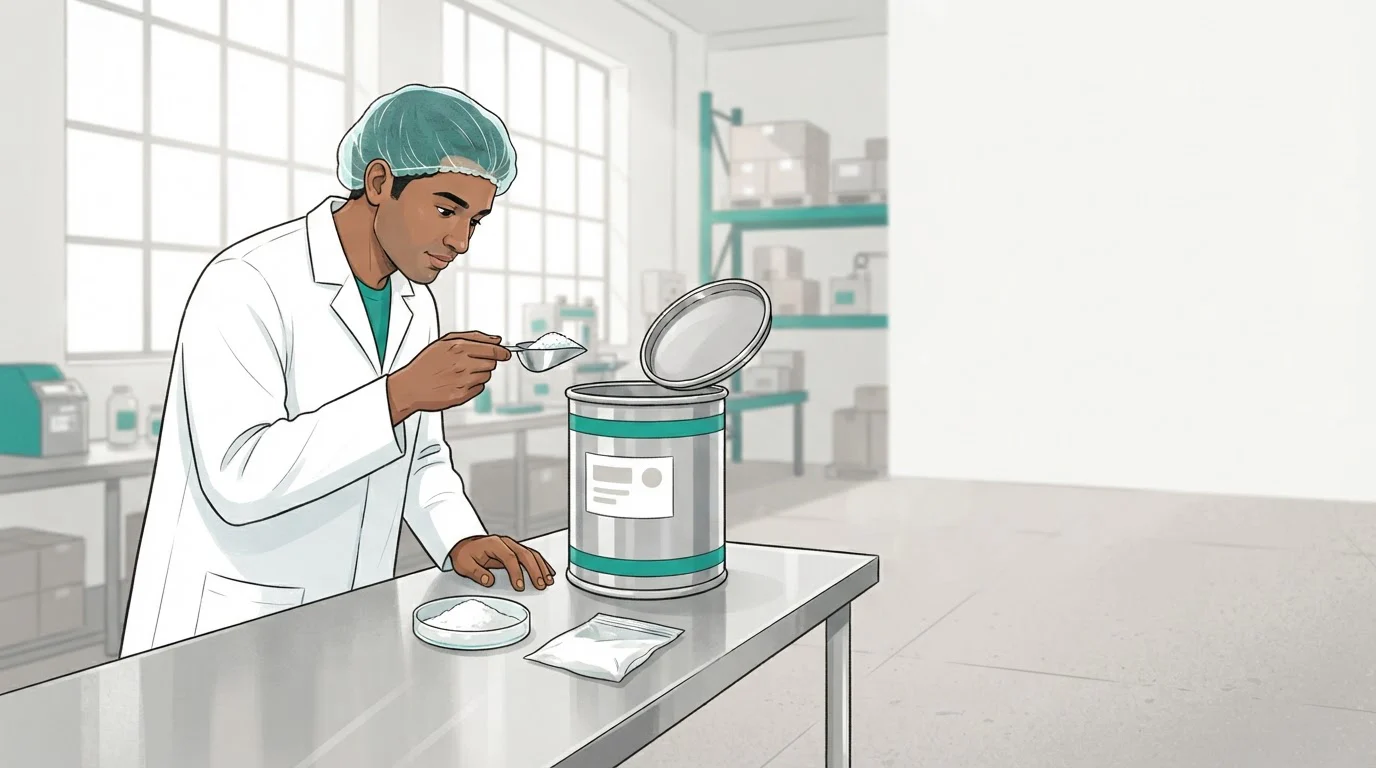
Ointment Manufacturing Process: Base Selection, Mixing and Quality Checks
The ointment manufacturing process runs from base preparation and active incorporation through mixing, in-process checks, a controlled hold, filling and release. Buyers should request the written records behind each step.

By Sunil Kumar, Managing Director - Sales · Updated 2 Nov 2026

Key takeaways
- An ointment is made by preparing a base, adding the active, mixing, testing, holding, filling and releasing, and the written parameter ranges and records behind each step make the process controlled.
- Base class is chosen first, because it fixes how the active is incorporated, how the product releases drug and how it washes off.
- Title 21 of the Code of Federal Regulations (CFR) §211.110 requires written in-process controls, including adequacy of mixing, and the useful ointment attributes are active solubility, particle size and crystal form, viscosity and homogeneity.
- Ask for eight documents, from the master batch record with critical-parameter ranges to the change-control procedure.
In this article
- 1Ointment vs. cream vs. gel: what changes in manufacturing
- 2What are the ointment manufacturing process steps?
- 3Step 1: How do you choose among ointment base types?
- 4Which four base classes does USP recognize for ointments?
- 5Which factors decide the ointment base?
- 6Step 2: How are the base and active melted, incorporated and mixed?
- 7Fusion (melting) method
- 8Incorporation and levigation of powders
- 9Emulsion-type bases: melting plus emulsification
- 10How heating, cooling and shear change the finished ointment (Chow et al., 2023)
- 11Step 3: Which in-process controls for ointments should be in place?
- 12Step 4: How are ointments filled, sealed and packaged?
- 13Scale-up and process changes: what FDA SUPAC-SS means for a buyer
- 14What to ask a contract manufacturer to document
- 15Where to start with your ointment requirement
- 16Frequently asked questions
Last updated: November 1, 2026
Two ointments can share an identical equipment list and still behave differently, because the temperatures, speeds and hold times inside each step belong to the product. How are ointments manufactured, then? The ointment manufacturing process steps below show where those parameters sit.
This guide covers nonsterile topical ointments. FDA's guidance on Scale-Up and Post-Approval Changes for Nonsterile Semisolid Dosage Forms (SUPAC-SS) describes an ointment as an unctuous, meaning greasy and smooth, semisolid for topical use. It is typically petrolatum-based, with too little water to separate into a second phase at room temperature. Creams and gels get a short comparison only.
An equipment list tells a buyer little about batch-to-batch quality. The semisolid manufacturing process is decided by the base, the mixing parameters, the checks and the rules for changing any of them. The sections below follow that order and end with eight documents to request from a manufacturer.
Ointment vs. cream vs. gel: what changes in manufacturing
Ointment vs cream manufacturing comes down to water. An ointment has too little water to form a second phase, so it is melted, combined and cooled. A cream is a semisolid emulsion, so it also needs an emulsification step. A gel is built by holding a liquid inside a cross-linked matrix.
| Form | Definition (FDA SUPAC-SS glossary, paraphrased) | Manufacturing consequence |
|---|---|---|
| Ointment | Unctuous semisolid; typically petrolatum-based; not enough water to separate into a second phase | Melt, combine and cool the base; control how the active is dissolved or dispersed |
| Cream | Semisolid emulsion with dissolved or suspended drug | Prepare two phases and combine them; the emulsifier and the shear applied set droplet size |
| Gel | Liquid phase constrained within a three-dimensional cross-linked matrix | Structure comes from a gel-forming matrix rather than petrolatum or waxes |
Source: FDA, SUPAC-SS (May 1997), glossary. The guidance covers all three forms. The rest of this page covers ointments.
What are the ointment manufacturing process steps?
An ointment moves through eight stages: weigh, prepare the base, incorporate the active, mix or mill, check, hold, fill and release. Each stage should leave a record. The two stages that most often decide quality are active incorporation and the bulk hold before filling.
Weigh → Prepare base → Incorporate active → Mix or mill → In-process check → Hold → Fill → Release
- Weigh. The batch record documents the weights and measures of components used (21 CFR 211.188).
- Prepare base. Melt or hydrate the base components.
- Incorporate active. FDA's SUPAC-SS names the point where the active is added as a critical point and, for emulsion-type products, also the point where a one-phase system separates into two. An ointment has too little water to form a second phase, so our reading is that only the first applies.
- Mix or mill. Reduce grittiness and reach uniformity.
- Check. Written in-process tests (21 CFR 211.110).
- Hold. SUPAC-SS says aging of the finished bulk before packaging is critical and should be addressed in process validation. 21 CFR 211.111 requires time limits for each production phase when appropriate.
- Fill. Tubes or jars, with packaging records.
- Release. The quality unit reviews the production records before release (21 CFR 211.192).
Step 1: How do you choose among ointment base types?
Choose the ointment base first, because it determines how the active is incorporated and how the product behaves on skin. The United States Pharmacopeia (USP) groups ointment bases into four classes: hydrocarbon, absorption, water-removable and water-soluble (USP–NF, Pharmaceutical Dosage Forms). Selection follows the drug's release needs, occlusion, stability in the base and ease of removal.
Which four base classes does USP recognize for ointments?
Hydrocarbon, absorption, water-removable and water-soluble are the four ointment base classes USP recognizes. USP describes water-removable bases as oil-in-water emulsions that are more correctly called creams (USP–NF, Pharmaceutical Dosage Forms). Teaching sources split emulsion bases into water-in-oil and oil-in-water types.
| Base class | Property | Processing implication (source) |
|---|---|---|
| Hydrocarbon (oleaginous) | Anhydrous and hydrophobic; used as protectants and emollients (UNC Eshelman School of Pharmacy) | Typical ointments are petrolatum-based (SUPAC-SS); mineral oil is a common levigating agent, and accelerated cooling changes consistency (UNC) |
| Absorption | Oleaginous base plus a surfactant that can take up aqueous solutions (UNC) | Adding a water phase makes the way phases are combined a defined step; changing it is a Level 2 (a more significant tier, defined in the SUPAC-SS section below) process change (SUPAC-SS) |
| Water-removable | Oil-in-water emulsion, washable (UNC); more correctly a cream (USP) | Two phases are prepared and combined; phase separation is a stated critical point (SUPAC-SS) |
| Water-soluble | Typically polyethylene glycol; stable, with good drug release (UNC); SUPAC-SS notes water-soluble ointments may use polyethylene glycol | Base is liquefied and the drug added to the molten base (UNC) |
Which factors decide the ointment base?
- Drug release. The base controls how freely the active leaves the product. UNC reports good release from water-miscible bases. FDA's SUPAC-SS describes in vitro release testing (a lab test of how fast the drug leaves the product) as a tool for judging sameness after changes.
- Occlusion. Hydrophobic hydrocarbon bases protect and soften the skin surface (UNC).
- Stability of the drug in the base. Our recommendation: settle this in development with excipient compatibility data. A drug that degrades in water points toward an anhydrous base.
- Ease of removal. Washable bases (water-removable and water-soluble) rinse off. Hydrocarbon bases do not (UNC).
Step 2: How are the base and active melted, incorporated and mixed?
Melting, incorporating and mixing turn a base and an active into a uniform semisolid. The method follows the ingredients: fusion for meltable components, levigation and incorporation for powders, and emulsification where a water phase is present.
Lab methods have plant equivalents. Pharmaguideline's industrial process description lists jacketed vessels with motor-driven agitation, vacuum transfer into the manufacturing vessel, high-speed homogenizers, colloid mills for particle size reduction and triple roller mills. It describes automatic and semi-automatic routes; the automatic route adds pump transfers, roller milling and clean-in-place cleaning.
Planetary mixers take the place of the spatula and slab. A vacuum emulsifier handles emulsion bases and, according to Pharma Now, can combine heating, mixing, homogenization and deaeration (removing entrained air) in one vessel. FDA's SUPAC-SS treats a move from non-automated to automated ingredient transfer on equipment of the same design as a Level 1 change, and a change in mixing equipment type, such as high shear to low shear, as a Level 2 change.
Fusion (melting) method
In the fusion method, components are melted together and cooled with stirring until congealed. The principle: heat to the lowest temperature that melts the highest-melting component, melt the remaining components in order, and add heat-labile and volatile ingredients last. No universal temperature ceiling applies, because each base has its own melting range.
Cool without shortcuts. UNC's compounding guidance warns that forcing cooling in water or ice changes consistency. Our inference: a grainy product after fusion can point to a high-melting component that separated on cooling, which is why the cooling profile belongs in the batch record.
Incorporation and levigation of powders
Incorporation mixes the active into a finished base. Levigation (wetting an insoluble powder with a small amount of liquid to make a smooth paste) comes first, so the powder disperses without lumps. UNC gives mineral oil as a good levigating agent for oleaginous bases, with a small amount of the base itself as an alternative. Geometric dilution then mixes the paste into equal portions of base, building up to the full quantity with mixing between additions.
The aim is a product that is not gritty. Fine powder, a suitable levigating liquid and milling at scale all work toward it. The particle size and crystalline form of the active are the attributes to control (see Step 3).
Emulsion-type bases: melting plus emulsification
Emulsion-type bases need two phase preparations and a combining step. The oil-and-wax phase is melted, the aqueous phase is prepared, and the phases are combined under shear. FDA's SUPAC-SS lists order of addition of non-active components to the oil or water phase as a Level 1 process change within approved ranges. It lists any change in how the phases are combined as Level 2. Because these products contain water, the manufacturer should explain how microbial quality is controlled; 21 CFR 211.110 includes bioburden (the number of viable microorganisms in the product) testing where appropriate.
How heating, cooling and shear change the finished ointment (Chow et al., 2023)
Mixing and cooling parameters change an ointment's structure, and the sensitive ones are product-specific. Chow and colleagues (Pharmaceutics 2023, 15, 2219) studied one model ointment (a petrolatum- and paraffin-wax-based system, with a mono- and diglyceride emulsifier and a propylene glycol phase carrying lidocaine) using designed experiments.
- Most influential: homogenization speed during cooling after solvent addition, and a lower solvent-addition temperature. Both mattered most for stability, rheology (flow behavior) and feel.
- More shear was not better. Further homogenization did not improve the product.
- Release unchanged. In vitro release was not affected by the processing parameters, so processing changed structure without changing release.
- Cooling rate. Between 0.8 and 1.5 °C/min, cooling rate showed no significant effect in the range tested.
This is a single formulation, so the parameter values do not transfer to other products. The buyer point: ask the manufacturer for the critical-parameter ranges established during development, and the study that supports them.
Step 3: Which in-process controls for ointments should be in place?
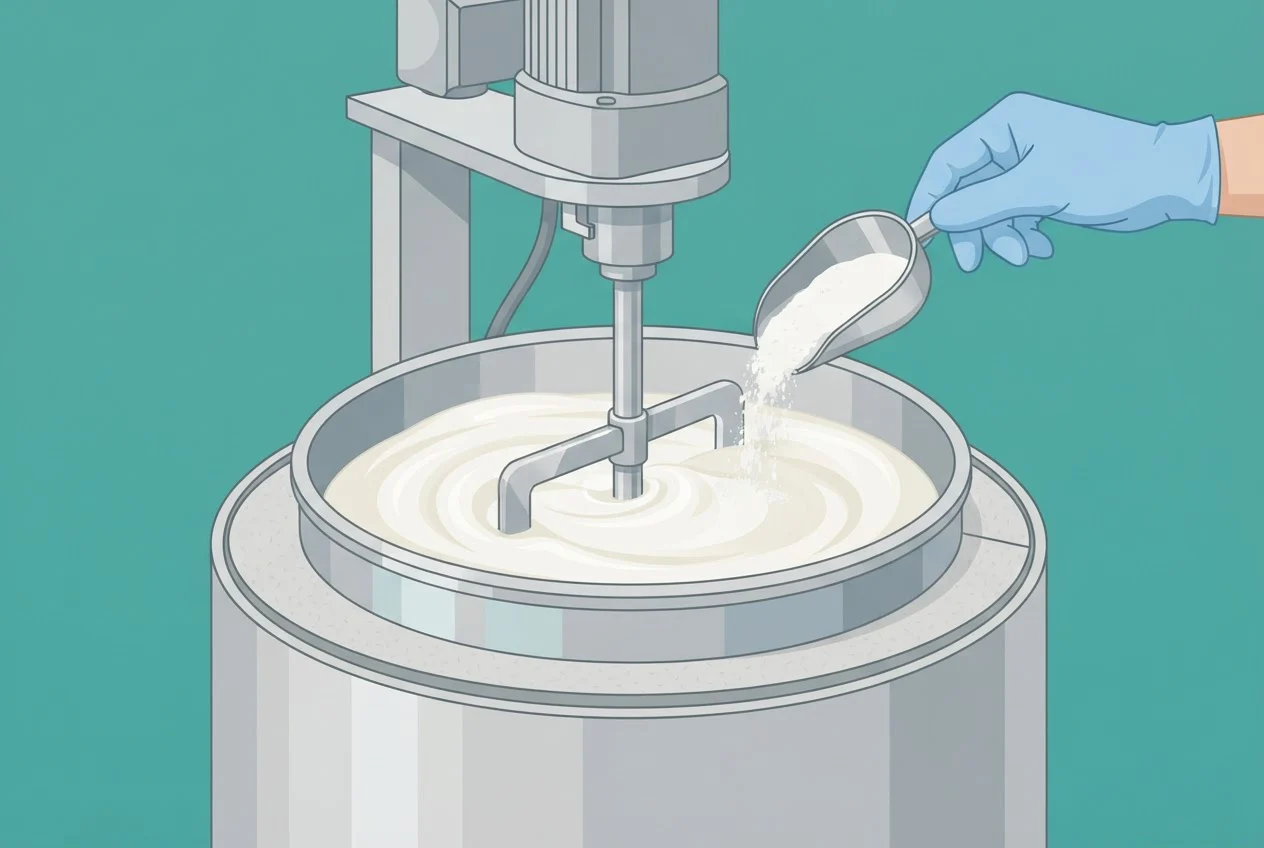
In-process controls for ointments are written tests on the bulk, set before filling. 21 CFR 211.110 requires written procedures for in-process controls, including adequacy of mixing to assure uniformity and homogeneity, and bioburden testing where appropriate. The attributes below come from FDA's SUPAC-SS.
| Attribute | Why it matters | How it is typically assessed | Record to request | Failure it catches |
|---|---|---|---|---|
| Solubility of the active in the base | SUPAC-SS flags actives near or above their solubility as critical to phase distribution | Solubility data, with optical microscopy | Development solubility data; microscopy at set points | Grittiness from undissolved or recrystallized active |
| Particle size and crystalline form of the active | Both are named in SUPAC-SS as tests that have shown consistent performance | Validated particle size method on the active; crystalline form check | Active specification; incoming and bulk results | Grittiness |
| Viscosity of the bulk | SUPAC-SS lists viscosity among the physical tests for consistent performance | Rheometer or viscometer at defined conditions (our recommendation) | Method, limits and trended results by batch | Batch-to-batch inconsistency |
| Homogeneity of the bulk | 21 CFR 211.110 requires adequacy of mixing | Samples from defined points in the vessel and in the filled containers (our recommendation) | Sampling plan and results | Separation of the dispersed phase, the instability Chow measured |
Limits come from the validated specification for each product. Ask for them in writing; this page does not set any.
Three further points:
- Hold times. 21 CFR 211.111 requires time limits for production phases when appropriate. Departures must be justified and recorded.
- In vitro release testing. FDA's SUPAC-SS says it is not required as a routine batch-to-batch quality control test. Its role is to judge sameness after scale-up and post-approval changes.
- Compendial references. USP general chapter <3>, Topical and Transdermal Drug Products—Product Quality Tests, covers quality tests for topical products, including uniformity of the active ingredient in semisolids (ECA Academy summary). USP <1724>, Semisolid Drug Products—Performance Tests, was revised and became official on December 1, 2023 (USP notice). It is guidance on developing in vitro release and permeation performance tests, not a routine release test (ECA Academy).
Step 4: How are ointments filled, sealed and packaged?
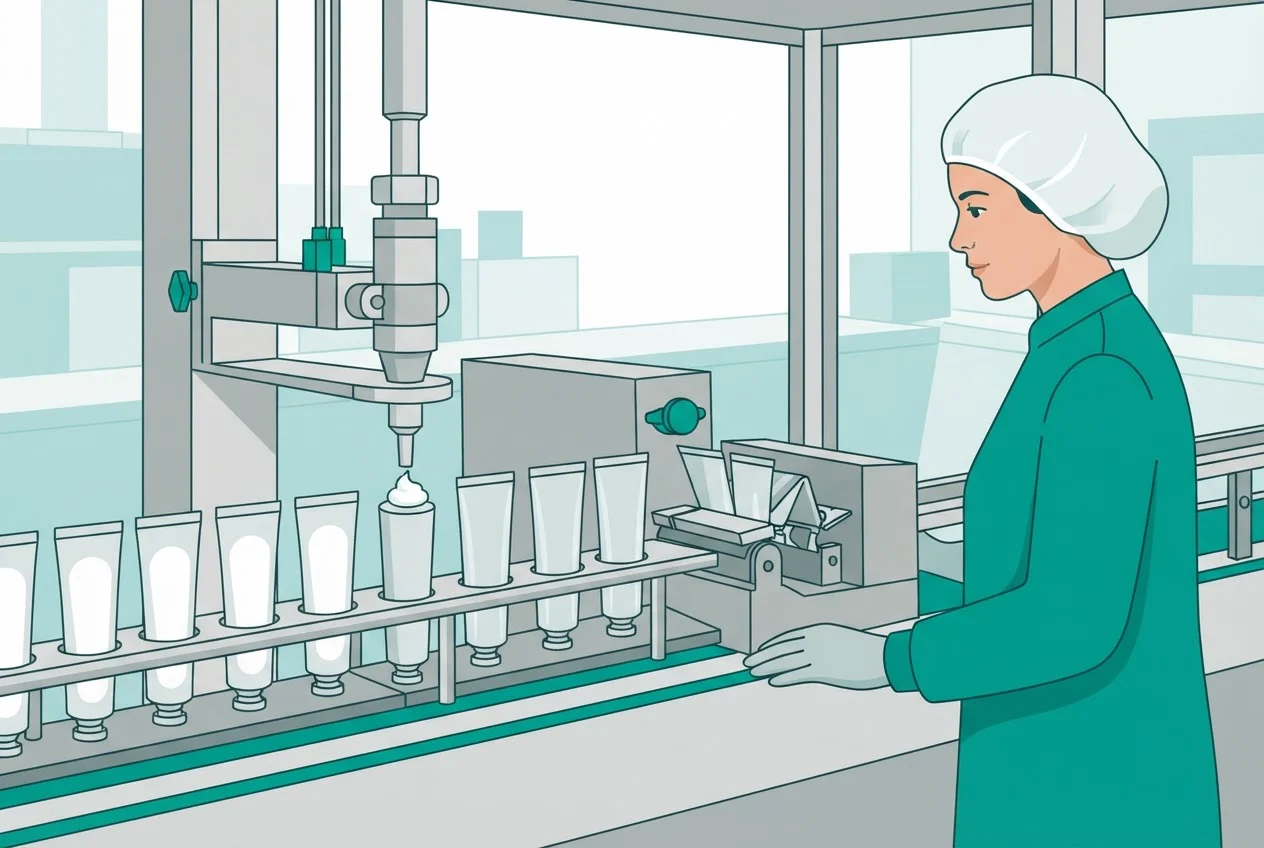
Filling moves the held bulk into tubes or jars, then seals and codes them. Pharmaguideline's description of an automatic line uses metering pumps into tubes, followed by pressing, crimping, coding and sealing stations. The record that matters is the packaging section of the batch record, which 21 CFR 211.188 requires. Stability is tested in the marketed container-closure system (21 CFR 211.166), so a change of tube or closure is a stability question.
Scale-up and process changes: what FDA SUPAC-SS means for a buyer
FDA's SUPAC-SS recommends how sponsors of approved new drug applications (NDAs), abbreviated new drug applications (ANDAs) and abbreviated antibiotic drug applications (AADAs) handle post-approval changes to nonsterile semisolids. It is a May 1997, non-binding guidance, not a good manufacturing practice (GMP) manual. Requirements vary by market and product status.
A manufacturer should classify every change to process, equipment, scale or site into a level and say what evidence follows. SUPAC-SS ranks changes from Level 1 (smallest risk, least data) to Level 3 (largest risk, most data). Here is the pattern in the guidance, summarized rather than reproduced:
| Category | Example change | Level | Typical tests and records |
|---|---|---|---|
| Process | Mixing rate, time, speeds or holding times within approved ranges; order of addition excluding actives | 1 | Product release requirements only; annual report |
| Process | Those parameters outside approved ranges; cooling rate; any change in how phases are combined | 2 | Updated executed batch records, accelerated stability data, in vitro release comparison with a pre-change lot; supplement |
| Equipment | Same design and operating principles | 1 | First production batch on stability; annual report |
| Equipment | Change in mixing equipment type, such as high shear to low shear | 2 | Stability data and in vitro release comparison; supplement |
| Batch size | Up to ten times the pivotal or biobatch size, same equipment design and procedures | 1 | Updated batch records; annual report |
| Batch size | Beyond ten times the pivotal or biobatch size | 2 | Stability data and in vitro release comparison; supplement |
| Site | Different campus; any change to a new contract manufacturer | 3 | New-site records, stability data, in vitro release comparison between sites; supplement |
No Level 3 category is defined for process, equipment or batch size. For a buyer, the practical reading is that mixing equipment and the manufacturing site are the two changes to lock down in the quality agreement. A move to a new contract manufacturer is always a Level 3 site change. See pharmaceutical quality agreement.
What to ask a contract manufacturer to document
Ask for eight documents before you commit to a project. Each row below is a test you can run on what you receive, with a pass and a fail. For how we run a project from inquiry to dispatch, see our third-party manufacturing overview.
| Request | Why it matters | Linked step |
|---|---|---|
| 1. Base and excipient rationale with certificates of analysis (CoAs) | Base class sets processing and performance. Pass: a written reason tying the base to release, stability and removal, plus a CoA per excipient lot used in development. Fail: a base named without reasons | Step 1 |
| 2. Master batch record with critical-parameter ranges | 21 CFR 211.186 requires complete manufacturing and control instructions. Pass: heating, mixing, homogenization, cooling, addition-order and hold parameters stated as ranges, with the study that supports them. Fail: single set-points or "as required". See batch manufacturing record | Step 2 |
| 3. In-process control plan with limits and sampling | 21 CFR 211.110 requires written procedures. Pass: each attribute has a method, sampling point, limit and action. Fail: "visual check" only | Step 3 |
| 4. Process validation summary including the bulk hold or aging step | SUPAC-SS says aging of finished bulk is critical. Pass: a defined hold-time limit supported by data. Fail: no hold limit | Step 3 |
| 5. Equipment list and equipment-change policy | A mixing-equipment type change is Level 2 under SUPAC-SS. Pass: the mixer and homogenizer type are listed, and a change requires your notice. Fail: "equivalent equipment may be substituted" | Step 2 |
| 6. Stability protocol | 21 CFR 211.166 requires a written stability program. Pass: storage conditions, time points and the marketed container-closure named, with conditions traceable to International Council for Harmonisation (ICH) Q1A(R2), whose general-case long-term conditions are 25 °C/60% relative humidity or 30 °C/65% and whose accelerated condition is 40 °C/75%. Semi-permeable containers may use different humidity conditions, so ask which applies. Fail: no marketed container | Step 4 |
| 7. Change-control procedure, including site change | SUPAC-SS levels determine the evidence for a change. Pass: changes classed by level, with notice to you before implementation. Fail: no notice commitment | SUPAC-SS section |
| 8. Cleaning and cross-contamination controls | 21 CFR 211.67 requires written cleaning procedures. Pass: procedure plus evidence that it removes the prior product's residue. Fail: procedure without evidence | Steps 2–4 |
Where to start with your ointment requirement
Three decisions carry most of the risk: the base class, the critical-parameter ranges written into the master batch record, and the change-control procedure that governs equipment, scale and site. Get those on paper before you compare suppliers, and test each document you receive against the pass and fail lines above.
A manufacturer that can hand over base rationale, parameter ranges, a control plan and a change-control procedure has answered most of your questions. One that cannot has told you something too.
To discuss a requirement with us, contact us or write to sunil@aarisepharma.com.
Frequently asked questions
Sources
- 1.Guidance for Industry: Nonsterile Semisolid Dosage Forms; Scale-Up and Postapproval Changes (SUPAC-SS), May 1997
- 2.FDA SUPAC-SS landing page
- 3.Influence of Manufacturing Process on the Microstructure, Stability, and Sensorial Properties of a Topical Ointment Formulation. Pharmaceutics 2023, 15(9), 2219
- 4.21 CFR §211.67
- 5.21 CFR §211.110
- 6.21 CFR §211.111
- 7.21 CFR §211.166
- 8.21 CFR §211.186
- 9.21 CFR §211.188
- 10.21 CFR §211.192
- 11.Pharmaceutical Dosage Forms
- 12.<3> Topical and Transdermal Drug Products–Product Quality Tests
- 13.<1724> revision notice
- 14.Revised USP chapter <3>
- 15.Semisolid Drug Product Quality and Performance Tests
- 16.Q1A(R2) Stability Testing of New Drug Substances and Products, Step 4, 6 February 2003
- 17.Ointments: Preparation and Evaluation of Drug Release
- 18.Manufacturing Procedure of Ointment and Tube Filling
- 19.Ointment and Cream Manufacturing: A Complete Guide to Formulation, Processes, and Quality Control, Pharma Now