
Glossary
Tablet Friability Test
A tablet friability test tumbles tablets for 100 rotations and measures weight lost. United States Pharmacopeia (USP) <1216> passes 1.0% loss or less (one run, or mean of three if repeated).

By Sunil Kumar, Managing Director - Sales · Updated 24 Oct 2026
On this page
- 01Definition
- 02Quick facts
- 03Friability and hardness: why a hard tablet can still fail
- 04How USP <1216> runs the friability test
- 05How much weight a tablet can lose before it fails
- 06What a failing friability result says about the formulation
- 07Friability vs hardness, capping and disintegration
- 08Specifying the friability test in a contract tablet agreement
- 09Does the 1.0% limit apply to coated, chewable and effervescent tablets?
- 10How Aarise Pharmaceuticals handles it
- 11Example
- 12Related terms
- 13Frequently asked
What is a tablet friability test?
A tablet friability test weighs tablets before and after tumbling and reports the percentage lost, showing their tendency to chip, crumble or break when handled.
Key takeaways
- A friability test runs 100 rotations at 25 revolutions per minute (rpm); USP <1216> passes a weight loss of no more than 1.0% and fails any sample with cracked, cleaved or broken tablets.
- At the limit, a 6.5 g sample may lose only 65 mg, so a single chipped corner can use a large part of the allowance.
- A failure often points to weak bonding at the tablet surface or edges (binder, granules, lubricant or press settings), not to a need for a harder tablet.
- A contract should name the method, limit, retest rule, test stage, exceptions and records, because the pharmacopoeia leaves several of those choices to the buyer.
Quick facts
- Set by
- USP <1216>, with the same figures in Ph. Eur. 2.9.7 and the WHO International Pharmacopoeia
- In force since
- August 1, 2023 (harmonized USP chapter)
- Run time
- About 4 minutes (100 rotations at 25 ±1 rpm)
- Applies to
- Tablets; Ph. Eur. 2.9.7 covers uncoated tablets only
- What buyers check
- Method, limit, retest rule, test stage, exceptions and records
Friability and hardness: why a hard tablet can still fail
A tablet can pass a hardness test and still fail friability. Hardness measures the force needed to crush a tablet. Friability measures how much material a tablet sheds when tumbled, which is closer to what happens in a coating pan, on a blister line and in a shipping carton. Breakage during coating, blistering and transport is exactly what the friability test is meant to predict.
That difference makes a failing result useful. It rarely means "press harder". It points to a binder, granule, lubricant or compression problem that a harder tablet can hide.
For a buyer, the result matters twice. It is a number on a batch record, and it is a clause in the contract that decides what happens when the number is bad.
How USP <1216> runs the friability test
USP <1216> tumbles about 6.5 g of tablets (or 10 tablets if heavier than 650 mg) in a drum for 100 rotations at 25 ±1 rpm, and weight loss of no more than 1.0% passes. The USP <1216> Tablet Friability harmonized chapter (official since August 1, 2023), the European Pharmacopoeia (Ph. Eur.) 2.9.7 method and the World Health Organization (WHO) International Pharmacopoeia use the same figures. The historical USP 32 text and BP 2012 method carry them too:
- Sample: for tablets of 650 mg or less, whole tablets as near as possible to 6.5 g. For heavier tablets, 10 tablets.
- Preparation: dedust the tablets before the run and after it.
- Drum: 283 to 291 mm in diameter and 36 to 40 mm deep, turning at 25 ±1 rpm for 100 rotations in total (about 4 minutes), not 100 per minute.
- Calculation: friability (%) = (W1 − W2) ÷ W1 × 100, where W1 is the starting weight and W2 the weight after tumbling and dedusting.
- Pass: run once. Weight loss of no more than 1.0% passes. If the loss is above 1.0% or the result is hard to read, repeat twice and take the mean of the three runs; the mean must be no more than 1.0%. Any obviously cracked, cleaved or broken tablet fails the sample.
- Adjustments: if tablets bind together, tilt the drum base about 10°. Hygroscopic tablets (those that absorb moisture) need a humidity-controlled room.
Check the current USP–NF wording before fixing a specification.
How much weight a tablet can lose before it fails
At 1.0%, a 6.5 g sample may lose 65 mg, and a 10-tablet sample of heavier tablets may lose 1% of its own mass. The table applies the USP sample-size rule above, with the allowance taken as 1.0% of sample mass.
One chipped corner against the 1.0% allowance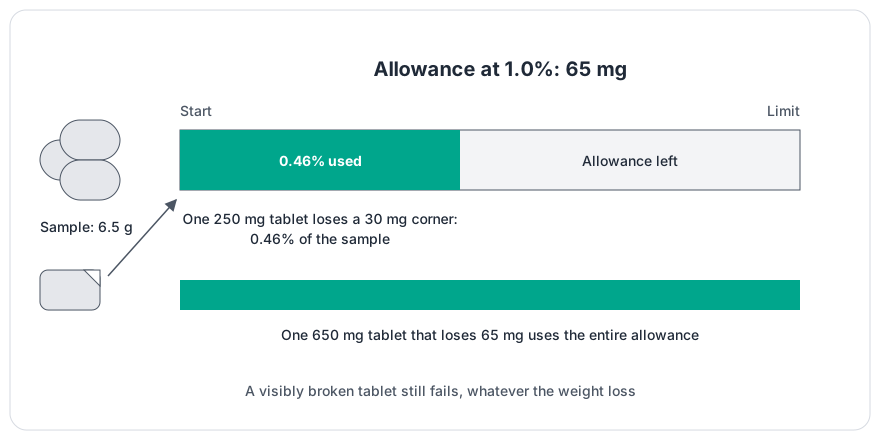
Three consequences follow:
- One 250 mg tablet that loses a 30 mg corner accounts for 30 ÷ 6,500 = 0.46% of the sample, almost half the allowance.
- One 650 mg tablet that loses 65 mg uses the entire allowance.
- Three runs of 0.6%, 0.9% and 1.3% average 0.93%. The mean passes even though one run exceeded the limit, and any visibly broken tablet still fails the sample whatever the weight loss.
- Unit weight
- 100 mg
- Tablets in sample
- 65
- Sample mass
- 6.5 g
- Maximum loss at 1.0%
- 65 mg
- Unit weight
- 250 mg
- Tablets in sample
- 26
- Sample mass
- 6.5 g
- Maximum loss at 1.0%
- 65 mg
- Unit weight
- 500 mg
- Tablets in sample
- 13
- Sample mass
- 6.5 g
- Maximum loss at 1.0%
- 65 mg
- Unit weight
- 650 mg
- Tablets in sample
- 10
- Sample mass
- 6.5 g
- Maximum loss at 1.0%
- 65 mg
- Unit weight
- 800 mg
- Tablets in sample
- 10
- Sample mass
- 8.0 g
- Maximum loss at 1.0%
- 80 mg
- Unit weight
- 1,000 mg
- Tablets in sample
- 10
- Sample mass
- 10.0 g
- Maximum loss at 1.0%
- 100 mg
What a failing friability result says about the formulation
A failure often means particles are poorly bonded at the tablet surface or edges. The usual culprits are the binder, granule quality, lubricant level and press settings. Raising hardness is not the cure, because past a point it slows disintegration and dissolution. The causes below, and the point about hardness, come from formulation experience, not a pharmacopoeial rule. One failing batch still needs an investigation to confirm which cause applies.
Fast-dissolving products make this trade-off sharper. A dispersible tablets guide explains why they are compressed at lower hardness.
- What you see in the drum
- Capping: the top layer ("cap") separates from the tablet
- Usual cause (formulation experience)
- Trapped air, press speed too high, too many fines
- Question for the manufacturer
- Is pre-compression (a light first compression that removes trapped air) used? What is the press speed and fines level?
- What you see in the drum
- Edges and embossing chip gradually
- Usual cause (formulation experience)
- Too little binder, over-lubrication, worn tooling
- Question for the manufacturer
- What are the binder level, lubricant blend time and tooling condition?
- What you see in the drum
- Passes breaking force, fails friability
- Usual cause (formulation experience)
- Over-compression causing capping or lamination (splitting into layers)
- Question for the manufacturer
- What is the compression force range and tablet thickness?
- What you see in the drum
- Brittle tablets from over-dried granules
- Usual cause (formulation experience)
- Granule moisture too low
- Question for the manufacturer
- What is the granule moisture limit at compression?
Friability vs hardness, capping and disintegration
The in-process checks listed in 21 CFR 211.110(a) name weight variation, disintegration and dissolution, not friability or hardness. Friability becomes a requirement because the buyer's specification and agreement say so.
- Aspect
- What it measures
- Friability
- Resistance to abrasion under tumbling
- Hardness
- Resistance to crushing (breaking force)
- Capping and lamination
- Defects of the tablet body: top layer separating, or splitting into layers
- Disintegration and dissolution
- How the tablet releases drug
- Aspect
- Role in a friability failure
- Friability
- The test that reports the failure
- Hardness
- A tablet can pass it and still fail friability
- Capping and lamination
- Often the cause of friability failures
- Disintegration and dissolution
- Measures release, not how the tablet survives handling
Specifying the friability test in a contract tablet agreement
Put the method, limit, retest rule, test stage, exceptions and records in the specification, and put out-of-specification handling in the quality agreement. FDA's quality agreement guidance says the agreement should state which party carries out each CGMP (current good manufacturing practice) activity. A pharmaceutical quality agreement covers the wider document.
Paste-ready lines:
- Method: "Friability per USP <1216>: 25 ±1 rpm, 100 rotations; about 6.5 g if unit weight is 650 mg or less, otherwise 10 tablets; dedusted before and after." Pass: the batch record shows each parameter.
- Limit: "Weight loss NMT (not more than) 1.0% on a single run, or on the mean of three runs if repeated. Any cracked, cleaved or broken tablet fails." Pass: the record shows the result and a visual check.
- Retest rule: "A single run above 1.0% triggers three runs; each run and the mean are reported." This is recommended, because the mean alone can hide one bad run.
- Stage: state whether friability is checked in-process at compression (with frequency), at release, or both. Pass: the frequency is a number, not "periodically".
- Exceptions: name coated, chewable, effervescent and hygroscopic products, each with its own limit and conditions. Pass: each listed product type has its own written limit and test conditions. Fail: a coated or chewable product is covered only by the 1.0% default.
- Records: friabilator (the tumbling-drum instrument) ID, balance ID, tablet count, and before and after weights. Pass: the batch record contains all five fields for every run.
- Out of specification: who investigates, within how many days, and who decides lot disposition (the decision to release, rework or reject a batch). Pass: the clause names an owner, a day limit and a lot-disposition decision-maker.
Does the 1.0% limit apply to coated, chewable and effervescent tablets?
Not automatically. The 1.0% limit applies to most products; USP says chewable and effervescent tablets may have different specifications, and Ph. Eur. 2.9.7 covers uncoated tablets only. For a coated product, it is recommended to agree in writing whether friability is tested on the cores before coating or on the finished tablet, and what limit applies.
How Aarise Pharmaceuticals handles it
We offer tablets within our oral-dose CDMO (contract development and manufacturing organization) services, from product development through commercial manufacturing. Our route runs from inquiry to feasibility review, commercial quotation, development or technical transfer, production and quality control, packaging and dispatch. Put your friability clause in the first inquiry so it is on the table from the start.
Send the strength, unit weight, coated or uncoated status and your clause through our contact form. See third party manufacturing pharma and pharmaceutical technology transfer for what to prepare.
Example
A buyer specifies 800 mg tablets, so the sample is 10 tablets weighing 8.0 g and the 1.0% allowance is 80 mg. If the tablets weigh 7.94 g after tumbling and dedusting, the loss is (8.00 − 7.94) ÷ 8.00 × 100 = 0.75%, which passes, provided no tablet is cracked, cleaved or broken.
Frequently asked
Sources
- 1.USP <1216> Tablet Friability, harmonized chapter (official August 1, 2023)
- 2.WHO International Pharmacopoeia, friability test (10.4.5)
- 3.21 CFR 211.110, sampling and testing of in-process materials
- 4.FDA, Contract Manufacturing Arrangements for Drugs: Quality Agreements (November 2016)
- 5.USP 32 text of <1216> (historical copy)
- 6.BP 2012, friability of uncoated tablets (historical copy)