
Glossary
Tablet Capping
Tablet capping is the separation of a tablet's top or bottom crown during or after compression. It stems from air, elastic recovery and process settings, so buyers should ask for validated controls.

By Sunil Kumar, Managing Director - Sales · Updated 24 Oct 2026
On this page
- 01Definition
- 02Introduction
- 03How tablet capping differs from lamination
- 04What causes tablet capping: the formulation or the press?
- 05Why does capping often appear only at production scale?
- 06Which process controls should you ask a contract tablet manufacturer about?
- 07How Aarise Pharmaceuticals handles it
- 08Example
- 09Related terms
- 10Frequently asked
What is tablet capping?
Tablet capping is the partial or complete separation of a tablet's upper or lower crown from its body.
Key takeaways
- Capping is a cohesion failure at the tablet crown. It is caused by the powder and the press together, never by one setting alone.
- A capped tablet breaks at the crown. A laminated tablet splits into layers anywhere in its body.
- Limits for fines, moisture and precompression depend on the formulation.
- Ask for evidence at commercial press speed.
Introduction
A blend that presses cleanly on a small development press can cap on a faster production press. Less time is available for trapped air to escape, and the powder, the press and the tooling all contribute. That is why one reassuring setting from a supplier tells a buyer very little.
The defect often surfaces only when production speed rises. A batch that misses specification must then be investigated, whether or not it has shipped, and rejected in-process material is quarantined. Title 21 of the Code of Federal Regulations (21 CFR) section 211.110 requires written in-process control procedures, so a manufacturer should be able to show them.
A buyer rarely adjusts the press. A buyer decides which manufacturer to trust with the formulation. The questions below turn that decision into checks with a pass and a fail, so answers from different suppliers can be compared. They are written for pharmaceutical and formulation buyers, contract formulators and distributors who outsource tablets.
How tablet capping differs from lamination
Lamination is separation into two or more layers anywhere in the tablet. Both defects mean the particles did not bond firmly enough, so they share causes, and even experienced staff confuse them (Tablets & Capsules, 2026).
Capping versus lamination: where the tablet separates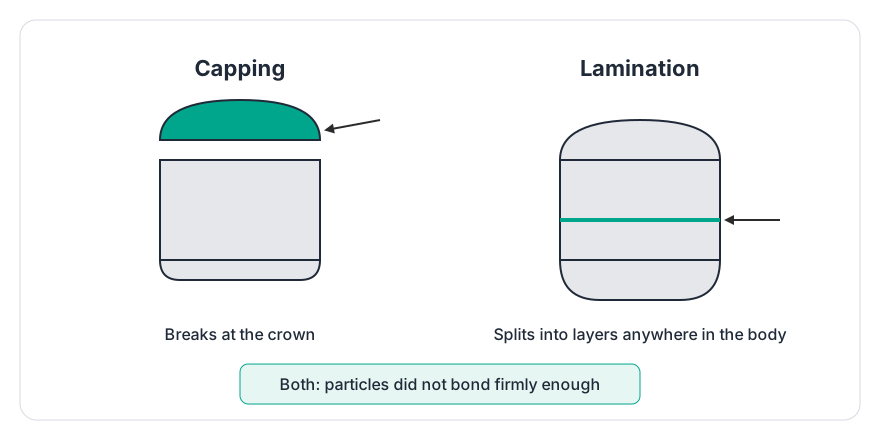
Chipping and picking are separate defects with their own causes. Capped tablets matter to a buyer because of friability testing, in which tablets are tumbled in a drum. A capped tablet is likely to break apart when tumbled. United States Pharmacopeia (USP) general chapter <1216> fails any sample containing obviously cracked, cleaved or broken tablets after tumbling, and accepts weight loss of not more than 1.0% from a single test or the mean of three tests for most products (USP <1216> Tablet Friability, harmonized text official August 1, 2023).
Moisture cannot name the cause on its own. It is one input among compaction force, lubricant level and fines, so correlate it with hardness (tablet breaking force, the force needed to break the tablet) and defect frequency.
What causes tablet capping: the formulation or the press?
Both. Air trapped in the powder bed and elastic recovery (the powder springing back as pressure is released) pull the crown away when the punch lifts. The cause then sits in the blend, the compression settings or the tooling, and usually in an interaction between them.
Air entrapment is measurable. In a study on celecoxib powder, in-die elastic recovery (how much the compacted powder springs back while still in the die) rose from about 4% at a main compaction pressure of 150 megapascals (MPa, a unit of pressure) to about 14% at 200 MPa and above, and adding a precompression step removed that jump (Vreeman and Sun, Int J Pharm 2022). Precompression is a light first squeeze that expels air before the main compression.
Formulation causes: a high share of fines (particles under 75 µm; above roughly 10% typically raises capping, per Tablets & Capsules), and binder, lubricant and moisture levels that weaken granule bonding. Compression causes: excessive force, short dwell time (how long the powder stays under pressure), and worn punches and dies.
Why does capping often appear only at production scale?
Capping often appears first at production scale because a faster commercial press shortens dwell time, leaving less time for air to escape. That is inferred from air-entrapment research. The celecoxib study (one compound) found that slowing the press and adding precompression mitigated air-entrapment lamination, the same air-entrapment mechanism that is one cause of capping (Vreeman and Sun, 2022). Commercial speeds are inferred to raise capping risk the same way.
So a clean development batch does not prove a clean commercial batch. Ask for evidence at commercial speed, and make sure the handover covers it (pharmaceutical technology transfer).
Which process controls should you ask a contract tablet manufacturer about?
Ask eight questions, and accept only answers that name a validated, written control. Limits for fines, moisture and precompression depend on the formulation, so a pass is a range backed by data, and a fail is a generic number or a verbal assurance.
The in-process and defect questions rest on these rules, as of October 2026. 21 CFR 211.110 requires written in-process control procedures covering, where appropriate, tablet weight variation, disintegration time, mixing adequacy and dissolution, and requires rejected in-process material to be quarantined (21 CFR 211.110). The U.S. Food and Drug Administration (FDA) inspection guide for dosage-form manufacturers also lists hardness, thickness and friability as in-process tests (guide dated 1993; FDA). A batch that misses specification must be thoroughly investigated whether or not it has shipped (21 CFR 211.192).
What press speed range is validated, and how does it compare with development?
Pass: a written speed range with results from batches pressed at the commercial speed, compared against development batches. Fail: "normal speed" with no results.
How was precompression set?
Pass: chosen from in-die elastic recovery or similar formulation data and recorded in the batch record. Fail: a fixed rule with no data.
What is the main compression force range?
Pass: a written range with results at both ends and the force at which defects begin recorded. Fail: a single set point.
What are the granule specifications?
Pass: fines, moisture, binder, lubricant and blend time each have a written specification supported by batch data from this product's development or validation runs. Fail: values copied from another product or stated without data.
How is tooling controlled?
Pass: a written inspection schedule, a wear limit and a replacement trigger. Fail: tooling replaced "when needed".
Which in-process checks run?
Pass: weight, thickness, hardness and friability, with frequency and limits in writing. Fail: no written frequency.
What happens after a defect?
Pass: quarantine and a written investigation that reaches related batches. Fail: rework without a record.
What is the batch acceptance rule?
Pass: a friability criterion in the specification, with no cracked or cleaved tablets accepted. Fail: no stated criterion.
How Aarise Pharmaceuticals handles it
Tablets are among our finished-dose categories, and whether we can make yours is settled at feasibility review. We are a technology-driven contract development and manufacturing organization (CDMO) for oral dosage forms, working from product development through commercial manufacturing. Our route runs from inquiry and feasibility review to quotation, development or technical transfer, production and quality control, packaging and dispatch.
Bring the questions above to the feasibility review, and ask for the answers in writing for your formulation. Our guide to third-party pharmaceutical manufacturing covers wider supplier checks.
To start, use the contact form. WhatsApp is also available at +91 9899783330.
Example
In the celecoxib powder study, in-die elastic recovery rose from about 4% at a main compaction pressure of 150 MPa to about 14% at 200 MPa and above, and adding a precompression step removed that jump. A buyer comparing suppliers can therefore ask whether precompression was set from elastic recovery data like this, rather than from a fixed rule.
Frequently asked
Sources
- 1.Vreeman G, Sun CC. Air entrapment during tablet compression. Int J Pharm, 2022 (PubMed)
- 2.21 CFR 211.110, In-process sampling and testing
- 3.21 CFR 211.192, Production record review
- 4.FDA, Dosage Form Drug Manufacturers cGMPs inspection guide (1993)
- 5.USP <1216> Tablet Friability, harmonized text official August 1, 2023
- 6.Tablets & Capsules, Tablet Delamination and Capping: Developing a Game Plan (2026)