Effervescent Tablet Formulation: Moisture Questions for a CMO
Effervescent tablet formulation pairs an acid with a bicarbonate, so moisture is the main risk. Ask any contract manufacturer for its humidity limit, raw-material water limits and final-pack stability data.

By Sunil Kumar, Managing Director - Sales · Updated 9 Nov 2026
Key takeaways
- An effervescent tablet formulation pairs an acid with a bicarbonate, and every moisture source in the process (air, raw materials, pack) can start the reaction early.
- Ingredient choice and manufacturing route decide where water enters: the form of citric acid, the lubricant, and whether the process uses water, solvent or heat.
- US drug good manufacturing practice (GMP) rules set no humidity figure. Published guidance sets ceilings of 20% to 30% relative humidity (RH), so “controlled humidity” means nothing until a CMO gives a number.
- Stability data must come from the pack you will sell. As of November 2026, that means 21 Code of Federal Regulations (CFR) 211.166(a)(4) for drugs, and International Council for Harmonisation (ICH) Q1A(R2) conditions of 25 °C/60% RH or 30 °C/65% RH, plus 40 °C/75% RH accelerated.
In this article
- 1What is effervescent tablet formulation, and why does moisture decide it?
- 2What goes into an effervescent tablet formulation?
- 3How much water does the reaction itself release?
- 4How is an effervescent tablet made, and where does water enter?
- 5What humidity does an effervescent production room need?
- 6How fast does a finished effervescent tablet pick up water?
- 7Which packaging protects effervescent tablets, and how should a CMO prove it?
- 8Does stability data have to come from the final pack?
- 9What 12 questions should you ask an effervescent tablet CMO?
- 10Which questions test humidity control in the production rooms?
- 11Which questions test water in raw materials and the finished tablet?
- 12Which questions test the pack?
- 13Which questions test stability and deviations?
- 14How do we handle an effervescent tablet inquiry at Aarise?
- 15What should you do before you shortlist a CMO?
- 16Frequently asked questions
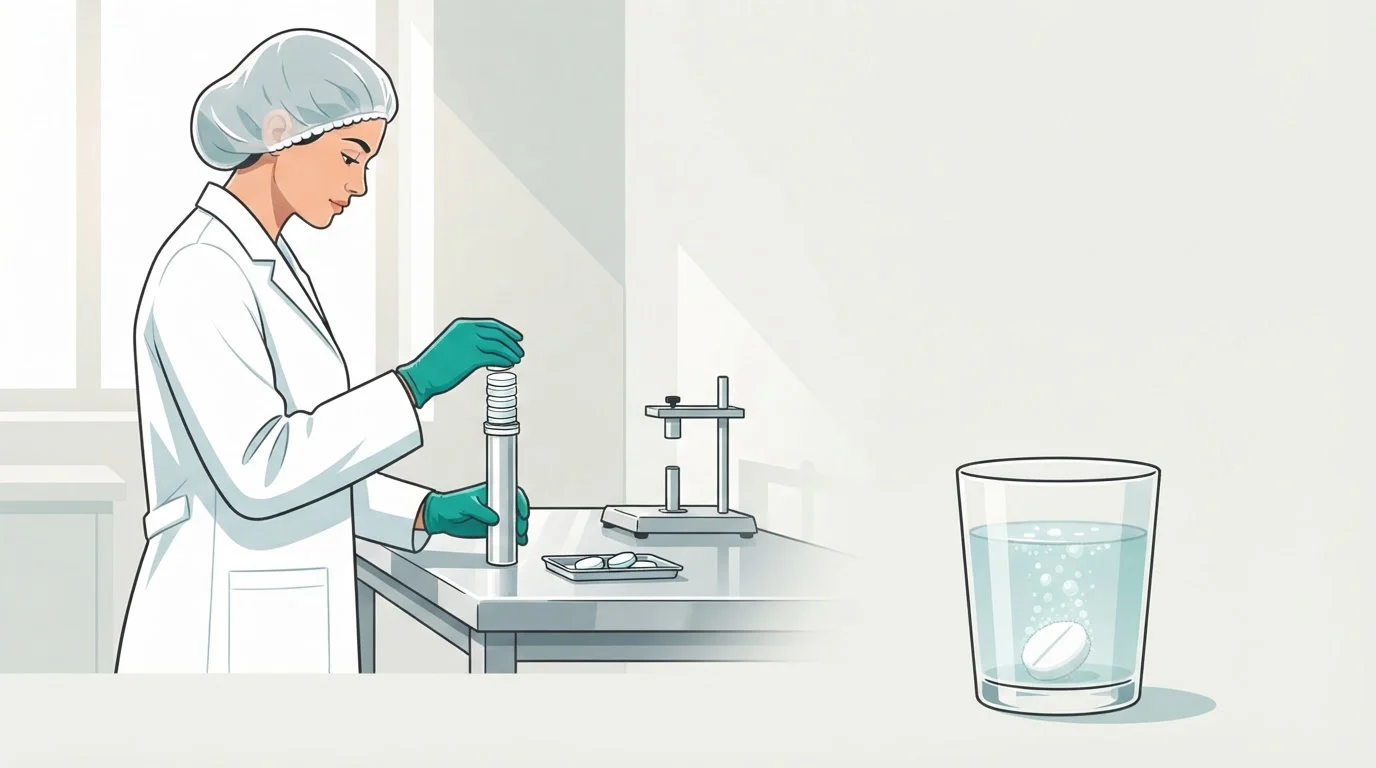
An effervescent tablet formulation rests on one line of chemistry. An acid and a bicarbonate stay inert while dry, then release carbon dioxide the moment water arrives. That water does not have to come from a glass. Humid air in a press room, water bound inside a raw material or a leaking tube can start the same reaction early.
This is why the formula is the easy part of a contract. Two suppliers can quote the same citric acid and sodium bicarbonate blend and deliver tablets that behave very differently after six months. The difference is whether each one keeps water out at every step, from raw material receipt and granulation to sealing.
This page is for buyers choosing a contract manufacturer (CMO), a company that makes your product for you. It covers the reaction, the main ingredients and manufacturing routes, a worked water calculation, the humidity figures published for effervescent production, and a 12-question sheet to put to any CMO.
What is effervescent tablet formulation, and why does moisture decide it?
Effervescent tablet formulation combines an acid source, usually citric or tartaric acid, with a carbonate source, usually sodium bicarbonate, plus the active ingredient and a few excipients (inactive ingredients). The tablet fizzes in water because the acid and bicarbonate react. Moisture is therefore the central risk, because the same reaction can start without a glass of water.
With citric acid the balanced reaction is:
C₆H₈O₇ + 3 NaHCO₃ → Na₃C₆H₅O₇ + 3 CO₂ + 3 H₂O
A published acetaminophen formulation shows the typical build: tartaric acid, citric acid and sodium bicarbonate as the couple, mannitol as filler and polyethylene glycol (PEG) 6000 as lubricant (Aslani and Eatesam, 2013). The recipe is textbook material. What separates a good batch from a failed one is how dry it stays.
What goes into an effervescent tablet formulation?
Every ingredient in an effervescent tablet formulation does one of three jobs: it carries the active, it makes the fizz, or it keeps the tablet stable until water arrives. The table lists the main groups and the question each one raises for a CMO.
| Ingredient group | Typical choices | Moisture or quality question | Ask the CMO |
|---|---|---|---|
| Acid source | Citric acid is the usual choice; tartaric, malic and fumaric acids also appear | Citric acid comes as anhydrous or monohydrate, and the hydrate adds water to the blend | Which acid, which form, and what water limit per lot? |
| Carbonate source | Sodium bicarbonate is the most common; sodium carbonate and potassium bicarbonate are also used | The carbonate is a raw material that can pick up water, and it adds sodium to every tablet | What is the water limit per lot, and how much sodium does one tablet carry? |
| Binder or filler | Water-soluble materials such as mannitol, sorbitol, xylitol, lactose or dextrose | It must dissolve cleanly and arrive dry | Why this material, and what is its water limit? |
| Lubricant | Water-soluble types such as polyethylene glycol 6000 or sodium benzoate; magnesium stearate does not dissolve in water | A lubricant that does not dissolve can slow breakdown and leave residue | Which lubricant, and does the finished solution stay clear? |
| Sweetener, flavor, color | Sucralose, aspartame, stevia or sorbitol; flavors are typically 0.5% to 3.0% of the dose | Each is another raw material with its own water content | Is each one covered by a water limit in the specification? |
Sources for the table: Nahata et al., 2025, Selvita, 2026 and ScienceDirect Topics.
Two points cut across the table. First, an effervescent tablet needs no separate disintegrant, because the gas from the reaction breaks the tablet apart, and the formula can be little more than acid, carbonate, sweetener, flavor and color.
Second, the active has to tolerate acid. Acid-sensitive drugs can degrade in an effervescent system, and an excipient compatibility study is one way to test the blend before scale-up. For definitions of the other ingredients, see our glossary entry on tablet excipients.
How much water does the reaction itself release?
Each gram of anhydrous citric acid that reacts with sodium bicarbonate releases 0.281 g of water. This is our own calculation from molar masses, and it shows why a trace of moisture matters: every reacting molecule of acid produces three molecules of water.
Our working, using molar masses of citric acid 192.12 g/mol, sodium bicarbonate 84.01, water 18.015 and CO₂ 44.01:
- 1 g citric acid is 5.205 mmol.
- The equation needs three times that, 15.61 mmol, of bicarbonate, which is 1.31 g.
- It releases 15.61 mmol of water (0.281 g) and 15.61 mmol of CO₂ (0.687 g).
Our inference from this: once a little reaction starts, it supplies water to itself, so early reaction tends to accelerate.
The same arithmetic applies to the starting materials. Citric acid monohydrate (210.14 g/mol) is 8.57% water by weight (18.015 ÷ 210.14). The finished tablets in the acetaminophen study were reported as under 0.5% water (Aslani and Eatesam, 2013, results text and Table 6). That is an upper bound, so the hydrate form carries at least 17 times the level found in the finished tablets (8.57 ÷ 0.5, our arithmetic; it compares the water fraction of a raw material with that of a finished tablet). The form of citric acid you specify can matter as much as the room. Moisture can be measured by Karl Fischer titration or by loss on drying (weight lost when a sample is heated).
How is an effervescent tablet made, and where does water enter?
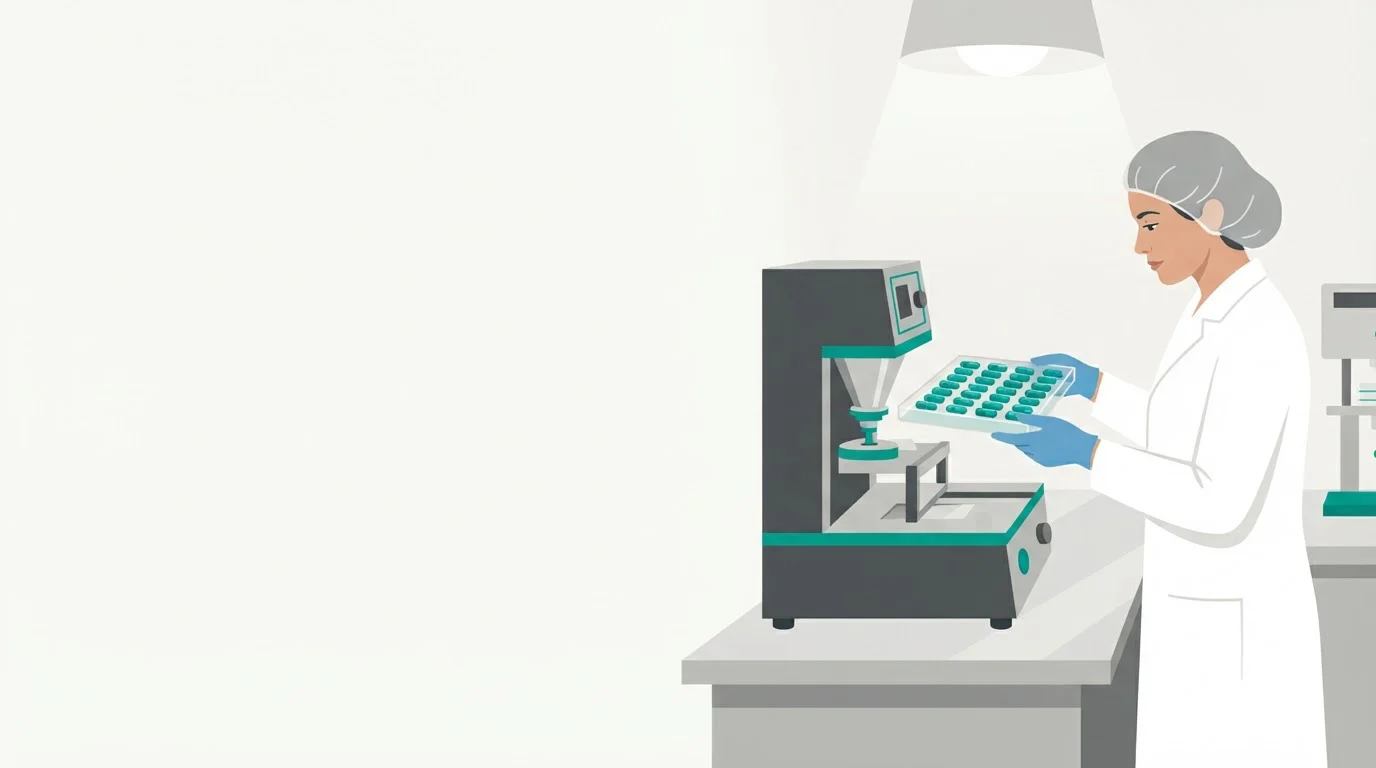
Effervescent tablets are made from granules or from a direct blend, and the route sets where water or solvent touches the formula. Published sources disagree on which route is most common: Selvita calls wet granulation the most commonly used, while Pharmapproach says traditional wet granulation is seldom used. Ask which route a CMO will use for your product, and why.
| Route | How it works | Where water or solvent enters |
|---|---|---|
| Wet granulation | Acid and bicarbonate are granulated, together or separately, with ethanol, isopropanol or a very small, carefully added amount of water (0.1% to 1.0% w/w), then dried | The binding liquid. Drying time and temperature then affect tablet hardness and disintegration time, and drying can be long and costly |
| Fusion | The blend is heated to about 100 °C to release the hydration water of citric acid monohydrate, moistened with ethanol and kneaded into granules. Tablets are dried at 70 °C to 75 °C | The hydrate water, used on purpose and then dried out |
| Dry granulation | Roller compaction or slugging presses the powder into flakes or slugs, which are milled into granules | No binding liquid, but it needs more excipient, which leaves less room for the active |
| Direct compression | The blend is compressed with no granulation step | No added liquid, but the blend is hygroscopic, compresses poorly and can react during compression, so it needs carefully chosen or pre-processed raw materials |
Newer routes aim to remove the liquid altogether. A 2025 Pharmaceutics paper reported effervescent granules made by twin-screw melt granulation with sorbitol as the binder, which the authors describe as a first. Selvita notes that melt granulation needs specialized equipment and is the least understood of the routes.
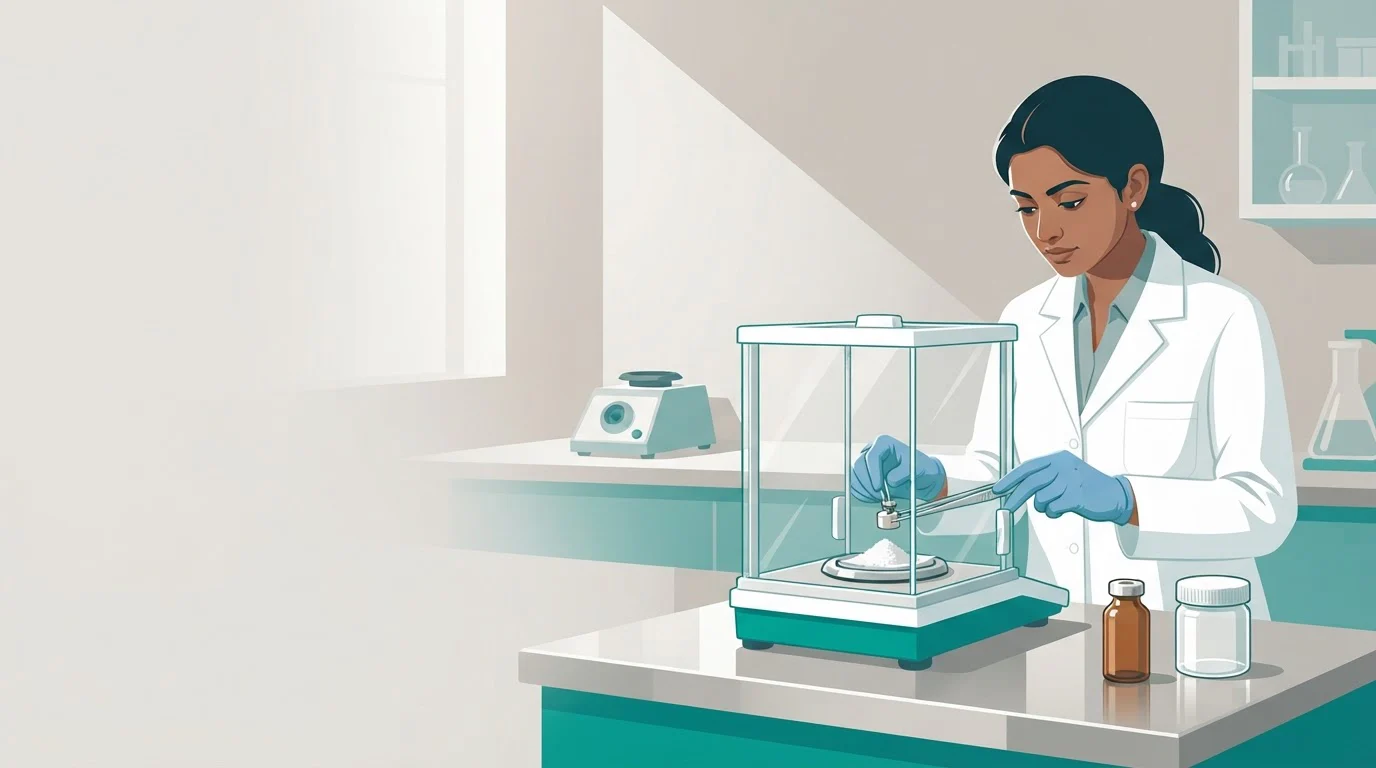
Before release, a CMO should test more than appearance. The sources describe disintegration (effervescence) time, carbon dioxide content, water content, hardness and friability, and hardness and friability matter because large effervescent tablets chip easily.
Our recommendation: ask the CMO to name the route, the step where water or solvent enters, and the in-process moisture check after drying. Then match that answer to the citric acid form in question 3, because a process built for anhydrous acid is not automatically safe for the monohydrate (our inference).
What humidity does an effervescent production room need?
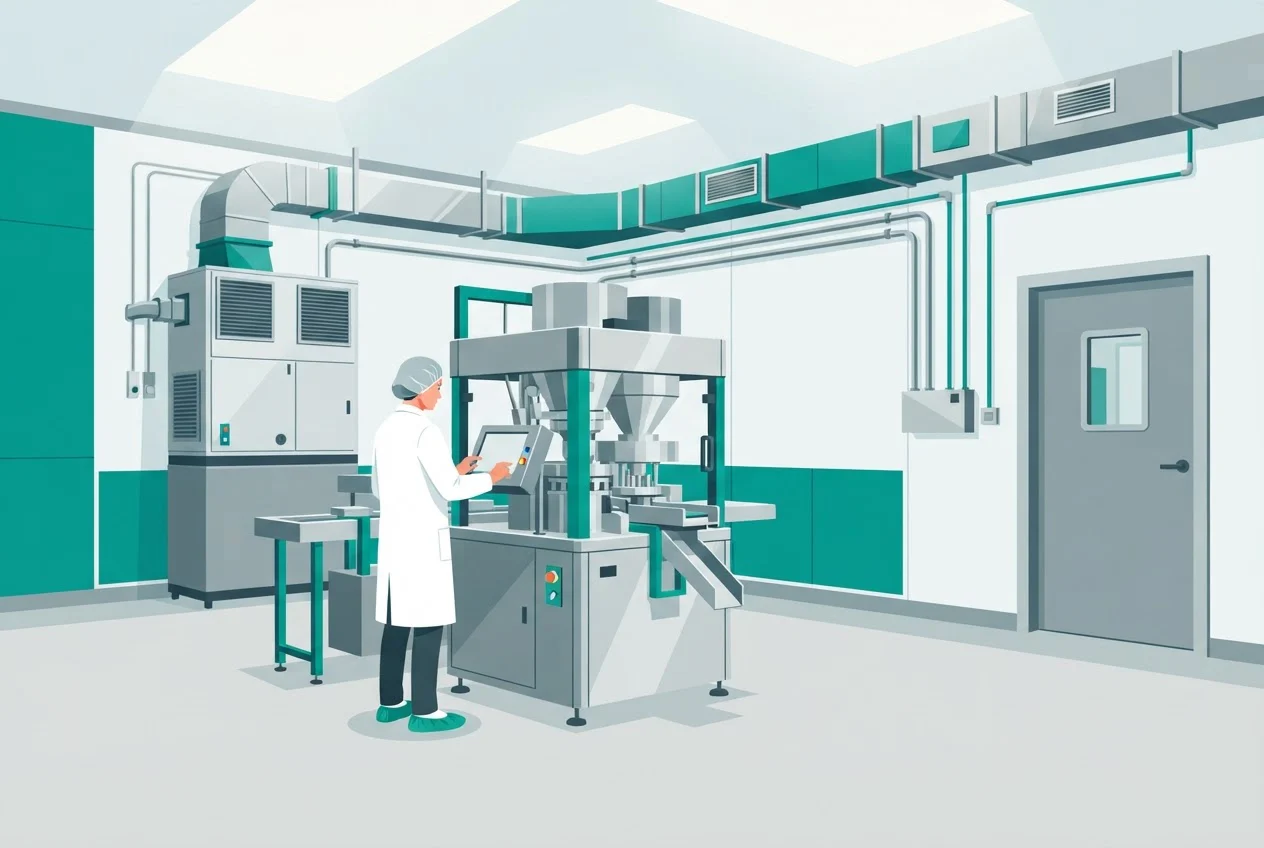
Published guidance sets effervescent production-room ceilings of 20% to 30% relative humidity; US drug rules (21 CFR 211.46(b), as of November 2026) require humidity control but name no figure.
The rule asks for equipment giving "adequate control over air pressure, micro-organisms, dust, humidity, and temperature" when appropriate for manufacture, processing, packing or holding of a drug product. The published guidance sets ceilings:
| Source | Relative humidity ceiling | Temperature |
|---|---|---|
Aslani and Eatesam, 2013, peer-reviewed study (introduction, citing an earlier reference) | under 25% | under 25 °C |
| maximum 25% | 25 °C | |
| under 20%, for the entire tableting room | under 20 °C | |
| under 20%; also quotes production areas at up to 30% | 21 °C |
These four sources give ceilings from 20% to 30% RH. They are study notes, a lab study, a review and a press maker's trade article, not a regulator's standard, so treat them as a range rather than a rule.
Our recommendation: ask for the validated set point and the alert and action limits for each room, and expect them at or below 25% RH unless the CMO can justify more. Ask whether the control covers the whole room, not just the press, as the Kilian trade article advises.
How fast does a finished effervescent tablet pick up water?
In one published study of acetaminophen effervescent tablets, moisture content rose within seven days at 60%, 71% and 90% relative humidity (18 °C), so a tablet made dry is not protected once exposed. Tablets of three formulations were held at those humidities, and equilibrium moisture content was higher on day 7 than on day 1 in every case (Aslani and Eatesam, 2013, Table 7).
This is one study on one drug and three formulations, measured in saturated-salt chambers rather than in opened packs, so it shows direction, not a shelf-life figure for your product. The paper states that tablets were placed in foil coats after compression. The pack is the second half of moisture control, and the next section covers it.
Which packaging protects effervescent tablets, and how should a CMO prove it?
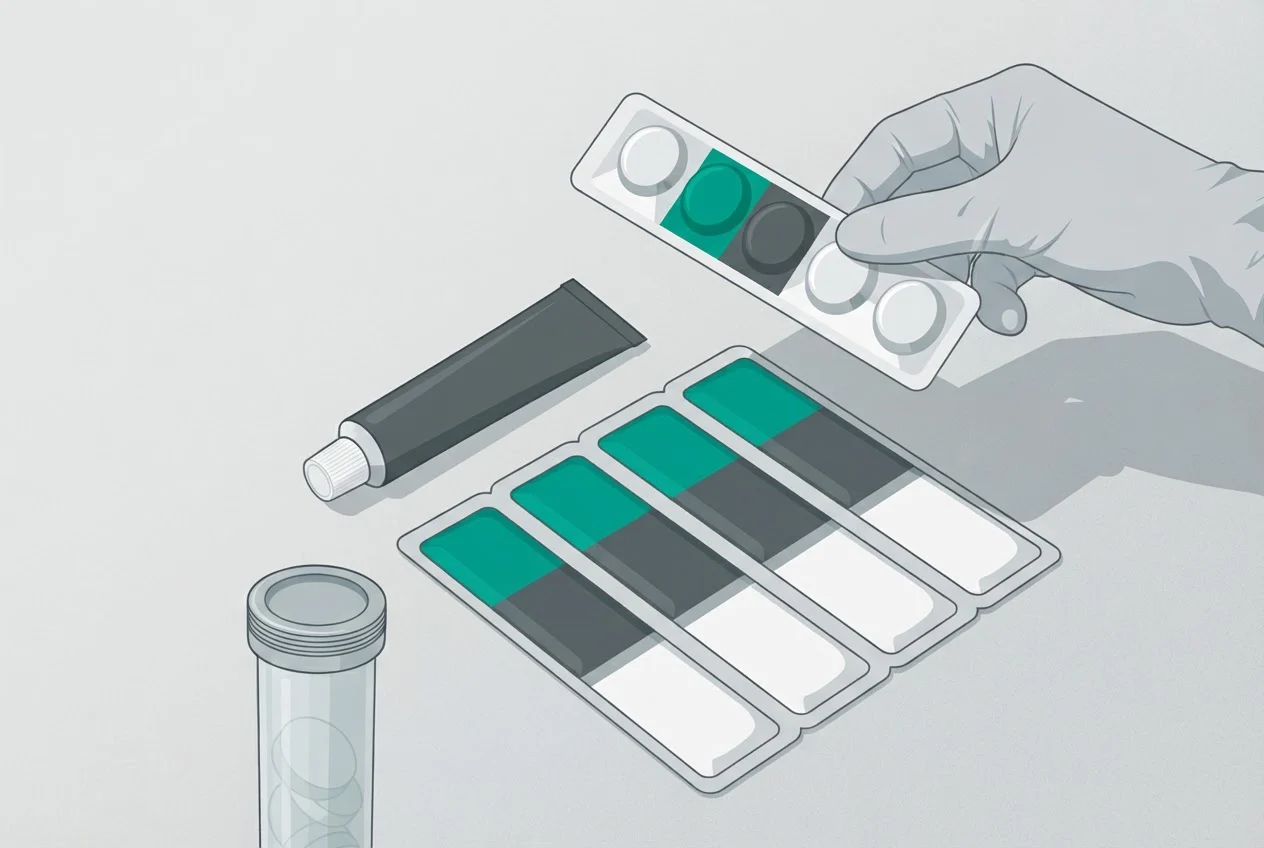
Effervescent tablets need a moisture barrier pack: sealed individual strips or blisters, or tubes with a desiccant (drying agent) in the cap. The options in the Pharmapproach study notes run from glass tubes, which give the most protection, through seamless aluminum tubes, which are impervious to moisture, to plastic tubes, which are less protective because plastic is permeable to moisture vapor. In strip packs, each tablet stays sealed until use.
Two checks turn "good packaging" into evidence:
- The legal standard. As of November 2026, container closure systems "shall provide adequate protection against foreseeable external factors in storage and use that can cause deterioration" (21 CFR 211.94(b)).
- Barrier data. As of November 2026, the current revision of United States Pharmacopeia (USP) <671>, official since 1 December 2025, sets the moisture-permeation test for packaging used with solid oral dosage forms (USP–NF). Ask for the result for your exact container and closure.
For the trade-offs between strip and blister formats, see our guide to pharmaceutical blister packaging.
Does stability data have to come from the final pack?
For a drug product, yes. As of November 2026, 21 CFR 211.166(a)(4) requires stability testing "in the same container-closure system as that in which the drug product is marketed" (21 CFR 211.166(a)(4)). As of November 2026, the international stability guideline says the same of the dosage form "packaged in the container closure system proposed for marketing" (ICH Q1A(R2), section 2.2.4).
For the general case, ICH Q1A(R2) lists long-term conditions of 25 °C/60% RH or 30 °C/65% RH and accelerated conditions of 40 °C/75% RH. Which long-term condition suits your market is covered in our guide to ICH stability zones. ICH published a consolidated draft of ICH Q1 in April 2025 to replace the Q1A to Q1F series, so check ICH's quality guidelines page for its adoption status before you agree a stability protocol. A tablet that passed in a glass tube proves nothing about a plastic one.
Many vitamin effervescents are sold as dietary supplements, which fall under a different GMP rule, 21 CFR Part 111. As of November 2026, our recommendation for a supplement is to ask for final-pack stability data anyway, because the supplement label's expiry rests on it. The humidity and packaging questions below apply either way.
What 12 questions should you ask an effervescent tablet CMO?
Ask these twelve, and ask for the document in the middle column. A pass is a written answer you can check; a fail is the answer that should make you pause. Our recommendations are marked; the rest follow the sources above.
Which questions test humidity control in the production rooms?
| # | Question | Evidence to request | Pass / fail |
|---|---|---|---|
| 1 | What RH and temperature are validated for granulation, compression and packing? | Room qualification report, monitoring trend | Pass: numbers with alert and action limits, at or below 25% RH unless justified (our recommendation). Fail: "controlled" with no figure |
| 2 | Is the whole room controlled, or only the press? | Room layout, sensor locations | Pass: sensors in press, filling and packing areas. Fail: sensors only at the press |
Which questions test water in raw materials and the finished tablet?
| # | Question | Evidence to request | Pass / fail |
|---|---|---|---|
| 3 | Is the citric acid anhydrous or monohydrate? | Formula and raw-material specification | Pass: form named, with a water limit per lot. Fail: form or water limit not stated |
| 4 | How are opened drums of acid and bicarbonate stored? | Written procedure | Pass: re-sealed and used within a set time. Fail: no written procedure |
| 5 | What is the maximum time between drying, compression and packing? | Batch record hold times | Pass: a stated limit in hours. Fail: no stated limit |
| 6 | What is the finished-tablet water limit and test method? | Specification | Pass: a numeric limit and a named method (the acetaminophen study reported finished tablets under 0.5%, an upper bound and a reference point, not a standard). Fail: no limit or no method |
Which questions test the pack?
| # | Question | Evidence to request | Pass / fail |
|---|---|---|---|
| 7 | Which primary pack, and why? | Pack specification, barrier data | Pass: format named with a reason. Fail: "our standard tube" |
| 8 | What is the USP <671> result for this container and closure, run to the current chapter? | Test report | Pass: report for the exact component. Fail: report for a different closure or an earlier revision |
| 9 | How is seal integrity tested, and at what line humidity? | Seal or leak test record | Pass: routine test with limits. Fail: no routine test or no limits |
Which questions test stability and deviations?
| # | Question | Evidence to request | Pass / fail |
|---|---|---|---|
| 10 | Is stability run in the final pack? | Stability protocol | Pass: marketed pack, 25/60 or 30/65 plus 40/75. Fail: protocol names a different pack |
| 11 | Is there data on opened and re-closed packs? | Study or plan | Pass: data or a dated plan (our recommendation). Fail: no data and no plan |
| 12 | What happens to a batch after a humidity excursion, and who approves a pack or desiccant change? | Batch manufacturing record, deviation procedure, quality agreement | Pass: RH logged per batch, a written rule, and your written approval for changes. Fail: RH not logged per batch, no written rule, or pack changes without your approval |
How do we handle an effervescent tablet inquiry at Aarise?
We are an oral-dose contract development and manufacturing organization (CDMO) in Haridwar, Uttarakhand. Effervescent tablets are among the tablet types listed on our third-party manufacturing page, alongside coated and uncoated tablets.
Our route for third-party pharmaceutical manufacturing runs from inquiry to feasibility review, commercial quotation, development or technical transfer, production and quality control, packaging, and dispatch. We confirm the specific effervescent format with you at feasibility review, before a quotation. Bring the twelve questions to that step.
Tell us about your product, target market and the pack you have in mind through our contact form, by phone or WhatsApp on +91 9899783330, or at sunil@aarisepharma.com.
What should you do before you shortlist a CMO?
Moisture decides whether an effervescent tablet formulation works, so judge a CMO by what it can show, not what it says. Use one rule when the replies come back. If the CMO gives numbers for room humidity, raw-material water and finished-tablet water, and shows stability data from the pack you will sell, keep it on your shortlist. If any answer is "controlled" or "our standard pack" with no document behind it, pause before you sign.
Your next step: pick the three questions from the sheet that matter most for your product, send them in writing to every shortlisted CMO, and compare the replies side by side. If your effervescent product is at the concept or transfer stage, send your target market, pack idea and any water-sensitive ingredients through our contact form, and we will review feasibility with you.
Frequently asked questions
Sources
- 1.21 CFR 211.46, Ventilation, air filtration, air heating and cooling (eCFR)
- 2.21 CFR 211.94, Drug product containers and closures (eCFR)
- 3.21 CFR 211.166, Stability testing (eCFR)
- 4.21 CFR Part 111, dietary supplement current good manufacturing practice (eCFR)
- 5.ICH Q1A(R2) Stability testing of new drug substances and products, Step 5, August 2003 (European Medicines Agency)
- 6.USP–NF, General Chapter <671> Containers, Performance Testing, revision bulletin (United States Pharmacopeia)
- 7.Aslani A, Eatesam P. Design, formulation and physicochemical evaluation of acetaminophen effervescent tablets. J Reports Pharm Sci 2013;2(2):140-149
- 8.Nahata S et al. Effervescent tablets: advances in formulation, manufacturing challenges and future prospects. Int J Pharm Sci 2025;3(7)
- 9.Hüffmann G. Solving the challenges of tableting. Scientist Live, 8 June 2015 (Kilian tablet-press maker trade article)
- 10.Manufacture of effervescent tablets (Pharmapproach study notes)
- 11.Packaging of effervescent tablets (Pharmapproach study notes)
- 12.Selvita. Effervescent Tablets: a Lasting Trend. 13 January 2026
- 13.Effervescent tablet (ScienceDirect Topics overview)
- 14.US patent 5,792,473, granular product or tablet containing an effervescent system (USPTO)
- 15.Horváth Z et al. Effervescent tablet preparation by twin-screw melt granulation with sorbitol as a melt binder. Pharmaceutics 2025