Pharmaceutical Blister Packaging: Choose by Water Budget
Pharmaceutical blister packaging should be chosen by how much water reaches each cavity over shelf life, not by film name alone. Stability data in the marketed pack decides which structure passes.

By Sunil Kumar, Managing Director - Sales · Updated 24 Oct 2026

Key takeaways
- The rule is protection, not a material. FDA expects the pack to guard against foreseeable deterioration, and stability data must come from the pack you market.
- The water that crosses one cavity over 24 months is the number to compare, and it varies about 13 times between plain PVC and the 23 µm Aclar film (about 28 times for 51 µm).
- A Class A rating under the United States Pharmacopeia (USP) test is a weak screen for a small cavity. On our unvalidated estimate, even plain PVC lands near the Class A limit.
- Use the worksheet to rank the options and rule films out. Let a stability study in the marketed pack make the final call.
In this article
- 1What does pharmaceutical blister packaging have to do under FDA rules?
- 2How much water does each blister film let in?
- 3Why is a USP Class A blister not proof of enough protection?
- 4How do you work out a water budget for one blister cavity?
- 5Which blister structure should you specify: PVC/PVdC, Aclar, Alu-Alu or a strip?
- 6What goes into a blister packaging RFQ?
- 7How do we handle blister and strip packaging for contract oral solids?
- 8Frequently asked questions
Two blister packs for the same tablet can look alike on a shelf and behave very differently after two years in storage. The names buyers compare, such as PVC (polyvinyl chloride), PVdC, Aclar and Alu-Alu, describe materials. Regulators judge something else: whether the finished pack protects the product for the whole labeled shelf life.
The stake is potency. One tablet in two different packs can lose potency at very different rates, and the pack you specify decides which rate your product gets over its shelf life.
This page is for buyers and formulators who specify the pack for tablets or capsules made by a contract manufacturer. It does not cover blister machines or how patients use the packs.
The method below turns published film data into one number you can compare against what your tablet tolerates. It ends with a specification block you can paste into a request for quotation (RFQ).
What does pharmaceutical blister packaging have to do under FDA rules?
It has to protect the product from foreseeable deterioration, and you have to prove it in the pack you sell. 21 CFR (Code of Federal Regulations) 211.94(b) requires container closure systems to "provide adequate protection against foreseeable external factors in storage and use". 21 CFR 211.166(a)(4) requires stability testing in "the same container-closure system as that in which the drug product is marketed". Both are current as of October 2026.
A blister is a lidding material (usually a laminate with an aluminum foil barrier layer) sealed to a forming film, which holds one dose per cavity. FDA's 1999 container closure guidance says solid oral forms generally need protection from water vapor, and sometimes from light and reactive gases. It also expects the container to have "an intrinsically low rate of water vapor permeation".
As of October 2026, FDA's August 2026 draft guidance on container closure systems would replace the 1999 guidance. The 1999 text still applies until the new guidance is final.
No rule names PVC, PVdC (polyvinylidene chloride coating), Aclar or Alu-Alu. Alu-Alu is a blister formed from an aluminum laminate by cold forming. The rules set a protection outcome. The material is your choice, and the stability data is your evidence.
How much water does each blister film let in?
Plain PVC lets in about 3.10 grams of water per square meter per day. A PVC film with a heavy PVdC coating or an Aclar layer lets in 0.11 to 0.50. The measure is the water vapor transmission rate (WVTR), in g/m² per day. Lower is better.
The table is from Perlen Packaging's film datasheet (April 2008), measured at 38 °C and 90% relative humidity by DIN 53122. Aclar is a Solstice Advanced Materials brand (formerly Honeywell) of PCTFE (polychlorotrifluoroethylene) film. "gsm" below means grams of PVdC coating per square meter. All rows, PVdC and Aclar alike, still come from the 2008 Perlen sheet.
| Film structure | WVTR, g/m² per day |
|---|---|
| PVC 250 µm, uncoated | 3.10 |
| PVC 200 µm + 25 gsm PVdC | 0.75 |
| PVC 250 µm + 40 gsm PVdC | 0.70 |
| PVC 250 µm + 60 gsm PVdC | 0.50 |
| PVC 250 µm + 90 gsm PVdC | 0.30 |
| PVC 250 µm + 120 gsm PVdC | 0.15 |
| PVC 250 µm + 23 µm Aclar | 0.23 |
| PVC 250 µm + 51 µm Aclar | 0.11 |
The datasheet's own technical table lists the 23 µm Aclar film at 0.23 under a different method and condition (40 °C, 75% relative humidity). Use these numbers to rank films, not to predict a result. They also come from one manufacturer, so ask any supplier for a certificate on the exact roll.
Why is a USP Class A blister not proof of enough protection?
Class A tells you the whole cavity passes a fixed water-uptake test, and that threshold is generous for a small cavity. Under USP general chapter <671> (revision bulletin), unit-dose blisters are sorted into Classes A to D. Class A allows at most 1 of 10 packs above 0.5 mg of water per day and none above 1 mg.
The test seals a desiccant (a moisture-absorbing material) into each cavity at 23 °C and 75% relative humidity, according to CS Analytical's method summary. For commercial repackagers putting solid oral products into unit-dose containers, FDA's July 2020 guidance accepts Class A or B only, and Class B only with moisture-permeability data and a risk assessment. Class C and D "do not fit". Under it, FDA generally does not intend to take action on expiry dating when the repackaged expiry does not exceed 6 months from repackaging or 25% of the time left to the manufacturer's expiry date, whichever is shorter. These limits apply to repackagers, not to a manufacturer's own approved pack.
The weakness is that the classes cap daily water per cavity, but your tablet cares about the total over shelf life. A pack can pass Class A and still let in far more than a moisture-sensitive formulation tolerates over 24 months. The next section shows the size of that gap.

How do you work out a water budget for one blister cavity?
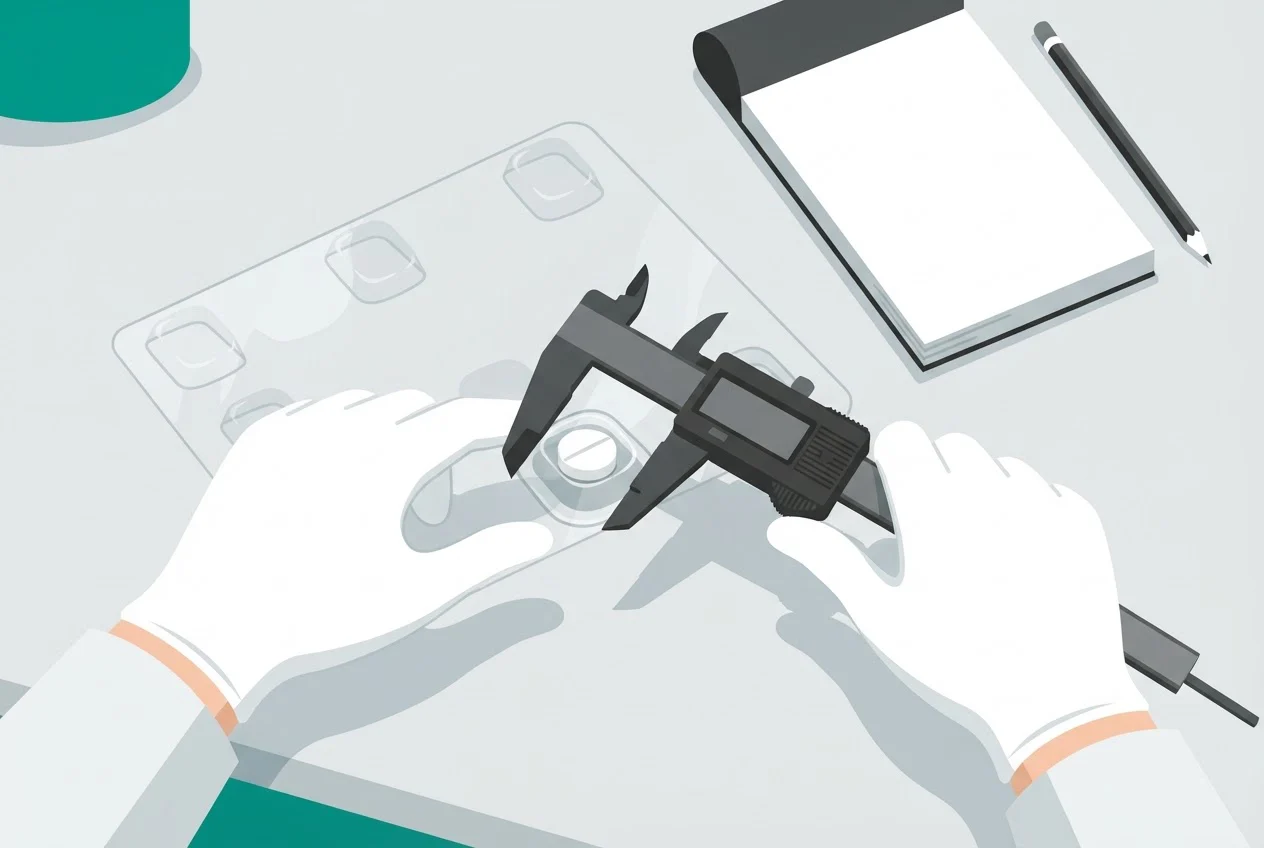
Multiply the film's WVTR by the cavity's formed-film area, adjust for the climate, and multiply by shelf-life days. The result is the water, in milligrams, that could enter one cavity. This is our own model, built from the datasheet values above, and not an official figure.
- Area.Formed area = π × r² + π × d × h for a round cavity of diameter d, radius r and depth h. Our example cavity is 12 mm across and 5 mm deep: 113.1 + 188.5 = 301.6 mm², or 3.02 × 10⁻⁴ m².
- Daily ingress at the datasheet condition.Area × WVTR. For plain PVC: 3.10 g/m² per day × 3.02 × 10⁻⁴ m² = 0.935 mg per day.
- Climate factor.
Water moves in proportion to the vapor-pressure difference across the film. We computed saturation vapor pressure with the Magnus formula, a standard equation for saturation vapor pressure, multiplied by relative humidity, and divided by the value at 38 °C and 90%. The factors: 23 °C/75% = 0.35, 25 °C/60% = 0.32, 30 °C/75% = 0.53. Which condition your market needs is covered in ICH Stability Zones.
- Shelf life.Multiply by days: 24 months is 730 days.
| Film | mg/day at 23 °C/75% (USP test condition) | 24 months at 25 °C/60% | 24 months at 30 °C/75% |
|---|---|---|---|
| Plain PVC 250 µm | 0.33 | about 217 mg | about 364 mg |
| PVC + 60 gsm PVdC | 0.05 | about 35 mg | about 59 mg |
| PVC + 23 µm Aclar | 0.02 | about 16 mg | about 27 mg |
Our assumptions: the lid is impermeable, the cavity interior stays dry, and temperature does not change the film's permeability. This is an unvalidated flat-film estimate that can under- or over-state real ingress: thermoforming thins the film, and seal-edge leaks could add water. Use it to rank films, not to forecast assay loss.
Two things follow. On our estimate, plain PVC at 0.33 mg per day sits below the 0.5 mg Class A limit, even though it admits about 13 times the water of the 23 µm Aclar film (0.935 ÷ 0.069). That comparison is our estimate, not a USP result. And ingress at 30 °C/75% is about 1.7 times that at 25 °C/60%, so the same pack can pass in one market and fail in another.
To use the result, set your tolerance from your own sorption and stability data: the water uptake at which assay, dissolution or hardness reaches its limit. A hypothetical 500 mg tablet that tolerates 1% water takes 5 mg. A film whose estimate is far above that is a poor candidate. Where screening cannot settle it, Pech and colleagues (Pharmaceutics, September 2025) describe a kinetic model that couples water permeation, uptake by the tablet and degradation, including water consumed by hydrolysis. We would use it only after a stability study supplies the rate constants.
Which blister structure should you specify: PVC/PVdC, Aclar, Alu-Alu or a strip?
Specify the cheapest structure whose 24-month estimate stays well under your tablet's tolerance, then confirm it in a stability study in that exact pack. This table is our recommendation, not a regulatory rule.
| Your estimate result | Start with | Watch for |
|---|---|---|
| Plain PVC estimate is already under tolerance | Plain PVC | Stability data must still come from the marketed pack |
| Only coated PVC fits | PVC with PVdC, heavier coating for the harsher climate | Coating weight changes the result, so state it in the RFQ |
| Only Aclar-laminated film fits | PVC with Aclar | State the Aclar thickness |
| Plastic films all exceed tolerance | Alu-Alu | Take the foil laminate's WVTR from the supplier's certificate |
| The formed cavity is the problem | Strip pack, which seals each unit between two flat foil webs instead of forming a cavity | Confirm the same water-budget logic with the supplier's foil data |
A change to the primary packaging of an approved product is a post-approval change under 21 CFR 314.70, supported by stability data in the new pack.
What goes into a blister packaging RFQ?
Name every layer, the climate, the stability protocol and the documents you need, so quotes compare like for like. Copy this block into your RFQ:
Product / strength:
Cavity: shape, diameter or length x width, depth (mm); cards x cavities
Forming film: material, thickness (µm), PVdC gsm or Aclar µm
Lid foil: alloy, thickness, heat-seal lacquer
Target market and long-term storage condition:
Stability protocol: in the marketed pack, with lot count and time points
Water budget at target condition (mg per cavity, 24 months):
Tolerance from our sorption data (mg per cavity):
Documents requested: film WVTR certificate for the supplied roll, COA (certificate of analysis), specifications
Test each answer on receipt:
- Structure. Pass: every layer has a thickness or coating weight. Fail: "high-barrier film".
- Stability. Pass: the protocol names the exact structure and cavity. Fail: data from a bottle or a different film.
- WVTR. Pass: a certificate for the supplied roll at a stated condition. Fail: a brochure number.
- Budget. Pass: estimate below tolerance with margin. Fail: only a USP class letter.
Our third-party manufacturing route runs from inquiry and feasibility review to commercial quotation, and a pharmaceutical quality agreement is where the agreed structure should be written down.
How do we handle blister and strip packaging for contract oral solids?
We are a Haridwar, India based CDMO (contract development and manufacturing organization) for oral dosage forms, from product development through commercial manufacturing. Packaging is a step in our buying route: inquiry, feasibility review, commercial quotation, development or technical transfer, production and quality control, packaging, and dispatch.
Our product list shows the packaging formats in practice. Omerise 20 (omeprazole 20 mg capsules) is listed as 10×15 capsules in a strip and as 10×10 capsules in Alu-Alu. Both carry the storage statement "Store protected from light & moisture."
Send the specification block through the contact page.
Frequently asked questions
Sources
- 1.FDA, Guidance for Industry: Container Closure Systems for Packaging Human Drugs and Biologics (May 1999)
- 2.FDA, Container Closure Systems for Human Drugs and Biological Products, draft guidance (Federal Register, 14 August 2026)
- 3.21 CFR 211.94, Drug product containers and closures (eCFR, current)
- 4.21 CFR 211.166, Stability testing (eCFR, current)
- 5.21 CFR 314.70, Supplements and other changes to an approved application (eCFR, current)
- 6.FDA, Expiration Dating of Unit-Dose Repackaged Solid Oral Dosage Form Drug Products (July 2020)
- 7.Perlen Packaging, PERLALUX / ACLAR datasheet (April 2008)
- 8.Solstice Advanced Materials, Aclar barrier films
- 9.USP general chapter <671> revision bulletin
- 10.CS Analytical, USP <671> permeation testing
- 11.Pech et al., Predictive Modeling of Drug Product Stability in Pharmaceutical Blister Packs, Pharmaceutics 17(9):1233 (September 2025)