
Glossary
Excipient Compatibility Study
An excipient compatibility study tests whether an active ingredient degrades or changes when mixed with each proposed excipient.

By Sunil Kumar, Managing Director - Sales · Updated 24 Oct 2026
On this page
- 01Definition
- 02Quick facts
- 03What an excipient compatibility study shows
- 04Compatibility study vs forced degradation and stability testing
- 05Design choices that make a compatibility study trustworthy
- 06How to read a compatibility report
- 07How much API a compatibility screen needs
- 08How Aarise Pharmaceuticals handles it
- 09Example
- 10Related terms
- 11Frequently asked
What is an excipient compatibility study?
An excipient compatibility study is a preformulation test that mixes an API with each proposed excipient, stores the mixtures under stress and checks for degradation.
Key takeaways
- Trust the study when it has a drug-only control, a stated drug-to-excipient ratio, stated storage conditions with several time points, and HPLC (high-performance liquid chromatography) impurity data, not thermal signals alone.
- A 1:1 screen ranks excipients. FDA looks at the excipient-to-API ratio of the actual formula, so confirm lead candidates at that ratio.
- Size the API a screen needs with a vial-count formula before ordering: vials multiplied by API per vial.
Quick facts
- Guideline
- ICH Q8(R2), which says compatibility of the drug substance with the excipients "should be evaluated"
- Common screening ratio
- 1:1 drug to excipient by weight
- Conventional accelerated condition
- 40°C and 75% relative humidity
- What reviewers want
- Impurity data that reflect the chemical stability of the API in the formulation
Two excipients can trigger the same alarm and mean opposite things. Lactose was flagged as incompatible in published studies of levothyroxine sodium and of a risperidone/methylated-β-cyclodextrin inclusion complex. Microcrystalline cellulose (MCC) shifted the thermal behavior of both drugs in an olmesartan and hydrochlorothiazide tablet, yet the authors concluded it was not an incompatibility.
The difference is the readout. A thermal shift is a signal. Measured degradation products, compared with a drug-only control at the ratio used in the formula, are evidence.
That difference decides whether a report survives review. FDA assessors list compatibility studies that do not reflect the chemical stability of the active pharmaceutical ingredient (API) in the formulation among the common deficiencies in generic drug applications. A thermal-only result leaves the reviewer without the impurity data needed to judge chemical stability. This page defines the study, shows the design choices that matter, and gives a checklist and a vial-count formula for reading a report from a contract formulator or your own laboratory.
What an excipient compatibility study shows
It is an early screen that ranks excipients. It does not set shelf life; that comes from stability data on the finished product at the long-term condition your market needs.
ICH Q8(R2), the International Council for Harmonisation guideline on pharmaceutical development, states that the compatibility of the drug substance with the excipients "should be evaluated". It also says excipient-to-excipient compatibility should be established where relevant, for example in a dual preservative system. The guideline says "should", not "mandatory".
Lactose is the usual first suspect for amine-containing drugs, because amines can react with reducing sugars in the Maillard reaction.
Design choices that make a compatibility study trustworthy
Four choices decide it: the drug-to-excipient ratio, a drug-only control, the storage conditions and time points, and whether degradation is measured by HPLC.
Four design choices behind a trustworthy study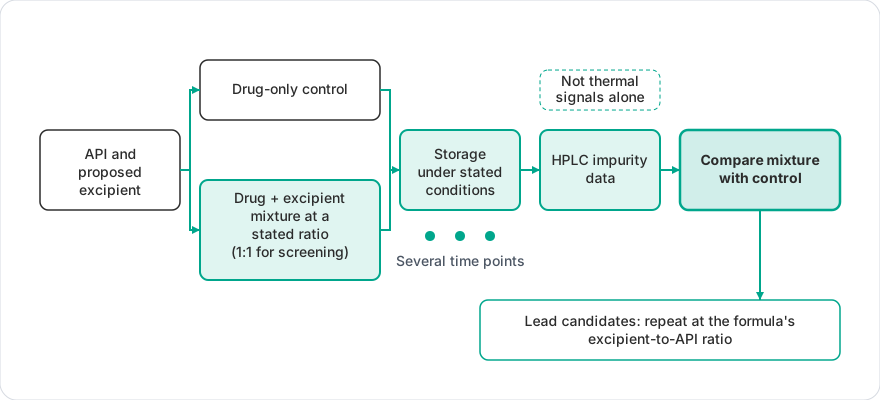
- Ratio. A 1:1 weight ratio is a common screening choice, as in the levothyroxine study. FDA assessors check the ratio of excipient to API per formula. A sound approach is to screen at 1:1, then repeat the lead candidates at the formula ratio, because a lubricant present as a small fraction of a blend meets the API very differently than at 1:1.
- Control. Store a drug-only control with every arm. Without it, degradation cannot be assigned to the excipient.
- Conditions. 40°C and 75% relative humidity (RH) is the conventional accelerated condition; the conventional studies in a 2023 paper in AAPS (American Association of Pharmaceutical Scientists) PharmSciTech ran it for 3 to 6 months. A screening design can use open and closed vials at 40°C/75% RH plus a closed 25°C/60% RH comparator, pulled at 2, 4 and 8 weeks.
- Speed. In that paper, a 60°C vial-in-vial method run for 1 to 2 weeks produced similar or higher degradation than the 3-to-6-month studies and kept the rank order, across 32 marketed formulations of six oral drugs. It is one study, so use it to rank excipients, not to clear them.
How to read a compatibility report
A sound report has a drug-only control, a stated ratio, an HPLC readout, stated conditions, recorded excipient grade and lot, and a conclusion backed by HPLC or finished-product data. The table sets a pass and a fail for each.
The last row matters because the olmesartan study found MCC shifted thermal stability by more than 100°C for olmesartan and lowered it by about 20°C for hydrochlorothiazide. Dissolution and long-term stability at 30°C/75% RH for 24 months showed no effect on product performance, so the authors did not treat it as an incompatibility. A report that also tracks degradants such as nitrosamine impurities against intake limits is stronger still.
- Check
- Drug-only control
- Pass
- Stored under the same conditions and pulled at the same time points
- Fail
- Absent
- Check
- Ratio
- Pass
- Stated for each mix; lead candidates repeated at the formula ratio
- Fail
- Only 1:1 behind the final excipient choice
- Check
- Readout
- Pass
- Assay and each degradation product reported by HPLC
- Fail
- Thermal or infrared signals only
- Check
- Conditions
- Pass
- Temperature, humidity, vial type and at least three time points stated
- Fail
- One time point, or conditions unstated
- Check
- Excipient identity
- Pass
- Grade and level justified by formulation development or performance data; lot recorded
- Fail
- Generic names only
- Check
- Conclusion
- Pass
- Every flagged signal resolved by HPLC or finished-product data
- Fail
- "Incompatible" declared from a thermal shift alone
How much API a compatibility screen needs
For eight excipients, three storage arms and three pull points, plan about 9 g of API (90 vials at 100 mg each, in this model). The formula is vials × API per vial.
Vials = (excipients × arms × stored time points) + excipients (initial) + [control: arms × stored time points + 1].
How Aarise Pharmaceuticals handles it
Qualified B2B buyers can request evaluation quantities from us. Sample quantity, pricing and documentation are confirmed product by product, and available documentation may include a certificate of analysis (COA), specifications and SDS/MSDS (safety data sheets) where applicable. Pricing is quoted per product on request.
We are a Haridwar-based, technology-driven contract development and manufacturing organization (CDMO) for oral dosage forms, from product development through commercial manufacturing. We also supply steroid, peptide, hormone, general pharmaceutical and supplement APIs to business buyers. Use the sizing above to state the quantity you need, and see our API quality testing methods (HPLC, IR, mass spectrometry). When a formulation moves between sites, we recommend the compatibility report travels in the technology transfer handover.
To request an evaluation quantity, send the API name or CAS (Chemical Abstracts Service) number, quantity, specification or grade, destination country and company details through our contact form, by WhatsApp at +91 9899783330, or to sunil@aarisepharma.com.
Example
A screen of 8 excipients across 3 arms (40°C/75% RH open, 40°C/75% RH closed, 25°C/60% RH closed) and 3 stored time points (2, 4, 8 weeks) needs 72 vials. Eight initial vials make 80, and the drug-only control adds 3 × 3 + 1 = 10, for 90 vials. At 100 mg of API per vial (1:1 with 100 mg of excipient), that is 9,000 mg, or 9 g, before repeats and analytical reserve.
Frequently asked
Sources
- 1.ICH Q8(R2) Pharmaceutical Development, guideline text
- 2.FDA: Q8(R2) Pharmaceutical Development, final guidance page (November 2009)
- 3.FDA CDER/OPQ, Integrated Quality Assessment: Drug Product, SBIA Generic Drug Forum, April 2022
- 4.Jain and Shah, Drug-Excipient Compatibility Study Through a Novel Vial-in-Vial Experimental Setup, AAPS PharmSciTech, 2023
- 5.Stability and Compatibility Studies of Levothyroxine Sodium in Solid Binary Systems, Pharmaceutics, 2020
- 6.Risperidone/Randomly Methylated β-Cyclodextrin Inclusion Complex, Compatibility Study with Pharmaceutical Excipients, Molecules, 2021
- 7.Interaction and Compatibility Studies in the Development of Olmesartan Medoxomil and Hydrochlorothiazide Formulations under a Real Manufacturing Process, Pharmaceutics, 2022
- 8.Bharate, Bharate and Bajaj, Interactions and incompatibilities of pharmaceutical excipients with active pharmaceutical ingredients, 2010