
Glossary · API quality testing
Karl Fischer Titration (KF)
Karl Fischer titration measures water by its reaction with iodine and sulfur dioxide, and is specific for water in most APIs. On a certificate of analysis it gives the water percent.

By Sunil Kumar, Managing Director - Sales · Updated 24 Oct 2026
Also called KF titration or Karl Fischer water determination
On this page
- 01Definition
- 02Quick facts
- 03Introduction
- 04What Karl Fischer titration is and what it measures
- 05Why the water line on a COA matters
- 06Choosing volumetric or coulometric KF
- 07Correcting an assay for the water KF finds
- 08Checking the method, lot and basis on a supplier's COA
- 09Checking the arithmetic and whether the method fits the level
- 10Karl Fischer vs loss on drying
- 11Common misconceptions
- 12How Aarise Pharmaceuticals handles it
- 13Example
- 14Related terms
- 15Frequently asked
What is Karl Fischer titration?
Karl Fischer (KF) titration is a method that determines the water in a sample through its reaction with iodine and sulfur dioxide in an alcohol medium. On an API certificate of analysis it supplies the water percent.
Key takeaways
- Pick the form by water level: coulometric below about 0.1%, volumetric above about 1%, either between.
- If a COA omits the sample weight and reagent F, ask the supplier for them.
- Check that assay is marked as-is or anhydrous, and that the conversion repeats within rounding.
- A method that suits the material matters, because some substances react with iodine and inflate the result.
Quick facts
- Governing method
- United States Pharmacopeia (USP) chapter 921, Water Determination
- Reagent strength
- Titer, the water equivalence factor F in mg of water per mL of reagent (volumetric KF)
- F can be set against
- Purified Water, sodium tartrate dihydrate, or a traceable commercial standard
- Sample size
- Enough to contain 2 to 250 mg of water, unless the monograph says otherwise
- Coulometric calibration
- Not necessary, because the current consumed is measured absolutely
Introduction
A 1 g sample of an active pharmaceutical ingredient (API) that holds 0.1% water contains 1 mg of water. The United States Pharmacopeia (USP) chapter 921 recommends sizing the sample so at least 2 mg of water is titrated, so that sample is too small for a typical volumetric setup. That arithmetic is the main reason low-water results need a different setup.
This entry defines the method, shows how to choose between its two forms, and gives the working to check a supplier's figure yourself. The calculations are built from the published USP chapter, so you can rerun them.
What Karl Fischer titration is and what it measures
Iodine and sulfur dioxide react with water in an alcohol medium, and the amount of iodine used gives the amount of water. In volumetric KF the iodine arrives in a reagent solution. In coulometric KF it is generated by electric current in the cell.
Volumetric KF depends on the reagent's strength, its titer, also called the water equivalence factor F (mg of water per mL of reagent). USP allows F to be set against Purified Water, sodium tartrate dihydrate, or a traceable commercial standard. Sodium tartrate dihydrate is 15.66% water (36.04 ÷ 230.08).
Substances that react with iodine, such as ascorbic acid, mercaptans or peroxides, give falsely high results, so the method must be shown to suit the material. Check that the COA names a method suited to the material.
Why the water line on a COA matters
Water in an API is a small number that moves large ones. It changes the assay you calculate, the quantity you weigh for a batch, and whether a moisture-sensitive material is safe to store.
Yet a line on a certificate of analysis (COA) can read only "Water (Karl Fischer): 0.4%", with no method, no basis and no sample size behind it.
ICH Q6A says a water test matters when a substance is hygroscopic (moisture-absorbing), degraded by moisture, or a stoichiometric hydrate.
Choosing volumetric or coulometric KF
Use coulometric KF below about 0.1% water, volumetric KF above about 1%, and either between (a working rule, not a USP limit). The deciding factor is whether you can weigh enough sample to titrate at least 2 mg of water.
Which KF form fits which water level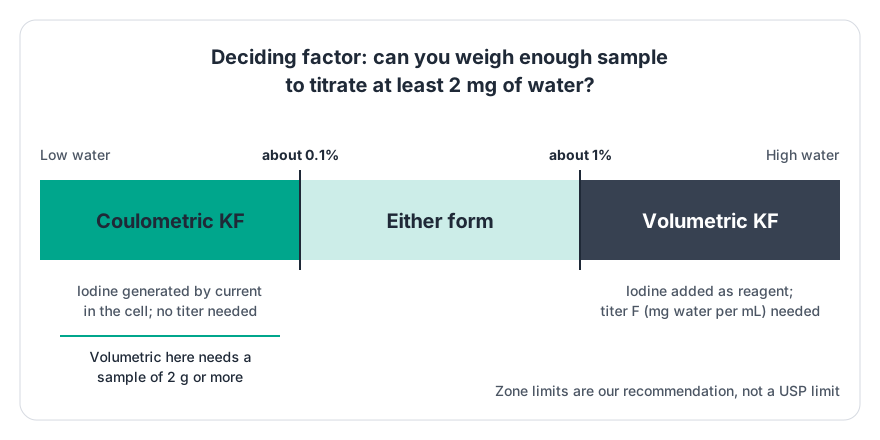
USP estimates the minimum sample as F × C × V ÷ KF. C is the percent of the buret (the graduated reagent tube) used, V is the buret volume in mL, and KF here is the expected water in percent. USP recommends F × C × V of at least 200, and a reagent with F of 2.0 or less for water under 1%.
Below about 0.1% water, volumetric KF needs a sample of 2 g or more, so coulometric KF is the better choice. USP calls coulometry a micro-method and requires the sample to be compatible with the cell chemistry. Above about 1% water, volumetric KF is straightforward.
Worked through with a 10 mL buret and 10% of it used:
- Reagent F (mg/mL)
- 5
- Expected water
- 5%
- Minimum sample
- 100 mg
- Water titrated
- 5 mg
- Reagent F (mg/mL)
- 5
- Expected water
- 0.5%
- Minimum sample
- 1,000 mg
- Water titrated
- 5 mg
- Reagent F (mg/mL)
- 2
- Expected water
- 0.5%
- Minimum sample
- 400 mg
- Water titrated
- 2 mg
- Reagent F (mg/mL)
- 2
- Expected water
- 0.1%
- Minimum sample
- 2,000 mg
- Water titrated
- 2 mg
Correcting an assay for the water KF finds
Divide the as-is assay by the dry fraction: anhydrous assay = as-is assay × 100 ÷ (100 − water %). The same idea, subtracting KF water, underlies the mass-balance purity calculation for reference standards.
Worked examples:
- 98.0% as-is with 2.0% water: 98.0 × 100 ÷ 98.0 = 100.0%.
- 90.0% as-is with 8.0% water: 90.0 × 100 ÷ 92.0 = 97.8%.
The same arithmetic tells you how much to weigh. See Assay on Anhydrous Basis. For peptide APIs, read the water figure next to Peptide HPLC Purity vs. Content.
Checking the method, lot and basis on a supplier's COA
Run these five checks on every COA, and ask the supplier for the sample weight and reagent F where the COA omits them. Each has a pass and a fail. The first three are below.
- Method named and suited to the material. Pass: the COA cites a pharmacopeial water method suited to the material (for KF, USP chapter 921 Method Ia or Ic, or the pharmacopeia the specification names). Fail: "moisture" with no method, or a method not shown to suit the material.
- Lot-specific. Pass: a measured percent tied to your lot number. Fail: only the specification limit.
- Basis stated. Pass: assay is marked as-is or anhydrous. Fail: unmarked.
Checking the arithmetic and whether the method fits the level
- Arithmetic repeats. Pass: converting as-is to anhydrous with the formula above matches the COA within rounding. Fail: it does not.
- Method fits the level. Pass: water below 0.1% was run coulometrically, or the supplier states reagent F, buret volume and sample weight and the weight is at least F × C × V ÷ water % (from USP chapter 921). Fail: a volumetric run at or below 0.1% water with a sample under about 2 g, or no sample weight available on request.
USP says precision depends largely on excluding atmospheric moisture, so seal the cell and weigh hygroscopic material quickly. For what a COA can and cannot prove, see 21 CFR Part 111: What a Supplier's COA Can and Can't Prove and ICH Q7 Explained.
Karl Fischer vs loss on drying
KF and loss on drying disagree because LOD is a weight loss on heating, while KF reacts with water. LOD is the weight lost when a sample is heated. USP reserves the LOD heading for cases where "the loss sustained on heating may be not entirely water", and directs articles containing water of hydration to the water methods the monograph names (titrimetric, azeotropic or gravimetric).
So a solvent-wet batch reads higher by LOD than by KF. ICH Q6A says "a detection procedure that is specific for water (e.g., Karl Fischer titration) is preferred."
- Aspect
- What it measures
- Loss on drying
- Anything that leaves on heating
- Karl Fischer titration
- Water, in most APIs
- Aspect
- Solvent-wet batch
- Loss on drying
- Reads higher
- Karl Fischer titration
- Reads lower than LOD
Common misconceptions
- Myth: Coulometric Karl Fischer needs a titer, just as volumetric does. Fact: USP states that calibration of a coulometric instrument is not necessary, because the current consumed is measured absolutely.
- Myth: The water percent on a COA can be dropped straight into an assay. Fact: The assay must be marked as-is or anhydrous, and the conversion between them has to repeat within rounding.
- Myth: Volumetric KF suits every water level. Fact: Below about 0.1% water it needs a sample of 2 g or more, which is why coulometric KF is the better choice there.
How Aarise Pharmaceuticals handles it
Karl Fischer titration is among the quality tests for Aarise Pharmaceuticals' APIs, and its test methods reference the USP and the European, British and Indian Pharmacopoeia (EP, BP, IP). The tests are described in its Pharmaceutical API Quality Testing Guide.
Available documentation may include a COA, specifications and safety data sheet (SDS/MSDS) where applicable, and the company confirms what is available for each product at the quotation stage. It also supplies evaluation quantities to qualified B2B buyers.
Example
To set F with sodium tartrate dihydrate, 100 mg of it holds 15.66 mg of water. If it consumes 3.10 mL of reagent, F = 15.66 ÷ 3.10 = 5.05 mg/mL.
Frequently asked
Sources
- 1.ICH Q6A: Specifications, Test Procedures and Acceptance Criteria for New Drug Substances and New Drug Products, International Council for Harmonisation
- 2.USP chapter 921: Water Determination, United States Pharmacopeia
- 3.LCGC: Certificate of Analysis and Calculations for Small-Molecule Drugs, LCGC (Michael W. Dong), June 10, 2024
- 4.Aarise Pharmaceuticals: Pharmaceutical API Quality Testing Guide, Aarise Pharmaceuticals