
Glossary
Assay on Anhydrous Basis
Assay on anhydrous basis is the active ingredient percentage calculated as if the sample held no water. It reads higher than the as-received value, so weigh powder using the water content.

By Sunil Kumar, Managing Director - Sales · Updated 23 Oct 2026
On this page
- 01Definition
- 02Quick facts
- 03What assay on anhydrous basis means
- 04Converting an assay between as-is and anhydrous basis
- 05How much powder to weigh from a water-corrected assay
- 06Why anhydrous results creep past 100%
- 07What a COA should show beside an anhydrous-basis assay
- 08Anhydrous vs as-is, dried and solvent-free basis
- 09Common misconceptions
- 10How Aarise Pharmaceuticals handles it
- 11Example
- 12Related terms
- 13Frequently asked
What is assay on anhydrous basis?
Assay on anhydrous basis is the percentage of active ingredient in a material, calculated from an assay and a water result as if no water were present. The United States Pharmacopeia (USP) names this correction.
Key takeaways
- Assay on anhydrous basis is a calculated figure: the as-is assay multiplied by 100 and divided by 100 minus the water percentage.
- Weigh using both the anhydrous assay and the water percentage; the weigh-out card below shows the working.
- Anhydrous basis removes water only. Dried basis removes everything lost on drying. A result with no stated basis is read as-is.
- A COA is usable when each assay shows its basis, a same-lot water result, and a conversion you can reproduce.
Quick facts
- Set by
- USP 38–NF 33 General Notices, section 6.40
- What it removes
- Water only
- Water test
- Karl Fischer titration (Method I of USP chapter 921)
- Unlabeled results
- Read as-is
- Reproducibility check
- Your result should match the printed value within 0.1 percentage point
A certificate of analysis (COA) can print 99.5% beside a powder that holds several percent water, and the two facts do not conflict. The 99.5% describes the material after the water has been removed on paper, not the powder in the drum.
The difference shows up at the balance. A formulator who treats that figure as the strength of the powder as received under-weighs the active ingredient by the water percentage, and every batch made from that lot repeats the shortfall. The result is a short batch or a rejected lot, and the cause is hard to find because the COA is correct. The lot is not faulty; the basis was misread.
Analysts, compounding pharmacists and buyers of bulk active pharmaceutical ingredients (APIs, covered in What Is an API in Pharma?) ask the same three things: what the term means, which way to convert, and which basis to trust. The answers follow, including a weigh-out card and four tests that run on any COA.
What assay on anhydrous basis means
Assay on anhydrous basis states how much active ingredient a material holds as if it contained no water. The powder is not dry; the figure combines an assay and a water determination. The United States Pharmacopeia (USP) calls a correction for water "anhydrous basis" and a correction for loss on drying "dried basis" (USP 38–NF 33 General Notices, 6.40, Dried, Anhydrous, Ignited, or Solvent-Free Basis).
A hydrate (a crystal that holds water in its structure) shows why the label matters. A pure monohydrate carries one molecule of water for every molecule of the substance, so even a flawless lot assays below 100% as-is while it assays 100% on the anhydrous basis. Reading a low as-is figure as a failed purity test misreads the basis.
Converting an assay between as-is and anhydrous basis
Multiply the as-is assay by 100 and divide by 100 minus the water percentage. To go back, multiply the anhydrous assay by 100 minus the water percentage and divide by 100.
Converting between as-is and anhydrous assay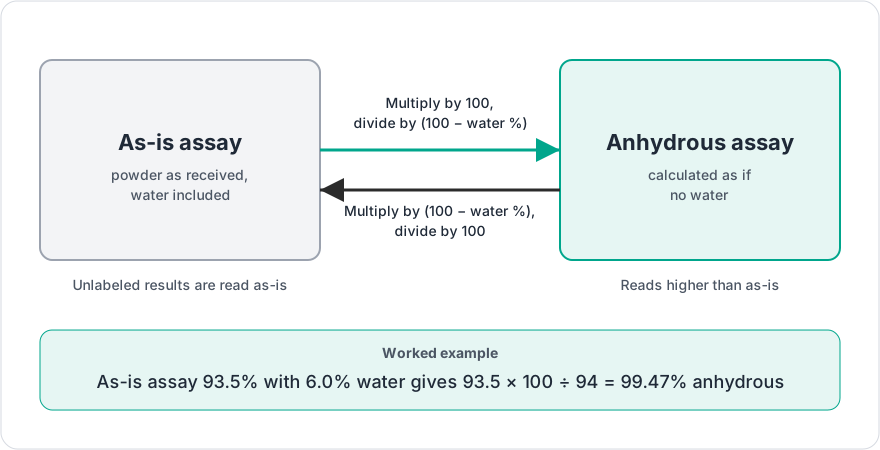
- Anhydrous assay (%) = as-is assay (%) × 100 ÷ (100 − water %)
- As-is assay (%) = anhydrous assay (%) × (100 − water %) ÷ 100
A published example uses an as-is assay of 93.5% and 6.0% water: 93.5 × 100 ÷ 94 = 99.47% (Journal of Pharmaceutical Compounding and Therapeutics, 2024). Run backward, 99.47 × 94 ÷ 100 = 93.5%. The material did not become purer; the basis changed.
How much powder to weigh from a water-corrected assay
Divide the target mass by the anhydrous assay as a fraction, then by the fraction of the powder that is not water. Skipping the water step leaves the batch short by the water percentage.
Weigh-out card:
- Inputs: assay 99.5% (anhydrous basis), water 8.0%, target 100.0 g of active ingredient on the anhydrous basis.
- Water step: 1 − 0.080 = 0.920. Assay step: 0.995.
- Powder to weigh: 100.0 ÷ (0.995 × 0.920) = 109.24 g.
- Skipping the water step gives 100.0 ÷ 0.995 = 100.50 g, which is 8.0% short of 109.24 g.
- If the COA reports an as-is assay, the water already sits inside it: divide by the assay only.
Keep the batch record on the basis the product specification declares for the active ingredient.
Why anhydrous results creep past 100%
The assay and the water test each carry measurement error, and the conversion magnifies both by 100 ÷ (100 − water %), so results drift toward or past specification limits (Indian Journal of Pharmaceutical Sciences, 2009). Arithmetic from that factor: 1.064 at 6.0% water and 1.087 at 8.0%.
A value a little above 100% is therefore possible. Check the water result and the lot pairing before accepting or rounding it. Three errors recur:
- Treating the anhydrous figure as the strength of the powder.
- Treating loss on drying as water, when it also counts other volatiles.
- Pairing an assay and a water result from different lots.
What a COA should show beside an anhydrous-basis assay
A COA is usable when each assay value carries its basis, a water result for the same lot, and a conversion you can reproduce. Four tests:
- Basis printed. Pass: "as is", "dried" or "anhydrous" sits beside every assay. Fail: a bare percentage.
- Water on the same lot. Pass: a water value with its method and the same lot number (in USP 35, 2012, Method I of chapter 921 is Karl Fischer titration). Fail: no water value, or another lot.
- Reproducible. Pass: your formula result matches the printed anhydrous value within 0.1 percentage point (recommended tolerance). Fail: a larger gap; ask for the calculation.
- Right correction. Pass: an "anhydrous" claim rests on a water test. Fail: "anhydrous" with only loss on drying reported.
The API quality testing guide covers the tests behind a COA.
Anhydrous vs as-is, dried and solvent-free basis
The USP 38 text reads a result as-is unless a monograph (the pharmacopeia's published specification for a substance) states another basis, and allows the assay to run on undried material and be calculated on the anhydrous basis when the monograph includes a water test. Some COAs print "anhydrous, solvent-free", which also removes residual solvents (Dong, Chromatography Online, 2024).
Loss on drying measures weight lost on heating; Karl Fischer titration measures water alone.
- Basis
- As-is
- What the calculation removes
- Nothing; the sample as received
- Basis
- Dried
- What the calculation removes
- Everything lost on drying (LOD), meaning water plus any other volatile
- Basis
- Anhydrous
- What the calculation removes
- Water only, from a water test such as Karl Fischer titration (a chemical titration that measures water only)
- Basis
- Anhydrous, solvent-free
- What the calculation removes
- Water plus residual solvents
Common misconceptions
- Myth: An anhydrous-basis assay of 99.5% means the powder in the drum is 99.5% active. Fact: The figure is calculated as if the water were removed, so the powder as received holds less active ingredient than the printed percentage.
- Myth: "Anhydrous" and "dried" mean the same thing on a COA. Fact: Anhydrous removes water only, while dried removes everything lost on drying, including other volatiles.
- Myth: A hydrate that assays below 100% as-is has failed its purity test. Fact: A pure monohydrate assays 100% on the anhydrous basis, so the lower as-is figure reflects the water in its structure.
How Aarise Pharmaceuticals handles it
Aarise Pharmaceuticals supplies bulk APIs to qualified B2B buyers, quoted product by product. To request a quote, send the API name or CAS (Chemical Abstracts Service) number, quantity, destination, grade or purity, documents needed, payment terms and Incoterms (standard international trade terms). Sample and evaluation quantities are available to qualified buyers, subject to the API, availability and regulations, and documentation may include the COA, specification and SDS/MSDS (safety data sheet) where applicable. Run the four tests on any COA you receive, Aarise's included.
Contact sunil@aarisepharma.com, WhatsApp +91 9899783330, or the contact page.
Example
A COA prints 99.5% on the anhydrous basis for a lot with 8.0% water. Using the as-is formula, 99.5 × 92 ÷ 100 = 91.54%, so the powder in the drum is 91.54% active as received.
Frequently asked
Sources
- 1.USP 38–NF 33 General Notices, section 6.40, Dried, Anhydrous, Ignited, or Solvent-Free Basis, United States Pharmacopeia
- 2.An Unrealistic Drift in Assay on Anhydrous Basis towards Content Limit, Indian Journal of Pharmaceutical Sciences, 2009
- 3.Quality Assurance in Pharmaceutical Compounding (QA Part 1): Verification of Certificate of Analysis, Journal of Pharmaceutical Compounding and Therapeutics, 2024
- 4.Certificate of Analysis (CoA) and Calculations for Small-Molecule Drugs, Chromatography Online, 2024