Pharmaceutical API Sourcing Alternatives for Global Buyers
Compare pharmaceutical API sourcing alternatives by provider model, molecule evidence, GMP, dossier support, and international buyer requirements.

By Sunil Kumar, Managing Director - Sales · Updated 11 Oct 2026

In brief
We help international buyers compare pharmaceutical API sourcing alternatives by provider model, exact molecule, manufacturing site, regulatory evidence, and commercial readiness. This guide separates direct manufacturers, integrated CDMOs, and sourcing partners, then provides a seven-question qualification rubric covering steroid APIs, dossier support, audits, quality agreements, supply continuity, and target-market requirements.
In this article
- 1What Counts as a Pharmaceutical API Sourcing Alternative?
- 2Which Provider Model Fits Your API Requirement?
- 3How Should Buyers Verify Regulatory and Steroid API Evidence?
- 4How Should Buyers Read DMF Evidence?
- 5How Should Buyers Read CEP and GMP Evidence?
- 6How Should Buyers Verify Steroid API Support?
- 7How Should International Buyers Qualify Suppliers?
- 8What Are the Seven Shortlist Questions?
- 9What Should the First RFQ Include?
- 10How Should Quality Agreements Protect Supply?
- 11Why Work with Aarise Pharma for Pharmaceutical API Sourcing Alternatives?
- 12FAQs on Pharmaceutical API Sourcing Alternatives
International buyers cannot treat an API source as interchangeable with a finished-dose manufacturer. The public list currently runs through DMF record 044443 and includes status changes recorded through 31 March 2026, according to the FDA DMF list.
Pharmaceutical API sourcing alternatives should be compared by service model, molecule fit, and regulatory readiness, not company size. A defensible shortlist separates direct API manufacturers, integrated CDMOs, and sourcing partners, then verifies the product-specific site, GMP history, dossier route, commercial capacity, target-market experience, audit access, quality agreement, and change-control process.
We compare the three provider models, show how to test dossier claims, and give a seven-question international-buyer rubric. The final sections cover commercial qualification, audits, change control, and questions procurement teams ask before sending an RFQ.
What Counts as a Pharmaceutical API Sourcing Alternative?
A valid alternative can supply the exact API a buyer needs, in the required grade and form, with evidence suited to the intended market. Corporate scale, broad therapeutic coverage, or finished-product capability do not prove that a supplier can provide a particular substance with a usable regulatory and commercial route.
FDA GMP guidance treats manufacturing as a broad chain of activity, from receiving materials through distribution. That means original manufacturers, contract manufacturers, repackers, and distributors need different evidence standards, even when they appear in the same sourcing conversation. The API GMP guidance supports this site-by-site approach.
For our pharmaceutical API sourcing alternatives comparison, we start with molecule identity, manufacturing responsibility, and documentation access. Buyers can then move into assay, impurity, particle-size, and stability questions with a clearer baseline using our API quality guide.
Which Provider Model Fits Your API Requirement?
The right provider model depends on what the buyer is actually purchasing. A direct manufacturer may be the strongest fit for a defined commercial API requirement, while an integrated CDMO may fit a development program, and a sourcing partner may fit buyers who need coordinated access to qualified raw-material options.
| Provider Model | Best Fit | What Buyers Must Verify | Weak Comparison |
|---|---|---|---|
| Direct API Manufacturer | Exact commercial API supply | Exact molecule, site, GMP record, dossier route, capacity | Comparing only headquarters or product categories |
| Integrated CDMO | API needs linked to development or dosage-form work | Whether the exact API is made at the disclosed site | Assuming finished-dose capability proves API capability |
| Sourcing Partner | International procurement and multi-source coordination | Original manufacturer, chain of custody, documentation transfer | Treating a trading route as proof of manufacturing |
WHO’s public prequalification list currently contains 198 API entries, each tied to product and assessment information. It is useful external evidence, but it does not remove the need to check the buyer’s precise molecule, market, and supply arrangement through the WHO API list.
For steroid requirements, a supplier should be compared by the exact steroid, salt or ester, site, dossier route, and commercial suitability. Our steroid API comparison helps buyers structure that discussion around product evidence rather than broad claims.

How Should Buyers Verify Regulatory and Steroid API Evidence?
Regulatory evidence is useful only when it maps to the exact API and relevant manufacturing site. A document can support a sourcing decision, but it cannot substitute for checking the molecule, site role, status, target market, and authorization route.
How Should Buyers Read DMF Evidence?
A Type II DMF can support a drug substance or intermediate, but FDA explains that DMFs are neither approved nor disapproved on their own. Buyers should confirm the exact substance, holder, active status, manufacturing-site link, and ability to issue a letter of authorization through the FDA DMF rules.
Our DMF support guide gives procurement teams a practical way to ask for that evidence without overstating what a DMF proves.
How Should Buyers Read CEP and GMP Evidence?
For Europe-facing supply, buyers should check the latest CEP status, substance, certificate number, issue details, and any relevant action affecting the product. The CEP database is updated daily, and recent actions show why an old certificate reference is not enough for a current purchase decision. The EDQM status list recorded several steroid-related CEP suspensions for GMP non-compliance on 27 July 2026.
| Evidence Type | What It Can Confirm | What It Does Not Establish | Buyer Action |
|---|---|---|---|
| Type II DMF | Confidential supporting information for a specific substance | FDA approval of the API | Confirm status, holder, site, and authorization route |
| CEP | Pharmacopoeial suitability for the named substance | Universal market approval | Check current validity and product match |
| GMP Certificate | Inspection-based compliance at a site | Capability for every product in a catalog | Match site operations to the required API |
| WHO Prequalification | Assessed API and relevant site for its stated program | Automatic fit for every market | Confirm grade, market, and supply route |
How Should Buyers Verify Steroid API Support?
Steroid API evidence must remain molecule-specific. The buyer should match the exact steroid, salt or ester, form, manufacturing site, active dossier pathway, and target-market requirements before describing a source as suitable.
For regulated-market sourcing, we recommend maintaining a separate document trail for the API rather than relying on general company certifications. Our regulated-market alternatives explains how to organize that evidence around the product under review.
How Should International Buyers Qualify Suppliers?
International qualification should connect quality, regulatory, commercial, and supply-continuity decisions. It is not a single document request, because an acceptable API route can fail if the supplier cannot support samples, audit access, change notification, or the buyer’s import requirements.
What Are the Seven Shortlist Questions?
- Site Disclosure: Does the supplier identify the exact manufacturing site and its role?
- Molecule Match: Does the API, grade, form, and specification meet the requirement?
- Dossier Route: Is the DMF, CEP, APIMF, or equivalent evidence product-specific and current?
- GMP History: Can the buyer verify relevant inspection or compliance information?
- Commercial Fit: Can the supplier support expected volume, MOQ, lead time, and samples?
- Quality Agreement: Will the supplier support audits, deviations, complaints, and documented change control?
- Market Readiness: Does the supplier have a workable route for the intended import market?
What Should the First RFQ Include?
An RFQ should name the molecule, required grade, specification, intended market, projected volume, sample requirements, packaging, and required document set. It should also request the manufacturing-site identity, whether repacking occurs, expected lead time, and continuity approach. For US-bound material, foreign API manufacturers may need registration and drug-listing support under FDA import guidance.
Our US filing guide can help teams align the first technical request with a filing-oriented sourcing process.
How Should Quality Agreements Protect Supply?
Quality agreements should define audit access, responsibilities for deviations and complaints, batch documentation, data transfer, material changes, subcontractor disclosure, and notification timing. WHO guidance says these agreements should provide mechanisms for transferring quality and regulatory information and handling change control through the WHO trade guidance.
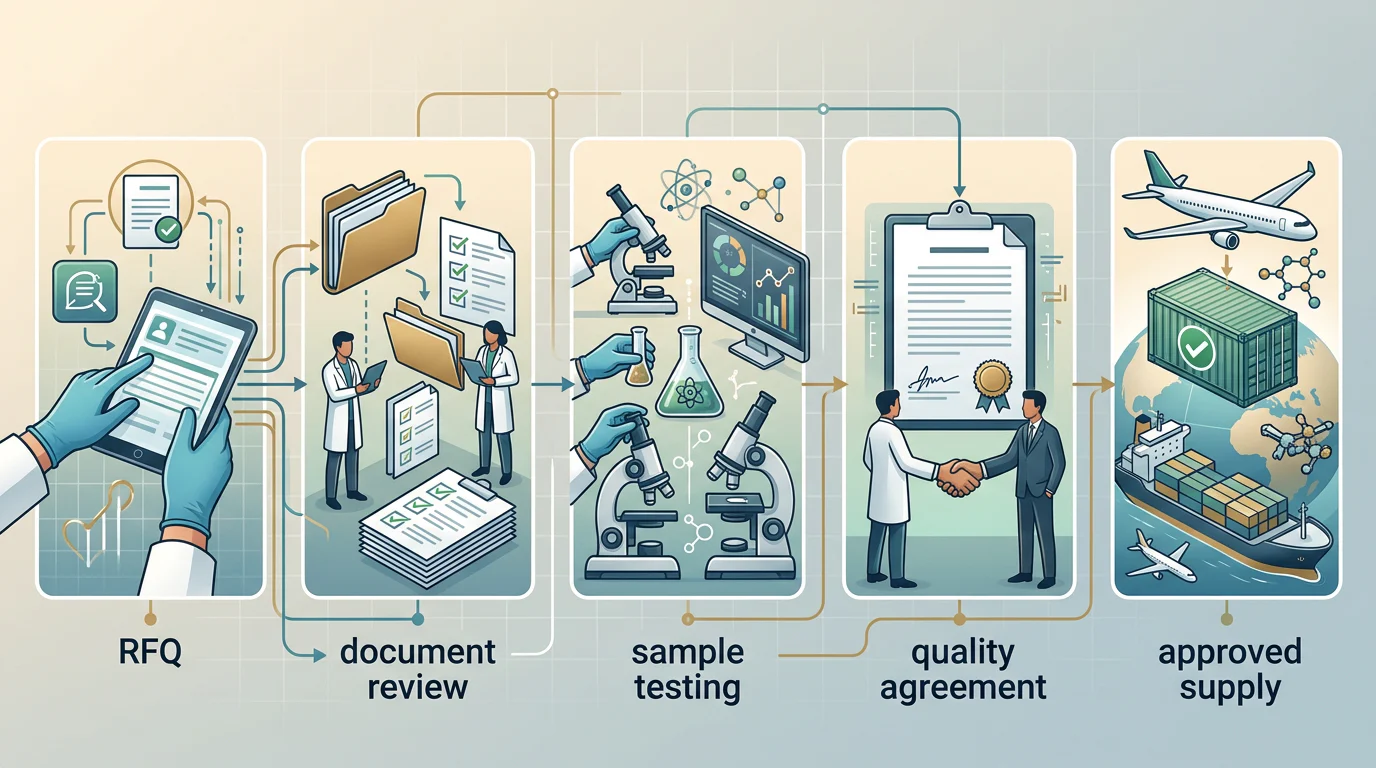
A simple three-step workflow keeps the process focused:
- Classify each candidate by provider model.
- Verify molecule, site, dossier, GMP, and commercial evidence.
- Qualify samples, audit access, quality agreement terms, and continuity plans.
Buyers importing steroid APIs can also use our US import guide when logistics and regulatory responsibilities need to be considered together.
Why Work with Aarise Pharma for Pharmaceutical API Sourcing Alternatives?
At Aarise Pharma, we focus on B2B active pharmaceutical ingredients and pharmaceutical raw materials for international buyers. We begin with the sourcing question that matters most: can the requested molecule, grade, documentation route, and commercial plan fit the buyer’s market? Our team can help organize product requirements, request source and dossier details, coordinate samples, and keep technical questions attached to the exact material being evaluated. We do not treat a broad company profile as proof of a qualified API. Instead, we help buyers create a documented comparison that can move into supplier qualification, quality-agreement review, and continuity planning. If you are assessing a steroid API, a regulated-market route, or a broader raw-material requirement, bring us the molecule, target market, specification, and expected volume so we can frame a practical evidence request. Start the conversation, document the next steps, and contact Aarise Pharma.
FAQs on Pharmaceutical API Sourcing Alternatives
These short answers repeat the product-specific evidence standard that should guide shortlisting. They are designed for procurement teams comparing manufacturing, documentation, and market-readiness requirements before a formal supplier qualification process begins.
What Makes a Valid API Sourcing Alternative?
A valid alternative documents the exact molecule, manufacturing site, quality controls, regulatory evidence, commercial capability, and target-market support needed for the buyer’s intended drug product.
Can a CDMO Replace a Direct API Manufacturer?
A CDMO qualifies only when it provides product-specific evidence that it makes or controls the requested API, site, dossier route, commercial supply, and quality responsibilities directly.
How Is Steroid DMF Support Verified?
Verify the exact steroid, salt or ester, manufacturing site, active Type II DMF status, authorization route, and target-market fit. Company-wide claims are insufficient for regulated buyers.
Does a DMF Equal FDA Approval?
A DMF is not independently approved. FDA reviews its confidential information with a referenced application, so buyers must verify the exact substance, site, and authorization path.
What Should an International API RFQ Include?
Include molecule and grade, target market, specification, expected volume, sample needs, site evidence, dossier route, quality-agreement expectations, lead-time needs, and continuity requirements for each supplier.