


TL;DR
We qualify dexamethasone API suppliers with DMF support by exact product form, manufacturing site, filing status, GMP evidence, and batch data, not by generic certification claims. This guide explains how to verify USDMFs, CEPs, ASMFs, Written Confirmations, and Letters of Authorization, then build a defensible ongoing supply qualification file.
Steroid API sourcing can look straightforward until the product, site, filing, and intended market do not align. FDA’s current quarterly list contains 22 active Type II records with dexamethasone in the subject, but that is a starting point for investigation, not a qualified supplier list, according to the FDA DMF list.
Dexamethasone API suppliers with DMF support must be verified by molecule, manufacturing site, filing status, and intended market. A DMF listing does not establish approval, current GMP compliance, or authorization to reference the file. Buyers should request the appropriate Letter of Authorization, current specification, impurity profile, stability package, recent GMP evidence, and representative batch data.
We explain how we evaluate those records, distinguish dexamethasone forms, test batch consistency, and build a documentation package that supports a defensible supplier decision.
Which Dexamethasone API Suppliers with DMF Support Are Actually Qualified?
For us, a qualified supplier is not simply a company associated with steroid APIs or a distributor carrying a broad catalog. It is a specific legal manufacturer, at a specific manufacturing site, supplying an exact dexamethasone form under a document set that matches the buyer’s market and dosage-form requirements.
That distinction matters because FDA says DMFs are confidential submissions and are neither approved nor disapproved. FDA reviews the technical content only when it is referenced by an appropriate application, which makes a public DMF listing a useful screening signal but not proof of current suitability. See the FDA DMF overview.
| Evidence Field | What We Verify | Why It Matters |
|---|---|---|
| Legal manufacturer | Entity named in product and filing records | Distinguishes a producer from a distributor |
| Manufacturing site | Full legal site identity and address | Connects GMP evidence to the actual production location |
| Dexamethasone form | Base, acetate, or sodium phosphate | Prevents unsupported form substitution |
| Compendial grade | USP, Ph. Eur., BP, or agreed specification | Aligns the material with intended use |
| Filing support | USDMF, ASMF, CEP, or Written Confirmation | Matches evidence to the destination market |
| Authorization | Product-specific LOA or letter of access | Enables permitted regulatory reference |
| Last verification | Dated regulatory and supplier evidence review | Keeps public status and documents current |
We use this product-site approach when buyers compare regulated-market partners. It avoids the common error of treating a company-level credential as evidence that the exact dexamethasone material, made at the quoted site, is filing-ready.
What Form, Grade, and Particle-Size Evidence Should Buyers Request?
Dexamethasone base, dexamethasone acetate, and dexamethasone sodium phosphate are distinct materials. A supplier may have regulatory evidence for one form without having equivalent evidence for another, so we keep each form in its own qualification row and never infer interchangeability.
Grade also needs more than a label. We request the current specification, analytical methods, and lot-specific certificate of analysis before describing material as USP, Ph. Eur., BP, or customer specification compliant. When particle size matters to blend uniformity, dissolution, suspension behavior, or processing, we ask for the method, target distribution, and batch result, rather than accepting “micronized” as a complete specification.
| Requirement | Evidence To Request | Qualification Decision |
|---|---|---|
| Identity and assay | Current specification and commercial CoA | Confirm method, basis of calculation, and acceptance limits |
| Related substances | Impurity profile and chromatographic summary | Compare individual and total impurity controls |
| Residual solvents | Method and lot-specific results | Assess process relevance and route expectations |
| Particle size | Method, target range, and representative lots | Confirm suitability for the intended dosage form |
| Storage and retest | Stability summary, storage statement, retest period | Support handling and inventory decisions |
| Packaging and scale | Container configuration, lead time, campaign details | Test commercial supply fit before approval |
European requirements recognize that controls such as particle size and residual solvents may need to supplement pharmacopoeial requirements where relevant. That makes particle-size evidence a technical qualification issue, not a sales attribute. The EU framework supports this approach.
For US-facing sourcing, our steroid raw material catalog helps buyers organize the wider molecule review. It also creates a clear distinction between a catalog inquiry and a documented technical qualification. Before approving a material, we still need to connect the commercial request to the intended form, compendial grade, and manufacturing-site evidence.
Commercial decisions should follow the same discipline. Packaging, shipping conditions, minimum order quantity, and expected lead time can all affect the feasibility of a supply program, but they do not replace product-quality evidence. We keep these commercial controls in the qualification file so procurement, quality, and regulatory teams assess the same material against the same documented conditions.
Technical review also requires method-level context. A certificate of analysis may confirm that one batch met a stated limit, but it does not show whether a supplier changed the method, calculation basis, impurity controls, or particle-size procedure. Buyers should compare the specification revision, method reference, and commercial batch results before treating a material as equivalent to an earlier qualification. Our quality testing guide explains how these controls fit together.
How Do We Verify USDMFs, CEPs, ASMFs, Written Confirmations, and LOAs?
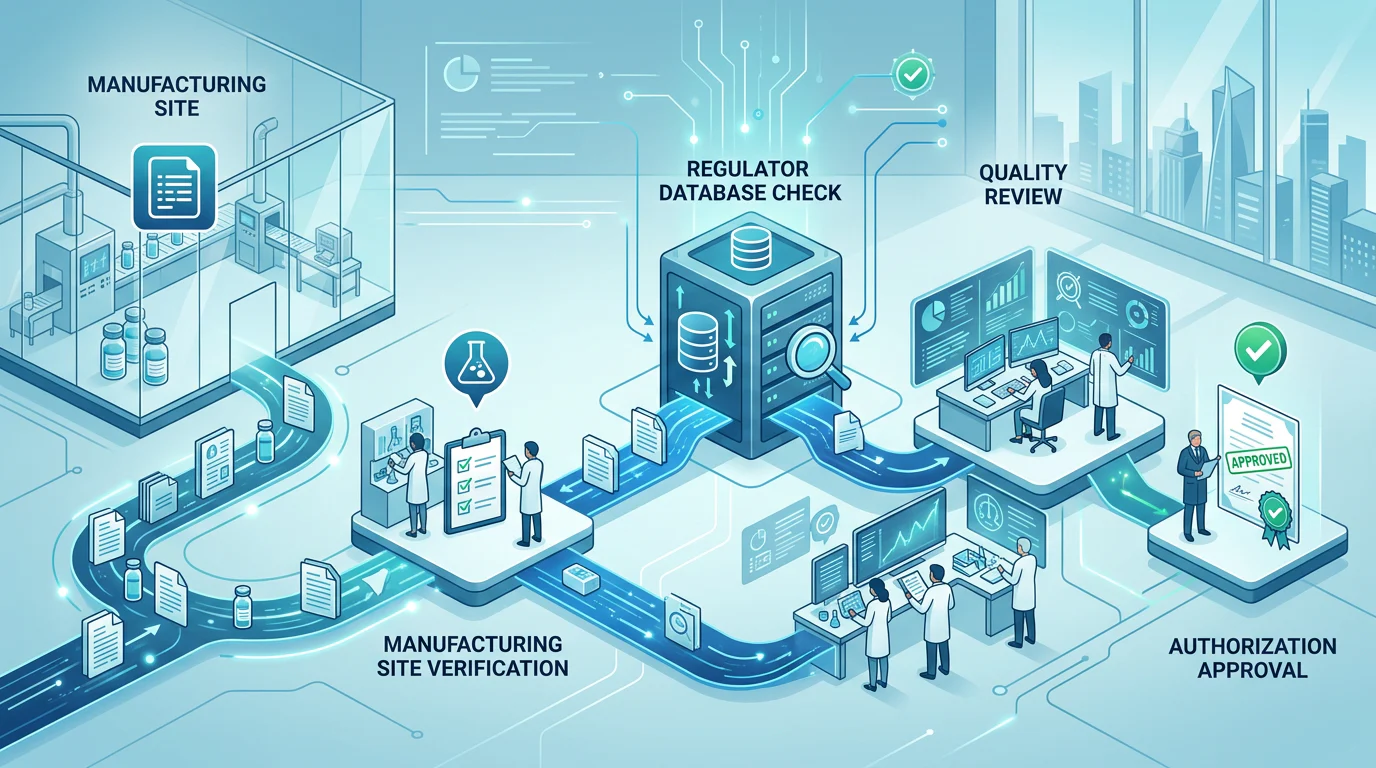
The core task is to match the document to the actual material. We first confirm the exact dexamethasone form, legal holder, production site, and target market. Only then can a buyer determine whether a USDMF, CEP, ASMF, Written Confirmation, or authorization letter actually supports the intended filing.
Verify the USDMF Record
We search the current FDA DMF list for the exact subject and confirm Type II status, holder name, and active or inactive designation. The supplier must then connect that record to the product and site through a dated document package. FDA’s guidance is unambiguous that a DMF is not a substitute for an NDA, ANDA, IND, or export application. Read the FDA guidance.
Check CEP Status Before Relying on It
A CEP should be checked in EDQM’s public database by substance and certificate number. Buyers should capture the latest valid version, issue status, and any relevant suspension or withdrawal history. EDQM’s public actions page recorded three dexamethasone-related CEP suspensions for GMP non-compliance on 27 July 2026, which is why we treat historical certificates as insufficient without a current status check. See EDQM actions.
Separate ASMF and Written Confirmation Roles
An ASMF allows confidential active-substance information to be evaluated while the marketing-authorisation applicant retains responsibility for product quality. A Written Confirmation addresses applicable EU import and GMP requirements. Neither document automatically proves that the other exists, and neither eliminates the need to verify the precise manufacturing site.
Obtain a Product-Specific LOA
For a US filing, we request a dated Letter of Authorization that identifies the holder, DMF number, authorized applicant, specific product, relevant submission details, and commitment that the file is current. FDA lists these expected LOA elements in its authorization guidance.
Our five-step review is simple: identify the exact form and site, match the filing record, check public status, obtain the authorization, then have regulatory affairs reconcile the evidence to the planned application. Buyers planning a US dossier can extend that review through our filing-ready supplier guide.
What Does GMP Evidence Prove About a Dexamethasone Site?
GMP evidence is site-specific and time-sensitive. It can show that an authority inspected a manufacturing location or issued a certificate, but it does not automatically confirm that every form of dexamethasone is currently manufactured there, nor that the site can support a buyer’s filing and commercial requirements.
We check public regulatory evidence first, then compare it with the supplier’s current certificate, inspection scope, quality agreement, and product documentation. EudraGMDP allows public searches of GMP certificates, non-compliance reports, and API manufacturer registrations using site details, making it a useful independent control. The EMA database should be reviewed alongside the supplier’s evidence.
A sound review also recognizes that a DMF status and a GMP status answer different questions. A current DMF may show that a file exists, while inspection information may show a regulatory outcome at a facility. Neither replaces the buyer’s audit, quality agreement, or product-specific technical assessment.
We use GMP certification guidance to frame the quality review. That review should cover the site named in the supplier’s documentation, its inspection scope, and whether any public non-compliance information creates a reason to pause or escalate the qualification.
How Do We Test Consistent Dexamethasone Batch Quality?
Batch consistency is demonstrated through comparable commercial evidence over time, not through one attractive certificate of analysis. We request representative batches, assess trends, and ask the supplier to explain meaningful shifts before moving toward approval.
Compare Assay and Identity Results
We compare assay results across at least three representative commercial batches and confirm the stated analytical method and calculation basis. This helps identify whether apparently similar results are actually reported on different bases or against different specifications.
Trend Related Substances
Related-substances data should show individual, unspecified, and total impurity results, not only a pass statement. We compare results against the current specification and ask whether analytical methods, process controls, or impurity limits changed between batches.
Review Residual Solvents and Particle Size
Residual-solvent results should reflect the process and the intended route of administration. For micronized material, we compare particle-size distributions, method settings, and the consistency of batch-to-batch results where particle size is a critical material attribute.
Examine Stability, Deviations, and Change Control
We request stability or retest support, deviation and out-of-specification summaries, major CAPA information, and the change-notification process. ICH Q7 expects annual product-quality reviews to examine critical test results, failed batches, critical deviations, and changes, as described in the Q7 guidance.
A complete qualification file should include a current specification, three representative CoAs, impurity profile, residual-solvent evidence, stability package, applicable filing evidence, LOA pathway, and GMP or audit evidence. For imported supply, product evidence must also travel with the logistics and regulatory review. Our US import guide helps buyers connect site verification, shipment planning, and documentation requirements before an order becomes a filing or quality risk.
Qualify Dexamethasone Supply with Aarise Pharma
At Aarise Pharma, we help procurement and regulatory teams turn a supplier conversation into a documented qualification decision. We start by matching the required dexamethasone form, site, market, grade, and dosage-form constraints, then organize the evidence your quality team needs to assess. Our approach keeps commercial questions, including packaging, lead time, shipping route, and change notification, connected to the regulatory file instead of treating them as separate workstreams.
We can structure a request around the exact data that matters: site identity, filing status, LOA pathway, specification, stability evidence, and representative batch documentation. That makes it easier to spot a mismatch early and escalate only when evidence warrants it. Buyers assessing a broader imported portfolio can also review our catalog comparison. Our team sets a clear evidence request and review path. To begin a molecule-specific qualification discussion, contact Aarise Pharma.
FAQs on Dexamethasone API Suppliers with DMF Support
These questions address the evidence gaps that most often create avoidable delays during dexamethasone API supplier qualification.
Does a USDMF Mean the API Is FDA Approved?
No. FDA says DMFs are neither approved nor disapproved. Technical contents are reviewed only when an application references the file with a written holder authorization.
What Should a Dexamethasone LOA Include?
Request a dated authorization naming the holder, file number, applicant, exact dexamethasone form, manufacturing site, referenced sections, and confirmation that the DMF remains current for submission use.
How Can Buyers Check Batch Consistency?
Compare three commercial batch CoAs and review assay, individual and total related substances, residual solvents, particle size when relevant, stability, deviations, and documented change trends.
How Do Buyers Verify a CEP?
Search EDQM’s public database for the latest valid CEP, then review its status, number, substance, and history. Ask EDQM for clarification when records remain unclear or conflicting.