
TL;DR
We explain how US filing-ready API suppliers support regulatory filings with product-specific CMC documentation, a current quality package, change-control commitments, and, where relevant, a Type II DMF and LOA. We also show importers how to verify the API, DMF holder, manufacturing site, documentation, and review support before shipment or batch release.
US API sourcing is not simply a commercial decision. FDA’s public DMF list is updated quarterly and currently reaches DMF 044443, a useful reminder that a file number is only one item in a much larger qualification record. FDA DMF list
US filing-ready API suppliers support regulatory filings when they can document the exact API, DMF holder, manufacturing site, current quality package, change-control commitments and, where relevant, a Type II DMF with a product-specific Letter of Authorization. We recommend verifying every element before filing, shipment, and batch release.
Here, we explain what that evidence means, how US importers can test it, and where a direct manufacturer or distributor must fit into a defensible filing and supply-chain record.
Which US Filing-Ready API Suppliers Actually Support Regulatory Filings?
We treat “filing support” as a product-level responsibility, not a company-level marketing claim. An API may be commercially available, yet still lack the correct site coverage, current DMF status, LOA scope, or CMC evidence for a buyer’s planned ANDA, NDA, or IND. For product-scope discussions, our US raw-material catalog can help teams name the material precisely.
FDA says foreign establishments that manufacture, repack, relabel, or salvage APIs for US import must register and list their commercially distributed APIs. They must also identify known importers in their registration. FDA API imports
A supplier matrix should therefore record the evidence tied to each API candidate. We do not treat a general capability statement as a substitute for a verified product row.
| API | Role | DMF Holder | Manufacturing Site | USDMF Status | LOA Availability | Inspection Evidence | CMC Support | Checked-On Date |
|---|---|---|---|---|---|---|---|---|
| Exact API name, salt or form, and grade | Declare direct manufacturer, distributor, repacker, or relabeler | Legal holder name matched to the file | Full physical site supporting the material | Public activity and available-for-reference status, never described as approval | Confirm applicant, product, sections, and supporting site | FDA classification or other traceable, dated inspection evidence | Current specifications, impurity, stability, and method documentation | Date, source, and reviewer recorded for each claim |
This is why we begin with the actual material and source rather than a broad supplier directory. Teams comparing candidates can use our generic-drug supplier guide after they establish the evidence fields that matter for their specific API.
What Documents Prove Filing Support?
The key documents overlap, but they are not interchangeable. A DMF protects confidential information, an LOA gives FDA permission to review it, and a CMC package helps the buyer assess the product without receiving every proprietary manufacturing detail.
| Document | What It Does | What It Does Not Prove | Buyer Verification Action |
|---|---|---|---|
| Type II DMF | Holds confidential information on a drug substance, intermediate, or material used in preparation | FDA approval of the DMF, the API, or the finished drug | Match holder, subject, activity, and filing route |
| Letter of Authorization | Permits FDA to reference specified DMF information for a named applicant | That every site or product in a DMF supports the buyer | Confirm API, applicant, referenced sections, and applicable sites |
| CMC Package | Supports quality assessment with specifications, controls, methods, and stability information | Automatic filing adequacy or finished-product approval | Review current version and align with intended use |
| CEP | Supports European Pharmacopoeia suitability for the covered substance | US DMF status or FDA authorization to reference a file | Treat as supplementary evidence, not a US filing substitute |
| GMP Evidence | Supports assessment of the quality system and site controls | Permanent compliance or approval of a specific API | Check source, site, scope, classification, and date |
What Is a Type II DMF?
A Type II DMF can cover a drug substance, intermediate, or material used in preparation. FDA does not approve or disapprove DMFs. Instead, it reviews the relevant information when an IND, NDA, ANDA, or other authorized submission references it. FDA DMF overview
What Does an LOA Actually Authorize?
An LOA is the document that allows FDA to review specified DMF content for the applicant’s submission. It should identify the holder, DMF number, authorized applicant, product, referenced material, current-status commitment, and the relevant supporting sites.
What Belongs in a Buyer-Facing CMC Package?
We expect an appropriate non-confidential package to address specifications, impurity controls, stability or retest information, analytical methods, and manufacturing-control context. Confidential detail can remain with the DMF holder, but the buyer still needs enough evidence to qualify the material and plan the filing.
Why Are CEP and GMP Evidence Different?
A CEP relates to European Pharmacopoeia suitability. It is useful evidence, but it is not a US Type II DMF and does not itself authorize FDA to review confidential CMC information. For site quality, ICH Q7 expects formal change control for changes that could affect API production or control. ICH Q7 guidance
For a deeper look at the evidence behind site quality, use our GMP certification guide.
How Do Buyers Verify US Filing-Ready API Suppliers?
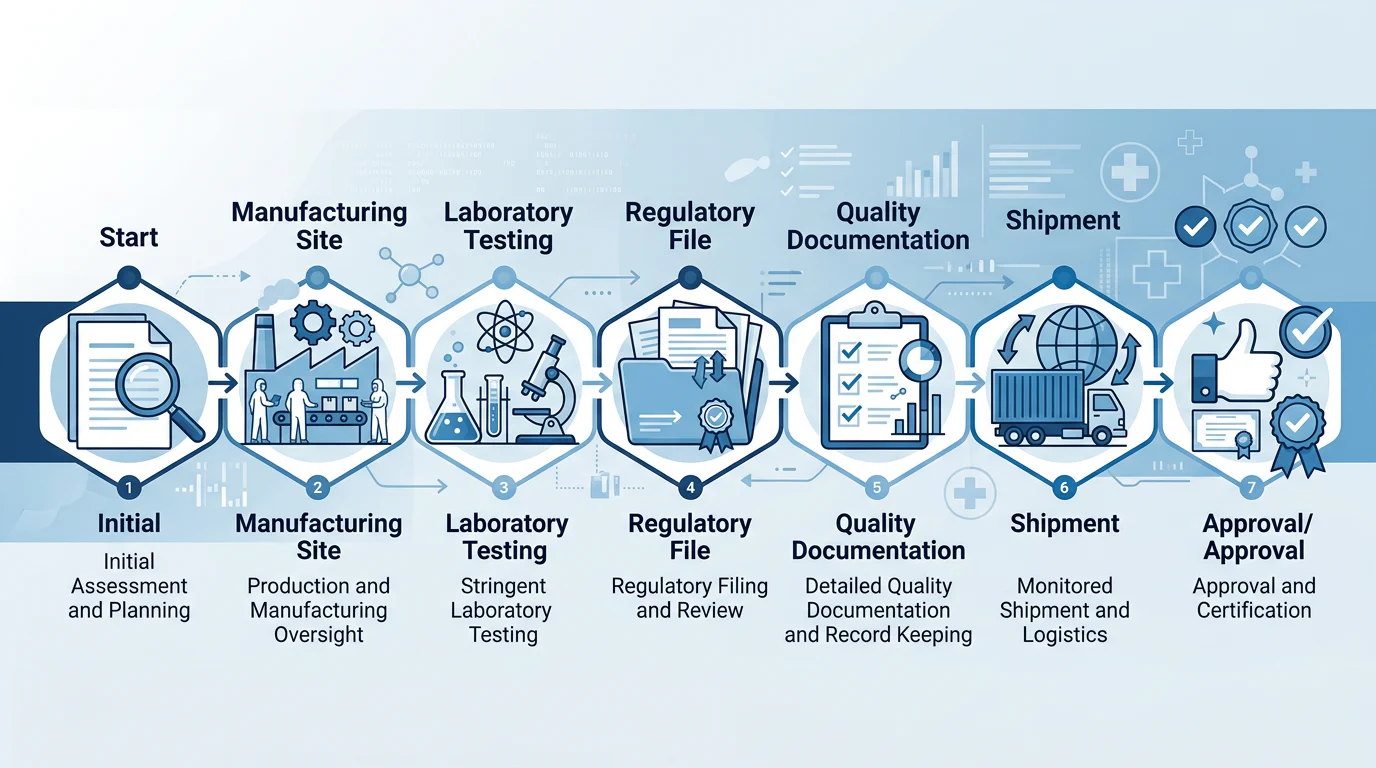
Verification works best as a repeatable sequence, with each conclusion dated and tied to an authoritative source. We recommend completing the workflow before a purchase order becomes a filing, quality, or customs problem.
- Confirm the intended route, such as commercial manufacture, IND, NDA, ANDA, or another permitted use.
- Identify the exact API, salt or form, actual manufacturer, full manufacturing-site address, and supplier role.
- Verify establishment registration, listing, and importer or consignee alignment where required.
- Check FDA Type II DMF resources for the holder, subject, activity, and available-for-reference status.
- Obtain an LOA that matches the applicant, API, and supporting manufacturing site.
- Review the current quality package, impurity risks, analytical-method plan, and change-control commitments.
- Check inspection and enforcement evidence, document the review date, and repeat critical checks before shipment or a material change.
FDA explains that a Type II API DMF can appear on the available-for-reference list after a completeness assessment, but that assessment does not replace full scientific review for a particular ANDA. FDA DMF types
We also check whether a seller’s role matches the evidence provided. A distributor may facilitate a supply relationship, but the original manufacturer and batch traceability still matter. FDA’s Q7 guidance expects distributors and related supply-chain parties to retain original-manufacturer identity, authentic COAs, batch information, transportation records, and retest or expiry data. Q7 distribution rules
Common red flags include a DMF number that does not match the API form, an LOA without applicable-site clarity, an unavailable original manufacturer, or a claim that a DMF itself is FDA approved. Buyers comparing possible materials can pair this workflow with our API catalog comparison.
What Documents Do US Importers Need Before Purchase and Entry?
We separate the documentation path into purchase qualification, shipment preparation, customs entry, laboratory testing, and batch release. The exact set depends on intended use and product status, so importers should validate the final entry strategy with their regulatory, legal, and customs specialists.
Before purchase, we recommend obtaining the product identity, actual manufacturer and site, specifications, quality agreement, traceability record, risk assessments, filing-support commitments, and current quality documentation. Before shipment, the working file should include the batch COA, invoice, packing list, labeling, transport conditions, retest or expiry information, and any agreed temperature or handling records.
At entry, FDA reviewers compare declared manufacturer, declared importer or consignee, product description, intended-use code, and applicable affirmations of compliance against FDA systems. Inaccurate or incomplete data can trigger further review or detention. FDA entry review
For testing and release, the finished-drug manufacturer needs methods, sample handling, acceptance criteria, deviation pathways, and a documented transfer approach where testing moves between laboratories. FDA describes method transfer as a preapproved protocol using representative test articles and defined acceptance criteria. FDA method transfer
Our quality testing guide can help teams structure analytical questions before they approve an API batch for downstream use.
How Does Supplier Support Continue After Filing?
Filing support does not end when the LOA is issued. The supplier, DMF holder, applicant, and quality teams need a shared understanding of what happens when FDA asks questions, a method changes, a site changes, or a new impurity risk emerges.
How Should Deficiency Responses Work?
When FDA identifies a deficiency in DMF information, the DMF holder receives the detailed deficiency communication. The party relying on the DMF is notified that additional supporting information is needed, while confidential technical detail remains with the holder. FDA DMF process
We recommend that supplier agreements define notification contacts, response ownership, document timing, and how the applicant will learn that the holder has addressed a deficiency.
What Should Change Control Cover?
The agreement should cover changes to starting materials, process steps, manufacturing sites, equipment, specifications, analytical methods, packaging, and impurity controls. It should also state how impact assessments and filing actions will be coordinated before a change affects supplied material.
For specialized development programs, product and lifecycle needs can differ considerably. Teams working with peptides can compare their pathway against our clinical peptide guide.
Which Risk Assessments Matter Most?
We look for relevant nitrosamine risk assessments, elemental-impurity assessments, residual-solvent controls, and genotoxic-impurity evaluations. FDA’s September 2024 nitrosamine guidance addresses both small-molecule nitrosamines and nitrosamine drug substance-related impurities. FDA nitrosamine guidance
Method-transfer expectations matter here as well. Where a buyer’s laboratory will test incoming API, the transfer plan should define the originating and receiving labs, representative batches, acceptance criteria, and responsibility for discrepancies.
Aarise Pharma Qualification Pathway
At Aarise Pharma, we focus on B2B active pharmaceutical ingredients and pharmaceutical raw materials for international buyers. For a US-focused sourcing conversation, we ask buyers to begin with the exact API, salt or form, intended use, and target timing. A sound qualification record then separates the commercial question from the regulatory evidence: actual manufacturing source, applicable Type II DMF holder, covered site, LOA scope, quality package, change-control terms, and import documents. That discipline helps teams identify what must be verified before an ANDA, NDA, IND, shipment, testing program, or batch-release decision proceeds. If confidential information is involved, the right process preserves it while giving FDA the authorization needed for review. Teams may use our US raw-material catalog to frame product questions and share the evidence that needs a regulatory review with your quality and import teams before procurement starts. Start a B2B conversation with Aarise Pharma.
FAQs on US Filing-ready API Suppliers
Which Pharmaceutical API Suppliers Support US Regulatory Filings?
We verify the exact API, manufacturing site, DMF holder, LOA scope, quality package, inspection evidence, and documented commitments for change control and regulatory review support throughout supply.
How Do We Verify an API Supplier’s USDMF?
First, we confirm that the Type II DMF is available for reference. Then we obtain an LOA identifying the applicant, API, supporting sites, and current submission details.
What Documents Should an API Supplier Provide for an ANDA?
Before purchase, we request a product specification, authentic batch COA, original manufacturer traceability, risk assessments, quality agreement, filing terms, and shipment documents appropriate for intended use.
Can a Distributor Support a US Regulatory Filing?
A distributor can support a filing by identifying the original manufacturer, preserving batch traceability, transferring regulatory information, and coordinating a product-specific LOA with the holder when required.