Orally Disintegrating Tablets: A Spec and RFQ Sheet for Buyers
Orally disintegrating tablets disintegrate rapidly on the tongue without chewing or liquid; FDA recommends a laboratory time of approximately 30 seconds or less. Specify disintegration time, weight, water instruction and packaging.

By Sunil Kumar, Managing Director - Sales · Updated 24 Oct 2026
Key takeaways
- An ODT is defined by performance: FDA recommends a laboratory disintegration time of approximately 30 seconds or less and a tablet weight of generally no more than 500 mg.
- In our count of 526 US ODT product listings in FDA's National Drug Code directory (24 October 2026), 12 molecules account for 80% of listings, and ondansetron alone has 98.
- Blister packs are the common format (72% of listings include one), but 33% list a bottle, so packaging has to be a stated specification line and not an assumption.
- Decide the water instruction early. FDA reviewers found that 17 of 39 older ODT product-specific guidances disagreed with the product label on water.
In this article
- 1How do you take an orally disintegrating tablet?
- 2What is an orally disintegrating tablet, and what makes a tablet qualify as one?
- 3Which medicines come as ODTs in the US?
- 4Do ODTs come in blister packs or bottles?
- 5Should an ODT be taken with water, and why does it decide the study design?
- 6What should an ODT specification and RFQ include?
- 7What can we supply for an ODT project?
- 8Frequently asked questions
A purchase brief that says only "orally disintegrating tablet" (ODT) leaves four decisions open.
How fast must the tablet disintegrate, and how is that measured? How heavy may it be? Is the bioequivalence study (the comparison of a generic with its reference product) run with or without water? What package protects a fragile, moisture-sensitive tablet?
Patients searching this term will find the handling steps in the first section below, and their label and pharmacist remain the authority. The rest of the page is for formulation and sourcing buyers: the FDA benchmarks, a count of US ODT product listings in FDA's National Drug Code directory, and a specification table you can paste into a request for quotation (RFQ).
How do you take an orally disintegrating tablet?
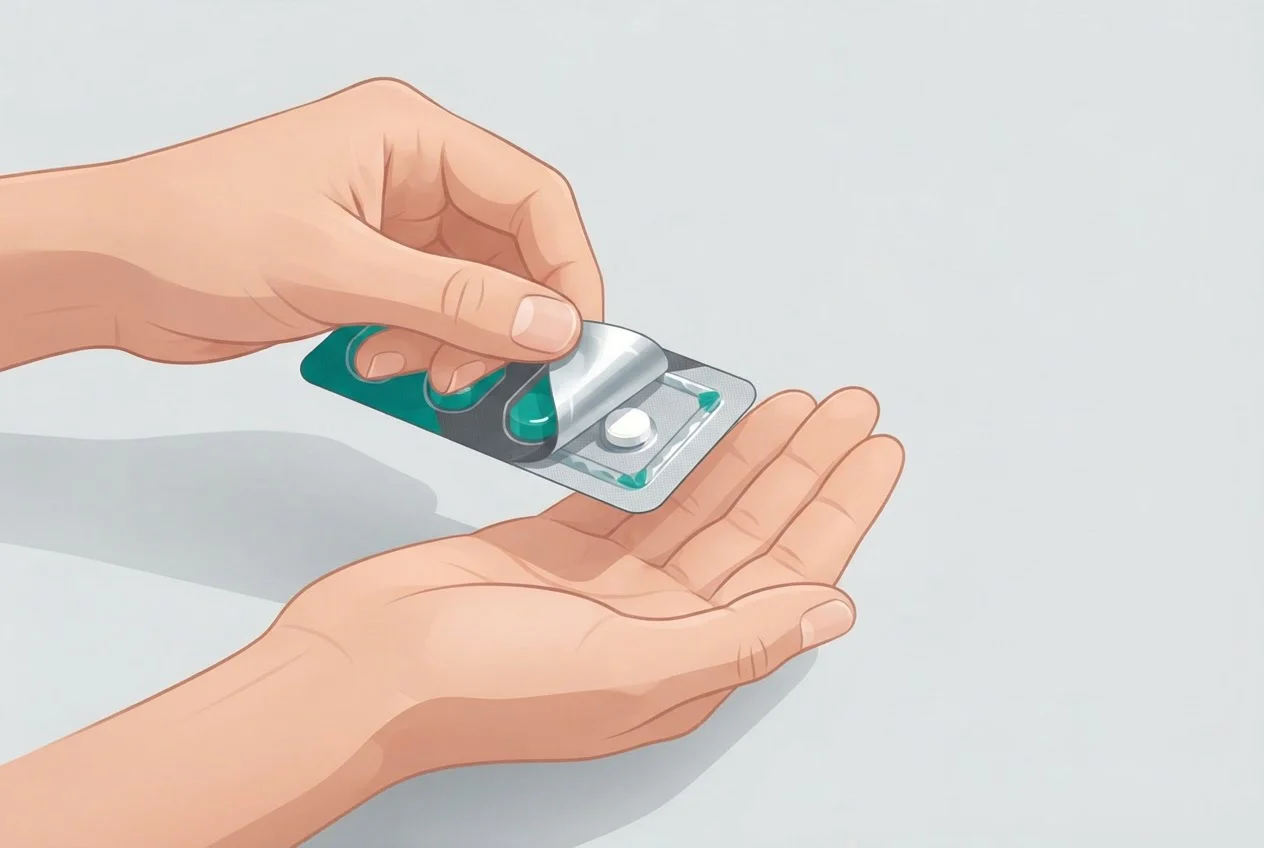
Place the tablet on your tongue, let it dissolve and swallow it with saliva. MedlinePlus (revised 15 September 2026) gives the handling for ondansetron ODTs: remove the tablet just before your dose, use dry hands, peel the foil back instead of pushing the tablet through it, and place the tablet on top of your tongue, where it dissolves in a few seconds. Follow your product's label, because each medicine has its own instructions. Questions about swallowing a tablet whole belong with a pharmacist.
What is an orally disintegrating tablet, and what makes a tablet qualify as one?
An orally disintegrating tablet is, in FDA's definition, "a solid dosage form containing medicinal substances which disintegrates rapidly, usually within a matter of seconds, when placed upon the tongue." FDA's Orally Disintegrating Tablets guidance (December 2008, final) adds numbers to that definition.
- Disintegration time. FDA recommends an in vitro disintegration time of approximately 30 seconds or less, measured by the United States Pharmacopeia (USP) disintegration method or by an alternative shown to correlate with it. FDA's survey of applications found times from a few seconds to longer than a minute, with a large majority at approximately 30 seconds or less.
- Tablet weight. FDA generally recommends no more than 500 mg. A heavier ODT must justify that it still performs as one.
- No liquid. Tablets that take longer than 30 seconds, or that are dosed with liquids, "may be more appropriately considered to be chewable or oral tablets."
FDA states that 30 seconds is not an arbitrary line between an ODT and another tablet. It is a representative period for products that work without chewing or liquid. Our recommendation: set the target well under 30 seconds, so normal batch variation does not push lots over it.
Which medicines come as ODTs in the US?
Ondansetron, olanzapine and loratadine have the most US ODT listings in the FDA National Drug Code (NDC) directory: 202 of 526 as of 24 October 2026, and 12 molecules account for 80% of listings.
We queried the directory through openFDA for the dosage form "TABLET, ORALLY DISINTEGRATING" on 24 October 2026, when the data were last updated 23 October 2026. That returned 604 listings. We kept finished products marketed under an abbreviated new drug application (ANDA, the generic route), a new drug application (NDA), an authorized generic or a biologics license application. That left 526 listings from 132 labelers (a labeler is the company that lists the product in the NDC directory), covering 31 distinct active-ingredient combinations.
| Molecule | Listings | Share of 526 |
|---|---|---|
| Ondansetron | 98 | 18.6% |
| Olanzapine | 57 | 10.8% |
| Loratadine | 47 | 8.9% |
| Lamotrigine | 40 | 7.6% |
| Risperidone | 31 | 5.9% |
| Rizatriptan benzoate | 30 | 5.7% |
| Clonazepam | 25 | 4.8% |
| Lansoprazole | 24 | 4.6% |
| Amphetamine | 18 | 3.4% |
| Omeprazole | 18 | 3.4% |
| Mirtazapine | 18 | 3.4% |
| Clozapine | 16 | 3.0% |
These 12 molecules total 422 listings, which is 80%, and the top three are 38%.
We publish this page, and we are not a labeler in the data. The count is a snapshot of one directory. A listing is a product entry, not a measure of sales or volume.
Do ODTs come in blister packs or bottles?
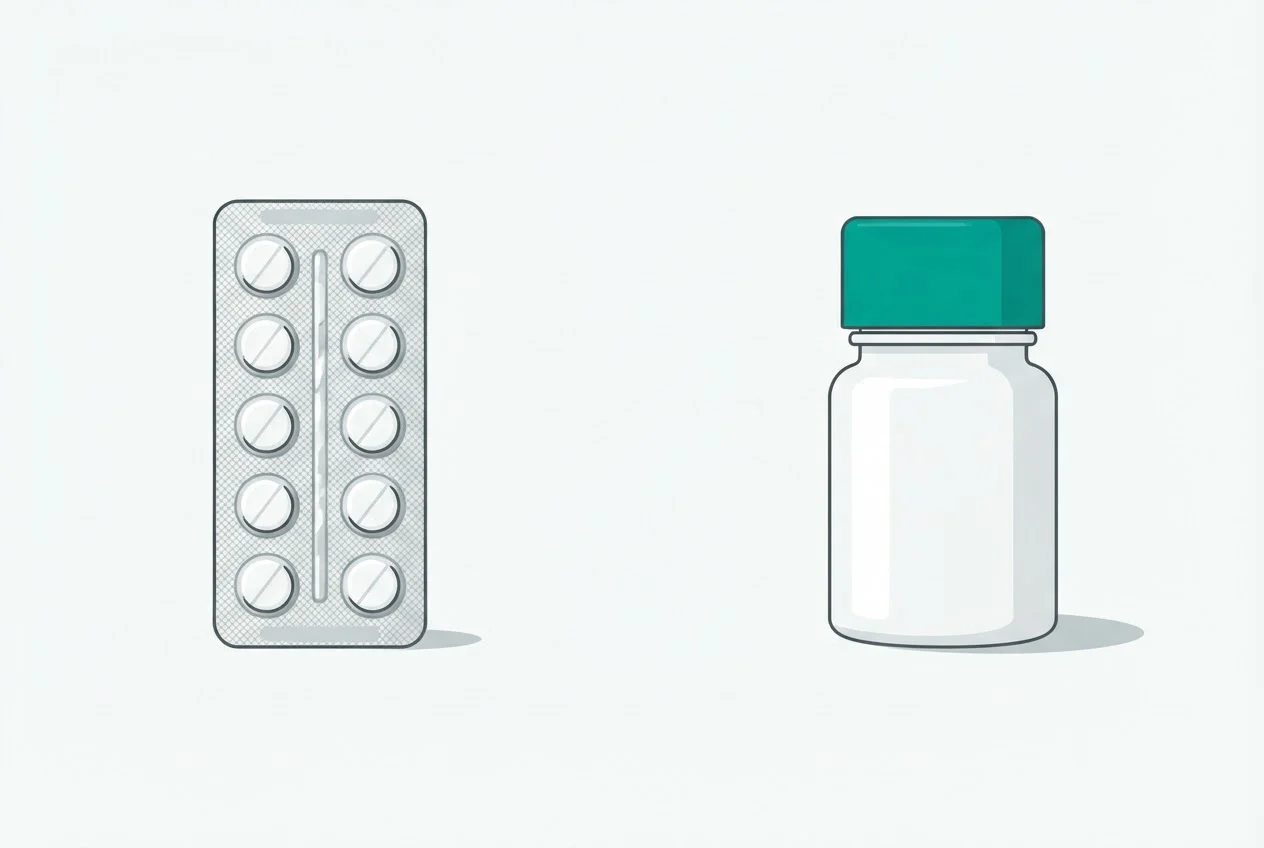
Most ODT listings include a blister pack, but a third include a bottle. In the same 526 listings, we marked a product as blister if any of its package descriptions contained the word BLISTER, and as bottle if any contained the word BOTTLE. Products can carry several package descriptions, so the categories overlap. The "includes" rows count every product with that word. The "only" rows count products whose package descriptions all fall in that one category.
| Package format in the listing | Products | Share of 526 |
|---|---|---|
| Includes a blister pack | 380 | 72% |
| Blister pack only | 296 | 56% |
| Includes a bottle | 174 | 33% |
| Bottle only | 95 | 18% |
| Both blister and bottle | 72 | 14% |
| Neither (unit-dose box, carton or other) | 44 | 8% |
The rows reconcile as follows. Blister-only (296) plus both (72) is 368; the other 12 blister listings also carry another package type, such as a carton. Bottle-only (95) plus both (72) is 167; the other 7 bottle listings likewise combine with another package type. Those 482 products with a blister or a bottle, plus the 44 with neither, make 526.
The pattern varies by molecule. All 47 loratadine listings are blister-only. Ondansetron splits into 33 blister-only, 27 bottle-only and 38 other combinations, meaning listings that are neither blister-only nor bottle-only (both formats, or another package type such as a carton). Olanzapine splits into 26 blister-only, 23 bottle-only and 8 other, defined the same way.
The directory records package format, not what protects the tablet inside a bottle. A 2026 review by FDA Office of Generic Drugs authors (Bagde et al., AAPS Open 2026) notes that ODTs are more fragile and moisture-sensitive, which is why blister packs are common. Our recommendation: if you plan a bottle, require stability data in that exact pack, and treat a blister as the default you must justify leaving.
Should an ODT be taken with water, and why does it decide the study design?
An ODT is taken as its own label directs; for ondansetron, the tablet dissolves on the tongue and is swallowed with saliva. For a developer, the water instruction sets the bioequivalence (BE) design: for generics, the study follows the reference product's labeled instruction.
FDA's ondansetron product-specific guidance (a document recommending how to study bioequivalence for one drug; draft, August 2026) recommends a fasting, single-dose, two-period crossover study on the 8 mg strength, with the tablet "swallowed without water." The 4 mg strength can be waived using comparative dissolution on 12 units per strength plus a proportionally similar formulation.
This is not a trivial point. M13A is FDA's guidance on bioequivalence studies for immediate-release solid oral products. FDA reviewers checked 39 ODT products approved before M13A and found that 17 product-specific guidances recommended a different water instruction from the product label. Those guidances were then updated (Bagde et al., AAPS Open 2026).
In the one example the review gives, water changed absorption timing: for alprazolam 0.5 mg, peak time was 1.75 hours for the conventional tablet, 2 hours for the ODT with water and 2.25 hours without, while peak concentration and total exposure were bioequivalent (Bagde et al., AAPS Open 2026). The authors consider the difference unlikely to matter clinically.
What should an ODT specification and RFQ include?
Put these lines in the brief and test each against the pass criterion. The benchmarks come from the FDA guidance, the ondansetron guidance and the AAPS Open review above. The pass criteria on stability, fragility and formulation are our recommendations.
Two terms in the table need explaining. Section 505(j) of the Federal Food, Drug, and Cosmetic Act is the generic (ANDA) approval route. A suitability petition asks FDA for permission to file an ANDA for a product that differs from the reference drug, for example an ODT version of a conventional tablet.
| Spec line | How to test it | Pass | Fail |
|---|---|---|---|
| Disintegration time | Ask for the method (USP disintegration or a method shown to correlate) and per-batch results | Lot results at or below an agreed internal target (our recommendation: well under 30 seconds) and within FDA's approximately 30 seconds; method named | Over 30 seconds without justification, or no method |
| Tablet weight | Read the target weight on the formula | 500 mg or less, or performance justified | Heavier with no justification |
| Dosing without liquid | Read the proposed administration instruction | Works with no chewing or liquid | Label needs a drink or chewing |
| Water instruction | Compare the study protocol with the reference label | Protocol matches the reference label | Protocol and label disagree |
| Approval route | Check what the reference product is | ODT reference: generic ANDA under section 505(j). Conventional-tablet reference: approved suitability petition first | Assuming a standard ANDA when the reference is a conventional tablet |
| Strength waiver | Check the product-specific guidance | Dissolution comparison and proportional formulation meet the guidance | Waiver claimed without both |
| Fragility | Ask for hardness and friability results at the packing stage | Results reported against an agreed limit | No data |
| Formulation (our recommendation) | Read the excipient list and the disintegration or in-mouth test results | Superdisintegrant and water-soluble filler present (Bagde et al. describe superdisintegrants at 4% to 15%); taste-masking addressed | Residue or a need for liquid shown in disintegration or in-mouth testing |
| Quality-control release | Request the dissolution testing method report | Method development report supplied | No method report |
| Packaging | Ask for stability data in the final pack | Data in the exact blister or bottle | Bottle chosen with no data |
What can we supply for an ODT project?
We are a Haridwar-based pharmaceutical company, and our relevant work for an ODT buyer is API supply by quotation and oral dosage-form CDMO services (contract development and manufacturing), from product development through commercial manufacturing. ODT-specific formulation capability is assessed at the feasibility review stage; contact us with your target product.
Eleven of the 31 active ingredients in the listings appear on our pharmaceutical API list: olanzapine (57 listings), lamotrigine (40), rizatriptan benzoate (30), lansoprazole (24), omeprazole (18), mirtazapine (18), clozapine (16), aripiprazole (14), zolmitriptan (14), cetirizine hydrochloride (13) and donepezil (4). Together they cover 248 of the 526 listings, 47%: 57+40+30+24+18+18+16 = 203 for the seven molecules in the table above, plus 14+14+13+4 = 45 for the other four, and 248/526 = 47%. This is our match, October 2026: a listing counts when its active ingredient name, including salt form, matches an entry on our list (for example donepezil hydrochloride and Donepezil HCl). We matched on active ingredient, not product name. Mannitol, a common ODT filler, is on the list too.
Appearing on the list is not a stock or price promise. We quote each product individually once you give the API name and CAS number (the Chemical Abstracts Service registry number).
A quote request should include the product or CAS number, quantity, destination, grade or purity, documents needed, payment terms and Incoterms (shipping terms). For qualified B2B buyers we support sample and evaluation quantities, confirmed product by product, with the certificate of analysis (COA), specifications and safety data sheet (SDS/MSDS) where applicable. Our buying route runs from inquiry through feasibility review, commercial quotation, development or technical transfer, production and quality control, packaging and dispatch. For how contract work is vetted and quoted, see our third-party manufacturing guide.
To start, send the specification table above, filled in for your product, to sunil@aarisepharma.com or WhatsApp +91 9899783330, or use our contact form.
Frequently asked questions
ODT stands for orally disintegrating tablet, a tablet designed to disintegrate rapidly on the tongue so it can be taken without chewing or drinking liquid (FDA guidance).
No. A sublingual tablet is designed to be absorbed under the tongue, while an ODT disintegrates and is swallowed (MedlinePlus). Some ODTs can be partly absorbed in the mouth, which complicates bioequivalence (Bagde et al., AAPS Open 2026). Follow the label on your product.
An ODT disintegrates in the mouth without liquid. A dispersible tablet is dissolved or dispersed in water before it is swallowed. See our dispersible tablets guide.
Not necessarily. In the one example given, for alprazolam, the ODT reached its peak later than the conventional tablet, with equivalent peak concentration and total exposure (Bagde et al., AAPS Open 2026).
Blisters are common but not universal: 380 of the 526 listings we counted include one, and 174 include a bottle (openFDA NDC directory, 24 October 2026). ODTs are described as moisture-sensitive, so our recommendation is stability data in the exact bottle used.
Sources
- 1.FDA, Guidance for Industry: Orally Disintegrating Tablets (December 2008)
- 2.FDA, Draft Guidance on Ondansetron, orally disintegrating tablet (August 2026)
- 3.Bagde et al., Evaluation of orally disintegrating tablets: regulatory pathways, administration practices and harmonization of bioequivalence study design, AAPS Open 2026, 12:2
- 4.MedlinePlus, Ondansetron (revised 15 September 2026)
- 5.openFDA, National Drug Code directory, dosage form "TABLET, ORALLY DISINTEGRATING" (data updated 23 October 2026, queried 24 October 2026)
- 6.Aarise Pharmaceuticals, pharmaceutical API list