
Glossary
Syrup vs suspension
In syrup vs suspension, a syrup is a drug in a sweet, thick liquid and a suspension holds undissolved particles. The shake direction on the label, not the name, tells them apart.

By Sunil Kumar, Managing Director - Sales · Updated 24 Oct 2026
Also called Syrup versus suspension or Dry syrup (for oral suspension)
On this page
- 01Definition
- 02Quick facts
- 03What is the difference between syrup and suspension?
- 04Why does the name on the pack not settle the question?
- 05How the shake check was run
- 06What goes wrong when a suspension is not shaken?
- 07How do you classify an oral liquid as a syrup or a suspension?
- 08What should a specification or inquiry say for an oral liquid?
- 09Which terms are often confused with syrup and suspension?
- 10How Aarise Pharmaceuticals handles it
- 11Example
- 12Related terms
- 13Frequently asked
What is the difference between syrup and suspension?
A syrup carries a drug in a sweet, viscous vehicle, usually dissolved; a suspension holds undissolved solid particles in a liquid that settle and need shaking.
Key takeaways
- A syrup carries the drug in a sweet, viscous vehicle, usually dissolved. A suspension holds solid particles that do not dissolve and must be shaken before every dose.
- USP's own definition of "syrup" includes oral suspensions in a sweet, viscous vehicle, so the name alone cannot classify a product.
- Of 208 syrup-listed US oral products with label text, 15% contained the word "shake". Of 226 sampled suspensions, 94% did. A match shows the word is present, not necessarily a dosing direction, so read the label direction, not the headline word.
- Classify any oral liquid with three tests (dose against solubility, label direction, how it ships), then put the result on the spec in USP terms.
Quick facts
- Governing standard
- United States Pharmacopeia (USP), the US standards book for medicines
- Also known as
- Dry syrup is filed by USP under "for oral suspension"
- Shake direction
- Oral suspension: every dose. Syrup: only if the label says so
- What to check
- The label shake direction, not the headline word
The United States Pharmacopeia (USP), the US standards book for medicines, defines "syrup" widely enough to include a suspension in a sweet, thick vehicle. So a bottle named syrup can hold particles that settle and need shaking.
The classroom rule, syrup means dissolved and suspension means particles, is only half the story. A product's listed name does not reliably tell you whether to shake the bottle.
That matters twice. A caregiver measuring a dose needs to know whether the drug has settled. A buyer writing a specification or an inquiry for a contract-made oral liquid needs one unambiguous word, because it drives handling, labeling and quality testing. This entry gives the definitions, a three-test check for any oral liquid, and wording to copy into a spec.
What is the difference between syrup and suspension?
A syrup is a liquid dosage form made in a sweet, viscous vehicle (the liquid base that carries the drug), usually with the drug dissolved, and USP's definition extends to oral suspensions in such a vehicle. A suspension is solid particles dispersed in a liquid where they are not soluble, so they settle on standing.
Syrup and suspension side by side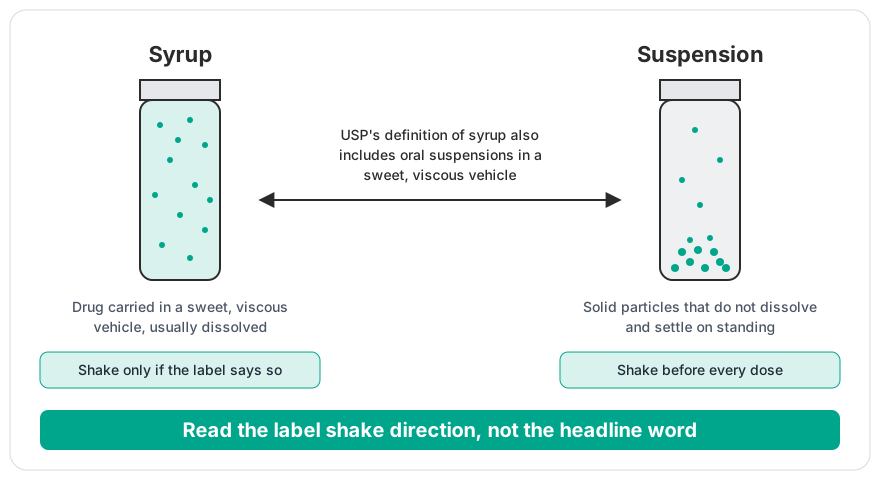
- Form
- Syrup
- What is in the bottle
- Drug usually dissolved in a sweet, viscous vehicle
- Shake?
- Only if the label says so
- Form
- Oral suspension
- What is in the bottle
- Undissolved particles in a liquid
- Shake?
- Yes, every dose
- Form
- For oral suspension
- What is in the bottle
- Dry powder made up with water before use
- Shake?
- Yes, once made up
Why does the name on the pack not settle the question?
Because the listed dosage form is typed by the labeler: 15% of syrup-listed US oral products with label text carry the word "shake", and 6% of sampled suspensions do not. On 23 October 2026 the oral-route products in the Food and Drug Administration (FDA) National Drug Code (NDC) directory were queried, through openFDA, by listed dosage form:
- Suspension: 1,010 products.
- Powder for suspension: 445 products.
- Syrup: 233 products.
- Elixir: 26 products.
Oral-route products listing acetaminophen as an active ingredient appear under four different words: solution (284), liquid (277), suspension (261) and syrup (31).
How the shake check was run
A shake check followed. For syrups, all 233 products from the syrup query above were taken. For suspensions, a random sample of 250 (Python's random.sample, seed 1) was drawn from the first 1,000 records the suspension query returned. Each product's label was looked up in the openFDA label endpoint by product NDC and the text searched for the word "shake". Label text was available for 208 syrup products and 226 sampled suspension products. The word appeared in 32 of 208 syrup labels (15%) and 213 of 226 suspension labels (94%). A match shows the word is present, not necessarily a dosing direction. The 13 suspension labels without it show why you read the whole pack.
What goes wrong when a suspension is not shaken?
Particles settle, so early doses are weak and late doses are strong. A commentary from the Agency for Healthcare Research and Quality's patient safety network (2003) describes a carbamazepine suspension that settled quickly, giving very dilute early doses and toxic later ones. The same commentary cites Barker et al. (2002), which found wrong-dose errors in 3% of all doses administered across all medicines; it is not a rate for unshaken suspensions (AHRQ PSNet).
MedlinePlus (reviewed 1 October 2025) says to shake a suspension well before using and to measure with an oral syringe rather than a household spoon, since 5 mL equals 1 teaspoon (MedlinePlus). Patients and caregivers should follow the label and ask the pharmacist.
How do you classify an oral liquid as a syrup or a suspension?
Run three tests. Each gives a clear result you can act on.
Test 1: dose against solubility (a screen). Divide the labeled strength by the volume to get mg per mL, then divide by the drug's water solubility (PubChem gives it for acetaminophen). A ratio above 1 flags a possible suspension, because more drug is present than water alone can dissolve; confirm with the drug's solubility in the actual vehicle or with the labeled dosage form. A ratio at or below 1 raises no flag, and a solution is possible. The screen can only flag, because sugar and co-solvents (liquids such as propylene glycol added to help a drug dissolve) shift solubility: acetaminophen products appear as both solution (284) and suspension (261) in the directory. This is a screening method, not a USP test.
Test 2: label direction. Result: a shake direction means you handle it as a suspension, whatever the headline word; no shake direction means this test raises no flag.
Test 3: how it ships. A powder that you make up with water is a "for oral suspension" product, which is what a dry syrup is. Result: pass (treat as a suspension) when the pack is a powder with a stated discard period after mixing; fail when it is a ready-to-pour liquid with no mixing step. One amoxicillin label (effective 9 January 2024) says to shake the oral suspension well and discard unused portion after 14 days; that is one product's period, not a rule.
What should a specification or inquiry say for an oral liquid?
It should name the dosage form in USP terms and state the vehicle, shake direction and dosing device. Copy this block:
Dosage form (USP term): Oral Suspension | For Oral Suspension | Oral Solution
Active and strength:    ___ mg per 5 mL
Vehicle:                sucrose-based | sugar-free
Shake direction:        "Shake well before each dose" | none
In-use period (powders): ___ days after mixing with water (constitution), stored at ___
Dosing device:          oral syringe or cup marked in mL
Pack size:              ___ mL
Do not use "syrup" as the dosage form; put it in the vehicle line (sucrose-based). USP's nomenclature guidelines point to Oral Solution or Oral Suspension rather than Syrup. The spec passes when every line is filled and the dosage form agrees with the label direction. It fails when they disagree, for example Oral Solution with a shake direction.
Which terms are often confused with syrup and suspension?
- Oral solution: drug fully dissolved in a solvent, without the sweet, viscous vehicle a syrup requires.
- Elixir: a solution that, under USP, must contain alcohol.
- Dry syrup / for oral suspension: powder made up with water before use.
- Drops: a small-volume measure, not a separate formulation class. Apply Tests 1 to 3 to drops too.
- Active ingredient vs finished product: see Drug Substance vs Drug Product.
- Shelf life of liquids: testing conditions depend on climate, see ICH Stability Zones. For solid forms, see Tablet vs Capsule.
How Aarise Pharmaceuticals handles it
We make oral liquids, including syrups, suspensions and drops, and dry syrup, within our oral-dose contract development and manufacturing. Our Pararise 125 is an oral suspension of paracetamol at 125 mg per 5 mL, in a flavored syrup base. Our AMS Aarise antacid liquid (aluminum hydroxide 250 mg, magnesium hydroxide 250 mg, activated dimethicone 50 mg per 5 mL) is an antacid suspension, and its label says "shake well before use".
If you are specifying a product, send us the block above with your strength and pack size at sunil@aarisepharma.com or on WhatsApp at +91 9899783330, or use our contact form. Our buying route runs from inquiry to feasibility review to commercial quotation.
Example
Paracetamol (acetaminophen) at 125 mg per 5 mL is 25 mg/mL. Its water solubility is about 14 mg/mL at 20 to 25 °C, so the ratio is 25 ÷ 14, about 1.8. Because that is above 1, the screen flags a possible suspension.
Frequently asked
Sources
- 1.USP general chapter <1151> Pharmaceutical Dosage Forms, edition 32 (2009), USP
- 2.USP nomenclature guidelines, USP
- 3.openFDA drug NDC directory (oral-route queries by dosage form, run 23 October 2026), openFDA
- 4.openFDA drug label endpoint (amoxicillin for oral suspension label, set ID 0173e9de-a995-4386-bb65-8fc2bbf347f9), openFDA
- 5.PubChem, acetaminophen solubility, PubChem
- 6.AHRQ Patient Safety Network, "Shake Well" (Flynn, 2003), AHRQ PSNet
- 7.MedlinePlus, giving medicine to children (reviewed 1 October 2025), MedlinePlus