
Glossary
Schedule M GMP
Schedule M is India's mandatory good manufacturing practice (GMP) standard for medicines and active pharmaceutical ingredients (APIs), revised in December 2023.

By Sunil Kumar, Managing Director - Sales · Updated 24 Oct 2026
Also called Revised Schedule M or Schedule M of the Drugs Rules, 1945
On this page
- 01Definition
- 02Quick facts
- 03Introduction
- 04What does Schedule M GMP mean?
- 05Where does revised Schedule M stand as of October 2026?
- 06Does Schedule M compliance make a supplier ready for the US?
- 07What should a buyer ask a supplier to prove Schedule M status?
- 08How Aarise Pharmaceuticals handles it
- 09Example
- 10Related terms
- 11Frequently asked
What is Schedule M GMP?
Schedule M GMP means the good manufacturing practice rules in Schedule M of India's Drugs Rules, 1945, covering premises, plant, equipment, quality systems and records for medicines and APIs. It was notified as G.S.R. 922(E) on 28 December 2023.
Key takeaways
- Schedule M GMP is India's mandatory manufacturing standard. The revised version, General Statutory Rules (G.S.R.) 922(E) of 28 December 2023, covers finished dosage forms and APIs.
- As of October 2026, every compliance date has passed. Ask which turnover category the site falls in, whether it relied on an extension, and the date of its latest inspection.
- Schedule M does not replace FDA requirements, a World Health Organization (WHO) GMP certificate or a quality agreement. Each answers a different question.
- Ask for evidence you can check: license holder and site, inspection date, product quality review and audit rights.
Quick facts
- Legal basis
- Schedule M of India's Drugs Rules, 1945
- Current text
- G.S.R. 922(E), notified 28 December 2023
- Published by
- CDSCO, under Gazette notifications
- Applies to
- Medicines and active pharmaceutical ingredients (APIs)
- Latest compliance date
- 31 December 2025, for sites with an extension
- What to check
- License holder and site, inspection date, product quality review, audit rights
Introduction
After the compliance deadline passed, Himachal Pradesh drug regulators inspected about 90 manufacturing units and found 10 fully compliant and served notices on 80, according to The Tribune, 16 January 2026. That is one state, not a national rate. It does show that a supplier's "Schedule M compliant" label means little without a date and a site attached.
The revised Schedule M requires a pharmaceutical quality system (Part I, §1.1), annual product quality reviews that include export-only products (Part I, §2.3.1), and a contract giver's right to audit the manufacturer (Part I, §9.2.2). A contract giver is the company that hires another manufacturer to make its product. Each of these can be tested in a supplier's documents, and the request list below does exactly that.
This page defines the term, shows where the revised rule stands as of October 2026, and gives a request list you can paste into a request for quotation (RFQ).
What does Schedule M GMP mean?
Schedule M GMP is the set of good manufacturing practice (GMP) rules in Schedule M of India's Drugs Rules, 1945. It covers premises, plant, equipment, quality systems and records for medicines and active pharmaceutical ingredients (APIs). The current text was notified on 28 December 2023 as G.S.R. 922(E). It substituted the earlier schedule and is titled "Good Manufacturing Practices and Requirements of Premises, Plant and Equipment for Pharmaceutical Products." It governs an Indian manufacturing license, not US FDA acceptance.
Part I sets the main principles, including a pharmaceutical quality system and annual product quality reviews. Later parts add rules by product type: oral solids (Part VIII), oral liquids (Part IX), topicals (Part X) and APIs (Part XII). Part XII applies the Part I principles to API manufacture as well.
Where does revised Schedule M stand as of October 2026?
As of October 2026, every compliance date in the notification and its extension has passed. The notification gave large manufacturers (turnover above 250 crore rupees) six months and small and medium manufacturers (250 crore or less) twelve months from publication. One crore is 10 million.
The first two dates are calculated from the 28 December 2023 publication date and the notification's six- and twelve-month periods.
The extension needed Form A, the application the Central Drugs Standard Control Organisation (CDSCO) required for the extension, with a section-wise gap analysis and an upgrade plan, as reported by Pharmabiz. On 8 November 2025 CDSCO told state regulators to inspect immediately the units that had not applied for an extension, and to plan inspections of those that had, according to Pharmabiz. Check CDSCO's Gazette notifications page for any later notice before relying on a date.
- Manufacturer category
- Turnover above 250 crore
- Deadline
- 28 June 2024
- Manufacturer category
- Turnover 250 crore or less
- Deadline
- 28 December 2024
- Manufacturer category
- Turnover under 250 crore with an extension
- Deadline
- 31 December 2025, per G.S.R. 127(E), 11 February 2025
Does Schedule M compliance make a supplier ready for the US?
No. Schedule M is Indian law, and US supply runs on US law. Under 21 CFR 210.1, a drug made in breach of current good manufacturing practice (CGMP) is adulterated. FDA says it inspects manufacturing facilities worldwide, including those making active ingredients. Import Alert 66-40 (revised 15 July 2025) allows detention without physical examination of drugs from firms that have not met drug GMPs.
Schedule M and US supply answer different questions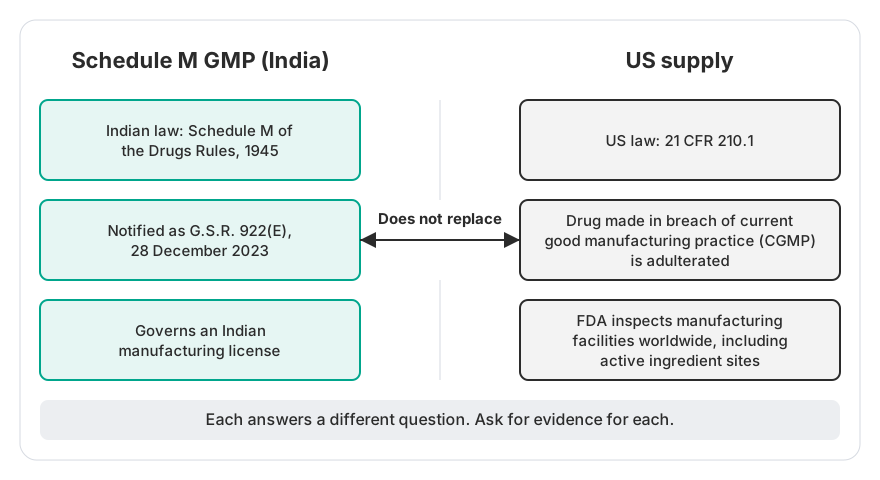
Schedule M is the floor for an Indian supplier, not the finish line. Three documents get mixed up with it:
- A WHO-GMP certificate is a separate document.
- ICH Q7 is the international GMP guide for APIs.
- FDA drug establishment registration is a US listing, not an Indian one.
What should a buyer ask a supplier to prove Schedule M status?
Ask for the eight items below. Each has a pass and a fail you can test.
The audit right and technical agreement are the contract side of the rule. A pharmaceutical quality agreement is where you write them down, and the guide to third party manufacturing shows how to build the vetting pack.
- Request
- License holder and site
- Pass
- Name and address on the license match the site on the COA (certificate of analysis) and quote
- Fail
- License holder differs, or the site is unnamed
- Request
- Turnover category and due date
- Pass
- Stated in writing, with the date
- Fail
- Compliance claimed with no category
- Request
- Extension, if the site relied on one (turnover under 250 crore only)
- Pass
- Provides the Form A submission acknowledgement or CDSCO approval letter showing the 31 December 2025 date
- Fail
- Only a verbal confirmation, or no document
- Request
- Inspection since 1 January 2026
- Pass
- Dated, with outcome and no open notices
- Fail
- None, or notices unresolved
- Request
- Parts covering your product
- Pass
- License matches the Part: VIII, IX, X or XII
- Fail
- Product not on the license
- Request
- Annual product quality review
- Pass
- Latest review on file, export-only products included (Part I, §2.3.1)
- Fail
- "Export products are exempt"
- Request
- Technical agreement and audit right
- Pass
- Signed, with your right to audit (Part I, §9.2.2)
- Fail
- Audit refused
- Request
- US-bound product
- Pass
- FDA Establishment Identifier (FEI) or registration number that you can find in FDA's drug establishment registration data, plus the date and classification of the latest FDA inspection, or a stated "not yet inspected"
- Fail
- Schedule M offered in place of either
How Aarise Pharmaceuticals handles it
Aarise Pharmaceuticals is an API sourcing, supply and export partner for business buyers, and it confirms documentation product by product. Regulatory status and permitted end use depend on the molecule, the manufacturer's documents and the destination country. Buyers confirm local registration and import authorization before commercial supply.
Buyers can add the request list above to their RFQ. Aarise asks for the product or CAS (Chemical Abstracts Service) number, quantity, destination, grade or purity, documents, payment terms and Incoterms (international delivery terms). It shares COA, specifications and SDS/MSDS (safety data sheets) where applicable, per product, and confirms license and site details at quotation. It also supports sample and evaluation quantities for qualified business buyers, and buyers can browse the US pharma raw material catalog first. RFQs go to the sales team, by email at sunil@aarisepharma.com or WhatsApp at +91 9899783330.
Example
A tablet maker with turnover under 250 crore that relied on a Form A extension was due to comply by 31 December 2025. State regulators were told to plan inspections to verify that. In October 2026, ask for the inspection date after 1 January 2026 and the outcome. If the supplier only quotes the 2023 notification, treat the claim as unverified. If the supplier produces the dated inspection report, a matching site address and an outcome with no open notices, the claim holds. An inspection date alone does not.
Frequently asked
Sources
- 1.CDSCO, Gazette notifications: General Statutory Rules (G.S.R.) 922(E), 28 December 2023, and G.S.R. 127(E), 11 February 2025
- 2.Pharmabiz, final notification on extension of revised Schedule M for micro, small and medium enterprises (February 2025)
- 3.Pharmabiz, CDSCO asks state regulators to act on non-compliant units (8 November 2025)
- 4.The Tribune, Himachal Schedule M enforcement (16 January 2026)
- 5.eCFR, 21 CFR 210.1
- 6.FDA, Facts about the current good manufacturing practice (CGMP)
- 7.FDA, Import Alert 66-40