
Glossary
FDA Drug Establishment Registration
FDA drug establishment registration means a site has told FDA it exists and what it does. It is not approval or a good manufacturing practice (GMP) clearance, so importers need further documents.

By Sunil Kumar, Managing Director - Sales · Updated 23 Oct 2026
On this page
- 01Definition
- 02Quick facts
- 03What is FDA drug establishment registration, and what does it not mean?
- 04Why does "FDA registered" mislead importers?
- 05What can FDA's public database confirm about a supplier?
- 06Which documents should a US importer ask an overseas supplier for?
- 07How Aarise Pharmaceuticals handles it
- 08Example
- 09Related terms
- 10Frequently asked
What is FDA drug establishment registration?
FDA drug establishment registration is the filing a facility makes so FDA knows it manufactures, repacks, relabels or salvages drugs for the US market.
Key takeaways
- Registration tells FDA a site exists and what operations it performs. It does not approve the site, the drug or the supplier's other products, and it does not make a product legally marketable.
- Check the manufacturing site in FDA's registration database, then check inspection history separately. The two sources answer different questions.
- A trader or distributor may not appear in the database. Ask for the name and address of the plant that made the batch.
- A Drug Master File (DMF, a confidential manufacturing dossier) is never approved or disapproved. A supplier cannot honestly call it an FDA approval.
Quick facts
- Legal basis
- 21 CFR 207.17 (who must register) and 21 CFR 207.77 (legal status of registration)
- Renewal
- Between October 1 and December 31 each year
- Public database
- Drug Establishments Current Registration Site (DECRS), updated each business day
- Inspection records
- FDA Data Dashboard, updated weekly
- What to check
- The manufacturing site that made the batch, not the seller
A supplier who writes "FDA registered" on a quotation has told you the least FDA can say about a site. FDA's public list of registered sites shows which sites are currently registered.
In a 2017 warning letter, FDA cited a trader for sending customers certificates of analysis (COAs, the batch test reports) that left off the original manufacturers' names and addresses, so buyers could not tell who made the drug. Two of those suppliers were not registered as drug manufacturers.
The lesson is practical. Registration belongs to a physical site, not to a seller, so the useful questions are which plant made the batch, whether that plant is currently registered, and what FDA found when it inspected. A seller's own registration says nothing about the plant behind it.
What is FDA drug establishment registration, and what does it not mean?
Under 21 CFR 207.77, registration "does not denote approval of the establishment, the drug, or other drugs of the establishment, nor does it mean that a product may be legally marketed."
What registration tells FDA, and what it does not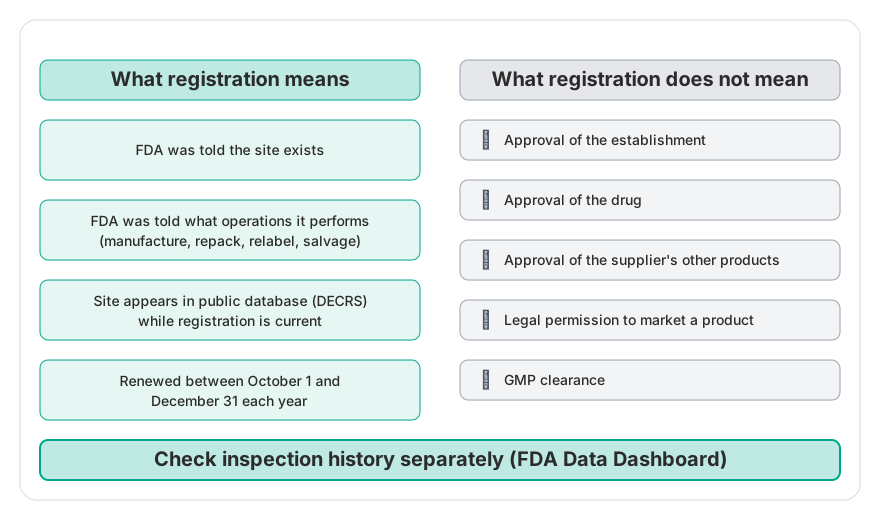
The same rule says a representation that registration signals approval is misbranding, a violation of the Federal Food, Drug, and Cosmetic Act. FDA's electronic registration and listing page adds that registering "does not indicate the products are approved or that FDA has verified the information provided."
Foreign makers are covered. 21 CFR 207.17 requires registration of any foreign establishment that makes a drug imported or offered for import into the US. FDA's API import page (current as of 15 June 2026) applies this to active pharmaceutical ingredients (APIs, the substances that make a medicine work) and requires foreign makers to list each importer they know of. To tell the substance from the finished medicine, see drug substance vs drug product.
Listing is a separate filing that names each product. Private label distributors that do not manufacture, repack, relabel or salvage are not required to register.
Why does "FDA registered" mislead importers?
"FDA registered" is read as "FDA checked" when it means only "FDA was told." The label measures the supplier's paperwork, not its quality system, and the consequences land on the importer. FDA's shipment admissibility page (current as of 15 June 2026) says a drug may be misbranded if its manufacturer has not registered and listed.
The worked example is the 2017 Sal Pharma letter above. Two of the company's suppliers were not registered as drug manufacturers, and the company left the original manufacturers' names and addresses off the COAs it sent customers. FDA wrote that "customers and regulators rely on COA for information about the quality and source of drugs."
Three confusions follow from that case. Registration is not approval. A National Drug Code (NDC, a product identifier) or a DMF is not approval either. And a seller's registration says nothing about the plant that actually made your batch.
What can FDA's public database confirm about a supplier?
FDA's Drug Establishments Current Registration Site (DECRS) confirms that a named site is currently registered. It does not confirm quality. FDA's DECRS page (current as of 5 February 2026) says the file is updated each business day. It also says sites whose registration expires or is inactivated drop off the list.
Registration must be renewed between October 1 and December 31 each year. DECRS does not include wholesale distributors or third-party logistics providers, so a trader can be legitimate and still not appear. The useful lookup is the manufacturing site, not the seller. For the wider qualification map, see API suppliers for US importers.
Inspection history is held elsewhere. The FDA Data Dashboard shows final classifications, updated weekly:
- NAI: No Action Indicated.
- VAI: Voluntary Action Indicated.
- OAI: Official Action Indicated.
Its notes say it excludes pre-approval inspections, and some records may be withheld until compliance actions finish. FDA's inspections page says it aims to classify an inspection within 90 days of its end and generally posts the classification to the Data Dashboard. A clean dashboard entry is therefore not proof of a clean site today.
Which documents should a US importer ask an overseas supplier for?
Ask for six items and test each one, because registration alone proves none of the quality points. The pass and fail columns are a recommended reading, not an FDA rule.
A DMF is reviewed only when an applicant references it. FDA's DMF guideline states that "a DMF is never approved or disapproved."
GMP evidence needs its own reading; what a WHO-GMP certificate proves covers it. An ICH Q7 audit report is the international GMP guideline for APIs. A Letter of Authorization is the DMF holder's permission for FDA to review the file for your company; compare batch documents with your quality agreement.
FDA's proposed rule on distributed manufacturing and certain foreign establishments (91 FR 42888, published in the Federal Register on 13 July 2026) would clarify that registration and listing apply to foreign establishments whose drug is further processed at another foreign establishment before import. It is a proposal and does not change current obligations. Asking for every site in the chain is already sound practice.
- Ask for
- Registration identifiers for each manufacturing site
- Pass
- Site name and address match DECRS, the quote and the COA
- Fail
- Not listed, address differs, or a consultant's certificate offered instead
- Verify at
- DECRS
- Ask for
- Original manufacturer on every COA
- Pass
- COA names the plant, and that plant is registered
- Fail
- Trader letterhead replaces the manufacturer
- Verify at
- DECRS
- Ask for
- Inspection history
- Pass
- Latest classification is visible; any OAI or warning letter is explained in writing
- Fail
- OAI left unexplained, or refusal to discuss
- Verify at
- Data Dashboard
- Ask for
- GMP evidence
- Pass
- Certificate or ICH Q7 audit report names your site and is in date
- Fail
- Head-office or group certificate only
- Verify at
- Issuing authority
- Ask for
- DMF number and a current Letter of Authorization
- Pass
- Letter addressed to you; holder matches the manufacturer
- Fail
- "DMF approved"
- Verify at
- DMF holder
- Ask for
- Batch COA, specification, SDS (safety data sheet)
- Pass
- Signed, batch-specific, names the site
- Fail
- Generic template
- Verify at
- Compare with your quality agreement
How Aarise Pharmaceuticals handles it
Aarise Pharmaceuticals operates as an API supplier, sourcing partner and exporter, not as the plant that makes every batch. It supplies bulk pharmaceutical, steroid, hormone and peptide APIs to business buyers and supports documentation and supply for US importers. It does not offer DMF, Certificate of Pharmaceutical Product (CPP) or Certificate of Suitability (CEP) support for steroid APIs, and it does not publish a US FDA establishment registration for itself.
Buyers should check the manufacturer's registration in DECRS themselves and remain responsible for confirming local registration, import authorization and permitted end use.
Buyers can send the document table through the contact page, and Aarise Pharmaceuticals will say per product which items it can supply and which it cannot.
Example
An importer holding a trader's quote asks for the batch COA and reads the plant's name and address from it. The importer searches DECRS for that exact site, then looks up its latest NAI, VAI or OAI classification on the FDA Data Dashboard. If the plant is missing from DECRS, its registration may have expired, and the quote's "FDA registered" line settles nothing.
Frequently asked
Sources
- 1.21 CFR 207.77, legal status conferred by registration and listing
- 2.21 CFR 207.17, who must register
- 3.FDA, Electronic Drug Registration and Listing System, FDA, 5 February 2026
- 4.FDA, Drug Establishments Current Registration Site, FDA, 5 February 2026
- 5.FDA, How to Register a Drug Establishment, FDA, 3 August 2026
- 6.FDA, Importing Active Pharmaceutical Ingredients, FDA, 15 June 2026
- 7.FDA, Shipment Admissibility, FDA, 15 June 2026
- 8.FDA warning letter to Sal Pharma, 20 April 2017, FDA, 20 April 2017
- 9.FDA Data Dashboard, inspections, FDA
- 10.FDA, Pharmaceutical Inspections and Compliance, FDA
- 11.FDA, Guideline for Drug Master Files, FDA
- 12.Federal Register, proposed rule 2026-14073, Federal Register, 13 July 2026