


TL;DR
We treat every peptide API temperature excursion as a documented quality decision, not an automatic release or rejection. This guide shows QA and receiving teams how we quarantine material, preserve route and logger evidence, separate shipping conditions from storage conditions, obtain supplier assessment, select testing, and choose release, return, or rejection while preventing repeat events.
Peptide API receipts deserve a different response than an ordinary parcel. The ICH stability standard calls for data from at least three primary batches, reinforcing that stability evidence belongs to a defined material and condition set.
A peptide API temperature excursion does not automatically show that material is acceptable or unusable. We compare the recorded time-temperature profile with product-specific stability data, packaging configuration, physical observations, and approved specifications. We quarantine the lot, preserve logger records, notify quality, obtain the supplier’s documented assessment, and test whenever the evidence does not support release.
Below, we provide the receiving record, transport-versus-storage distinction, scientific review, disposition branches, and prevention controls. For route selection in future shipments, our air versus sea guide helps teams consider transport-mode differences. Our aim is a defensible decision path, not a molecule-wide assumption.
How We Quarantine a Peptide API Temperature Excursion
When a shipment arrives warm, frozen unexpectedly, delayed, damaged, or with an alarmed logger, we stop the material from moving into usable inventory. We do not sample, blend, dispense, or release it while the event remains unresolved.
Our receiving team records the arrival time, receiving employee, shipment identifier, lot number, package condition, and immediate transfer to controlled storage. We preserve the carton, coolant, logger, and relevant photographs long enough for quality review, because those items form part of the event evidence.
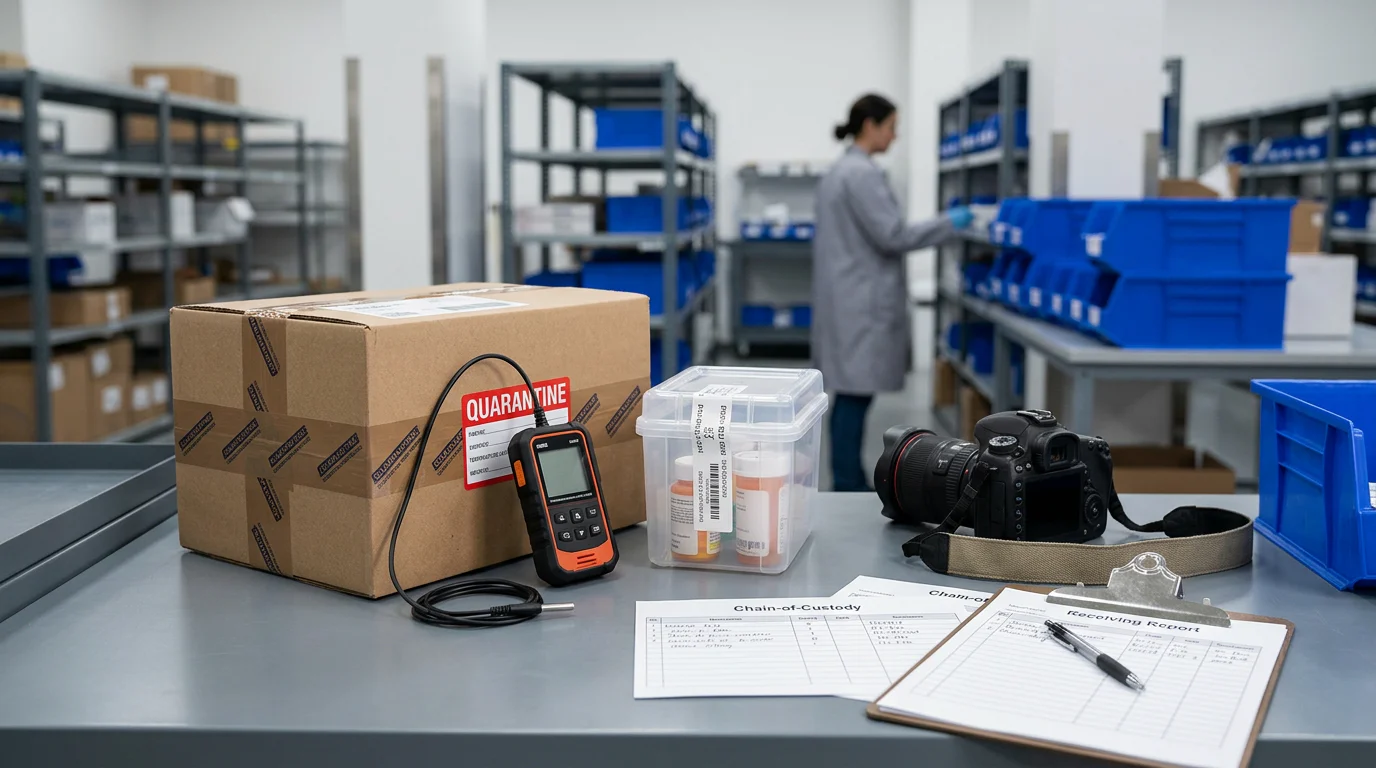
Apply a Clear Quarantine Status
We assign a physical or electronic quarantine status that prevents accidental use while maintaining the product under its best available controlled condition. The ICH Q7 guide expects incoming materials to be examined for correct labels, damage, broken seals, tampering, or contamination and held in quarantine until appropriate examination, testing, and release.
The status should identify the lot, receipt number, event date, responsible quality contact, and storage location. A quarantine label alone is not enough if inventory systems, sample requests, or production schedules can still make the lot appear available.
Preserve Evidence Before It Disappears
We download the original logger file before resetting, returning, or discarding the device. We also retain the logger serial number, calibration status, placement inside the shipper, start and stop times, sampling interval, minimum and maximum temperatures, and complete time-temperature trace.
- Shipment facts: Record the carrier, tracking number, dispatch time, delivery time, route, handoffs, delay notices, and customs events.
- Packaging facts: Photograph carton damage, seal condition, insulation, coolant state, moisture, leaks, condensation, and primary-container integrity.
- Receiving facts: Record who opened the shipment, when it entered controlled storage, and every person who handled it during the event.
For teams refining incoming controls before placing future orders, our peptide sourcing guide can help connect procurement requirements with receiving expectations.
Use an Evidence Intake Form
We use a repeatable intake form so a missing data point does not become an assumption later. The form makes it easier for quality, logistics, and the supplier to review the same event record.
| Evidence Item | Why We Capture It | Receiving-Team Record |
|---|---|---|
| Labelled transport condition | Defines the applicable shipment expectation | Product label and shipping instruction |
| Complete logger profile | Establishes actual exposure over time | Original file and device details |
| Route and transit duration | Identifies lane-specific risk and delays | Tracking history and carrier notices |
| Packaging configuration | Connects the event to the qualified packout | Photos, coolant, insulation, orientation |
| Physical observations | Flags possible container or material concerns | Inspection notes and photographs |
Why Transport Conditions Differ from Long-Term Storage Conditions
We do not use a warehouse storage statement as a shortcut for transport disposition. Long-term storage conditions, formal stability-study conditions, and shipping conditions serve related but different purposes.
A shipping profile must consider the real route, packout, duration, seasonal exposure, handoffs, and logger placement. WHO transport guidance says a qualified transport system should maintain the product within the manufacturer’s stability profile or applicable transit specification, with qualification considering the route and anticipated ambient profile.
Read the Label in Context
ICH Q1A(R2) formal stability conditions for a general drug-substance case include long-term testing at 25°C ± 2°C/60% RH ± 5% RH or 30°C ± 2°C/65% RH ± 5% RH, plus accelerated testing at 40°C ± 2°C/75% RH ± 5% RH. Those conditions help generate stability evidence, but they do not create a universal shipping allowance for every peptide API.
Transport may expose material to faster changes, different humidity, vibration, variable package orientation, or localized hot and cold spots. We therefore compare the shipment against the product’s approved transport condition or supplier-supported excursion data, not against an assumed interpretation of its long-term storage label.
Avoid Molecule-Wide Assumptions
One peptide’s stability package cannot release another peptide. Sequence, physical form, concentration, water exposure, oxidation sensitivity, container closure, headspace, and known degradation pathways can all change the outcome of an excursion.
Our peptide buyer guide helps teams document these product-specific questions before shipment, rather than trying to reconstruct them after an event.
Match Packaging to the Actual Lane
We treat insulation and coolant as elements of a qualified system, not proof that a shipment stayed in range. A packout that performs on a short, mild route may not protect the same material through a long delay or a different season.
| Condition Type | Question It Answers | What It Does Not Prove |
|---|---|---|
| Long-Term Storage Condition | How material should be stored over its defined period | Whether a specific shipment stayed protected |
| Formal Stability Condition | How the material performed in a planned study | A permissible real-world excursion |
| Transport Condition | What the qualified shipment should maintain | That every lane and packout is interchangeable |
| Logger Record | What the monitored shipment experienced | That the event is acceptable without product evidence |
How We Evaluate Product Risk and Select Testing
A normal-looking vial does not establish purity, identity, potency, or the absence of degradants. Conversely, a concerning carton does not by itself prove failure. We use physical observations to identify what must be investigated, then align testing with the specific peptide and the plausible risk.
A peptide stability review identifies factors including sequence, pH, concentration, charge, excipients, surfaces, impurities, temperature, agitation, and lyophilization as relevant to peptide physical stability. That breadth is why our assessment starts with the particular material, not with a generic heat or cold threshold.
For quality-system context around documented controls, our GMP export basics explains why evidence-based handling requirements matter across international API movement.
Inspect the Physical Evidence
We document unusual color, moisture, leakage, particulates, cake collapse, texture changes, broken seals, damaged closures, or signs of water ingress. We also confirm that labels, lot numbers, and container counts match the shipping documents.
Physical observations can justify escalation, especially when they indicate compromised package integrity. We do not, however, convert a visual pass into a quality release decision when the time-temperature evidence or supplier support is incomplete.
Choose Stability-Indicating Analytical Checks
We ask the supplier which approved, stability-indicating methods address the most credible risk for the event. Depending on the material and its control strategy, this may include identity confirmation, assay, purity, related substances, water content, or targeted characterization.
- Identity: Confirm the material is the intended peptide API before further disposition.
- Purity and Related Substances: Evaluate whether the event could have increased relevant degradation products.
- Water Content: Assess moisture-related risk when packaging, seals, or condensation raise concern.
- Targeted Characterization: Use an appropriate method when known peptide-specific degradants or modifications require investigation.
Our quality testing guide provides context on analytical approaches that can support an event-specific review.
Escalate When Evidence Is Incomplete
We do not force a release decision from an incomplete logger file, unknown logger placement, unqualified route, unsupported packout, or unexplained package damage. Those gaps can lead to additional testing, supplier investigation, return, or rejection.
The key question is not whether the material was merely outside a number on a label. It is whether the available evidence supports continued compliance with approved specifications and intended use.
How We Choose Release, Testing, Return, or Rejection
We turn the evidence record into a documented quality-risk decision. The ICH Q9 framework supports science-based, transparent, and reproducible decisions by defining the risk question, assessing what might go wrong, and evaluating likelihood and severity.
The supplier’s excursion assessment should identify the precise product and lot, labelled transport requirement, actual time-temperature profile, logger limitations, route, packaging configuration, physical findings, applicable product-specific stability evidence, and a quality conclusion. It should also explain whether testing is required and what corrective actions apply to the route or packout.
For materials planning alongside quality requirements, our US peptide catalog can help teams establish a clearer product record before the shipment is booked.

Release When Evidence Supports It
We release only when the complete evidence package falls within supported product-specific allowances and our quality approval confirms that the lot remains suitable. A release decision should name the evidence reviewed and preserve the supplier assessment with the deviation record.
Request Additional Testing When Uncertainty Remains
We direct testing when the actual exposure is not fully supported by available stability data, logger evidence is incomplete, packaging observations raise concern, or the supplier requires analytical confirmation. Testing must answer the event-specific risk rather than become a generic panel.
Return or Reject When Release Is Not Justified
We return material only through controlled, documented logistics when the supplier agreement and chain of custody support it. We reject material when approved specifications fail, packaging integrity is compromised, evidence supports unacceptable risk, or a supplier assessment cannot justify use.
| Disposition Branch | Minimum Evidence | Immediate Action | Documentation Outcome |
|---|---|---|---|
| Release | Complete profile within supported product-specific allowance | Quality approves use | Closed deviation and retained assessment |
| Additional Testing | Uncertain exposure or incomplete supporting evidence | Maintain quarantine and test | Test results and final quality decision |
| Return | Supplier-directed controlled reverse logistics | Segregate and preserve chain of custody | Return authorization and shipment record |
| Rejection | Failed specification or unacceptable unsupported risk | Block use and follow rejection process | Rejection record and CAPA review |
Prevent the Next Excursion
We trend events by route, carrier, season, packout, receiving delay, and product. That trend can expose a recurring weak point before another shipment becomes a disposition problem.
WHO packout guidance says qualified passive shipping systems should define packaging assembly, conditioning regime, permitted shipping volume, weight, thermal mass, monitor placement, route, ambient profile, and transport duration. Those requirements help us turn an isolated excursion into a more robust future shipment process.
Work with Aarise Pharma on Peptide API Shipment Controls
At Aarise Pharma, we help teams turn an ambiguous shipment event into a documented quality decision. We can support peptide API sourcing conversations with batch documentation, defined handling expectations, and a practical handoff between supplier, logistics, and receiving teams. When an event occurs, our priority is not a convenient blanket answer. It is a product-specific record that quality personnel can review, including the relevant lot, transport evidence, packaging condition, and any testing rationale. We also help teams establish clearer pre-shipment requirements so repeat lanes are easier to manage and receiving teams know exactly whom to contact. For broader scale and supplier planning, explore our peptide manufacturing options. Our technical team can work with your quality process, rather than bypass it, and can provide the information needed to make the appropriate disposition decision. If you need to discuss a peptide API shipment or future handling plan, contact Aarise Pharma.
FAQs on Peptide API Temperature Excursion
Can We Release a Peptide API After a Temperature Excursion?
We release a lot only when complete temperature evidence, packaging review, product-specific stability support, and quality approval justify use. Missing evidence or failed specifications requires another disposition.
Does a Warm Carton Prove the Peptide API Failed?
We do not treat a warm carton or depleted coolant as proof of failure. It triggers evidence capture, quarantine, and comparison with the actual product-level transport allowance.
Which Tests Are Relevant After an Excursion?
Relevant testing follows the supplier’s stability-indicating control strategy and the event’s plausible risks. Identity, purity, related substances, water content, or targeted characterization may be appropriate.
How Do We Prevent Repeat Shipment Excursions?
We prevent repeats by qualifying each packout and route, logging real transit performance, defining receiving escalation, and trending events by lane, season, carrier, and packaging configuration.