
Glossary
Cleaning Validation
Cleaning validation in pharma is documented proof that cleaning removes residues to justified limits, so one product cannot contaminate the next.

By Sunil Kumar, Managing Director - Sales · Updated 24 Oct 2026
On this page
- 01Definition
- 02What is cleaning validation in pharma?
- 03Do FDA and EU GMP require the same cleaning validation limits?
- 04Why is a fixed 10 ppm limit unreliable?
- 05What does a shared-equipment failure look like at a contract manufacturer?
- 06Which 12 questions test a CDMO's shared-line cleaning controls?
- 07How Aarise Pharmaceuticals handles it
- 08Example
- 09Related terms
- 10Frequently asked
What is cleaning validation in pharma?
Cleaning validation is documented evidence that an approved cleaning procedure consistently removes active ingredient, cleaning agent and microbial residues from product-contact equipment to predetermined limits.
Key takeaways
- FDA sets no numeric limit. EU Good Manufacturing Practice (EU GMP) requires limits based on a toxicological evaluation and says a visual check alone is not generally acceptable.
- In the worked example, carryover limits for the same two products run from 200 mg to 200,000 mg depending on the limit logic, so ask how each limit was derived.
- A contract manufacturer passes only if each answer comes with a document: a product-by-equipment matrix, a health-based exposure limit written by a qualified toxicologist, a validated method with recovery data, and defined hold times.
A fixed limit of 10 parts per million (ppm) is a familiar figure in cleaning validation, and it is not a rule. FDA's inspection guide lists it only among limits "mentioned by industry representatives in the literature or in presentations" and says FDA "does not intend to set acceptance specifications" (FDA, Validation of Cleaning Processes, 7/93).
That matters when you hand a product to a contract manufacturer. Your batch runs on equipment that has carried other companies' products. What protects it is a limit someone calculated, a method someone validated and a cleaning someone repeated. If a contract development and manufacturing organization (CDMO) sets the limit by default instead of from the product, carryover can end up ten times too high for a potent product, as the worked example below shows.
Twelve document-based questions let buyers test a contract manufacturer's shared-line controls. This page defines the term, sets FDA and EU rules side by side, works one limit calculation with numbers and ends with twelve questions to put to any contract manufacturer.
What is cleaning validation in pharma?
FDA states that "firms must validate that cleaning procedures are adequate to ensure that cross-contamination does not occur" (FDA Q&A on equipment, 6/8/2015).
Cleaning validation is often confused with cleaning verification, which is a check after a given cleaning. EU GMP treats verification after each campaign (consecutive batches of one product) as an extra detection tool for higher-risk products, not a replacement for validation (EU GMP Chapter 5, §5.21).
Do FDA and EU GMP require the same cleaning validation limits?
No. FDA leaves limits to the manufacturer's logic, while the EU ties them to toxicology.
How FDA and EU GMP approach cleaning limits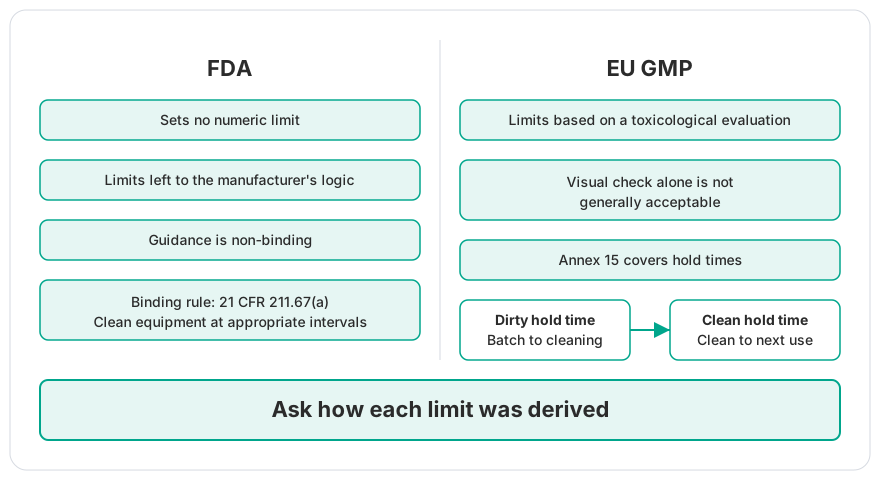
The FDA column draws on guidance, which is non-binding. FDA's binding requirement is 21 CFR 211.67(a), which requires equipment to be cleaned at appropriate intervals to prevent contamination that would alter the safety, identity, strength, quality or purity of the drug (eCFR).
Annex 15 also covers hold times (dirty hold time is the time between manufacture and cleaning; clean hold time is the time between cleaning and next use), campaign length, worst-case product selection (the product hardest to clean or most hazardous, judged on solubility, cleanability, toxicity and potency, used to represent the others) and recovery (the share of residue a swab actually picks up). For active ingredients, the International Council for Harmonisation's ICH Q7 §12.70 to §12.76 sets the equivalent expectations (ICH Q7). As of October 2026, the 2015 Annex 15 text remains in force; EMA and PIC/S (the Pharmaceutical Inspection Co-operation Scheme) consulted on a revision concept paper in February to April 2026, and a draft is expected later in 2026. Check the current text before relying on a section number. Even for a US-only supply, the EU text is the better benchmark, because it is more explicit.
- Topic
- Residue limits
- FDA
- Rationale must be "logical… practical, achievable, and verifiable" (FDA inspection guide)
- EU GMP
- Based on a toxicological evaluation (Annex 15 §10.6)
- Topic
- Visual check
- FDA
- Between batches of the same product, "visibly clean" is enough, without validation
- EU GMP
- "Not generally acceptable" as the only criterion (§10.2)
- Topic
- Potent products
- FDA
- Dedication "is not specifically required", but controls must eliminate the risk (FDA Q&A on equipment)
- EU GMP
- If controls cannot hold contamination below the health-based limit, use dedicated facilities (European Medicines Agency (EMA) Q&A, 2018, Q3)
Why is a fixed 10 ppm limit unreliable?
A health-based exposure limit (HBEL) is a toxicology-derived daily amount of a substance not expected to harm patients; the permitted daily exposure (PDE) is one form. Because it depends on the substance, it can sit far above or far below 10 ppm. EMA expects HBELs "for all medicinal products" (EMA Q&A, Q1).
The model uses hypothetical products. Next product B: 200 kg batch, 500 mg maximum daily dose, so 200,000,000 mg ÷ 500 mg = 400,000 daily doses. Previous product A: 10 mg minimum daily dose. Shared surface: 200,000 cm².
Working: allowed carryover = PDE of product A × batch size of B ÷ maximum daily dose of B; surface limit = allowed carryover ÷ shared surface area.
For a 0.0005 mg/day PDE, 10 ppm allows ten times too much. For a 0.5 mg/day PDE, it is 100 times stricter than needed. EMA lets a historical limit stay as an alert limit (an internal trigger set stricter than the acceptance limit) when it gives sufficient assurance that the HBEL will not be exceeded (Q6). Ask for the calculation, not the number.
- Limit logic
- 10 ppm (10 mg/kg × 200 kg)
- Allowed carryover in batch B
- 2,000 mg
- Surface limit
- 10 µg/cm²
- Limit logic
- 1/1000 of A's minimum dose (0.01 mg × 400,000)
- Allowed carryover in batch B
- 4,000 mg
- Surface limit
- 20 µg/cm²
- Limit logic
- PDE of product A 0.5 mg/day (× 400,000)
- Allowed carryover in batch B
- 200,000 mg
- Surface limit
- 1,000 µg/cm² (1 mg/cm²)
- Limit logic
- PDE of product A 0.005 mg/day
- Allowed carryover in batch B
- 2,000 mg
- Surface limit
- 10 µg/cm²
- Limit logic
- PDE of product A 0.0005 mg/day
- Allowed carryover in batch B
- 200 mg
- Surface limit
- 1 µg/cm²
How Aarise Pharmaceuticals handles it
Aarise Pharmaceuticals is a technology-driven CDMO for oral dosage forms, from product development through commercial manufacturing. Its buying route runs from inquiry through feasibility review and commercial quotation to development or technical transfer, production and quality control, packaging and dispatch.
Buyers can put the twelve questions into an inquiry to Aarise Pharmaceuticals, then write the agreed answers into a pharmaceutical quality agreement. The third party manufacturing vetting pack covers the wider quote check, and pharmaceutical technology transfer covers the handover.
To start, use the contact form, email sunil@aarisepharma.com, or call or WhatsApp +91 9899783330.
Example
In the worked calculation, product B has a 200 kg batch and a 500 mg maximum daily dose, giving 400,000 daily doses. If product A has a PDE of 0.0005 mg/day, the allowed carryover is 0.0005 mg × 400,000 = 200 mg. Spread over 200,000 cm² of shared surface, that is a limit of 1 µg/cm².
Frequently asked
Sources
- 1.FDA, Validation of Cleaning Processes (7/93), content current as of 26 August 2014
- 2.FDA, Questions and Answers on Current Good Manufacturing Practice Requirements for Equipment, 8 June 2015
- 3.eCFR, 21 CFR 211.67, Equipment cleaning and maintenance
- 4.European Commission, EU GMP Chapter 5: Production, 13 August 2014
- 5.European Commission, EU GMP Annex 15: Qualification and Validation, 30 March 2015
- 6.EMA and PIC/S, concept paper on the revision of Annex 15: Qualification and Validation, consultation 9 February to 9 April 2026
- 7.ICH Q7, Good Manufacturing Practice Guide for Active Pharmaceutical Ingredients, 10 November 2000
- 8.EMA, Questions and answers on risk-based prevention of cross-contamination and HBELs, 19 April 2018
- 9.FDA warning letter, Signature Formulations, LLC, 21 January 2026