
TL;DR
We help US supplement manufacturers source bulk vitamins through global producers, authorized distributors, and US-stocked importers. This guide explains how to compare supplier roles, vitamin forms, origin, logistics, quality documents, and approval evidence so a quoted material can be traced from factory to finished supplement.
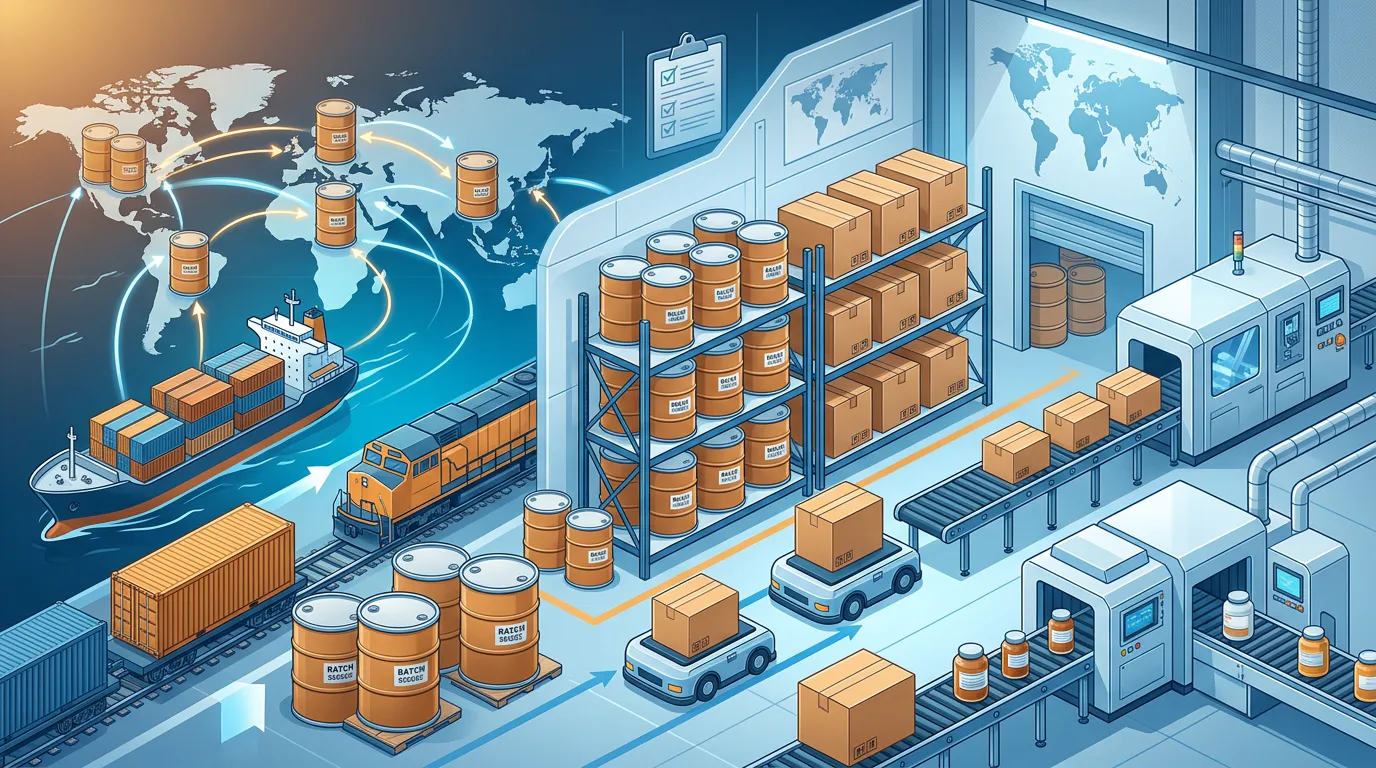
Bulk vitamin sourcing is a global supply-chain decision, not simply a domestic purchasing task. Mainland China accounted for about 76% of vitamin production in 2023, which makes factory origin and contingency planning important even when material ships from a US warehouse.
Bulk vitamins for US manufacturers are supplied by global vitamin producers, authorized distributors, and specialty ingredient importers with domestic inventory. We recommend separating the actual manufacturer from the seller, then verifying origin, lot traceability, identity and potency testing, contaminant limits, order terms, storage, and compliance records before approving a source.
We cover the supplier roles, vitamin forms, origin risks, bulk logistics, documentation, and approval steps that help procurement and quality teams make that distinction. Our broader ingredient catalog is separate from the supplier-qualification process described here.
Who Supplies Bulk Vitamins for US Manufacturers?
We group sources into three practical categories: producers that manufacture and release a vitamin, authorized distributors that resell a producer’s material, and importers or stockists that bring material into the United States and hold it domestically. One company can perform more than one role, so a quotation alone does not establish which role applies to a particular lot.
A US warehouse address proves availability, not where a vitamin was manufactured. FDA does not approve individual food importers or shipments before importation, so we treat facility identity, country of production, and lot records as evidence that buyers must obtain and assess themselves under the FDA import framework.
| Supplier Type | Actual Role | Best Fit | Evidence We Require |
|---|---|---|---|
| Global Producer | Manufactures and releases the vitamin | Forecastable, higher-volume demand | Producing facility, country, lot CoA, specification, release traceability |
| Authorized Distributor | Resells a producer’s material | Domestic buying, consolidated ordering, smaller demand | Current authorization, producer identity, lot chain of custody, warehouse status |
| Importer Or Stockist | Imports and holds material | Faster replenishment or US inventory | Foreign facility, importer role, lot documents, storage records, import traceability |
For buyers comparing several suppliers, our nutraceutical sourcing guide helps frame the commercial questions, while the purchase file should remain specific to the exact vitamin form and lot being approved.
Which Vitamin Forms Should Manufacturers Specify?
“Vitamin C” or “vitamin E” is not a complete procurement specification. We advise buyers to state the chemical form, assay or concentration, carrier, physical form, intended dosage format, packaging, and storage conditions before asking for a quote. That prevents a low-priced offer from being compared against a different grade, concentration, or delivery system.
Fat-soluble requirements typically involve vitamins A, D, E, and K. Water-soluble requirements commonly involve vitamin C and B-complex forms. The FDA’s Supplement Facts guidance lists vitamins such as A, C, D, E, K, thiamin, riboflavin, niacin, B6, folate, B12, biotin, and pantothenic acid in the regulated label sequence, which makes clear why names and forms need careful handling on the Supplement Facts panel.
Natural Vitamin E Needs Its Own Specification
Natural vitamin E is commonly labeled RRR-alpha-tocopherol or d-alpha-tocopherol. Synthetic vitamin E is commonly all-rac-alpha-tocopherol or dl-alpha-tocopherol. These are not interchangeable simply because both are called vitamin E.
NIH explains that 1 mg of natural alpha-tocopherol has the activity of 2 mg of the synthetic form. We therefore specify the exact form, ester where relevant, potency basis, and label declaration before comparing vitamin-E offers. Our related testing methods guide can help teams structure method and result review without assuming that every material needs the same analytical approach.
Specialty Forms Need Functional Criteria
Beadlets, powders, oils, emulsions, microencapsulated forms, mixed tocopherols, and tocotrienols can solve different formulation problems. We tie selection to the finished dosage format, mixing process, stability needs, and target declaration rather than treating specialty forms as a marketing upgrade.
Why Does Manufacturing Origin Matter?
Origin affects more than customs paperwork. It can determine exposure to production concentration, precursor availability, shipping routes, tariff treatment, release timing, and the ability to replace a disrupted source without reformulation or renewed qualification.
We ask for the actual producing facility and country, not only the ship-from location. For imported material, the responsible US party must also understand food-import requirements, including facility registration, prior notice, and the possibility of FDA examination at entry. Our regulated supply guide provides useful context for organizing quality evidence across regulated ingredient supply chains.
A tariff cannot be responsibly summarized as one fixed vitamin rate. Classification, country of origin, product form, and entry date can change the landed-cost result. We build tariff review into the sourcing process with a customs broker or qualified trade adviser, then record the conclusion alongside the supplier quotation instead of relying on an old market estimate.
How Do Bulk Orders and US Inventory Work?
Direct producer purchases can offer clearer factory access and production allocation when volume is predictable. Domestic stock can reduce launch risk, simplify receiving, and support smaller replenishment orders. Neither route is inherently better, because the right choice depends on demand stability, qualification capacity, import responsibilities, and the traceability supplied with each lot.
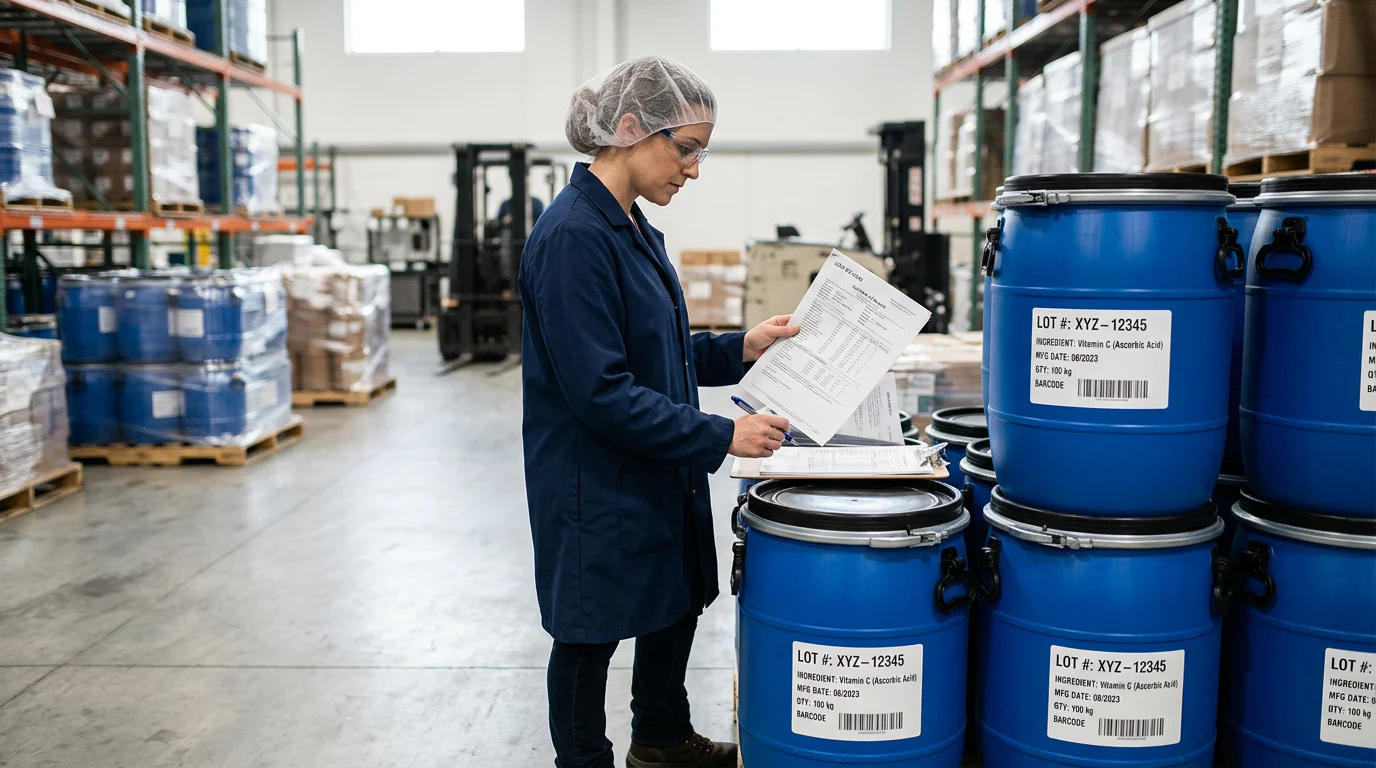
We require written confirmation of MOQ, sample policy, packaging, lead time, Incoterms, retest or expiry date, and storage conditions. These values are product-specific, so we do not assume a universal drum size, temperature range, or lead time. Material that is already in the United States still needs to match the approved producer, grade, and lot records.
| Choose Direct Producer When | Choose US-Stocked Distribution When |
|---|---|
| Forecasted demand can meet the producer’s order requirements | Lower volume, launch timing, or split delivery is more important |
| The buyer can manage importing and supplier qualification | The buyer needs domestic delivery and multi-ingredient consolidation |
| Factory access and allocation are contractually documented | Authorization and lot traceability are documented |
| Landed cost remains favorable after risk allowance | Local availability reduces stockout exposure |
Imported food shipments require prior notice, with FDA guidance specifying minimum windows of 2 hours by road, 4 hours by rail or air, and 8 hours by water. For logistics decisions, our shipping guide helps buyers think through transit tradeoffs, while each vitamin’s own stability evidence should control the final handling plan.
What Quality Documentation Must a Vitamin Supplier Provide?
Quality documentation should connect the requested material to the received lot. At a minimum, we expect a lot-specific certificate of analysis, specification, manufacturing origin, identity, assay or potency, package details, retest or expiry information, storage requirements, and evidence showing who handled the material between release and delivery.
Identity and Potency Evidence
Under 21 CFR 111.75, dietary-supplement manufacturers must conduct at least one appropriate test or examination to verify the identity of each dietary ingredient before use, except under a petitioned FDA exemption. We do not treat a supplier CoA as a replacement for this obligation.
Contaminant and Method Records
The approval file should identify relevant contaminant controls, including heavy metals, microbiological limits, residual solvents, and stability evidence where applicable. FDA guidance includes examples of method-based specifications for these categories, but those examples are not universal limits for every vitamin or finished formulation.
The Limits of Supplier Certificates
A CoA can support other component specifications only after the manufacturer establishes the supplier’s reliability, reviews methods and actual results, documents qualification, periodically reconfirms the supplier, and obtains quality-control approval. We use our quality systems guide to reinforce that a certificate supports a documented process, not a shortcut around one.
Seven Approval Steps
- Define the exact form, assay, carrier, packaging, and contaminant limits.
- Identify the actual manufacturing facility and country of origin.
- Confirm producer status or distributor authorization.
- Review lot-specific CoA, method, limits, and result consistency.
- Verify identity and document the supplier-qualification basis.
- Assign import, storage, and corrective-action responsibilities.
- Requalify after material, facility, documentation, or performance changes.
How Does Aarise Pharma Support Vitamin Sourcing?
At Aarise Pharma, we help supplement manufacturers turn an ingredient request into a traceable sourcing decision. We start by clarifying form, assay, carrier, package, order profile, and destination, then separate the producing facility from the party quoting the material. Our team can organize technical-document review, coordinate requests for lot records and samples, and align shipment planning with the buyer’s own quality and import responsibilities. Our US supplier guide can support this document review. We do not treat a warehouse claim or a generic certificate as final evidence. Instead, we help buyers build a file that connects the specification, quoted material, lot documents, logistics terms, and approval record. That approach gives procurement, quality, and operations one shared basis for deciding whether direct supply or domestic stock makes sense. For a sourcing discussion tailored to your formula and volume, contact Aarise Pharma.
FAQs on Bulk Vitamins for US Manufacturers
Who Supplies Vitamin Raw Materials for US Supplement Production?
Global producers, authorized distributors, and ingredient importers can supply them. We recommend identifying the actual manufacturer, lot origin, and US stockholder before comparing price or availability.
Which Supplement Raw Material Suppliers Handle Bulk Orders?
Producers, distributors, and importers may handle bulk orders. We compare their ability to document MOQ, package format, allocation, lead time, origin, and lot-specific quality records before approval.
Which Bulk Vitamin Suppliers Maintain US Inventory?
Domestic distributors and importers may hold US inventory, but stock status changes. We require confirmation of location, available lot, producer, specification, storage conditions, and release documents.
How Can Supplement Manufacturers Verify a Vitamin Supplier?
We verify the supplier’s identity, factory origin, authorization, lot traceability, analytical methods, actual CoA results, quality records, and requalification evidence. A generic certificate alone does not complete qualification.
Should Brands Buy Vitamins from Manufacturers or Distributors?
Buy directly when demand, import capacity, and allocation support it. Choose distribution when domestic availability, lower volume, consolidated purchasing, or replenishment speed provides greater operational value.