
Nutraceutical Ingredient Suppliers for US Supplement Brands
Compare nutraceutical ingredient suppliers for U.S. supplement brands by category, sourcing model, documentation, logistics, and lot-quality evidence.

In the latest nationally representative estimate, 57.6% of adults in the United States reported using a dietary supplement within the prior 30 days. That demand makes supplier qualification a practical procurement decision, not a paperwork exercise.
We help U.S. supplement brands evaluate nutraceutical ingredient suppliers across four routes: direct manufacturers, authorized distributors, botanical specialists, and fermentation or algal producers. The right choice depends on ingredient identity, origin, MOQ, lot-specific testing, traceability, allergen controls, import responsibility, and delivery needs. We verify claims against current certificates, specifications, and lot results.
This guide shows what to filter, what to request, and how to make a documented choice without confusing a supplier’s marketing claims with quality evidence.
| Supplier Type | Ingredient Classes | Sourcing Role | Manufacturing Origin | US Inventory | MOQ | Certifications | Testing Package | Contact Route |
|---|---|---|---|---|---|---|---|---|
| Direct Manufacturer | Vitamins, minerals, amino acids, specialty nutrients | Produces the ingredient | Confirm site and country | Confirm by SKU | Confirm in writing | Review current scope and expiry | Request lot COA and methods | Technical RFQ |
| Authorized Distributor | Multi-category ingredients | Domestic sales and inventory partner | Document producer and chain of custody | Confirm warehouse availability | Confirm by SKU | Verify authorization and quality records | Request original and distributor documentation | Sales or procurement RFQ |
| Botanical Specialist | Extracts, powders, plant-derived actives | Sourcing, extraction, or standardization | Confirm botanical origin and processing site | Confirm by SKU | Confirm in writing | Review botanical and food-safety scope | Request identity, contaminants, and microbiology | Technical RFQ |
| Fermentation Or Algal Producer | Fermentation-derived nutrients, algal oils | Produces specialized ingredients | Confirm production site and process disclosure | Confirm by SKU | Confirm in writing | Review relevant quality scope | Request assay, identity, and ingredient-specific testing | Technical RFQ |
| Bulk-Order Partner | High-volume replenishment ingredients | Warehousing, import, or consolidated supply | Confirm original producer | Confirm storage location | Confirm pallet and container quantities | Review quality agreement | Request storage, release, and lot records | Logistics RFQ |
Which Nutraceutical Ingredient Supplier Types Serve US Supplement Brands?
We start by separating supplier type from ingredient type. A direct manufacturer can offer stronger access to the production site and change-control team, while an authorized distributor can simplify domestic inventory, samples, consolidated ordering, and commercial communication. Neither route is automatically better. The decision should match the ingredient’s risk, expected volume, timing, and the documentation your quality team needs.
| Sourcing Model | Strongest Fit | Main Advantage | Main Tradeoff | Evidence To Request |
|---|---|---|---|---|
| Direct Manufacturer | Recurring or specialized ingredient demand | Direct access to specifications and production accountability | Import coordination or higher volume commitments may apply | Site origin, quality agreement, change-notification process |
| Authorized Distributor | Faster domestic replenishment or mixed baskets | Local inventory and consolidated purchasing | Less direct control of upstream production | Authorization proof, chain of custody, original COA |
| Botanical Specialist | Plant extracts and standardized botanicals | Ingredient-specific botanical knowledge | Species, plant part, and adulteration risks need closer review | Botanical identity, extraction method, contaminant panel |
| Fermentation Or Algal Producer | Specialized nutrients and oils | Process expertise and source transparency | Specifications can vary by process and formulation | Source declaration, assay, stability, and lot results |
For any route, we ask who owns the underlying specification, who can approve a material change, and who will investigate an out-of-specification result. FDA’s supplier requirements make documented supplier qualification especially important when a manufacturer relies on a supplier’s certificate of analysis.
Our procurement approach also keeps technical verification separate from commercial convenience. A domestic contact route is useful, but it does not replace evidence from the production site, the original lot, or the laboratory that generated the result. For broader analytical context, our testing guide explains the value of matching a claimed result to its method, limit, and actual finding.
Which Ingredient Categories Belong in a US Supplier Search?
A useful supplier hub should not force a brand to search a single mixed list. We organize the search around ingredient classes because each class creates different sourcing and quality questions. Vitamins and minerals need form, potency, and source clarity. Amino acids need identity and purity controls. Botanicals need species, plant part, extraction, and contaminant evidence. Specialty nutrients often need source or process disclosure that a general certificate does not provide.
For algal oils, we ask for the actual DHA and EPA specification, oxidation testing, storage conditions, and the declared source. The NIH fact sheet identifies algal oil as a vegetarian omega-3 source and notes that plant-based algal products commonly provide about 100 to 300 mg of DHA. That makes “algal” a starting point for verification, not a complete procurement specification.
- Vitamins And Minerals: Confirm the chemical form, source, potency, and relevant allergen statement.
- Amino Acids: Confirm identity, assay, purity profile, residual solvents when relevant, and manufacturing origin.
- Botanicals: Confirm Latin binomial, plant part, extraction solvent, marker-compound specification, and contaminant testing.
- Specialty Nutrients: Confirm ingredient identity, source, intended formulation role, and lot-level assay.
- Algal Oils: Confirm DHA and EPA content, oil form, oxidation controls, storage requirements, and allergen status.
- Fermentation-Derived Ingredients: Confirm production-process disclosure, substrate or allergen considerations, microbial controls, and specification changes.
When teams need to compare adjacent material classes, our raw-material catalog can help keep technical records organized without treating every ingredient as interchangeable.
How Should Buyers Verify Specialty Ingredient Claims?
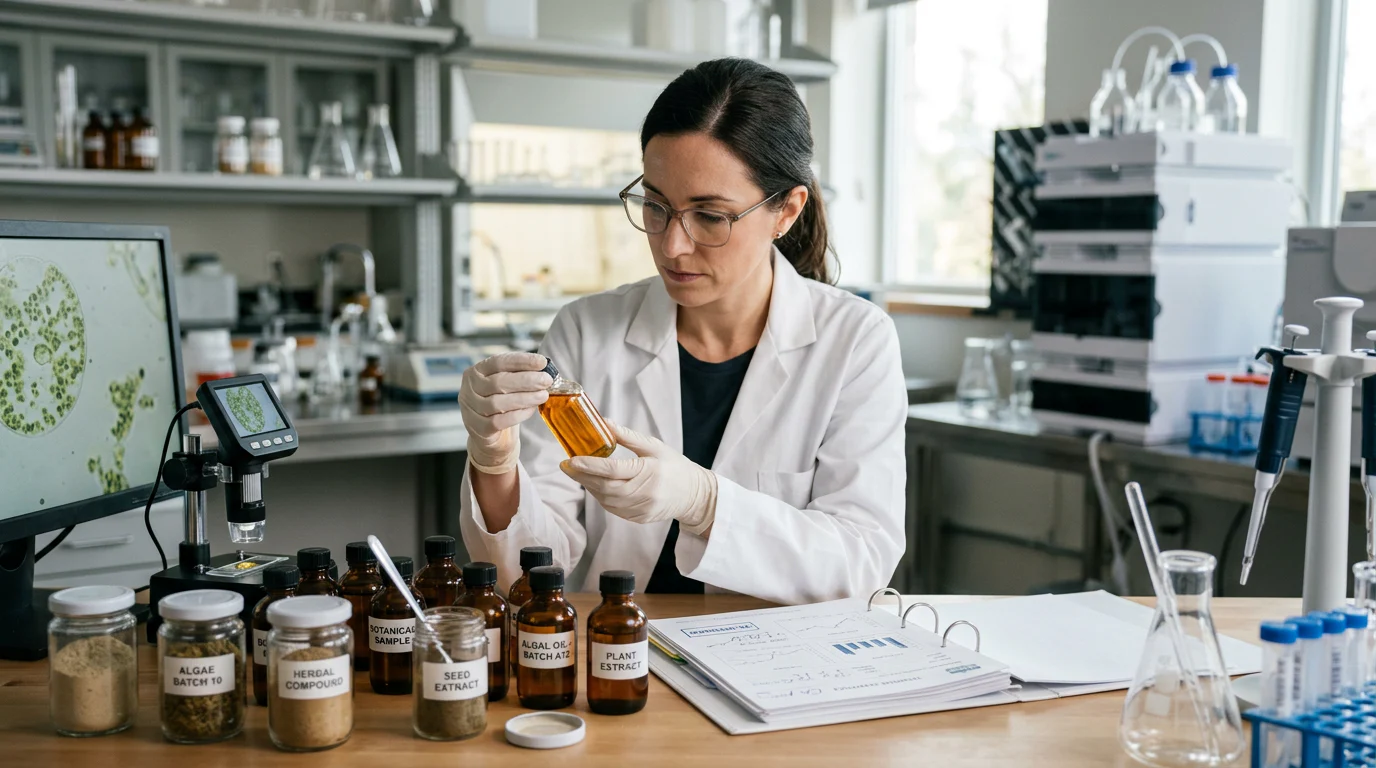
Specialty ingredients deserve more scrutiny because a short label claim can hide meaningful sourcing differences. We focus on what the supplier can document today, rather than what a brochure implies. That means asking for current specifications, a source declaration, a lot-specific COA, and a clear explanation of how the ingredient claim relates to the material itself.
What Proves a Vegan Vitamin D3 Claim?
A vegan vitamin D3 claim should be supported by a source declaration and processing statement, not merely a broad vegetarian label. Typical vitamin D3 production uses lanolin-derived material, while an animal-free lichen-sourced option is available, according to NIH documentation. We request source confirmation, assay results, allergen information, and any evidence needed to support the finished product’s positioning.
What Proves an Algal DHA Claim?
For algal DHA, we look beyond the oil’s source category. A useful package identifies the algae-derived source, DHA and EPA specification, lot number, storage requirements, and oxidation controls. We also require the supplier to distinguish a raw-material assay from a consumer-facing health claim, because formulation, dose, and finished-product stability still matter.
How Should We Handle Glutathione Claims?
Glutathione should be assessed in two separate lanes: ingredient quality and finished-product substantiation. We can verify identity, assay, origin, and contaminant controls for a raw material, but a quality document alone cannot establish a consumer outcome. A research trial found no significant change in glutathione status or oxidative-stress biomarkers after four weeks of oral supplementation in healthy adults.
For specialized procurement requests, we use a written specification first, then compare responses against that specification. Our quality standards resource is a useful companion when teams need to formalize certificate review and supplier documentation expectations.
What Bulk Order and Logistics Evidence Matters?
MOQ, samples, packaging, warehousing, and import responsibility should be treated as evidence fields, not sales assumptions. We ask suppliers to state the minimum order quantity by SKU and unit, whether samples are available, how the material is packed, how it is stored, whether U.S. inventory exists, and which party owns the import process. If the supplier cannot confirm a field, we record it as unconfirmed instead of filling the gap with an estimate.
Imported ingredients and domestic materials must meet the same U.S. legal requirements, according to FDA import requirements. For imported food ingredients, the responsibility split among producer, importer, distributor, and brand should be written into the procurement record before an order is released.
A practical logistics request should include shelf life at dispatch, storage temperature, pallet or drum configuration, release documentation, and delivery terms. It should also identify whether the quoted lead time begins when a purchase order is placed, when payment clears, when production begins, or when the lot is released. Our shipping guide offers a useful framework for comparing transit choices when timing and handling conditions affect the buying decision.
Which Quality Evidence Should Suppliers Provide?
A credible supplier record is built from the material lot upward. We request a current specification and a lot-specific COA, then check whether the result actually matches the specification, the batch number, and the material being offered. For dietary ingredients, FDA expects at least one appropriate test or examination to verify identity unless an approved alternative applies.
Lot-Specific Documentation
The basic file should include a COA, lot number, manufacture date, expiry or retest date, identity result, potency or assay result, and the current version of the applicable specification. Every document should identify the material clearly enough for procurement and quality teams to trace it back to the shipment.
Ingredient-Matched Test Panels
The test package should reflect the material’s risks. We look for identity and potency on every appropriate lot, then add contaminant, microbiological, allergen, and residual-solvent evidence where relevant. Botanical extracts, oils, fermentation-derived materials, and mineral ingredients do not share identical risk profiles, so they should not receive identical review.
Credible COAs and Laboratories
FDA COA rules specify that a relied-upon certificate should describe test methods, limits, and actual results. We also ask whether the laboratory’s accreditation scope covers the claimed analysis, rather than accepting an accreditation reference without context.
Traceability and Change Notification
Country of origin is only one traceability field. We also want the production site, distributor handoffs, shipping and warehouse conditions where relevant, and a named process for specification, site, method, or origin changes. Procurement teams should receive change notification before a new version becomes the only available material.
For an import-focused documentation review, our import workflow helps teams structure the questions that should be resolved before a shipment is committed.
How Should We Compare Nutraceutical Ingredient Suppliers?
We recommend a scorecard that keeps commercial, technical, and quality criteria visible in the same decision. It does not replace a quality system, but it prevents an attractive price or quick delivery promise from obscuring an incomplete evidence package. Score each area from 0 to 2, then compare the total alongside any non-negotiable requirements.
| Scorecard Criterion | 0 Points | 1 Point | 2 Points |
|---|---|---|---|
| Ingredient And Formulation Fit | Does not meet specification | Partially documented fit | Fully documented fit |
| Origin And Traceability | Origin unclear | Country known, chain incomplete | Site and chain documented |
| Lot Testing Completeness | Generic or missing evidence | Partial lot evidence | Complete lot-specific evidence |
| Quality And Laboratory Evidence | Claims only | Certificates supplied | Certificates and relevant test scope reviewed |
| Allergen And Contaminant Controls | Not documented | Partial documentation | Ingredient-matched controls documented |
| Logistics And MOQ | Commercial terms unclear | Some terms confirmed | MOQ, packaging, storage, and delivery documented |
| Change Notification And Support | No defined process | Informal response | Written, accountable process |
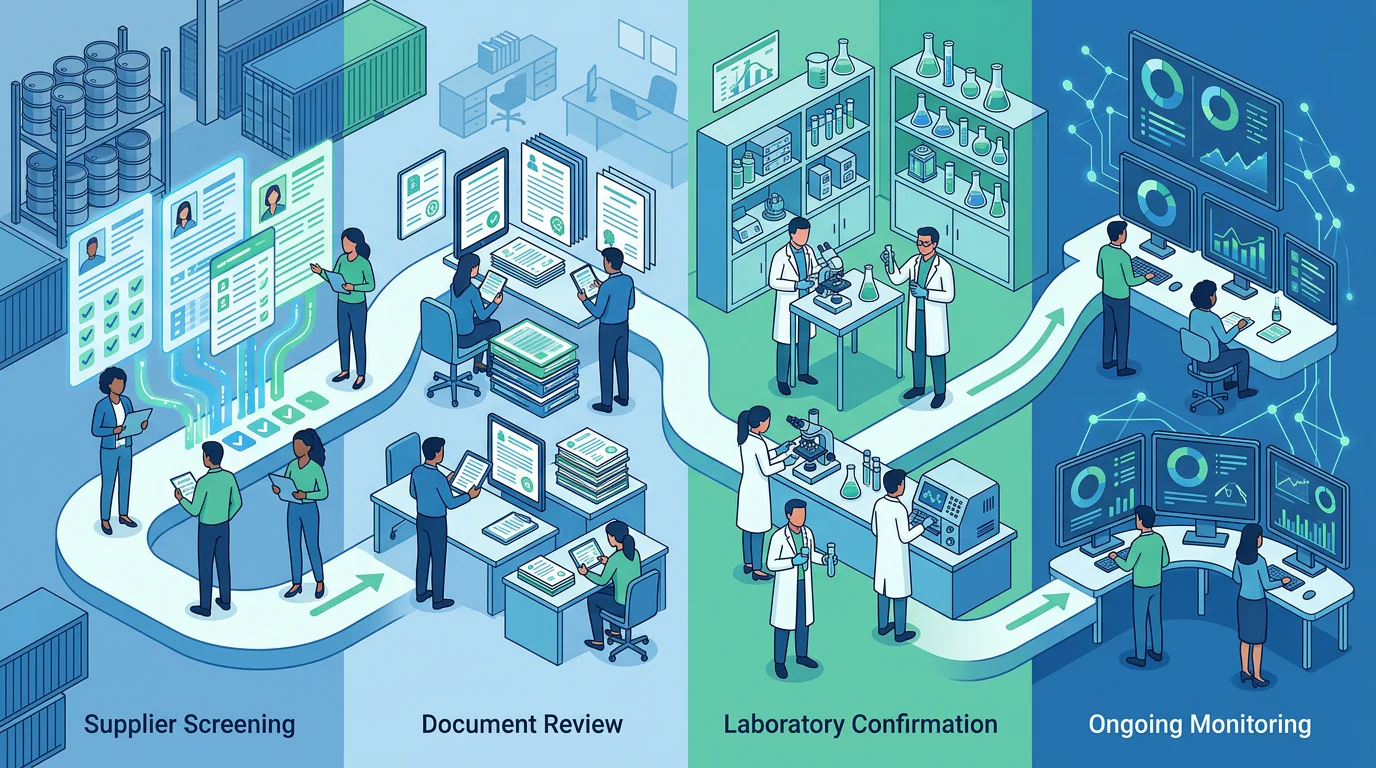
We then follow a four-step workflow:
- Screen The Fit: Match the ingredient, target specification, volume, destination, sourcing model, and dietary constraints.
- Review The File: Collect specifications, certificates, sample COAs, origin statements, allergen declarations, and testing evidence.
- Confirm The Material: Verify sample and lot evidence, document supplier qualification, and resolve gaps before approval.
- Monitor The Record: Recheck certificates, inventory claims, contact routes, and material changes monthly.
An ISO/IEC 17025 laboratory standard is useful because it addresses laboratory competence, impartiality, and consistent operation. We use it as one signal in the record, not as a substitute for reviewing whether the laboratory performed the specific test that matters.
For a more structured procurement checklist, our sourcing guide can help teams build a consistent evidence-review routine.
Work with Aarise Pharma
At Aarise Pharma, we help U.S. supplement procurement teams turn a broad supplier search into a documented buying decision. Bring us the ingredient, target specification, expected volume, destination, preferred sourcing model, and any dietary or allergen constraints. We will help you frame an RFQ that asks for the details this guide prioritizes: origin, current certificates, lot documentation, samples, packaging, storage, import responsibilities, and change notification. Our role is to make comparison practical, not to replace your quality team’s approval process. Use the scorecard to keep suppliers comparable, then keep the final record with the people who own release decisions. If your team needs a structured starting point for a U.S.-bound ingredient request, contact us with the documentation you already have and the gaps you need to close for a clearer, documented next step. Our buyer’s guide offers a procurement framework. Start a supplier conversation with Aarise Pharma.
FAQs on Nutraceutical Ingredient Suppliers
Which Documents Should We Request from a Supplier?
Request a current specification, lot COA, identity results, potency results, origin statement, allergen declaration, contaminant testing, microbiological testing, relevant solvent testing, certificates, and change contacts.
Is Vegan Vitamin D3 Available?
Yes. Lichen-sourced vitamin D3 can be animal-free. Confirm its source, processing details, potency results, allergen status, and the finished-product claim support your team needs.
How Often Should Supplier Records Be Rechecked?
Review directory records monthly. Requalify immediately if the production site, origin, specification, test method, certificate status, supplier ownership, or lot documents change materially for approved materials.