Bulk Vitamin Suppliers by Origin and Documentation
Compare bulk vitamin suppliers by origin, role, and documentation for US supplement production, including qualification documents and lot traceability.

By Sunil Kumar, Managing Director - Sales · Updated 12 Oct 2026

In brief
We help US supplement procurement teams qualify bulk vitamin suppliers by separating the actual manufacturing site from the seller, then checking the lot evidence that connects them. This guide compares source roles, vitamin forms, origin disclosure, seven essential documents, and a sample-to-commercial workflow, so our buyers can make defensible sourcing decisions.
In this article
- 1Who Supplies Vitamin Raw Materials for US Supplement Production?
- 2Which Bulk Vitamin Suppliers Handle Commercial Orders?
- 3Which Bulk Vitamin Suppliers Disclose Manufacturing Origin?
- 4Original Producers Must Identify the Site
- 5Authorized Distributors Must Preserve the Link
- 6Importers and Brokers Must Be Clear About Their Role
- 7What Documents Should US Buyers Request from a Vitamin Supplier?
- 8Lot-Specific Quality Records
- 9Origin and Supply-Chain Records
- 10Suitability and Safety Records
- 11How Do We Qualify a Sample Before a Bulk Order?
- 12Source Bulk Vitamins with Aarise Pharma
- 13FAQs on Bulk Vitamin Suppliers
For US procurement teams, raw-material sourcing turns on traceability, not an undifferentiated catalog. The NIH database contains more than 200,000 dietary-supplement labels, yet a finished label does not necessarily identify the production site behind a bulk lot.
At Aarise Pharma, we advise US supplement manufacturers to source vitamins from qualified original producers or documented importers and distributors. The defensible choice depends on vitamin form, manufacturing origin, compendial specification, order volume, and documentation. Before approval, we verify the named site, chain of custody, identity, contaminant limits, batch COA, and recurring availability.
We cover the evidence needed to compare suppliers of vitamin C, D3, natural vitamin E, and selected B vitamins, alongside our bulk vitamin overview for broader sourcing context.
| Vitamin | Chemical Form | Supplier | Supplier Role | Manufacturer | Origin | Grade | MOQ / Pack / Lead Time | Documentation | Verification Date |
|---|---|---|---|---|---|---|---|---|---|
| Vitamin C | L-ascorbic acid | Approved seller with lot disclosure | Original producer or authorized distributor | Named in approved lot file | Country and site named in approved lot file | USP or FCC when documented | Confirmed per commercial quote | COA, specification, site declaration | Current lot review |
| Vitamin D3 | Cholecalciferol | Approved seller with lot disclosure | Original producer or authorized distributor | Named in approved lot file | Country and site named in approved lot file | Product specification | Confirmed per commercial quote | COA, specification, site declaration | Current lot review |
| Natural Vitamin E | RRR-alpha-tocopherol | Approved seller with lot disclosure | Original producer or authorized distributor | Named in approved lot file | Country and site named in approved lot file | Product specification | Confirmed per commercial quote | COA, specification, site declaration | Current lot review |
| Vitamin B1 | Thiamine mononitrate | Approved seller with lot disclosure | Original producer or authorized distributor | Named in approved lot file | Country and site named in approved lot file | Product specification | Confirmed per commercial quote | COA, specification, site declaration | Current lot review |
| Vitamin B7 | Biotin | Approved seller with lot disclosure | Original producer or authorized distributor | Named in approved lot file | Country and site named in approved lot file | USP when documented | Confirmed per commercial quote | COA, specification, site declaration | Current lot review |
| Vitamin B12 | Cyanocobalamin | Approved seller with lot disclosure | Original producer or authorized distributor | Named in approved lot file | Country and site named in approved lot file | USP when documented | Confirmed per commercial quote | COA, specification, site declaration | Current lot review |
Who Supplies Vitamin Raw Materials for US Supplement Production?
We separate the commercial seller from the actual producer because they answer different procurement questions. An original producer can disclose its manufacturing site and batch records. An authorized distributor should prove its authority and maintain lot continuity. An importer adds an import and storage chain that needs review. A broker can assist with access, but should not be represented as the manufacturer.
US supplement manufacturers remain responsible for establishing component specifications covering identity, purity, strength, composition, and contamination limits. Those obligations make documentary readiness more useful than a broad product list. Our supplier landscape helps teams frame that first sourcing discussion around the material and evidence they actually need.
| Source Role | What We Expect To See | Core Qualification Question | Red Flag |
|---|---|---|---|
| Original Producer | Site identity, product specification, lot COA | Does the stated site make this exact form? | Seller cannot identify the production site |
| Authorized Distributor | Authorization trail and unchanged lot traceability | Can the distributor link its lot to the producer? | Repacked material without disclosure |
| Importer | Foreign-supplier records and shipment traceability | Who is accountable for the imported lot? | Origin stated only as a shipping location |
| Broker | Transparent commercial role and source documents | Can the broker provide the same evidence? | Broker presented as manufacturer |
The component rules require dietary-supplement manufacturers to establish component specifications. We therefore treat a supplier claim as the start of qualification, not as qualification itself.
Which Bulk Vitamin Suppliers Handle Commercial Orders?
Commercial capability is not a promise that a supplier can ship “bulk.” We look for a current written quote tied to the requested vitamin form, approved specification, pack configuration, delivery location, and expected order cadence. MOQ, pack size, and lead time can change by site, grade, availability, and destination, so we confirm them for the actual material rather than applying a generic number.
A practical request also identifies whether the buyer needs a trial sample, pilot volume, or recurring commercial volume. We connect that request to a commercial sourcing guide so document review and supply planning begin together.
- Form And Grade: State the chemical form, intended dosage format, and specification required for the finished supplement.
- Commercial Quantity: Provide first-order volume and expected annual demand, without assuming a quoted MOQ applies to every lot.
- Delivery Requirement: Confirm destination, requested arrival date, packaging needs, and temperature or light protection where relevant.
- Document Package: Request the COA, specification, site declaration, allergen statement, and applicable contaminant results before approval.
Which Bulk Vitamin Suppliers Disclose Manufacturing Origin?
Manufacturing origin should mean the country and named site where the material was made. It should not mean a seller’s headquarters, a warehouse, a port of export, or an unspecified global network. We ask for the production site in writing and reconcile it with the product specification, batch COA, outer label, and shipping trail.
Country of origin is a defined customs concept tied to manufacture, production, or growth, with later work changing origin only when it creates a substantial transformation. We use that distinction when reviewing the import record guide and when separating a genuine site disclosure from a commercial address. CBP guidance explains the underlying origin-marking standard.
Original Producers Must Identify the Site
We expect the original producer to identify the legal manufacturer, manufacturing site, country of origin, and exact product form. A corporate name without a production location does not resolve the source question for a vitamin lot.
Authorized Distributors Must Preserve the Link
We ask authorized distributors for evidence that connects the producer to the distributor and then to the buyer’s lot. Authorization documentation, unchanged lot numbers, and repackaging disclosure make that chain reviewable.
Importers and Brokers Must Be Clear About Their Role
We do not treat importer or broker status as a quality failure. We do require role clarity, source transparency, and records that connect the imported material to its producer. Our quality standards provide useful context for evaluating document control.
What Documents Should US Buyers Request from a Vitamin Supplier?
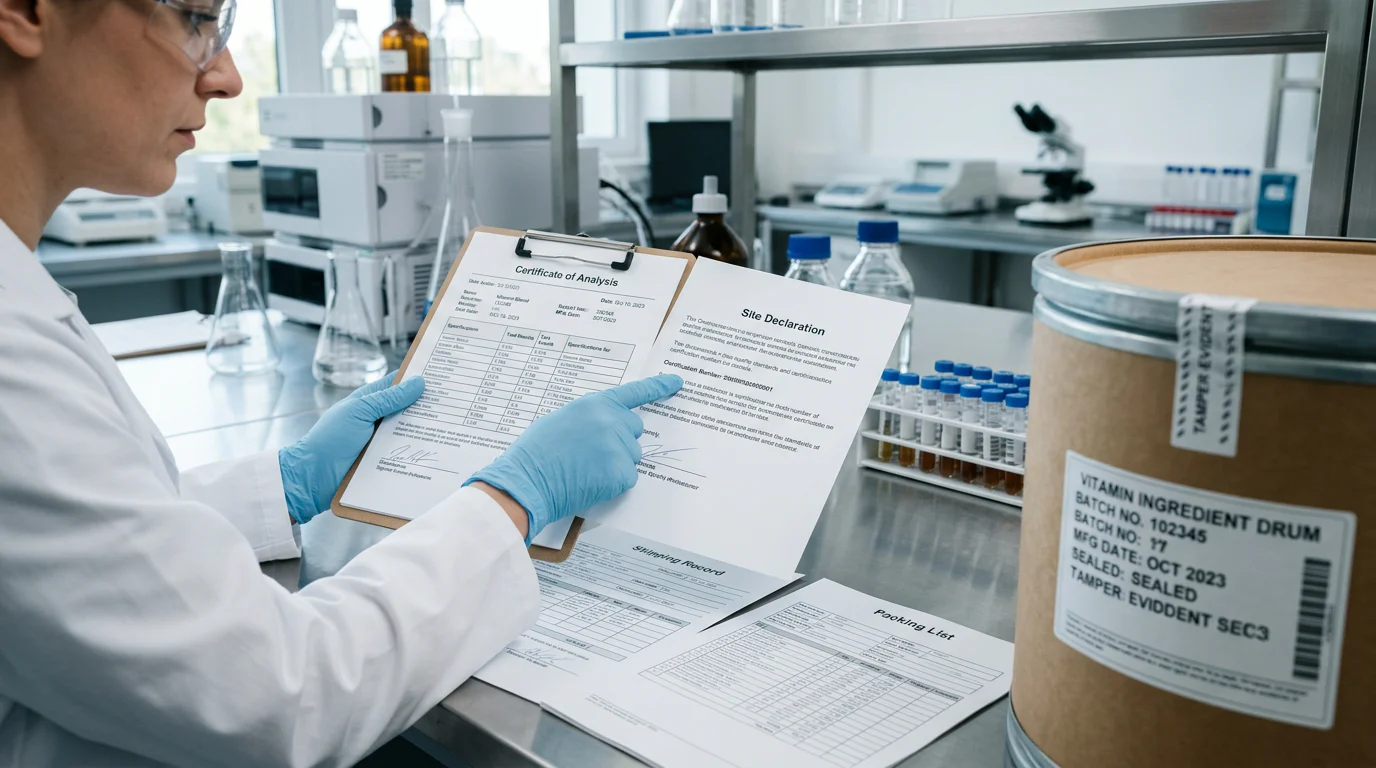
We use a seven-document package because no single certificate answers every qualification question. A COA can show a batch result, but it cannot independently prove that the seller is authorized, the named site made the material, or the material remained traceable after production.
FDA’s 2026 enforcement record reiterates that dietary-ingredient identity must be verified before use. We build that requirement into the supplier review instead of treating a supplier COA as a substitute for incoming qualification. FDA enforcement makes the distinction explicit.
Lot-Specific Quality Records
- Batch COA: Include lot number, assay result, method, release date, and approval.
- Current Product Specification: Define identity, purity, strength, composition, storage, and relevant contaminant limits.
- Identity Evidence: Describe the applicable identity method and the buyer’s own incoming verification approach.
Origin and Supply-Chain Records
- Manufacturing-Site Declaration: Identify the legal producer, full site, country of manufacture, and covered product form.
- Authorization And Chain Of Custody: Connect producer, distributor or importer, and the lot supplied.
- Commercial Supply Confirmation: Confirm pack size, MOQ, lead time, and whether recurring volume is supportable.
Suitability and Safety Records
- Suitability Package: Include allergen statements, applicable GMO or BSE/TSE statements, and contaminant results relevant to the material and finished use.
For vitamin C and biotin, compendial language should be checked against the actual material. Public USP monograph previews set ascorbic acid at 99.0% to 100.5% and biotin at 97.5% to 102.0%, which illustrates why an assay claim needs an attached specification and method. Our COA review guide helps procurement teams ask sharper batch questions.
How Do We Qualify a Sample Before a Bulk Order?
We treat a sample as a qualification event, not a miniature commercial order. The sample should arrive with the same identity, form, documentary package, and traceability expectations required for a subsequent purchase. If those elements change, we review the new material rather than assuming the first sample remains representative.
Our workflow also keeps commercial urgency from bypassing quality controls. Foreign-supplier verification can involve audits, sampling and testing, or record review based on risk, and FDA says importers should reevaluate suppliers at least every three years or sooner when new information appears. FSVP guidance informs how we structure that review.
- Specify And Sample: We document the required form, grade, test expectations, intended use, and sample acceptance criteria.
- Qualify The Source: We review source role, site identity, origin, authorization, specification, and initial lot evidence.
- Approve The Pilot Lot: We reconcile the label, lot number, COA, incoming identity result, and agreed contaminant review.
- Release The Commercial Order: We lock the approved form, site, documentation set, packaging, and change-notification expectations.
| Risk Area | 0 Points | 1 Point | 2 Points |
|---|---|---|---|
| Site And Origin | No site evidence | Country disclosed | Country and named site verified |
| Supplier Role | Role unclear | Role stated | Role supported by authorization |
| Lot Traceability | No lot link | Partial lot records | Full producer-to-buyer lot chain |
| Quality Evidence | Generic documents | COA or specification only | COA, specification, identity, and contaminant evidence |
| Commercial Continuity | Unconfirmed | One-time availability | Current recurring-volume confirmation |
A score of 8 to 10 supports QA approval, subject to the buyer’s testing and quality agreement. A score of 5 to 7 calls for conditional review. A score below 5 means we do not treat the source as commercially qualified. Our testing-method guide supports the analytical side of that decision.
Source Bulk Vitamins with Aarise Pharma
At Aarise Pharma, we help procurement teams turn a promising sample into a documented sourcing decision. Bring us the vitamin form, intended dosage format, expected order volume, delivery point, and required specification. We will align the conversation around the evidence that matters: manufacturing-site disclosure, source role, batch traceability, suitable grade, test methods, packaging, logistics, and commercial continuity.
We do not ask buyers to treat a catalog entry as proof. Our team can organize document review before a commercial conversation moves forward, identify where an origin or chain-of-custody claim needs support, and structure the sample-to-approval path around your written acceptance criteria. That approach keeps commercial decisions connected to the controls your finished supplement needs. If your team is qualifying vitamin C, D3, natural vitamin E, or selected B vitamins for the US market, start with a clear evidence request from us and contact Aarise Pharma.
FAQs on Bulk Vitamin Suppliers
Can a Distributor Prove Manufacturing Origin?
Yes. We require a manufacturer declaration, authorization trail, and lot-linked shipping record. A warehouse address or country shown on a quote does not establish origin.
Does a COA Replace Incoming Identity Testing?
No. We use a supplier COA as one record in qualification, while incoming identity verification and agreed contaminant review determine whether we accept the lot.
Can a Seller Call a Vitamin USP Grade?
Only when the material and lot documentation support that designation. We compare the form, assay, method, impurities, and written specification before accepting any catalog label.
When Should We Requalify a Vitamin Supplier?
We requalify when site, form, specification, process, test method, or supply route changes. We also review supplier risk sooner when new concerns arise.