TL;DR
An API export dossier links the accepted material, original manufacturer, batch COA, safety data, regulatory support, and shipping records so an international buyer can qualify, file, and clear the same API without data conflicts. We map the core records, market-specific documents, ownership checks, and pre-shipment reconciliation steps that matter when sourcing steroid APIs from India.
India recorded US$30.47 billion in pharmaceutical exports in FY 2024 to 2025. For international buyers of steroid APIs, that scale makes document control as important as price, lead time, and available capacity.
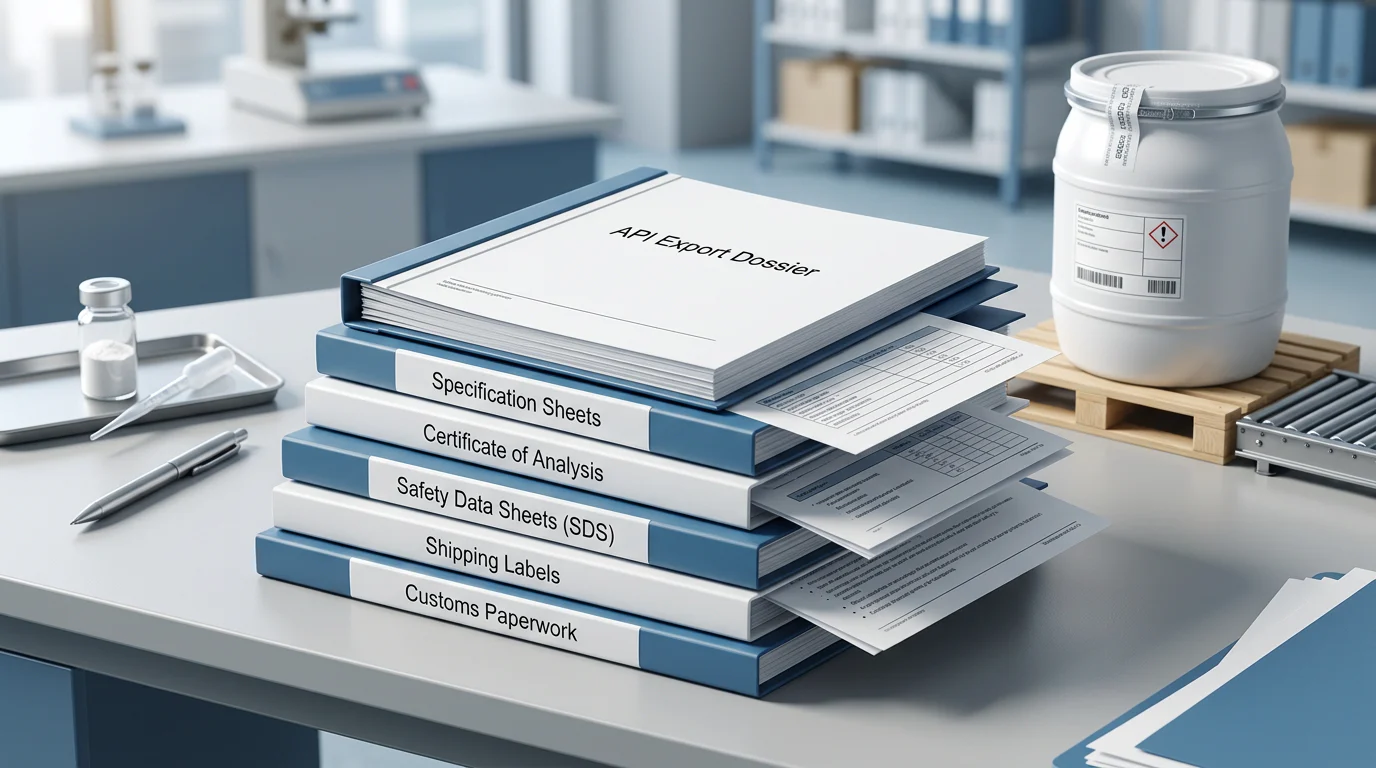
An API export dossier connects the quoted material, manufacturing source, batch documentation, shipping records, and destination-market requirements. The exact package varies by product and jurisdiction, but buyers commonly evaluate specifications, batch COAs, safety information, manufacturing and quality evidence, regulatory support, origin records, packaging details, and transport conditions before approving shipment.
We use this guide to separate core supplier and batch records from documents that only apply to a specific market, filing route, or controlled substance requirement.
What Belongs in an API Export Dossier?
We treat the dossier as an evidence chain, not as a folder of unrelated certificates. It should let procurement, QA, regulatory, logistics, and the importer verify that the same material is being quoted, released, shipped, and received.
The practical division is simple: some records establish material quality and traceability, some move the consignment through customs, and some exist only when the market or ingredient triggers them. ICH Q7 connects API documentation, packaging, release, storage, and distribution controls in that same way.
| Stage | Buyer Decision | Core Records Usually Requested | Conditional Records | Primary Owner |
|---|---|---|---|---|
| Supplier Qualification | Approve the source | Manufacturer identity, site evidence, specification, SDS | Audit package, quality agreement | Procurement and QA |
| Batch Release | Approve the lot | Batch COA, labels, pack details, retest or expiry status | Additional testing or stability support | QA |
| Regulatory Review | Support filing or import | Product and manufacturer identifiers | DMF, CEP, CPP, letter of access, EU written confirmation | Regulatory |
| Shipment And Clearance | Dispatch and receive | Invoice, packing list, transport document | Certificate of origin, import permit, controlled-substance authorization | Logistics and importer |
A supplier qualification package should establish who actually manufactures the steroid API, where it is made, and how changes will be disclosed. We recommend keeping the exporter, distributor, and original manufacturer as separate fields because they may not be the same legal entity. Buyers reviewing quality-system evidence can also use our GMP export guide to frame the questions that belong before an order is released.
How Do Buyers Qualify the Source and Release the Batch?
Before a buyer accepts an API source, we recommend agreeing the exact material master: API name and salt form, intended grade, original manufacturing site, packaging configuration, and destination market. That record becomes the reference point for every document that follows.
Manufacturer and Site Evidence
Manufacturing-site evidence should identify the legal manufacturer, site address, relevant quality credentials, and the route for notifying changes that could affect the material. For steroid APIs, this matters because high pharmacological activity can make segregation, cleaning, and contamination-control evidence especially relevant.
We also recommend asking whether the documentation refers to the original manufacturer or a repacker, trader, or agent. A complete chain is more useful than a generic statement of quality because it gives the buyer a traceable route back to the source.
Specification and Quality Agreement
A specification defines what acceptable material looks like. It should set the tests, method references, and acceptance criteria for the agreed API, including relevant impurity controls, instead of merely repeating a generic product description.
The quality agreement should then state who approves changes, handles deviations, issues notifications, and decides whether further data are needed. It also gives procurement and QA teams a shared route for resolving a document conflict before it becomes a release delay.
COA and Batch Release
A COA is the batch-specific release record. ICH Q7 says an authentic COA should identify the API, grade where relevant, batch number, release date, applicable expiry or retest date, tests, limits, and numerical results. It should also be signed by authorized quality personnel. COA requirements make this one of the most useful reconciliation documents in the package.
A buyer should read the COA against the approved specification, not in isolation. Our steroid COA checklist can support that review when identity, assay, impurities, residual solvents, and storage details need to be checked before release.
SDS, Labels, and Packaging
The SDS answers a different question from the COA. It communicates hazards, handling, storage, emergency response, and transport information, while the COA reports quality results for the released batch. The UN GHS framework uses 16 SDS headings, including transport and regulatory information.

We recommend matching the product name, grade, batch number, original manufacturer, retest or expiry date, net weight, and storage conditions across the COA, label, packing list, and invoice. Where an API has moved from pilot to commercial supply, buyers can also use our scale-up overview to ask whether manufacturing and documentation remain aligned.
When Do Regulatory, Customs, and Controlled-Substance Documents Apply?
Regulatory records are not universal badges that travel with every API export. We separate them by destination, filing route, and the exact ingredient, then confirm availability before the buyer commits to a qualification or import timeline.
DMF, CEP, CPP, and Letters of Access
A US Drug Master File can provide confidential information about facilities, processes, or articles for reference in a regulatory application. It is not required by statute or regulation, and it is neither approved nor disapproved on its own. FDA guidance is clear on that distinction.
A letter of authorization may permit an applicant to reference a specific DMF. A CEP may support a relevant European pharmacopoeial route. A CPP belongs to the WHO certification scheme for pharmaceutical products, so we do not present it as a standard substitute for an API quality dossier. Buyers needing US filing support can review DMF support options alongside the exact dosage-form and market requirements.
EU Written Confirmation
For APIs manufactured outside the EU and imported for human medicines, the EU can require a written confirmation from the competent authority in the exporting country. The document is issued per manufacturing site and active substance, unless an exemption or waiver applies. EMA requirements make it a destination-specific import record, not a generic GMP certificate.
We advise buyers to confirm the destination’s current import and filing expectations before requesting a document list. A regulatory reference that applies to one site, salt form, or market should never be assumed to cover another.
Customs, Origin, and Transport Records
For API export documents from India, the standard commercial layer usually includes a transport document, commercial invoice and packing list, plus a shipping bill or bill of export. India’s foreign trade policy also allows additional documents where goods are restricted or subject to product-specific conditions. DGFT rules explain why customs paperwork must match the commercial agreement.
A certificate of origin may be needed for tariff treatment, customs clearance, or a buyer requirement. The shipping plan should also capture the agreed route, carrier, packaging, storage conditions, and any temperature-monitoring evidence. For route selection, our air versus sea guide can help teams compare the documentation and handling implications.
Controlled-Substance Decision Gate
A steroid API should not be assumed to be controlled, or not controlled, based on its therapeutic class alone. We recommend checking the exact substance, destination law, importer license, quantity, and transit-country requirements before booking freight.
Where international controlled-drug rules apply, import authorization can precede export authorization, and a copy of the export authorization accompanies the consignment. UNODC conventions support this country-specific review. Buyers should resolve this before a shipment is booked, because a customs hold can affect both delivery timing and material acceptance.
How Do Buyers Close Pre-Shipment Document Gaps?
A pre-shipment review should happen before the freight booking becomes difficult to change. We recommend one controlled checklist with a named owner for every missing, expired, or mismatched document.
The buyer should verify the commercial, quality, regulatory, and logistics layers together. That is where a document package becomes a workable API export dossier rather than a collection of attachments.
| Evidence Group | Procurement | QA | Regulatory | Logistics | Buyer Or Importer |
|---|---|---|---|---|---|
| PO, Material Master, And Consignee Details | Prepares | Verifies | Verifies | Verifies | Approves |
| Manufacturer, Site, And Quality Evidence | Verifies | Approves | Verifies | N/A | Verifies |
| Specification, COA, Labels, And Release Status | N/A | Approves | Verifies | Verifies | Verifies |
| DMF, CEP, LOA, And Market Documents | N/A | Verifies | Approves | N/A | Verifies |
| Import Permits And Controlled-Substance Approvals | N/A | N/A | Verifies | N/A | Approves |
| Invoice, Packing List, Origin, And Transport Records | Verifies | Verifies | N/A | Approves | Verifies |
For a more disciplined analytical review, our API testing guide can help teams match the results on a batch record to the controls defined in the approved specification.
Use this final gap check before release:
- Identity: Confirm the exact API name, salt form, grade, and batch number across all records.
- Source: Confirm the original manufacturer and manufacturing site match the quality evidence.
- Quality: Match COA tests and results to the approved specification and current release status.
- Packaging: Confirm pack type, pack count, net weight, labels, storage conditions, and tamper evidence.
- Commercial Details: Reconcile PO, invoice, packing list, consignee, destination, Incoterm, and transport mode.
- Regulatory Documents: Confirm that requested DMF, CEP, LOA, CPP, written confirmation, and import-permit claims are applicable and current.
- Shipment Conditions: Confirm carrier instructions, route risks, monitoring plan, and delivery acceptance expectations.
Build a Cleaner Dossier with Aarise Pharma
We work with international pharmaceutical buyers who need documentation to be organized before the shipment becomes urgent. At Aarise Pharma, we focus on B2B APIs and pharmaceutical raw materials, so our conversation starts with the material, grade, source, documentation needs, destination, and shipping conditions. We can help you identify which records are available for a proposed supply route, align commercial details with QA records, and surface country-specific requests before dispatch. We do not treat a COA, an SDS, or a regulatory filing reference as interchangeable evidence. Our aim is a package that lets procurement, quality, regulatory, and logistics teams review the same facts without chasing conflicting versions. For US shipments, our US import guide gives teams a market-specific documentation workflow. Share your target API, intended market, required documents, and expected delivery window to begin a documentation-focused discussion with Aarise Pharma.
FAQs on API Export Dossier
Is Every Document Required for Every API Export?
No. Commercial and batch records should be consistent, but DMF, CEP, CPP, EU written confirmation, import permits, and controlled-substance approvals depend on the API and destination.
What Is the Difference Between a COA and a Specification?
A COA reports released-batch results. A specification defines tests and acceptance criteria. An SDS communicates hazards, handling, storage, emergency measures, and transport information for the material.
What Should Buyers Reconcile Before Shipment?
Before booking, reconcile material identity, grade, batch, manufacturer, quantity, consignee, storage conditions, shipping documents, destination permits, and every regulatory reference with the buyer’s current approved-source requirements.