Which Nutraceutical Ingredient Suppliers Fit Your Product?
Compare nutraceutical ingredient suppliers by category, role, documentation, origin, MOQ, and US-market fit before qualifying raw materials.
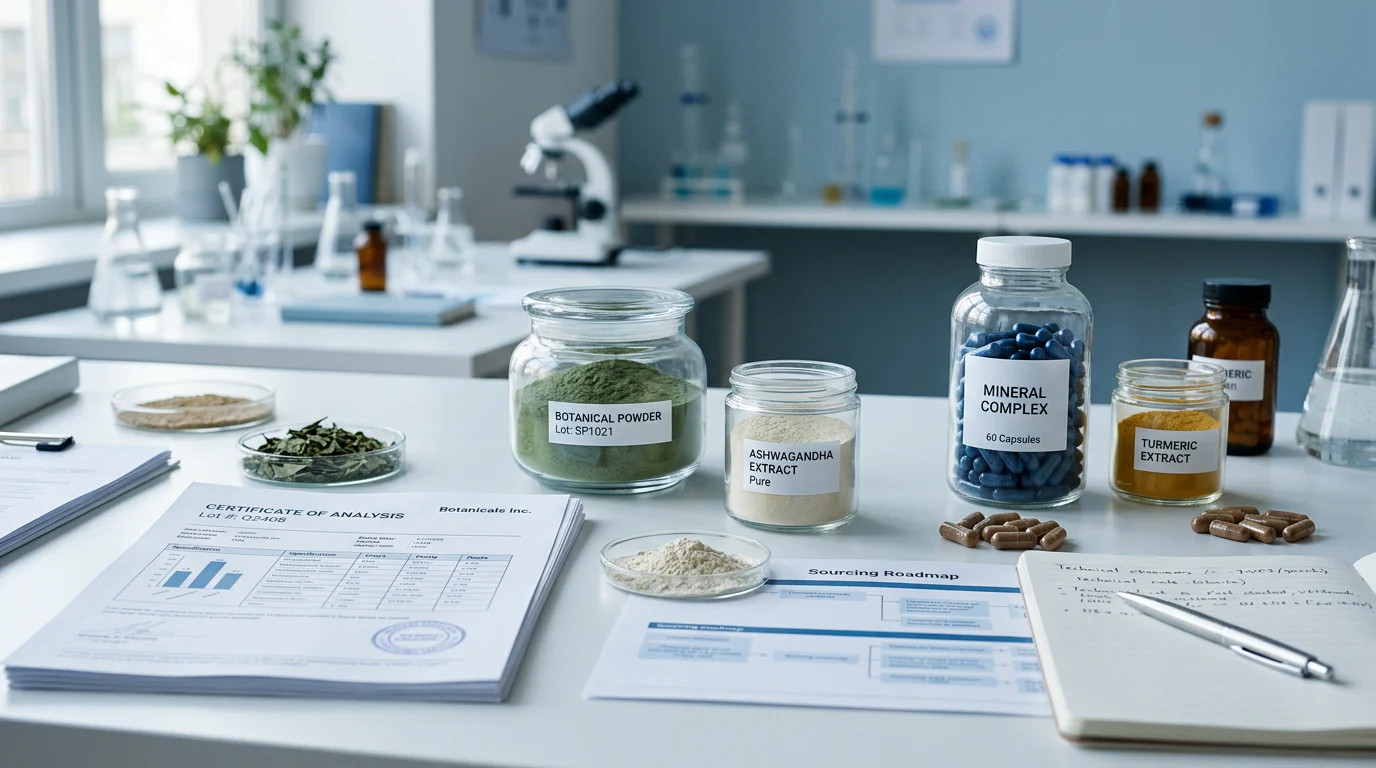
During August 2021 through August 2023, 60.2% of US adults reported using a dietary supplement in the previous 30 days, making disciplined ingredient qualification a commercial as well as quality decision.
The best nutraceutical ingredient supplier is the one matched to your product category, required grade, order volume, target market, and documentation needs. Supplement manufacturers should identify whether a company is an original manufacturer, distributor, importer, branded-ingredient owner, or contract processor, then verify identity, contaminants, origin, traceability, allergen status, certifications, and lot-specific records before approving material.
We built this guide to help teams shortlist suppliers by the evidence needed to make a product, not by an alphabetical list of company names.
How to Evaluate Nutraceutical Ingredient Suppliers
Start with the ingredient, not the supplier logo. A mineral for a capsule, a botanical extract for a gummy, and a live culture for a powder can each demand different grades, test methods, packaging, and storage conditions. FDA dietary-supplement CGMP requirements make clear that manufacturers need specifications for components and quality controls at the points where they matter most, as reflected in the Part 111 framework.
The first question is whether you need an original manufacturer, a distributor, an importer, a branded-ingredient owner, or a contract processor. Original manufacturers may offer deeper process visibility. Distributors can improve access, samples, and smaller-order flexibility. Importers may support logistics, but their role does not replace the buyer’s own qualification work. Contract processors can help with premixes or processing, yet they are not necessarily the material’s original source.
Before adding a supplier to a shortlist, align the request with your finished format, target label claim, intended market, required evidence, and commercial timing. For vitamin programs, our bulk-vitamin options resource can help frame the category questions worth asking.
How We Verify Directory Records
A useful directory should reveal what a supplier does, what it can document, and when that evidence was checked. We use a documentation-first approach because procurement teams need facts they can compare across quality, regulatory, operations, and formulation reviews.
Separate Supplier Roles Clearly
We label whether a record represents an original manufacturer, distributor, importer, branded-ingredient owner, or contract processor. Those roles can overlap, but they should never be assumed to be identical. A distributor’s certificate, for example, may describe a material without proving direct control of its manufacture.
Treat Commercial Fields as Time Sensitive
MOQ, sample availability, lead time, packaging format, and inventory status change. We treat them as dated commercial fields, not permanent claims. If a supplier has not provided a current written answer, the record should say that rather than substitute an estimate.
Require Lot-Specific Quality Evidence
A current specification sheet is useful, but lot release requires more. Buyers should request a certificate of analysis, identity method, contaminant and microbiological results where relevant, allergen statement, origin declaration, traceability information, and stability or shelf-life support. Our quality-testing checklist provides a practical way to organize technical-document review.
Check Certification Claims at the Source
A certificate can support qualification, but it should be checked against the issuer’s listing or current certificate. Ingredient certification and finished-product certification are not interchangeable, a distinction explained in NSF’s ingredient guidance.
Browse by Ingredient Category and Formulation Need
Category filters should answer practical formulation questions before a buyer starts emailing suppliers. We group nutraceutical ingredient suppliers by material type, then narrow by grade, dosage-form suitability, solubility, standardization, dietary-positioning attributes, and available documentation.

Vitamins, Minerals, and Amino Acids
For vitamins and minerals, compare chemical form, assay, particle size, flow properties, moisture sensitivity, and premix compatibility. For amino acids, confirm source, purity, powder behavior, allergen profile, and whether the material fits capsules, tablets, powders, or beverages. Buyers comparing international supply can also use our GMP export overview to structure broader quality-system questions.
Botanicals, Lipids, and Enzymes
Botanical records should identify the Latin binomial, plant part, extraction method, marker compounds, standardization target, and contaminant controls. Lipid sourcing calls for oxidation, storage, packaging-barrier, and shelf-life evidence. Enzyme qualification should state activity units, assay method, intended processing conditions, and stability profile.
Probiotics and Specialty Ingredients
Probiotic sourcing requires strain-level identification, potency basis, storage conditions, and end-of-shelf-life viability support. Specialty ingredients, including fibers, carotenoids, co-factors, and delivery systems, need clear format and application evidence.
Compare Supplier Types Before You Shortlist
A category-first comparison prevents teams from treating every seller as the same kind of partner. Use the table below to decide which supplier role fits the risk, volume, and documentation profile of your project.
| Supplier Role | Best Fit | Evidence To Request | Common Watchout |
|---|---|---|---|
| Original manufacturer | High-volume or technically sensitive material | Site details, process controls, lot traceability, specifications | Assuming direct manufacture without proof |
| Distributor | Smaller orders, broader catalog access, faster samples | Original-source documentation, storage history, authorization | Incomplete chain-of-custody visibility |
| Importer | Cross-border buying and logistics coordination | Import responsibilities, origin records, supplier verification evidence | Confusing import support with material qualification |
| Branded-ingredient owner | Differentiated, specification-led ingredient | Trademark use terms, technical dossier, quality documentation | Treating brand status as regulatory approval |
| Contract processor | Premixes, blends, encapsulation, or processing | Component controls, batch records, processing specifications | Assuming it made the original raw material |
Then compare the documentation and formulation fit by category. This is more useful than a single “best supplier” label because the qualification threshold changes with the ingredient and product format.
| Ingredient Category | Formulation Questions | Documentation Priorities | Bulk Continuity Questions |
|---|---|---|---|
| Vitamins and minerals | Form, assay, particle size, blend compatibility | CoA, identity, elemental impurity controls | MOQ, packaging, storage |
| Amino acids | Solubility, taste, flow, source | Assay, identity, allergen statement | Samples, production timing |
| Botanicals | Plant part, extract ratio, marker standardization | Species identity, pesticides, heavy metals, residual solvents | Seasonal origin, change control |
| Lipids | Oxidation, encapsulation, sensory profile | Peroxide or anisidine data, storage conditions | Temperature control, package barrier |
| Enzymes | Activity units, pH, temperature stability | Activity assay, microbiological data | Shelf life, handling instructions |
| Probiotics | Strain identity, CFU target, stability | Strain documentation, viability support | Cold-chain needs, end-of-life potency |
| Specialty ingredients | Delivery format, claim support, application fit | Specification, compatibility, positioning evidence | Alternate-source feasibility |
For any imported material, freight conditions can affect the quality record. Our air and sea freight guide helps buyers plan questions about transit, packaging, and handoff points.
What Should US Brands and Bulk Buyers Verify?
US suitability is not a badge. It is an evidence trail showing that the material, documentation, import arrangement, and finished-product controls can support lawful and well-documented supply. Dietary supplements are not FDA approved before sale, and a supplier should never imply otherwise.
Review the US-Market Evidence
Ask whether the ingredient has a documented US dietary-supplement history or requires an NDI assessment. FDA identifies October 15, 1994 as the key historical date for determining whether a dietary ingredient may be new, while placing responsibility for that determination and supporting records on the manufacturer or distributor. Review the NDI background before treating an unfamiliar ingredient as routine.
Build a Bulk-Order Qualification File
For bulk orders, capture verified MOQ, sample policy, lead time, packaging size, storage conditions, shelf life on delivery, capacity signals, and change-notification commitments. A second-source plan should be built before a supply interruption, not after one. For broader US sourcing context, review our US raw-material catalog.
Document Allergens and Chain of Custody
Request an allergen and cross-contact statement that addresses the finished formula’s intended positioning. The United States recognizes nine major food allergens, including sesame, and FDA labeling expectations also apply to dietary supplements. Review FDA’s allergen requirements alongside each supplier’s current statement.
Find Alternatives by Sourcing Need
When a buyer needs an alternative, the better question is not which company replaces another. It is which supplier role and evidence package resolves the actual sourcing constraint.
- Need A Commodity Nutrient: Prioritize verified chemical form, assay, particle size, packaging, and lead-time reliability.
- Need A Standardized Botanical: Prioritize species identity, plant part, extraction method, marker assay, and contaminant testing.
- Need A Small Launch Order: Compare sample terms, MOQ, application support, and whether the seller is authorized to distribute the material.
- Need A US Import Path: Document the supplier, importer role, applicable verification activities, allergen controls, and chain of custody.
- Need Continuity At Scale: Ask about alternate manufacturing sites, inventory policy, change notifications, and lot traceability before approval.
A useful alternative is one that preserves the product’s critical quality attributes while improving the documentation, availability, or commercial fit that caused the search. Our sourcing alternatives resource can help teams make that comparison more systematically.
Work with Aarise Pharma
Aarise Pharma works with international B2B buyers who need a disciplined path from initial inquiry to qualified pharmaceutical raw-material supply. Our primary focus is active pharmaceutical ingredients and pharmaceutical raw materials, so we will be clear about whether a request belongs in our scope and what evidence is needed before it moves forward. Bring us your target material, destination market, expected volume, dosage-form requirements, and documentation list. We can help you structure the request, identify the quality questions that deserve written answers, and plan continuity before purchasing pressure narrows your options. For supplement-related ingredient searches, use the same documentation-first approach and compare records by role, category, origin, lot evidence, and availability. That discipline makes supplier selection easier to audit across purchasing, quality, and regulatory teams. Start with a concise requirement brief, then use our sourcing alternatives resource to sharpen the comparison. Talk with Aarise Pharma
FAQs on Nutraceutical Ingredient Suppliers
What Documents Should I Request for Each Ingredient Lot?
For each lot, request a CoA, specification, identity method, contaminant and microbiological results, allergen statement, origin declaration, traceability record, and shelf-life or stability evidence before final approval.
Does a Certificate Mean FDA Approval?
No. These items may demonstrate a defined quality activity, but they do not equal FDA premarket approval of an ingredient or finished dietary supplement in the United States.
What Should a US Importer Document?
A US importer should document supplier evaluation, applicable hazard and allergen controls, verification activity, corrective-action process, and component specifications appropriate to the import arrangement on record.
What Makes Botanical Qualification Different?
Botanical qualification should confirm Latin name, plant part, extraction details, marker standardization, identity method, adulterant controls, contaminants, residual solvents, and lot-to-lot consistency evidence before approval.
How Should Bulk Buyers Compare Suppliers?
Prioritize storage conditions, packaging barrier, production timing, sample availability, MOQ, lead time, backup-source feasibility, and written change-notification commitments before you approve a bulk supplier for routine use.