Liraglutide API for US Buyers: A 7-Gate Check Before You Order
Liraglutide API is the peptide drug substance in generic Victoza and Saxenda. US buyers should pass seven checks before ordering, led by the manufacturing site, which determines whether Import Alert 66-80 applies.

By Sunil Kumar, Managing Director - Sales · Updated 14 Oct 2026

Key takeaways
- A US buyer of liraglutide API should pass seven checks before ordering. The manufacturing site comes first because it decides whether FDA Import Alert 66-80 treats the shipment as exempt from detention.
- FDA's July 2026 draft guidances for generic liraglutide list the same impurity thresholds for recombinant, synthetic and semi-synthetic peptides: report impurities above 0.1% of the drug substance and identify those above 0.5%.
- Size orders on net peptide content, not purity. At an assumed 92% content, 1.80 kg of active liraglutide needs about 1.96 kg of powder.
- Match the import declaration to the real end use. FDA names declaring GLP-1 products as cosmetics, as peptides, or as not for human consumption or for research purposes among improper declarations.
In this article
- 1What should a US buyer check before ordering liraglutide API?
- 2Is the intended use declared truthfully?
- 3How do you check the manufacturing site?
- 4Which production route made the peptide?
- 5What impurity data should the certificate show?
- 6What is the net peptide content?
- 7Does the certificate match the lot you receive?
- 8Can the lot be traced to the manufacturer's batch record?
- 9Why does the manufacturing site decide whether a GLP-1 peptide can clear US import?
- 10Do synthetic and recombinant liraglutide face the same impurity thresholds?
- 11How much liraglutide do you need to order once net peptide content is counted?
- 12What should a request for quotation include, and what can we supply?
- 13Frequently asked questions
Every liraglutide active pharmaceutical ingredient (API) listing leads with a Chemical Abstracts Service (CAS) registry number and a purity percentage. Neither tells a US buyer whether the material is usable. Where it was made, how it was made and how much active peptide the powder holds do.
As of the 9 October 2026 version of its Import Alert 66-80, FDA reports that of 48 foreign glucagon-like peptide-1 (GLP-1) API sites it evaluated, 21% were noncompliant under section 501 of the Federal Food, Drug, and Cosmetic Act.
Generic liraglutide pens are on the US market, so formulators and importers are buying the API now. The checks belong before the purchase order, not after a detention notice.
What follows are pass and fail tests for each check, the reasoning behind them, an order-quantity calculation and the details we need to quote.
What should a US buyer check before ordering liraglutide API?
A US buyer should confirm seven things before issuing a purchase order, starting with the manufacturing site, because that decides whether FDA Import Alert 66-80 treats the shipment as exempt from detention. The table summarizes the gates. Each is explained below with a pass test and a fail test.
| Gate | Pass in one line |
|---|---|
| 1. Intended use | Written end use matches your filing and import declaration |
| 2. Manufacturing site | Named facility found on FDA's green list |
| 3. Production route | Route stated in writing |
| 4. Impurity profile | Impurities reported against FDA's thresholds |
| 5. Net peptide content | Content on the certificate and used to size the order |
| 6. Documents | Lot-specific paperwork arrives before shipment |
| 7. Traceability | Lot ties to the manufacturer's batch record |
Is the intended use declared truthfully?
Yes, only if the supplier's written end use matches your filing and your import declaration. Pass: the supplier states in writing whether the material is for a human drug product, and your customs entry uses the matching intended-use code. Fail: material sold for research or as not for human consumption that you plan to put into a drug program.
How do you check the manufacturing site?
Ask for the facility name and address, then look the facility up on the green list in Import Alert 66-80, the FDA list of manufacturers excluded from detention without physical examination. Pass: a named facility that appears on the list. Fail: no named facility, a trader's name only, or a facility absent from the list, which exposes the shipment to detention.

Which production route made the peptide?
Ask whether the peptide is recombinant, fully synthetic or semi-synthetic (a recombinant backbone finished by chemical acylation, meaning attachment of a fatty acid). Pass: the route is written on the specification and is consistent with your filing. Fail: the supplier cannot state it. The route decides which impurities to expect, such as host cell proteins and residual DNA from recombinant processes.
What impurity data should the certificate show?
Ask for every peptide-related impurity as a percentage of the drug substance, with the analytical method named. Pass: every impurity above 0.1% is reported and every impurity above 0.5% is identified, the thresholds in FDA's July 2026 draft guidance for generic liraglutide. Fail: a single purity figure with no impurity list.
What is the net peptide content?
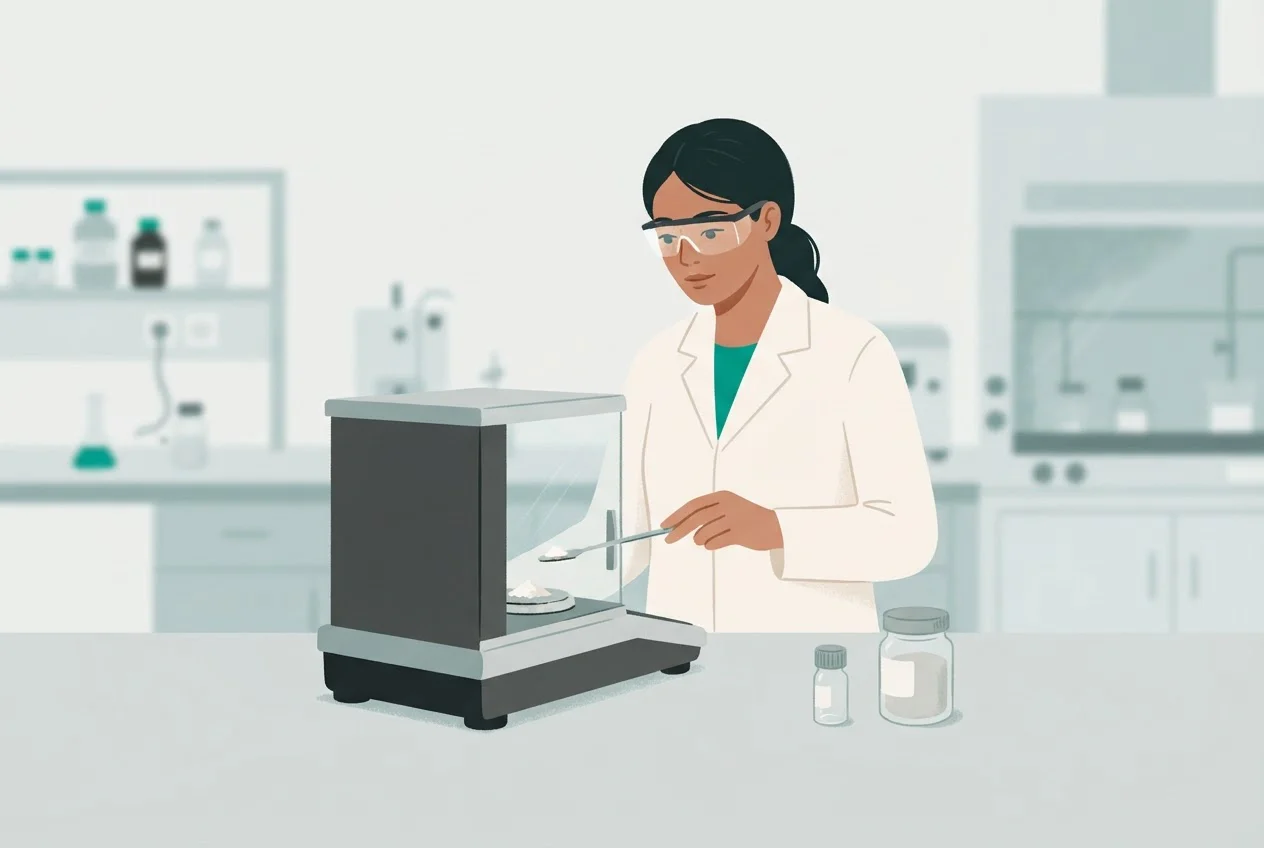
Net peptide content is the share of the powder's mass that is peptide, after water, any counter-ion (the salt ion, such as acetate, that binds the peptide) and residual solvent are subtracted. Pass: the figure is on the certificate of analysis (COA) and drives your order quantity. Fail: only purity from high-performance liquid chromatography (HPLC), which measures something different.
Does the certificate match the lot you receive?
It matches only if the paperwork is specific to the lot. Pass: a lot-specific COA, the specification and the safety data sheet (SDS) arrive before you pay, and the lot number matches the labeled pack. Fail: a generic sample COA, or a lot number that differs between document and drum.
Can the lot be traced to the manufacturer's batch record?
It can if the manufacturer's batch number appears on the COA and the shipping papers, which ties the lot to the site you checked in gate 2. Fail: the lot number changes between COA and pack, or the supplier cannot name where the batch came from. Our peptide API supply chain qualification checklist covers the document trail in detail.
Why does the manufacturing site decide whether a GLP-1 peptide can clear US import?
The manufacturing site decides it because Import Alert 66-80 allows FDA to detain GLP-1 bulk drug substances without physical examination unless the manufacturer is on the green list. As of October 2026, the alert covers GLP-1 receptor agonist bulk drug substances, including semaglutide, tirzepatide, liraglutide, exenatide, dulaglutide, lixisenatide and orforglipron.
The green list names registered foreign manufacturers whose facilities and products, on FDA's recent evidence, appear to comply with current good manufacturing practice (cGMP). A manufacturer asking to be added supplies evidence including COAs for its last ten lots, process validation reports and master batch records (Import Alert 66-80). A certificate in a supplier's brochure cannot stand in for that evidence, so gate 2 asks for the facility and you check the facility.
Declarations matter as much as sites. FDA's filing accuracy bulletin says GLP-1 products are often misdeclared as cosmetics, as peptides, or as not for human consumption or for research purposes, and calls those declarations improper. Pharmacy compounding (code 150.013) and laboratory research (code 180.017) carry different documentation. The same import rules apply to our related guides, Semaglutide API for US Buyers and Tirzepatide API: What a US Buyer Must Verify First.
Do synthetic and recombinant liraglutide face the same impurity thresholds?
Yes. FDA's revised draft product-specific guidances for liraglutide, published July 28, 2026 for Victoza (new drug application (NDA) 022341) and Saxenda (NDA 206321), list the same impurity thresholds whether the peptide is recombinant, synthetic or semi-synthetic. They are drafts and nonbinding, so read them before you set supplier specifications (Victoza guidance, Saxenda guidance).
The guidances, written for generic makers filing an abbreviated new drug application (ANDA), set these levels as percentages of the drug substance:
- Report every active ingredient-related impurity above 0.1%.
- Identify every one above 0.5%.
- Keep an impurity shared with the reference product no higher than the reference level or 1.0%, whichever is greater.
- Reduce new impurities below 1.0%.
- Keep the total no higher than the reference product's total.
Recombinant processes add a duty to show that host cell proteins and residual DNA are well controlled. The reference product's peptide precursor is made by recombinant DNA expression in yeast and then acylated (Victoza label).
On July 28, 2026, FDA also announced it is withdrawing its 2021 guidance on synthetic peptide ANDAs that refer to recombinant products, because it no longer reflects current scientific thinking. Our recommendation: ask each supplier to report at 0.1% and identify at 0.5%, so its data already fit the draft guidances, and confirm the final position with your regulatory affairs team.
FDA approved Hikma's generic Victoza on December 23, 2024 and Teva's generic Saxenda on August 28, 2025. The sources do not state the API route for either product, so gates 3 and 4 still need written answers from each supplier.
How much liraglutide do you need to order once net peptide content is counted?
You need the label-claim amount divided by net peptide content, so a powder that is 92% peptide requires about 1.96 kg to deliver 1.80 kg of active. HPLC purity does not enter this formula, and our page on peptide HPLC purity versus content explains why.
This is our model, not an official figure:
- Inputs: Victoza is supplied as 18 mg per 3 mL pen at 6 mg/mL (Victoza label), and Saxenda as a 6 mg/mL solution in a 3 mL pen (Saxenda label). Both give 18 mg per pen.
- Batch: 100,000 pens × 18 mg = 1,800,000 mg = 1.80 kg of liraglutide at label claim.
- Formula: powder needed = 1.80 kg ÷ net peptide content.
- Assumptions: no manufacturing overage and no filling loss. Real batches need an allowance for both.
| Net peptide content (illustrative) | Powder needed |
|---|---|
| 95% | 1.89 kg |
| 92% | 1.96 kg |
| 85% | 2.12 kg |
Order 1.80 kg of powder at 92% content and you hold 1.656 kg of liraglutide, 144 g (8%) short. The content figures are assumptions that show the effect, not typical values for any supplier. Ask for the real figure in gate 5.
What should a request for quotation include, and what can we supply?
A request for quotation (RFQ) should give us the product and CAS number (204656-20-2), the quantity stated as active peptide, the destination country, the grade or purity and net peptide content you require, the documents you need, and your payment terms and Incoterms (the international trade terms that set who handles shipping and risk). Documents can include a COA, a specification and an SDS where applicable.
Liraglutide is part of our peptide API portfolio. We supply it as bulk API or raw powder for business buyers, and we provide documentation and supply support for US importers. Each quotation names the approved manufacturing source. Whether that facility is on FDA's Import Alert 66-80 green list is something you should confirm on FDA's site, and we do not claim a green-list listing here. Our peptide API catalog shows the wider range, and you can ask us to confirm liraglutide availability in your RFQ.
Our prices depend on chemical rates and market conditions. We quote product by product at the current rate once you give us the API name and CAS number. Minimum order quantity, supply capacity and lead time depend on the approved manufacturing source and current availability, and we confirm them in the commercial quotation or proforma invoice. For international commercial orders, standard payment terms are generally 100% advance by bank transfer, unless alternative terms are agreed in writing for a particular transaction.
We support sample and evaluation quantities for qualified business buyers, subject to the API, availability and applicable regulatory requirements. After successful evaluation and approval, we can support commercial and bulk requirements. Before commercial supply, you confirm your local registration, import authorization and permitted end use. To start, send us your RFQ through our contact form, or reach our sales team on WhatsApp at +91 9899783330 or at sunil@aarisepharma.com.
Frequently asked questions
Liraglutide is an acylated analog of human GLP-1(7-37), 97% homologous to it, with arginine replacing lysine at position 34 and a palmitic acid chain attached through a glutamic acid spacer at lysine 26. Its formula is C172H265N43O51 and its CAS number is 204656-20-2 (Victoza label, PubChem).
No. A research declaration does not fit a drug program. FDA lists declaring GLP-1 products as not for human consumption or for research purposes among improper declarations when the material is meant for human use (FDA bulletin). Drug programs need a documented end use and a cGMP source.
Sources
- 1.FDA Import Alert 66-80, Detention Without Physical Examination of GLP-1 Receptor Agonist Bulk Drug Substances
- 2.FDA filing accuracy bulletin on GLP-1 drugs (GovDelivery)
- 3.FDA notice on revised draft product-specific guidances for generic peptide products, July 28, 2026
- 4.FDA draft product-specific guidance on liraglutide, Victoza (NDA 022341), July 2026
- 5.FDA draft product-specific guidance on liraglutide, Saxenda (NDA 206321), July 2026
- 6.FDA prescribing information for Victoza
- 7.FDA prescribing information for Saxenda
- 8.PubChem: Liraglutide (CAS 204656-20-2)
- 9.Healio: FDA approves a generic form of liraglutide to treat type 2 diabetes
- 10.Pharmacy Times: FDA approves generic version of liraglutide injection for weight loss