
Glossary
Certificate of Pharmaceutical Product (CPP)
A certificate of pharmaceutical product (CPP) comes from a regulator, not a manufacturer, for one finished product.

By Sunil Kumar, Managing Director - Sales · Updated 23 Oct 2026
Also called CPP or WHO-type certificate of a pharmaceutical product
On this page
- 01Definition
- 02Quick facts
- 03What is a certificate of pharmaceutical product, and who issues it?
- 04Why importing regulators ask for a CPP
- 05Can an API have a certificate of pharmaceutical product?
- 06What to request when an API supplier has no CPP
- 07CPP vs GMP certificate, COA and other documents
- 08Common misconceptions
- 09How Aarise Pharmaceuticals handles it
- 10Example
- 11Related terms
- 12Frequently asked
What is a certificate of pharmaceutical product?
A certificate of pharmaceutical product (CPP) is a document the exporting country's competent authority validates and issues for a specific product, for use by the regulator in the importing country. It is the main document of the WHO Certification Scheme.
Key takeaways
- A manufacturer cannot issue a CPP, and a CPP does not certify a batch.
- A CPP is about a product, a GMP certificate is about a site, and a certificate of analysis (COA) is about a batch.
- The WHO scheme for APIs dates from 2003 and, as of October 2026, has not been fully operationalized, so importers should not expect suppliers to hold such a certificate.
- If a supplier says it has "its own CPP", ask for the regulator's copy.
Quick facts
- Issued by
- The competent authority of the exporting country
- Covers
- One product; a 10 mg tablet and a 5 mg tablet need separate certificates
- Scheme
- WHO Certification Scheme, a voluntary agreement operating since 1969
- Designed for
- Finished dosage forms
- What to check
- That a regulator is named as issuer
When an importer writes "send the CPP" to an active pharmaceutical ingredient (API) supplier, two assumptions sit inside the request. One is that the supplier can produce the document. The other is that it vouches for the batch being shipped. A supplier cannot issue a CPP; only a regulator can. A CPP does not certify a batch.
Asking for the wrong paper costs time on both sides. A buyer who requests a CPP for a bulk API may wait for a document that does not exist, while the documents that do answer the question, a batch certificate of analysis and site GMP evidence, go unrequested.
GMP certificates, certificates of analysis and CPPs each answer a different question. Mixing them up leaves buyers holding paperwork that proves less than they think.
What is a certificate of pharmaceutical product, and who issues it?
A CPP is a document that the competent authority of the exporting country validates and issues for a specific product, for use by the regulator in the importing country. The manufacturer does not issue it. It is the main document of the WHO Certification Scheme, a voluntary agreement that has operated since 1969. The Scheme also defines a statement of licensing status and a batch certificate, which the manufacturer issues for a specific batch.
The certificate states the product's name, dosage form and composition, and whether it is authorized for marketing in the issuing country. It also names the marketing authorization holder and lists the manufacturing sites and whether they are periodically inspected. A product that is not authorized in the issuing country can still be certified. In that case a separate section records why, for example "not requested" or "withdrawal for commercial reasons".
Why importing regulators ask for a CPP
CPPs matter because importing regulators ask for them. A 2020 study of 18 maturing pharmaceutical markets by the Centre for Innovation in Regulatory Science found that 16 required a CPP for new registrations (PubMed abstract). The importing regulator still makes its own decision. The CPP is one input.
A CPP names one product, so a 10 mg tablet and a 5 mg tablet need separate certificates. WHO notes that manufacturing arrangements and approved information differ by dosage form and strength, and the certificate is "for a single product only".
Can an API have a certificate of pharmaceutical product?
Not under the WHO CPP itself. The WHO Scheme applies to finished dosage forms, and certification of APIs and excipients is handled in separate guidelines.
Those guidelines, the WHO starting-materials scheme, provide that the regulator issues the certificate. A manufacturer may issue its own only where no national authority or legal framework exists, and it must attach the document from an independent certifying body or competent authority.
As of October 2026, the WHO starting-materials scheme (SMACS, 2003) has not been fully operationalized and WHO is reviewing it, so importers should not expect suppliers to hold such a certificate.
Whether a regulator issues a CPP-format certificate for a bulk API depends on that regulator, so confirm with the issuing authority before you rely on one.
If a supplier says it has "its own CPP", ask for the regulator's copy. A document with no regulator named as issuer is not a CPP.
What to request when an API supplier has no CPP
Request a batch COA, a specification and SDS/MSDS, GMP evidence for the named site, and the site's FDA inspection history. Run each as a pass or fail test.
- Batch COA. Pass: the lot number matches the shipment label and results are listed against a stated specification. Fail: no lot number or no limits.
- Specification and SDS/MSDS. Pass: the specification names the test methods and limits you will release against. Fail: methods or limits missing, or no release limits you can test against.
- GMP evidence for the named manufacturing site. Pass: a regulator or recognized certifying body issued it, and the site name and address match your quote. Fail: only a seller's own letter.
- FDA inspection history, where FDA has inspected the site. Look up the site's FDA Establishment Identifier (FEI) on the FDA Data Dashboard. Pass: latest classification is NAI (No Action Indicated) or VAI (Voluntary Action Indicated). Fail: OAI (Official Action Indicated), or no record for a site claimed to be FDA-inspected.
- Written list from your importing regulator. Pass: you hold in writing which certificates it requires. Fail: only a verbal or supplier-relayed requirement.
For the standards behind these checks, see ICH Q7 and the API export dossier guide. For a full supplier assessment, use how to qualify a steroid API supplier and the steroid API RFQ checklist.
CPP vs GMP certificate, COA and other documents
A CPP covers one product, a GMP certificate covers one manufacturing site, and a COA covers one batch. Health Canada's guidance (GUI-0024, Step 1) has applicants use a separate GMP-only form when the certificate is not tied to a specific product, while a CPP indicates the status of the product and the GMP status of the sites.
Product, site and batch: three different documents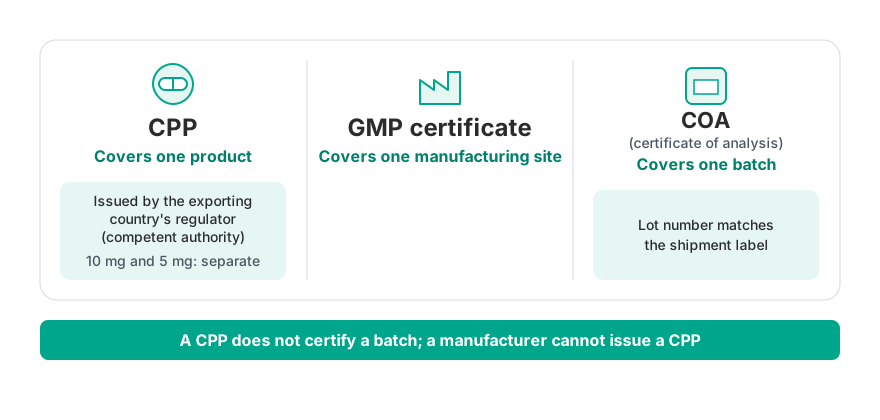
Related terms: marketing authorization (the license to sell a product), the WHO Certification Scheme, and WHO GMP. FDA treats the CGMP declaration as a follow-on. It should be requested only if a foreign regulator does not accept a valid CPP, and the applicant must already hold one.
- Document
- CPP
- Issued by
- Exporting country's regulator
- Subject
- One product, dosage form and strength
- Does not prove
- Quality of a delivered batch
- Document
- GMP certificate
- Issued by
- Regulator
- Subject
- One manufacturing site
- Does not prove
- Any product's authorization
- Document
- Batch certificate (WHO Scheme)
- Issued by
- Manufacturer
- Subject
- One batch
- Does not prove
- Authorization status (that is the CPP's role)
- Document
- Starting-material certificate (WHO scheme, 2003; not fully operationalized)
- Issued by
- Regulator; a manufacturer only with independent backing
- Subject
- One starting material
- Does not prove
- Quality of a delivered batch
- Document
- Current good manufacturing practice (CGMP) declaration (FDA)
- Issued by
- FDA, sent to a foreign regulator
- Subject
- One establishment
- Does not prove
- Product authorization
- Document
- COA
- Issued by
- Manufacturer's quality control
- Subject
- One batch
- Does not prove
- Site GMP status
Common misconceptions
- Myth: "My API supplier can issue a CPP." Fact: A supplier cannot issue a CPP; only a regulator can.
- Myth: "A CPP vouches for the batch being shipped." Fact: A CPP does not certify a batch. That is the job of the batch COA.
- Myth: "A CPP means the product can be sold in the importing country." Fact: The importing regulator decides under its own rules, and the CPP is one input.
How Aarise Pharmaceuticals handles it
For API enquiries, Aarise Pharmaceuticals supplies a COA, specification and SDS/MSDS where applicable, confirmed product by product, and it provides documentation and supply support for US importers.
A quote request asks for the product or Chemical Abstracts Service (CAS) number, quantity, destination, grade or purity, documents, payment terms and Incoterms (standard shipping-term codes). Pricing is product by product on request.
To start, send the details through the contact form, email sunil@aarisepharma.com, or message +91 9899783330 on WhatsApp.
Example
Take a registration team preparing a 10 mg tablet for a new market. The CPP they attach gives the authorization number, the holder, the authorized label and every manufacturing and packaging site. It says nothing about the lot they will ship. That is the job of the batch COA. If the regulator also wants site-level assurance, a GMP certificate or inspection report is requested alongside it.
Frequently asked
Sources
- 1.WHO Technical Report Series 1033, Annex 9: Guidelines on implementation of the WHO Certification Scheme (CPP), WHO, 2021
- 2.WHO model certificate of a pharmaceutical product, WHO
- 3.WHO Technical Report Series 917, Annex 3: starting materials certification scheme, WHO, 2003
- 4.Health Canada GUI-0024: electronic certificates of pharmaceutical product and GMP, Health Canada
- 5.FDA: Electronic certificates of pharmaceutical product, FDA, 16 September 2024
- 6.FDA: Current good manufacturing practice declarations, FDA, 16 September 2024
- 7.FDA Data Dashboard: inspections, FDA
- 8.Use of the CPP in 18 maturing pharmaceutical markets, Therapeutic Innovation & Regulatory Science (PubMed Central full text), Therapeutic Innovation & Regulatory Science, 2020
- 9.Use of the CPP in 18 maturing pharmaceutical markets (PubMed abstract), PubMed, 2020