
Glossary
Batch Manufacturing Record (BMR)
A batch manufacturing record is the signed, step-by-step account of how one specific batch was made, reviewed by quality before the batch is released.

By Sunil Kumar, Managing Director - Sales · Updated 23 Oct 2026
Also called Batch production and control record or Batch record
On this page
- 01Definition
- 02Quick facts
- 03Introduction
- 04What a batch manufacturing record contains and where the rules come from
- 05How a batch record differs for an API and a finished drug
- 06Batch record, master record and batch packaging record
- 07What a completed record shows that a COA does not
- 08What a buyer can ask a supplier for, and what each document proves
- 09How to check an executed batch record in five minutes
- 10How Aarise Pharmaceuticals handles it
- 11Example
- 12Related terms
- 13Frequently asked
What is a batch manufacturing record?
A batch manufacturing record (BMR) is the signed, executed record of how one specific batch was made, with actual weights, results, deviations and yield. U.S. rules call it a batch production and control record.
Key takeaways
- A certificate of analysis (COA) only summarizes the release tests; the BMR is where the step-by-step history sits.
- Finished drugs follow 21 CFR Part 211 and APIs follow ICH Q7, and the two list different required contents.
- Agree which documents you will receive in the quality agreement before the first order.
- Run seven tests on any executed record, such as actual values instead of "as per master" and a quality sign-off dated before dispatch.
Quick facts
- Also known as
- Batch production and control record (U.S. rules)
- Who produces it
- The manufacturer, which writes and keeps it
- Legal basis
- 21 CFR 211.188 for finished drugs; ICH Q7 §6.50 for intermediates and APIs
- What it covers
- Actual weights, equipment, lot numbers, test results, deviations and yield for one batch
- What buyers check
- Actual values, signatures, dated corrections, yield and a quality approval dated before dispatch
Introduction
A certificate of analysis (COA) shows what a batch tested at. It does not show how the batch was made. That history sits in the batch manufacturing record, which the manufacturer writes and keeps.
The rules fix the record's contents, not its layout, so two compliant records can look nothing alike. One site may keep packaging and labeling entries inside the batch record, while another keeps them in a separate document, and both can comply with 21 CFR 211.188(b) and ICH Q7 §6.52. The same name also covers different documents for an active pharmaceutical ingredient (API) and for a finished tablet, and the two regimes list different required content.
This entry is written for formulation, import and distribution buyers who are qualifying a supplier, not for operators filling in a form. Two things follow: a ladder of documents to request, and a seven-point pass/fail check you can run on any executed record.
What a batch manufacturing record contains and where the rules come from
A batch manufacturing record starts as a copy of the approved master record and collects the actual weights, equipment, lot numbers, test results, deviations and yield.
21 CFR 211.188 requires one for every batch of finished drug product. It must be "an accurate reproduction of the appropriate master production or control record, checked for accuracy, dated, and signed." Section 6.50 of ICH Q7 requires the same for every intermediate and API batch. Both texts were current as of October 2026.
No rule prescribes a layout. The rules prescribe contents. That is why a downloaded template cannot make a record compliant.
How a batch record differs for an API and a finished drug
Finished drug product follows 21 CFR Part 211; the API, or drug substance, follows ICH Q7. FDA's Q7 page lists it as guidance for APIs used in human drug products. Both require complete batch records, but they list different content.
Dietary supplements follow a separate rule, 21 CFR Part 111. For the full API standard, see ICH Q7.
- Point
- Required documentation items
- ICH Q7 (API)
- 12 (§6.52)
- 21 CFR Part 211 (finished drug)
- 13 (§211.188(b))
- Point
- Unique to this regime
- ICH Q7 (API)
- Actual results for critical process parameters; release test results
- 21 CFR Part 211 (finished drug)
- Packaging and labeling area inspection; labeling control records; containers and closures
- Point
- Master record check
- ICH Q7 (API)
- Prepared, dated and signed by one person, independently checked by a person in the quality unit (the independent quality department that approves release) (§6.40)
- 21 CFR Part 211 (finished drug)
- Prepared by one person, independently checked by a second person (§211.186(a))
- Point
- Batch record issue
- ICH Q7 (API)
- Checked for the correct version and an accurate reproduction of the master (§6.50)
- 21 CFR Part 211 (finished drug)
- Accurate reproduction of the master, checked, dated and signed (§211.188(a))
- Point
- Pre-release review
- ICH Q7 (API)
- Quality unit reviews critical-step records and all deviation and out-of-specification (OOS) reports (§6.71, §6.72)
- 21 CFR Part 211 (finished drug)
- Quality control unit reviews all production and control records (§211.192)
Batch record, master record and batch packaging record
Under 21 CFR 211.188 and ICH Q7 §6.52, packaging and labeling documentation is part of the batch production and control record. Many sites split it into a separate batch packaging record (BPR), so ask which document holds the packaging and labeling entries.
Master record, batch record and packaging record compared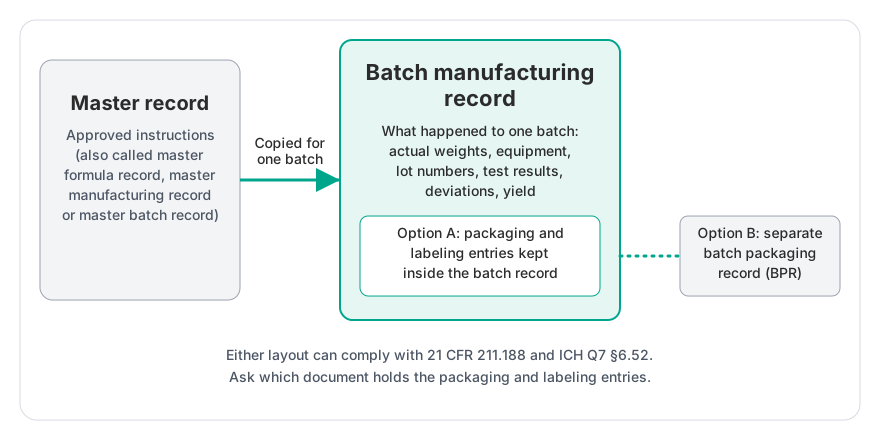
The master record (also called the master formula record, master manufacturing record or master batch record) holds the approved instructions. The batch manufacturing record holds what happened to one batch. The regulations do not prescribe a layout, so a site may keep packaging records inside the batch record or as a separate document (21 CFR 211.188(b); ICH Q7 §6.52).
What a completed record shows that a COA does not
A completed record shows the step-level history of a batch: which lots went in, actual weights, who performed and checked each step, and what deviated. A COA reports only the release test results.
Incomplete records are a recurring finding. FDA's quality agreement guidance gives a hypothetical case: a contract facility's batch records omit the addition of reclaimed powder, so the records are inaccurate and non-compliant with current good manufacturing practice (CGMP) even though they match the quality agreement. A real warning letter dated 20 March 2026 cited 211.188 for incomplete batch records. GMP Journal's FY2025 warning letter report lists 211.188 among the frequently cited sections, after 211.22, 211.84 and eight others; it gives no citation counts.
What a buyer can ask a supplier for, and what each document proves
Ask in this order, from the document most easily shared to the most sensitive. This ladder is a recommended order, not a published standard.
Whether and how a copy is delivered is a contract matter. A pharmaceutical quality agreement should define who makes and keeps originals or true copies and how records are made available.
- Ask for
- COA
- It shows
- Release test results for the batch
- It cannot show
- How the batch was made
- Ask for
- Batch summary or release statement
- It shows
- Batch number, date, quality release
- It cannot show
- Step detail
- Ask for
- Executed record (redaction, meaning blacking out confidential details, agreed in advance)
- It shows
- Lots, weights, parameters, signatures, yield, deviations
- It cannot show
- Whether the process is validated
- Ask for
- Deviation and OOS reports for the batch
- It shows
- What went wrong and how it was decided
- It cannot show
- Whether the process is controlled outside this batch
- Ask for
- Master record or process description
- It shows
- The approved instructions
- It cannot show
- What happened to your batch
How to check an executed batch record in five minutes
Run seven tests drawn from ICH Q7 §6.52, §6.14 and §6.71. Each is pass or fail.
- The batch number matches the COA. Any mismatch is a fail.
- Every raw material line has a lot number and an actual weight. One blank is a fail.
- Critical parameters show measured values. "As per master" or a tick alone is a fail.
- Each critical step has a performer and a checker, with dates. A missing second signature is a fail.
- Corrections are dated and signed, and the original entry is still readable. Obscured or unsigned changes fail.
- Actual yield and percentage of theoretical yield are stated. An out-of-range figure with no investigation reference fails.
- The quality unit approval date is before the dispatch date. Approval after shipping fails.
How Aarise Pharmaceuticals handles it
Aarise Pharmaceuticals confirms a COA, specifications and SDS/MSDS (safety data sheet) where applicable, product by product. A buyer can ask for an executed batch record in the documents field of the quote request and have the answer written into the quotation or quality agreement.
It supplies steroid, peptide, hormone, general pharmaceutical and supplement APIs as bulk material, and provides oral-dose contract development and manufacturing from development through commercial production. It also supports evaluation quantities for qualified B2B buyers. Its guide to reading an API COA explains the tests.
The quote request asks for the product or CAS (Chemical Abstracts Service) number, quantity, destination, grade or purity, documents, payment terms and Incoterms (international shipping terms such as FOB or CIF). For peptide synthesis steps, see Solid Phase Peptide Synthesis.
Example
Take a yield entry, with illustrative numbers. The theoretical yield is 100.0 kg and the actual is 96.5 kg, so the percentage of theoretical yield is 96.5%. Section 211.186(b)(7) requires the master record to state the minimum and maximum percentages that trigger an investigation. If the master allows 95% to 102%, the batch passes; at 93%, 211.192 requires an investigation.
Frequently asked
Sources
- 1.21 CFR 211.188, Batch production and control records
- 2.21 CFR 211.186, Master production and control records
- 3.21 CFR 211.192, Production record review
- 4.21 CFR 211.180, General requirements (retention)
- 5.ICH Q7 Good Manufacturing Practice Guide for Active Pharmaceutical Ingredients
- 6.FDA, Q7 Good Manufacturing Practice Guidance for Active Pharmaceutical Ingredients
- 7.FDA, Contract Manufacturing Arrangements for Drugs: Quality Agreements
- 8.FDA warning letter, RC Outsourcing, LLC, 20 March 2026
- 9.GMP Journal, The FDA Warning Letter Report for Fiscal Year 2025