
Glossary
Bacterial Endotoxin Test (BET)
A bacterial endotoxin test measures fever-causing bacterial cell-wall material.

By Sunil Kumar, Managing Director - Sales · Updated 24 Oct 2026
Also called BET, LAL test or USP <85>
On this page
- 01Definition
- 02Quick facts
- 03What does a bacterial endotoxin test measure?
- 04How is the endotoxin limit calculated for an injectable?
- 05Is the rabbit pyrogen test (USP <151>) the same as the BET?
- 06How does a product limit become an API specification?
- 07What should a buyer ask an API supplier to document?
- 08How Aarise Pharmaceuticals handles it
- 09Example
- 10Related terms
- 11Frequently asked
What is a bacterial endotoxin test?
A bacterial endotoxin test (BET), defined in USP <85>, detects endotoxin, a component of the Gram-negative bacterial cell wall, using Limulus amebocyte lysate (LAL), a reagent from horseshoe crab blood cells.
Key takeaways
- A bacterial endotoxin test (BET) has no universal pass number. The limit is a threshold dose, usually 5 endotoxin units (EU) per kilogram of body weight per hour, divided by the product's maximum hourly dose. Intrathecal (into the spinal fluid) products use 0.2 EU/kg.
- USP <85> is the test and the source of the limit. USP <151> is the rabbit pyrogen test, a fallback and not the way limits are derived.
- An API's endotoxin ceiling is the product limit, minus what the other ingredients contribute, divided by the API in one dose.
- Ask a supplier for the number, the limit it was judged against, the method, and proof the method works on that API.
Quick facts
- Defined in
- USP <85>
- Reagent
- Limulus amebocyte lysate (LAL); recombinant reagents also allowed under USP <86>
- Standard threshold
- 5 EU/kg per hour for parenteral routes except intrathecal
- Intrathecal threshold
- 0.2 EU/kg
- Fallback test
- Rabbit pyrogen test, USP <151>
The pass limit comes from USP <85>: a threshold dose, usually 5 endotoxin units (EU) per kilogram, divided by the maximum hourly dose. Oral products are not held to the same injectable limit.
That is why a number on an active pharmaceutical ingredient (API) certificate of analysis (COA) means little until you know the product it is going into. A COA that shows only "pass", with no limit, no method and no sign that the method works on that material, gives a buyer nothing to recompute. The buyer may have to hold or reject the lot until the supplier supplies the missing data.
This entry defines the test and shows how a label dose becomes a limit. It separates two easily confused USP chapters and ends with a worksheet and a request list you can send to any API supplier.
What does a bacterial endotoxin test measure?
A bacterial endotoxin test, addressed in FDA's March 2026 guidance, reads the reaction of the reagent as a gel clot or as turbidity or color change.
As of October 2026, USP <86> (official 1 May 2025) also allows recombinant reagents (recombinant factor C, rFC, and recombinant cascade reagent, rCR) as an alternative to LAL, per GMP-Compliance.
Endotoxin exposure can cause fever, shock and death, and most sterilization methods do not inactivate it. A sterile product can therefore still fail. A sterility test asks whether living organisms are present. The BET asks how much endotoxin remains.
How is the endotoxin limit calculated for an injectable?
The limit is K ÷ M. K is the threshold pyrogenic dose: 5 EU/kg for any parenteral (injected) route except intrathecal, and 0.2 EU/kg for intrathecal. For products dosed per square meter of body surface area, K is 100 EU/m² per hour, and radiopharmaceuticals have separate limits in USP <85>. M is the maximum recommended dose per kilogram in a single hour. Use the label's worst case.
How the endotoxin limit is calculated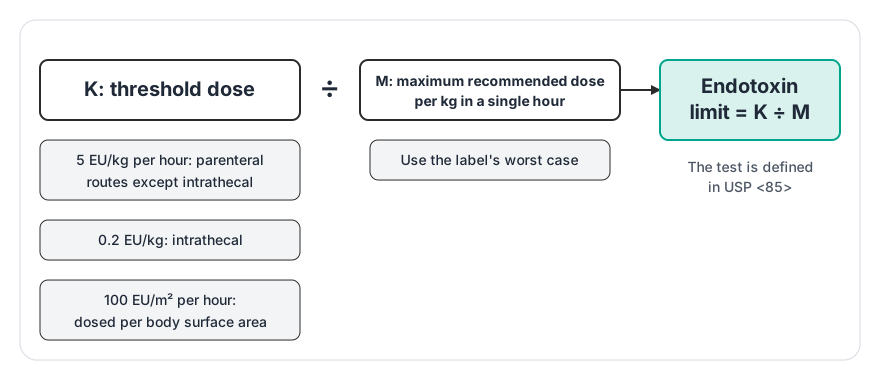
FDA applies it with a 70 kg standard adult and a pediatric weight where the label allows children.
In FDA's two examples the limits differ by a factor of about 2,500 (350 ÷ 0.14), which shows how far dose and body weight move the limit. FDA's March 2026 guidance also says monograph limits may not reflect current strengths or regimens and should be rechecked against the calculation.
- FDA worked example
- Leuprolide acetate, subcutaneous
- Worst-case dose
- 1 mg
- Body weight
- 70 kg
- Limit
- 5 ÷ (1/70) = 350 EU/mg
- FDA worked example
- Levetiracetam, intravenous
- Worst-case dose
- 1,500 mg
- Body weight
- 41.8 kg (12-year-old)
- Limit
- 5 ÷ 36 mg/kg = 0.14 EU/mg
Is the rabbit pyrogen test (USP <151>) the same as the BET?
No. USP <151> is the rabbit pyrogen test, and the limit calculation comes from USP <85>. FDA's guidance says the rabbit test is still required for certain biologics under 21 CFR 610.13(b). Some monographs also still require it.
The rabbit test is also the fallback when interference cannot be overcome by dilution up to the maximum valid dilution (MVD), or when non-endotoxin pyrogens are a risk in drug materials. A firm may substitute a validated endotoxin or cell-based test where a monograph names the rabbit test.
How does a product limit become an API specification?
Subtract what the other components contribute, then divide the remainder by the API in one dose. FDA states that the overall limit for a parenteral product should not exceed the USP <85> threshold, whatever each component's own limit.
Low limits also squeeze the test. Under USP <85>, the maximum valid dilution is (limit × sample concentration) ÷ λ, where λ is the lysate's labeled sensitivity. Assuming λ = 0.03 EU/mL, an API ceiling of 300 EU/mg at 1 mg/mL gives an MVD of 10,000. For a levetiracetam-type case at 10 mg/mL, the whole-product limit of 0.14 EU/mg gives about 47, and the real API ceiling is lower, so its MVD is no higher. A small MVD leaves little room to dilute interference away.
What should a buyer ask an API supplier to document?
Ask for evidence that you can recompute. Each item below has a pass and a fail:
- The result with its limit. Pass: a value in EU/mg beside the specification it was judged against. Fail: "complies" with no number.
- The derivation. Pass: dose, route and body weight behind the supplier's limit, and it is no looser than your ceiling. Fail: "per USP" alone.
- The method and laboratory. Pass: gel-clot (a clot forms or not at a set level), kinetic chromogenic (color develops over time) or kinetic turbidimetric (cloudiness develops over time) named, or a recombinant-reagent method under USP <86>, with the lab. Alternatives must be validated and shown equivalent. Fail: method or laboratory not named, or an alternative with no equivalence data.
- Method suitability on this API (does the test work on this material). Pass: spike recovery (how much added endotoxin the test finds in the sample) within the range USP <85> allows, at a dilution not above the MVD. Fail: no recovery data.
- Sensitivity and concentration. Pass: λ and sample concentration stated, so you can check the MVD. Fail: λ or concentration missing, or the stated MVD does not reproduce.
- Failure handling. An out-of-specification result at the MVD that is not a testing error means the lot should be rejected. Pass: a written retest and rejection procedure, ideally in a quality agreement. Fail: no written retest and rejection procedure.
A COA reports one batch under the supplier's method, so run your own suitability check on first receipt. For the drug substance and drug product distinction, see the related terms.
How Aarise Pharmaceuticals handles it
We supply bulk APIs, so the supplier side of this problem is ours too. We supply bulk pharmaceutical, steroid, hormone and peptide APIs to business buyers. Peptides ship as bulk powder, not finished vials. Documentation may include a COA, specifications and a safety data sheet (SDS) where applicable, and sample quantities go to qualified buyers.
Our API quality testing guide lists LAL testing for injectable-grade APIs. Availability of a result, its limit and its method is confirmed per API at quotation. When you request a quote, send the API name or Chemical Abstracts Service (CAS) number, quantity, destination, grade, and the dose and route of your product.
Contact us at sunil@aarisepharma.com, on WhatsApp at +91 9899783330, or through our contact page.
Example
Assumed inputs: a leuprolide-type product has 350 EU per 1 mg dose. If water and excipients add 50 EU, 300 EU remain, so the API ceiling is 300 EU ÷ 1 mg = 300 EU/mg. A real calculation needs your formulation's measured contributions.
Frequently asked
Sources
- 1.FDA, Pyrogen and Endotoxins Testing: Questions and Answers (Edition 2), March 2026, FDA
- 2.FDA CDER, The Bacterial Endotoxins Specification: Points to Consider, FDA CDER
- 3.FDA Inspection Technical Guide, Bacterial Endotoxins/Pyrogens (content current as of 11/17/2014), FDA
- 4.GMP-Compliance, USP follows the 3R principle: implementation of new chapter on recombinant test methods, GMP-Compliance