
Bulk Beta Alanine: 25 kg Spec, COA and Lot-Math Checklist
Bulk beta alanine is a purchase decided by testing and documents, not price: one 25 kg lot covers 4,167 to 6,250 person-days at the studied 4 to 6 g daily dose.

By Sunil Kumar, Managing Director - Sales · Updated 13 Nov 2026
Key takeaways
- A 25 kg lot of beta alanine covers about 4,167 person-days at 6 g a day and 6,250 at 4 g a day.
- At these doses, each $1.00 per kg of price adds $0.004 to $0.006 per person-day. Our view: a $250 saving on a 25 kg lot (a $10 per kg gap) is small next to the value of a rejected lot.
- If you make dietary supplements, Title 21 of the Code of Federal Regulations (21 CFR) Part 111, the US Food and Drug Administration's (FDA) dietary supplement manufacturing rule, requires at least one identity test on a component that is a dietary ingredient (section 111.75(a)(1)(i)). A supplier's certificate does not replace it.
- The International Society of Sports Nutrition (ISSN) supports 4 to 6 g a day, while the NIH Office of Dietary Supplements (ODS) and the National Center for Complementary and Integrative Health (NCCIH) call the performance evidence mixed, so keep claims modest.
In this article
- 1What should a bulk beta alanine purchase checklist test before you order 25 kg?
- 2Do the documents describe the same material?
- 3Is the assay stated in a way you can check?
- 4Does the COA carry everything a reviewer needs?
- 5Has a sample passed in your own lab before you order?
- 6Does the received powder pass your own identity test?
- 7Are the commercial terms written down?
- 8What should a bulk beta alanine specification include?
- 9What daily dose should the lot arithmetic for beta alanine assume?
- 10How many person-days does 25 kg of beta alanine cover?
- 11Does the price per kg matter when you buy bulk beta alanine?
- 12Why test beta alanine identity yourself instead of relying on the COA?
- 13What do we supply for bulk beta alanine, and how do you request it?
- 14Frequently asked questions
A supplement brand buying 25 kg of beta alanine is deciding on documents and tests, not bag size. At the doses studied, the gap between two supplier quotes shrinks to cents per person-day. What separates a good lot from a bad one is what the paperwork says and what your own lab finds in the drum.
Beta alanine is an amino acid, identified by the Chemical Abstracts Service registry number CAS number 107-95-9. Athletes take it to raise muscle carnosine, a dipeptide that buffers acid in muscle. The evidence for what that does is split between a sports nutrition society and two US government health bodies.
This page gives you a checklist to send with your request for quotation, the lot arithmetic to size an order, and the reason to test identity yourself. If you want a bag for your own training, a retail product is the right route. We supply businesses.
What should a bulk beta alanine purchase checklist test before you order 25 kg?
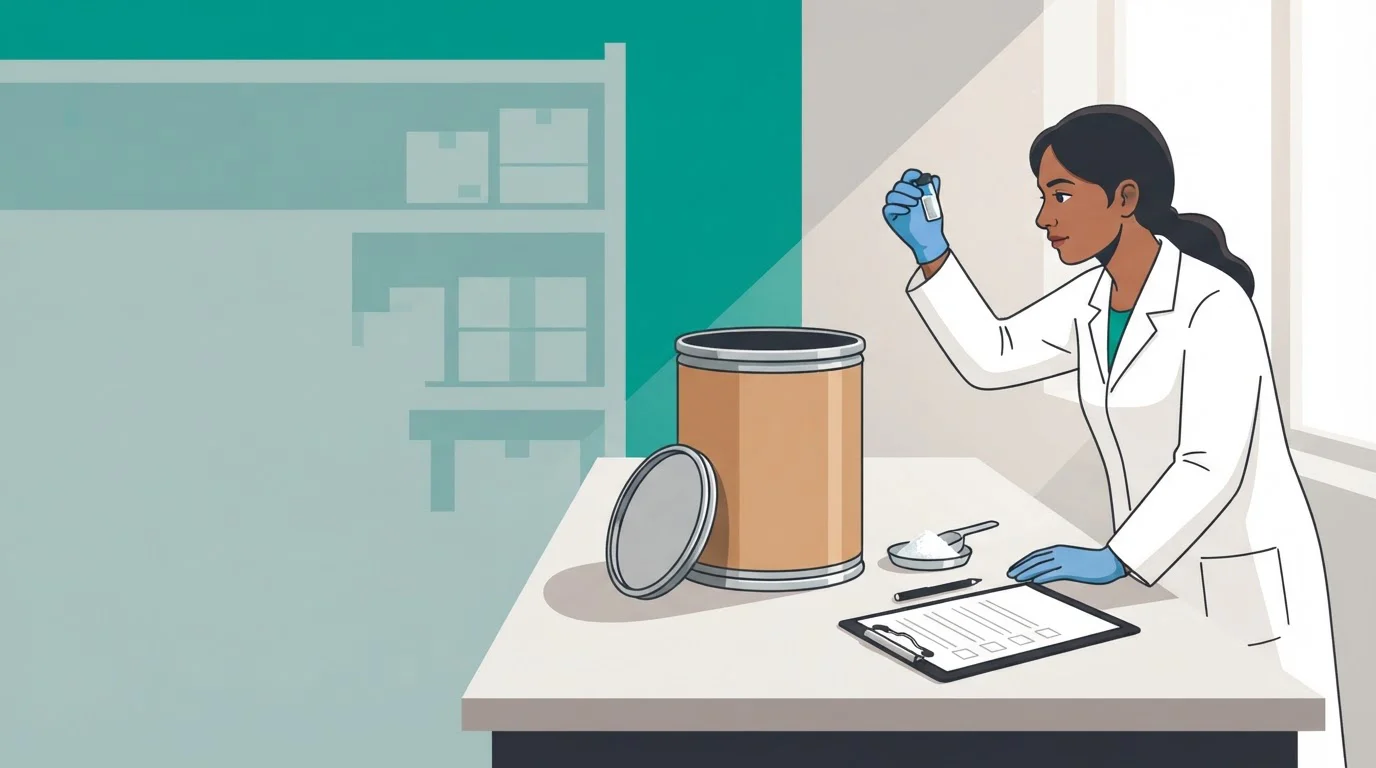
Run eight tests before committing to a lot: name and CAS match, lot traceability, safety data sheet (SDS), assay, certificate of analysis (COA) content, a sample, your own identity test, and written commercial terms. Each has a pass and a fail below. Send the list with your request for quotation (RFQ).
Do the documents describe the same material?
- Name and CAS. Pass: the quote, COA and SDS all say beta-alanine and CAS 107-95-9. Fail: any document shows another name or number, or omits the number.
- Lot number. Pass: the lot number on the COA matches the label on the drum you receive. Fail: the number is missing or different.
- SDS. Pass: it names the same product and CAS number. Fail: it is generic or for a different substance.
Is the assay stated in a way you can check?
Assay is the measured percentage of beta alanine in the powder. Pass: the COA gives the result, the method, the limits and the basis (as received or dried), and the result sits inside the limits in your own specification. Fail: a bare "99%" with no method or basis, or limits wider than your specification.
Does the COA carry everything a reviewer needs?
Pass: the COA names the product and CAS, the lot number, the test date, the method for each result, the limits and the signing manufacturer or lab, and the lot matches the drum label. Fail: any of these is missing.
Has a sample passed in your own lab before you order?
Pass: the assay of an evaluation sample, measured in your lab (or your contract lab), falls inside both the COA limits and the limits in your own specification. Fail: it falls outside either. Stop and ask the supplier why before ordering. Our active pharmaceutical ingredient (API) sample request guide covers what to send and test.
Does the received powder pass your own identity test?
Pass: your lab's identity method on the received powder matches a reference standard (a material of known identity used for comparison). Fail: any mismatch, so reject the lot.
Are the commercial terms written down?
Pass: minimum order quantity (MOQ), lead time, Incoterms (the standard trade terms that say who arranges and pays for shipping and insurance) and payment terms all appear in the quotation or proforma invoice (a preliminary invoice that states the price and terms). Fail: any of them exists only in a chat message.
What should a bulk beta alanine specification include?
A specification for bulk beta alanine should cover identity, assay, loss on drying, heavy metals, microbial limits, and packaging and storage. 21 CFR 111.70 is the rule in the supplement manufacturing regulations that requires component specifications. Write a numeric limit for each parameter into your own specification, and have the COA report against it.
| Parameter | What to write down | Pass |
|---|---|---|
| Identity | The identity method and the reference standard | Your lab's result matches the reference standard |
| Assay | Percentage of beta alanine, method and basis | The result is inside your limits |
| Loss on drying | Maximum weight lost when the powder is dried (a measure of moisture) | The result is within your limit |
| Heavy metals | A limit for each metal you name | Each reported result is within its limit |
| Microbial limits | A limit for each count you name | Each reported count is within its limit |
| Packaging and storage | Container type, net weight and storage condition | The drum label and contents match the order |
What daily dose should the lot arithmetic for beta alanine assume?
Assume 4 to 6 g a day. The International Society of Sports Nutrition (ISSN) position stand of 2015 links 4 to 6 g daily for at least 2 to 4 weeks to improved exercise performance, most clearly in efforts lasting 1 to 4 minutes. It reports tingling as the only side effect and says divided doses of about 1.6 g reduce it (ISSN position stand, 2015).
The evidence is not uniform. The NIH Office of Dietary Supplements (ODS) says sports-medicine experts disagree on the performance value of beta alanine, and that the safety of daily use beyond several months is not known (ODS fact sheet). The National Center for Complementary and Integrative Health (NCCIH) calls the results "mixed but generally don't show that it improves athletic performance significantly" (NCCIH, January 2021).
Our recommendation: write label and marketing language no stronger than this split evidence supports. Decide first whether the powder is headed for a supplement or a drug, using the three-gate screen for dietary supplement versus drug.
How many person-days does 25 kg of beta alanine cover?
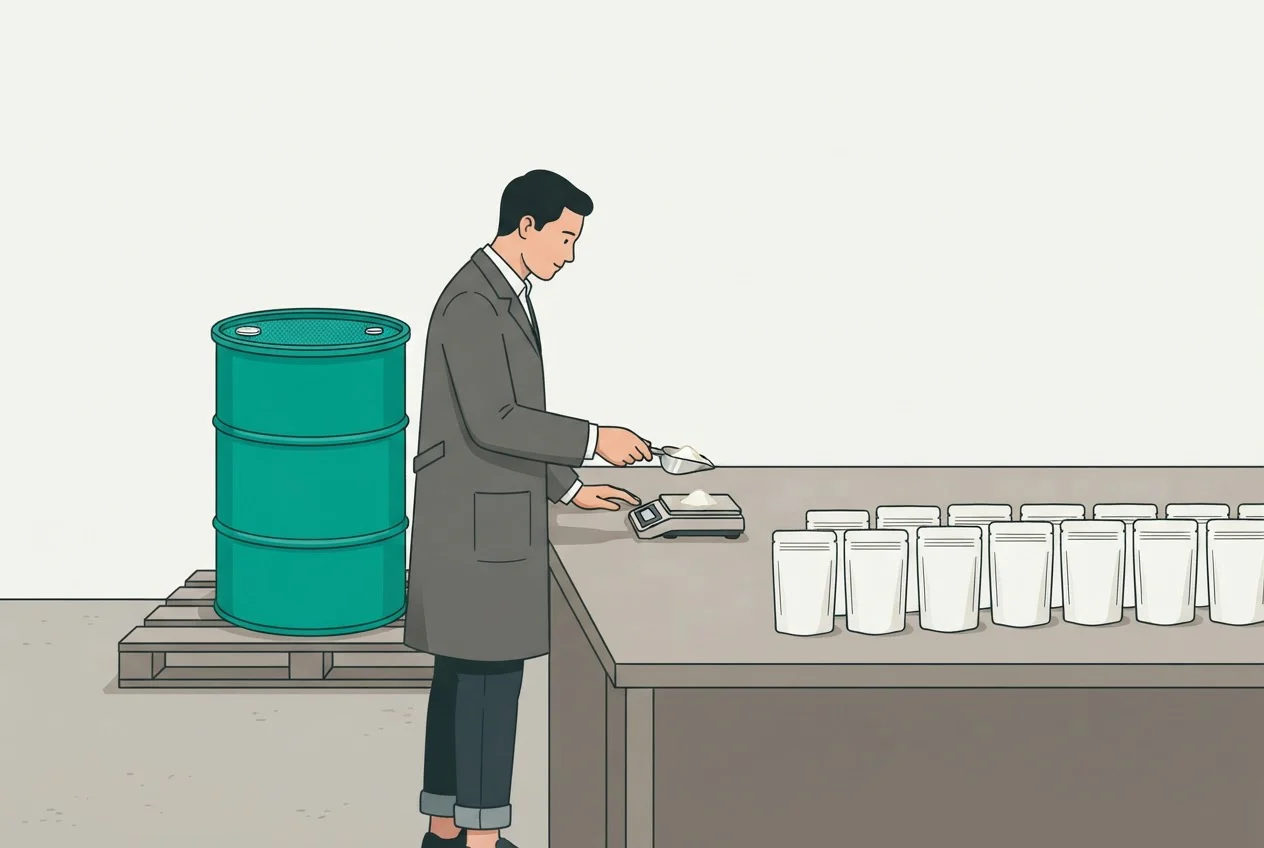
A 25 kg lot covers between 4,167 and 6,250 person-days at the ISSN dose range. A person-day is one person taking the full daily dose for one day. Our model: 25 kg is 25,000 g, divided by the daily dose in grams.
| Daily dose | Person-days in 25 kg |
|---|---|
| 4 g | 6,250 |
| 5 g | 5,000 |
| 6 g | 4,167 (4,166.7 rounded) |
Split into 1.6 g divided doses, the lot gives 15,625 doses (25,000 ÷ 1.6). These figures assume no loss to blending, extra ingredient added to cover losses, or sampling, so real yield is lower. Size your first order from your own batch records.
Does the price per kg matter when you buy bulk beta alanine?
At these doses it matters less than the spec does. Our model: cost per person-day equals price per kg ÷ 1,000 × daily grams. Each $1.00 per kg of price therefore adds $0.004 at 4 g a day and $0.006 at 6 g a day.
| Gap between two quotes | Per person-day at 4 g | Per person-day at 6 g | Across a 25 kg lot |
|---|---|---|---|
| $5 per kg | $0.02 | $0.03 | $125 |
| $10 per kg | $0.04 | $0.06 | $250 |
These are illustrations of the formula, not quoted prices. Our recommendation: compare quotes on cost per person-day only after each one passes the checklist. A $250 saving on a 25 kg lot is small next to the cost of a lot you cannot use.
We quote beta alanine at the current rate once you give us the name and CAS number. Our prices depend on chemical rates and market conditions, so there is no fixed list price to read off.
Why test beta alanine identity yourself instead of relying on the COA?
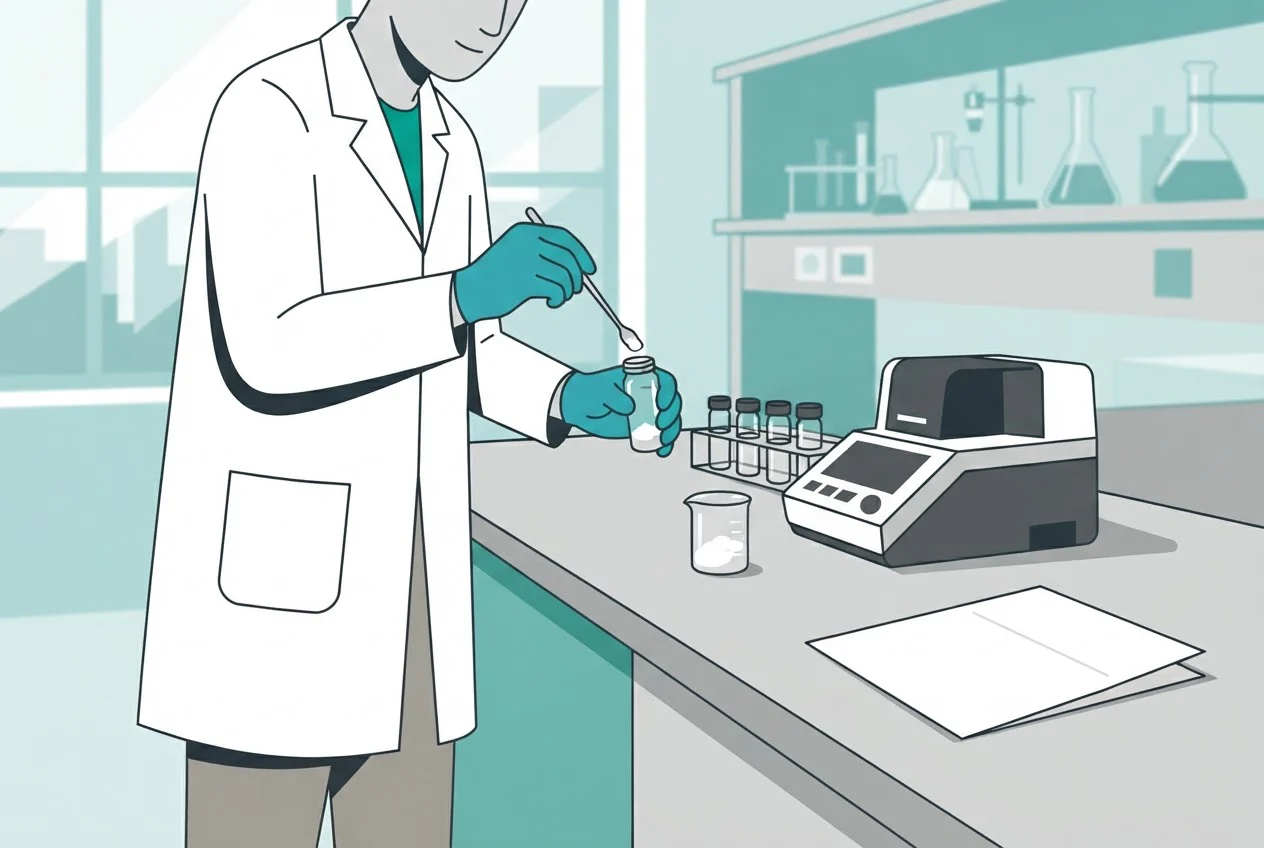
Because the US supplement rule asks for your own test. As of November 2026, 21 CFR 111.75(a)(1)(i) requires a manufacturer to "conduct at least one appropriate test or examination to verify the identity of any component that is a dietary ingredient," unless FDA grants an exemption on petition. A COA is the supplier's statement of its own results, not your test.
There is a practical reason too. NCCIH notes that FDA warns of undeclared substances in bodybuilding products, including anabolic steroids and banned stimulants. The NCCIH warning concerns finished products; our inference is that the same check is worth running on a bulk single ingredient. An identity test on the powder you receive is the check that tells you what is in the drum.
Our recommendation: run the identity test on every lot you receive, not only the first. Part 111 also sets rules on how far you may rely on a supplier's certificate for other specifications. 21 CFR Part 111: what a supplier's COA can and can't prove covers that.
What do we supply for bulk beta alanine, and how do you request it?
We list Beta-Alanine (CAS 107-95-9) among our supplement APIs, on our supplement ingredient list. We supply it to businesses such as generic-drug manufacturers, contract formulators, importers and distributors, not to consumers.
How we work with a beta alanine request:
- Quote. We quote at the current rate once you send the name and CAS number. Our API quote requests ask for the product or CAS number, quantity, destination, grade or purity, the documents you need, payment terms and Incoterms.
- MOQ. MOQ varies by product, source and availability, and is confirmed at quotation.
- Samples. We support evaluation quantities for qualified business buyers, subject to availability and applicable regulatory requirements. Send the API name, quantity, specification or grade, destination country and company details. We confirm sample quantity, price and documents per product, then support commercial and bulk supply after you approve.
- Documents. These may include COA, specifications and SDS where applicable. We also support documentation and supply for US importers.
- Lead time. We confirm it after checking stock, schedule, quality release and documents, and state it in the quotation or proforma invoice.
- Payment. For international commercial orders, payment is generally 100% advance by bank transfer, unless we agree other terms in writing for a specific transaction.
To start, email sunil@aarisepharma.com, message us on WhatsApp at +91 9899783330, or use our contact form with the inquiry type "Product Information". Send the checklist above with your request.
Frequently asked questions
A single dose of 800 mg or more can cause paresthesia, a tingling, prickling or burning feeling. It typically lasts 60 to 90 minutes and is not considered serious. Divided doses or a sustained-release form can reduce or remove it (NIH ODS).
The ISSN position stand judges beta alanine safe for healthy people at recommended doses (ISSN, 2015). NIH ODS says it is not known whether daily use beyond several months is safe (ODS). Treat that long-term gap as open when formulating.
Yes, if you manufacture dietary supplements. As of November 2026, 21 CFR 111.75(a)(1)(i) requires at least one appropriate test or examination to verify the identity of a component that is a dietary ingredient, unless FDA grants an exemption on petition.
The evidence is mixed. The ISSN position stand links 4 to 6 g a day for at least 2 to 4 weeks to improved performance, most clearly in efforts of 1 to 4 minutes (ISSN, 2015). NCCIH says results generally don't show a significant improvement (NCCIH, January 2021).
Sources
- 1.International Society of Sports Nutrition position stand: Beta-Alanine (Trexler et al., 2015)
- 2.NIH Office of Dietary Supplements, Dietary Supplements for Exercise and Athletic Performance, Health Professional Fact Sheet
- 3.NCCIH, Bodybuilding and Performance Enhancement Supplements (January 2021)
- 4.21 CFR 111.70, Electronic Code of Federal Regulations
- 5.21 CFR 111.75, Electronic Code of Federal Regulations
- 6.Aarise Pharmaceuticals supplement ingredient list