API Sample Request: What to Send and Test (Pharma Buyers)
An API sample request works when it names the API, Chemical Abstracts Service (CAS) registry number, quantity, specification, destination and company. The sample then has to pass your own identity test and a comparison against the COA before you rely on it.

By Sunil Kumar, Managing Director - Sales · Updated 6 Nov 2026

Key takeaways
- A complete API sample request names the API, Chemical Abstracts Service (CAS) registry number, quantity, specification, destination and company. It also asks the supplier to state which batch the sample comes from and whether that batch is commercial scale, pilot or development material.
- The COA should show the original manufacturer’s name, address and telephone number. A COA re-lettered with a trader’s details is a reason to stop. When the sample arrives, it must pass your own identity test and match the COA. If it does not, ask the supplier for its raw data before you order more.
- One sample is one batch. Full analyses on at least three batches from different production runs come before you reduce your own testing of a supplier, and a passing sample does not replace testing of the first commercial shipment.
- Anabolic steroid samples can need a Drug Enforcement Administration (DEA) import declaration filed at least 15 calendar days before customs release. Start that paperwork before the sample ships.
In this article
- 1How do you write an API sample request to a pharmaceutical supplier?
- 2Which documents must the supplier send with the material?
- 3What should you test on receipt?
- 4Is one batch enough to approve a supplier?
- 5When does an anabolic steroid API sample need DEA paperwork?
- 6How does Aarise Pharmaceuticals handle sample requests?
- 7What should you decide before you send the request?
- 8Frequently asked questions
Searches for an “API sample request” return two unrelated things. One is an example call to a software interface, with a method, a URL and a JSON body. This guide covers the other: asking a pharmaceutical supplier for a sample of an active pharmaceutical ingredient (API), the component of a medicine that produces its therapeutic effect.
The request itself is short. Its value depends on what you ask for in the message and what you verify when the sample arrives. A certificate of analysis (COA) is the supplier’s test report for a single batch, so one passing sample shows that batch meets specification. It does not make the supplier qualified.
As an API supplier to qualified business buyers, we handle sample requests product by product. This guide gives you a message you can paste, the documents that must come back with the material, a receipt checklist with pass and stop criteria, and the DEA import timeline that US buyers of anabolic steroid APIs need to plan for before a sample ships.
How do you write an API sample request to a pharmaceutical supplier?
Send the API name, required quantity, specification or grade, destination country and company details. Those are what we need to check availability and quote a sample. Add the extra lines below, which prevent most follow-up emails and set up the checks in later sections.
Paste and fill in:
Subject: API sample request: [API name], CAS [number]
Company / role: [manufacturer, formulator, importer or distributor], [country]
API: [name], CAS RN [number]
Specification / grade: [e.g. United States Pharmacopeia (USP), European Pharmacopoeia (EP), Indian Pharmacopoeia (IP), or your in-house specification attached]
Sample quantity: [amount, based on the tests listed below]
Intended use: evaluation and analytical testing, qualification of a new source
Destination country and importer of record: [name]
Documents wanted with the sample: COA for the exact batch, specification, SDS/MSDS
COA must show: original manufacturer name, address and telephone; batch number; release date
Sample provenance: original manufacturer and site, batch number, manufacturing date, and whether the batch is commercial scale, pilot or development material
Batches: sample from one released batch now; second and third batches from different production runs available if the first passes
Test methods: method reference for each COA test (pharmacopoeial or in-house) and reference standard details, where the supplier can share them
Controlled-substance status in destination: [yes / no / to be confirmed]
Next step if the sample passes: commercial quotation for [quantity per year]
Three notes on the fields:
- CAS number. The CAS Registry Number identifies the exact substance, so we are not guessing between salts or esters. If you are new to the term, what an API is in pharma explains the label.
- Importer of record. This is the party named as responsible for the import at customs.
- Quantity. Work backward from your test list: identity, assay, impurities, plus a retained portion. The International Council for Harmonisation (ICH) Q7 guideline on good manufacturing practice for APIs bases sample size on the criticality and variability of the material, the supplier's history and the quantity needed for analysis (section 7.33). We confirm the available sample quantity for each product.
Which documents must the supplier send with the material?
The sample must arrive with a batch-specific COA that is signed, dated and shows the original manufacturer's name, address and telephone number. The ICH Q7 guideline requires this in section 11.43. Treat any COA missing the original manufacturer as unfinished. A repackager's COA is acceptable only if it also names the original manufacturer (Q7 11.43).
Q7 also says the COA should list each test performed, the acceptance limits and the numerical results (11.42). Signature by the quality unit is required (11.43). A COA that only says "conforms" gives you nothing to compare your own results against.
The manufacturer line matters because COAs can be re-lettered. In an April 2017 warning letter to the API distributor Sal Pharma, the US Food and Drug Administration (FDA) wrote that the firm had omitted "the names and addresses of the original manufacturers of your API" and that it had generated its COAs "by replacing the original manufacturers' information with your letterhead". Two of its suppliers were not registered with FDA as drug manufacturers (FDA warning letter, April 20, 2017). FDA's concern was supply-chain accountability: if you cannot see who made the material, you cannot audit it.
Aarise Pharmaceuticals is a supplier and sourcing partner. Before a sample ships, ask us to confirm in writing which manufacturer made the batch and that the COA names that manufacturer. Ask for the COA, the specification and the SDS/MSDS (safety data sheet) with each sample. We share these where applicable.
What should you test on receipt?
Run your own identity test and compare your results with the COA before using the material. FDA's CGMP (current good manufacturing practice) guidance on components says a supplier's report of analysis can be accepted only if you conduct at least one specific identity test yourself. You must also validate the supplier's analyses at appropriate intervals (FDA Q&A on control of components, June 2015). ICH Q7 section 7.30 asks for the same: at least one identity test on each batch.
According to FDA's FY2025 Report on the State of Pharmaceutical Quality, only 22% of the 1,309 drug quality assurance inspections it counted ended with no action indicated; 60% ended with voluntary action indicated and 18% with official action indicated. Those outcomes describe a site's systems, not the material in your vial, so a clean supplier record does not replace your own identity test.
Use this receipt checklist. Each row is a test you can run, with a pass and a stop condition:
| Check | Pass | Stop |
|---|---|---|
| Label vs COA | Material name and batch number on the container match the COA exactly | Any mismatch in name or batch number |
| Original manufacturer on COA | Name, address and telephone of the original manufacturer shown (Q7 11.43) | Manufacturer missing, or the sender's letterhead replaces it |
| COA completeness | Signed and dated; each test listed with limits and numerical results (Q7 11.41 to 11.43) | "Conforms" only, no numbers, no signature |
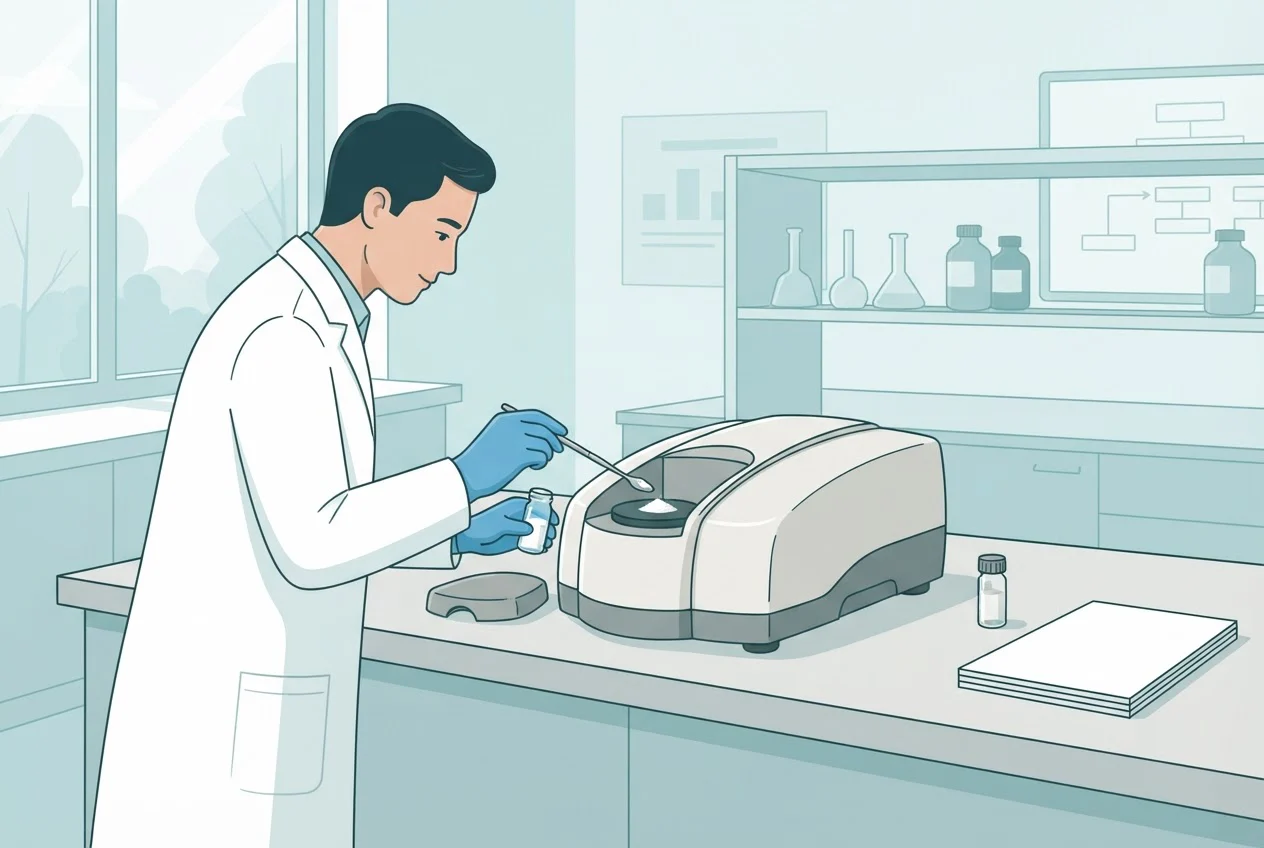
| Identity test in your lab | Result matches your reference standard using the pharmacopoeial identity method for that API (infrared spectroscopy is the usual choice for many APIs; check the monograph) | Any mismatch |
| Assay and key impurities | Your results meet your specification and are consistent with the COA values | Outside your specification, or clearly different from the COA |
| Import status | You can show the import authorization the destination requires | No documented authorization (see the DEA section below) |
For the methods behind these tests, our pharmaceutical API quality testing guide covers high-performance liquid chromatography (HPLC), infrared (IR) spectroscopy and mass spectrometry.
Is one batch enough to approve a supplier?
No. One sample is one batch, and ICH Q7 section 7.31 asks for full analyses on at least three batches before you reduce in-house testing of a supplier's material. Even afterward, a full analysis should be repeated at appropriate intervals and compared with the COA, and COA reliability should be checked regularly.
Two limits apply to that rule. ICH Q7 is written for API manufacturers, and the FDA component rule behind the identity test applies to finished-dose manufacturers, so an importer or distributor should follow the testing its customer's quality agreement requires. Also, FDA's component Q&A says samples for incoming-material testing should be taken from containers after receipt, and that pre-shipment samples are generally not acceptable. Treat a passing evaluation sample as evidence for the supplier decision, then run your own identity test on the first commercial shipment as well.
Our recommendation is to treat the sample as the first of three data points. Specify in the request that you will ask for a second and third batch if the first passes. If you are building a wider qualification file, ICH Q7 explained for buyers covers what else to check on a supplier.
When does an anabolic steroid API sample need DEA paperwork?
An anabolic steroid sample can need the same US import authorization as a commercial lot. As of November 2026, Title 21 of the Code of Federal Regulations (CFR), section 1312.18 requires the declaration (DEA Form 236) to be filed through DEA's secure network application not later than 15 calendar days before the anticipated customs release. The declaration is not valid until DEA issues a transaction identification number (21 CFR 1312.18, 2025 edition).
Anabolic steroids are Schedule III substances, a US controlled-substance category (21 CFR 1308.13). Corticosteroids and other non-scheduled steroids are not covered; check the schedule for your molecule.
DEA's notice implementing the Anabolic Steroid Control Act of 2004 states that importing Schedule III steroids is illegal unless the importer is registered with DEA as an importer or researcher and files the declaration for each shipment (Federal Register, December 16, 2005). Our recommendation is to plan a sample the same way as a commercial lot.
Our worked timeline, from that 15-day rule: if DEA issues the transaction identification number on March 1, customs release can be no earlier than March 16. A sample cannot ship on request day. The DEA Form 236 explainer shows what the form needs.
For peptides, regulatory status differs by peptide and destination market. Name the peptide and the destination in your request so we can review it properly.
How does Aarise Pharmaceuticals handle sample requests?
We support sample and evaluation quantities for qualified business buyers, subject to the specific API, availability and applicable regulatory requirements. Sample quantity, price and documentation are confirmed product by product.
For a new buyer, the sample sequence runs in this order:
- You send the filled-in message above, including the API name, CAS number, specification and destination.
- We confirm availability and, for the batch we propose, the original manufacturer, batch number and whether it is commercial-scale, pilot or development material.
- We share the batch COA, specification and SDS/MSDS where applicable, with a quotation for the sample and for your annual quantity.
- For anabolic steroid samples into the US, your DEA import declaration is filed before shipment (see the DEA section above).
- After the first batch passes, you can request a second and third batch from different production runs, and we quote commercial supply.
Courier cost, import duties and taxes are confirmed in the quotation.
Our range covers steroid and hormone APIs, general pharmaceutical APIs and peptide APIs. See our steroid APIs and peptide APIs pages for the catalog, and use our steroid API RFQ checklist when you move to a commercial quote. Peptides are supplied as bulk API raw powder, not finished lyophilized vials. We also provide documentation and supply support for US importers. Our API supply is positioned for export and institutional use, not consumer sale.
Send the filled-in message above through our contact form, by WhatsApp at +91 9899783330, or by email to sunil@aarisepharma.com. We respond to business enquiries during Indian business hours.
What should you decide before you send the request?
Decide before you send the request what would make you stop. If the COA names the original manufacturer, your identity test matches the reference standard and your assay sits within the tolerance you set against the COA, ask for a second and third batch. If any one of those fails, ask the supplier for its underlying data before you order more.
The common trap is treating a passing sample as approval of every lot that follows, so test the first commercial shipment as well. For anabolic steroids, confirm your importer's DEA registration first, because customs release cannot come sooner than 15 calendar days after DEA issues the transaction identification number.
Today, fill in the message above and write your pass and stop criteria beside it. Then request a sample through our contact page and we will confirm availability and documents product by product.
Frequently asked questions
Sources
- 1.FDA, Questions and Answers on Current Good Manufacturing Practice Requirements: Control of Components and Drug Product Containers and Closures (June 2015)
- 2.ICH, Q7 Good Manufacturing Practice Guide for Active Pharmaceutical Ingredients, sections 7.30 to 7.33 and 11.40 to 11.43
- 3.FDA, Warning Letter to Sal Pharma, April 20, 2017
- 4.DEA, 21 CFR 1312.18, Import declaration (2025 edition, govinfo)
- 5.DEA, 21 CFR 1308.13, Schedule III (eCFR)
- 6.DEA, Implementation of the Anabolic Steroid Control Act of 2004, Federal Register, December 16, 2005
- 7.FDA, Report on the State of Pharmaceutical Quality FY2025 (June 2026)