
Glossary
DEA Form 236
DEA Form 236 is the declaration a DEA-registered importer or exporter files for non-narcotic controlled substances at least 15 calendar days before customs release.

By Sunil Kumar, Managing Director - Sales · Updated 24 Oct 2026
Also called Controlled Substances Import/Export Declaration
On this page
What is DEA Form 236?
DEA Form 236 is the Controlled Substances Import/Export Declaration filed with the US Drug Enforcement Administration (DEA) for non-narcotic controlled substances.
Key takeaways
- Form 236 is a declaration, not a permit. For Schedule III non-narcotic imports, DEA still has to issue a transaction identification number before you proceed.
- File at least 15 calendar days before customs release. The return report is due within 30 days of receipt.
- The supplier's data decides whether the declaration is accepted: drug name, DEA code, packaging, net base weight, ports and dates.
- Enter the net quantity as base weight in grams, because DEA's online application takes grams base, and convert to kilograms only where a document asks for it.
Quick facts
- Issued by
- DEA Diversion Control Division
- Legal basis
- 21 U.S.C. 952 and 953; 21 CFR 1312.18 (imports) and 1312.27 (exports)
- Filing deadline
- At least 15 calendar days before customs release
- Return report
- Within 30 days of actual receipt
- Where it is filed
- DEA's secure network application, with data then submitted to CBP through ACE
Importers file Form 236 through DEA's secure network application, under 21 CFR 1312.18. The importer or its agent then submits the declaration's data to U.S. Customs and Border Protection (CBP) through the Automated Commercial Environment (ACE), CBP's electronic filing system.
The form belongs to the importer, but most of its fields describe the shipment, and only the supplier knows those details. DEA holds declarations when the product description, base weight or dates are wrong. Without a transaction identification number the declaration is not valid and the importer may not proceed, so a wrong base weight that causes a hold delays the whole shipment.
Base weight, the weight of the active drug alone excluding any salt, has to agree between the supplier's invoice and the declaration. A date less than 15 days out is itself a hold reason. Schedules III to V are DEA's tiers of controlled substances, and the consignor is the foreign shipper named on the form.
What is DEA Form 236, and when is it used instead of a permit?
DEA Form 236 is the Controlled Substances Import/Export Declaration. As of October 2026, it covers imports of non-narcotic Schedule III, IV and V substances, and exports of non-narcotic Schedule III and IV and all Schedule V substances. The authority is 21 U.S.C. 952 and 953.
DEA's quick reference guide sorts the forms this way:
- Form 236 for Schedule III non-narcotics (delta-9-THC excepted), Schedule IV and V non-narcotics, and Schedule V narcotics on export only.
- Form 357, the import permit, for Schedules I and II and for narcotics in Schedules III to V.
- Form 161, the export permit, for Schedules I and II and Schedule III narcotics.
Which schedule a given steroid falls into is covered in Is Testosterone a Controlled Substance? Schedule III Rules.
What are the Form 236 deadlines?
An import declaration must be filed not later than 15 calendar days before customs release. It is not valid until DEA issues a transaction identification number, and the importer may proceed only after that. The return report is due within 30 days of actual receipt, or within 10 days of a DEA written request, whichever is sooner. Amendments are due at least one full business day before release.
Form 236 timeline from filing to return report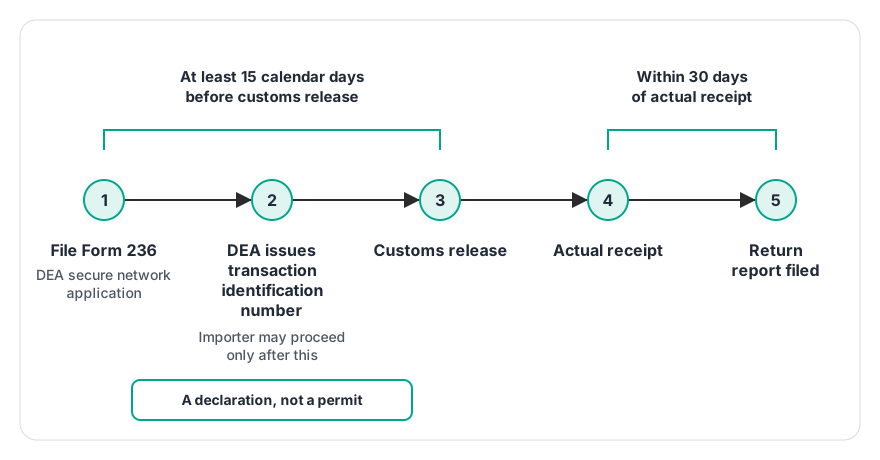
Submit the return information online, or email the completed application to CSIMEX@dea.gov with box 6c completed, and do not change the ports, NDC number or quantity (DEA Supply Chain Conference 2025).
DEA's 2025 conference materials say that once DEA approves a declaration, any remaining days of the 15 are waived.
What supplier data does a Form 236 need?
Form 236 needs product identity, packaging, net base weight, ports and dates, and the consignor's details, and a supplier's paperwork has to support each one. 21 CFR 1312.18(c) lists the contents. The checklist below turns each into a pass or fail test.
For salts, use DEA's conversion-factor page (quantity of salt times conversion factor equals quantity of base). If an ester is not listed there, ask DEA236@dea.gov before you file.
DEA's instructions give a worked case: 50 bottles of 100 tablets at 15 mg is 75,000 mg, or 75 g. CBP's own message-set example is an anabolic steroid import under drug code 4000 with a base weight of 114,400 g, which is 114.4 kg.
- Field
- Product
- Ask the supplier for
- Drug name, DEA drug code, National Drug Code (NDC)
- Pass
- Identical on invoice, packing list and your draft
- Fail
- Any mismatch
- Field
- Packaging
- Ask the supplier for
- Number and size of containers
- Pass
- Containers multiplied by size equal the stated total
- Fail
- Totals do not reconcile
- Field
- Net quantity
- Ask the supplier for
- Weight as base, not salt. Ask the supplier for grams (DEA's online application takes grams base, per the 2025 DEA supply chain conference) and convert to kilograms only where a document asks for kilograms
- Pass
- Invoice grams match the declaration grams exactly, and salt weight times the conversion factor equals the base weight shown
- Fail
- Salt weight entered as base, or a unit mismatch
- Field
- Ports and dates
- Ask the supplier for
- Departure and arrival ports and dates
- Pass
- Dates fall at least 15 days after you submit
- Fail
- Sooner than 15 days
- Field
- Consignor
- Ask the supplier for
- Legal name and address
- Pass
- Matches the foreign paperwork
- Fail
- Differs
- Field
- Delivery
- Ask the supplier for
- Final destination address
- Pass
- It is your registered location
- Fail
- Any other address
Why does DEA put declarations on hold?
DEA holds or sends back a Form 236 declaration when the National Drug Code does not show base or salt correctly, packaging detail is too thin, the requested amount exceeds the foreign document, the date is under 15 days out, or a required signed translation is missing. DEA's 2025 import and export training treats these as hold reasons for permits and declarations alike. It adds that incorrect foreign permit information cannot be amended and needs a new application, and that a required signed translation of a foreign permit or licence must be provided.
The supplier's documents are where most of these fields originate, so the product, packaging and weight lines are best collected from the supplier before the form is opened.
How Aarise Pharmaceuticals handles it
The importer files Form 236, and we supply the shipment data it needs. Our steroid and hormone portfolio of active pharmaceutical ingredients (APIs) includes testosterone, nandrolone, drostanolone and trenbolone derivatives, methenolone enanthate, boldenone undecylenate, stanozolol and oxandrolone. Several of these steroids can be Schedule III controlled substances in the US; see Is Testosterone a Controlled Substance?. The checklist above is also what we expect to be asked for.
We supply them as bulk raw material to business buyers, with documentation and supply support for US importers. Available documents may include a certificate of analysis (COA), specifications and safety data sheets where applicable.
Before supply, buyers confirm their own registration, import authorization and permitted end use. A request for quotation (RFQ) asks for the product or CAS number (Chemical Abstracts Service registry number), quantity, destination, grade, documents, payment terms and Incoterms (International Commercial Terms, the delivery and cost-responsibility codes). Add the checklist lines above to it. Our steroid API RFQ checklist and supplier qualification guide cover the rest of the sourcing check.
Send your request to sunil@aarisepharma.com, on WhatsApp at +91 9899783330, or through our contact form.
Example
For a release on 16 November, the import declaration must be filed by 1 November (16 minus 15 days). If the goods arrive at the registered location on 20 November, the return report is due by 20 December (20 November plus 30 days).
Frequently asked
Not by mail. 21 CFR 1312.18 requires the importer to file through DEA's secure network application, and the importer or its agent then submits the declaration's data to CBP through ACE. Contact DEA236@dea.gov or 1-800-882-9539 with questions about a declaration. Return information goes to CSIMEX@dea.gov.
Sources
- 1.DEA Form 236, Diversion Control Division
- 2.DEA quick reference: Forms 357, 161 and 236
- 3.21 CFR 1312.18, import declaration (4-1-25 edition)
- 4.21 CFR 1312.27, export declaration
- 5.DEA instructions for completing Form 236
- 6.DEA conversion factors for controlled substances
- 7.DEA 2025 import/export training
- 8.DEA 2025 supply chain conference: imports and exports of controlled substances
- 9.CBP implementation guide for DEA, v2.7, April 2026