
Glossary
Exhibit Batch
An exhibit batch is the batch made to support a generic drug application.

By Sunil Kumar, Managing Director - Sales · Updated 23 Oct 2026
On this page
- 01Definition
- 02Quick facts
- 03How big must an exhibit batch be?
- 04How many exhibit batches does an ANDA need?
- 05How much API does an exhibit batch consume?
- 06Exhibit batch vs pilot and validation batch
- 07What to lock before making the exhibit batch
- 08How Aarise Pharmaceuticals handles it
- 09Example
- 10Related terms
- 11Frequently asked
What is an exhibit batch?
An exhibit batch is the drug product batch made, tested and documented to support an ANDA, the abbreviated new drug application filed with FDA for a generic drug.
Key takeaways
- For tablets and capsules, FDA recommends two of three stability batches at pilot scale (at least 10% of the commercial batch or 100,000 units, whichever is greater); the third can be as small as 25% of that size.
- The commercial master batch record you submit cannot be for runs larger than 10 times the exhibit batch.
- An exhibit batch at 10% scale does not replace process validation. FDA expects commercial-scale batches for that.
- Fix the API source, lot and quantity before you make the batch. A second API source later means extra data.
Quick facts
- Term status
- Industry shorthand; FDA does not define it
- Where it appears
- ANDA sections 3.2.P.3.3 and 3.2.P.3.4
- Tablet and capsule size
- At least 10% of the commercial batch or 100,000 units, whichever is greater
- Commercial batch ceiling
- No more than 10 times the exhibit batch
- Stability data
- At least 6 months (180 days) of accelerated and long-term data on each batch
The term gets used for three different things: the first scale-up batch, a process validation batch, and the batch that goes into the filing. Only the last is an exhibit batch. The mix-up costs money, because the batch is sized, sourced and documented before anyone knows whether the filing will hold.
"Exhibit batch" is industry shorthand, not a term FDA defines. In FDA's ANDA content and format guidance (https://www.fda.gov/media/125312/download), it appears in section 3.2.P.3.4, where the applicant must show what was actually made. It also appears in section 3.2.P.3.3, where the commercial batch record is tied to the exhibit batch by a ceiling of 10 times.
That ceiling and a 100,000-unit floor set the batch size. They also set how much active pharmaceutical ingredient (API) you must buy, from which source, and with which certificate of analysis (COA). Those decisions come first, and this page works through them.
How big must an exhibit batch be?
For tablets and capsules, FDA's stability Q&A (May 2014) says two of the three batches should be "at least 10 percent of the proposed production batch or 100,000 finished dosage units, whichever is greater". It recommends a minimum of 100,000 units in all proposed presentations. FDA does not define "exhibit batch"; this stability batch size is read across to the exhibit batch.
Other forms differ. Powders, solutions and suspensions use 10% of the maximum commercial batch. Parenterals use at least 10% of the maximum commercial batch, 50 L (fill volume above 2.0 mL) or 30 L (fill volume up to 2.0 mL), whichever is larger. Transdermal patches use 10% or 25,000 units per strength, whichever is greater. Creams, lotions and gels use 100 kg or 10% of the production batch, whichever is larger.
How many exhibit batches does an ANDA need?
As of October 2026, FDA recommends three stability batches: three pilot-scale, or two pilot-scale plus one small-scale (stability Q&A, May 2014; ANDA content and format, September 2018). These are read as the exhibit batches. The guidance asks for at least 6 months (180 days) of accelerated and long-term data on each. For tablets and capsules, the third batch can be smaller than 10% but not under 25% of the pilot-scale batch.
Three stability batches that serve as exhibit batches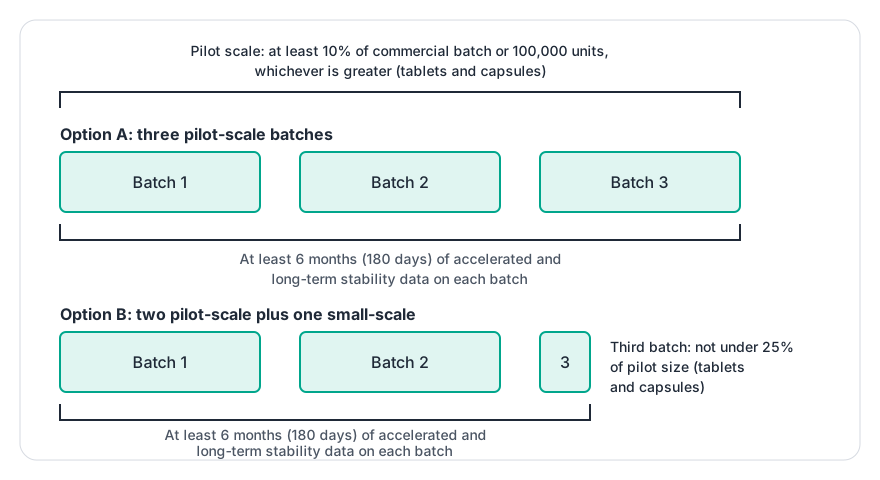
The same guidance requires commercial master batch records "no more than 10 times the exhibit batch(es)", plus a table comparing equipment, process parameters and in-process controls between exhibit and commercial batches.
How much API does an exhibit batch consume?
API needed follows a simple model: units × strength in mg ÷ 1,000,000 = kg at 100% of label claim. Assay correction, overage and analytical material come on top, so treat these as minimums.
The table is arithmetic on the FDA figures above. The 100,000-unit floor keeps small commercial batches from shrinking the exhibit batch.
- Commercial batch (tablets)
- 500,000
- Minimum exhibit batch: greater of 10% or 100,000
- 100,000
- Minimum set (2 × exhibit + 25%)
- 225,000
- Largest commercial batch it supports (10×)
- 1,000,000
- Commercial batch (tablets)
- 2,000,000
- Minimum exhibit batch: greater of 10% or 100,000
- 200,000
- Minimum set (2 × exhibit + 25%)
- 450,000
- Largest commercial batch it supports (10×)
- 2,000,000
- Commercial batch (tablets)
- 5,000,000
- Minimum exhibit batch: greater of 10% or 100,000
- 500,000
- Minimum set (2 × exhibit + 25%)
- 1,125,000
- Largest commercial batch it supports (10×)
- 5,000,000
Exhibit batch vs pilot and validation batch
FDA's process validation guidance (January 2011) says a manufacturer must complete process performance qualification (PPQ, the commercial-scale validation runs) before commercial distribution. Distribution should rest on commercial-scale batch data, with pilot data as added assurance.
Route any batch-size change through change control (the documented approval process for changing a batch size or process). For handover steps, see pharmaceutical technology transfer.
- Aspect
- Purpose
- Exhibit batch
- Supports the filing
- Pilot batch
- Builds process knowledge
- Validation batch
- Proves the process at commercial scale
- Aspect
- Basis for commercial distribution
- Exhibit batch
- At 10% scale, cannot replace validation; at full commercial size it may serve both purposes
- Pilot batch
- Added assurance only
- Validation batch
- Commercial-scale PPQ completed before distribution
What to lock before making the exhibit batch
Lock the API source, the lot, the quantity and the equipment comparison before the batch is made, because the filing records them. FDA's ANDA guidance asks for batch analysis, including COAs from the drug substance manufacturer, for the lots used to make the exhibit batch.
A second source needs a physico-chemical and impurity comparison and stability data on three batches of the first source. It also needs a pilot-scale batch of the second source with comparative dissolution data (FDA stability Q&A, May 2014). Confirm with your regulatory team that the API source can be referenced in your ANDA before committing the exhibit batch.
- Check
- API manufacturer and site
- Pass
- Named in writing and used in the batch formula
- Fail
- "To be confirmed"
- Check
- Lot COA
- Pass
- The COA lot number matches the batch record
- Fail
- No COA, or a different lot
- Check
- Quantity
- Pass
- API on hand ≥ set units × strength (mg) ÷ 1,000,000 ÷ assay (as a fraction), plus overage and testing margin
- Fail
- API for one batch only
- Check
- Second API source
- Pass
- Decided before filing
- Fail
- Added after the exhibit batches
- Check
- Equipment comparison
- Pass
- Commercial equipment train named
- Fail
- Commercial equipment unknown
How Aarise Pharmaceuticals handles it
Aarise Pharmaceuticals supplies evaluation quantities of API to qualified business buyers, subject to the product, availability and applicable regulatory requirements. Quantity, pricing and documentation are confirmed product by product. Documentation may include a COA, specifications and a safety data sheet (SDS/MSDS) where applicable. After successful evaluation and approval, it can support commercial and bulk requirements.
For a quote it asks for the product name or CAS number (Chemical Abstracts Service registry number), quantity, destination, grade or purity, documents, payment terms and Incoterms (shipping terms). The steroid API RFQ checklist shows how to write that request. Supplier choice for pilot-scale API is covered in who can run your steroid API pilot batch. Its steroid raw material catalog lists the categories it supplies. Aarise also provides oral-dose contract development and manufacturing, from product development through commercial manufacturing.
Example
For a 500,000-tablet commercial batch of 10 mg tablets, the exhibit set is 100,000 + 100,000 + 25,000 tablets, which needs 225,000 × 10 mg = 2.25 kg of API at 100% of label claim. The same set at 500 mg needs 112.5 kg. Assay correction, overage and analytical material come on top.