GHK-Cu Peptide: Cream vs. Injection, FDA Status and Buying Checks
GHK-Cu peptide is a copper-binding tripeptide with lab data but thin human evidence. Creams and compounded injections differ, and the U.S. Food and Drug Administration has not approved GHK-Cu as a drug.

By Sunil Kumar, Managing Director - Sales · Updated 10 Oct 2026
Key takeaways
- GHK-Cu has consistent cell and animal results, but controlled human evidence is small, and no published human data show that injecting it is safe and effective.
- A cream and an injection are different products. As of FDA's April 22, 2026 update, injectable GHK-Cu sits among withdrawn bulk-substance nominations and FDA cites immune-reaction and impurity risk. A withdrawn nomination is not an approval.
- The name "GHK-Cu" does not fix the chemistry. The copper-free peptide (Chemical Abstracts Service, or CAS, number 49557-75-7), the 1:1 copper complex (89030-95-5), an acetate salt and a 2:1 form carry copper from 0% to 15.8% by weight.
- Before ordering GHK-Cu raw material, run a ten-point check on the quotation and certificate of analysis (COA, the batch test report): copper form, identity by mass, purity and peptide content as separate numbers, copper assay, water and salt form, impurities, endotoxin, batch match, good manufacturing practice (GMP) document and intended use. Any fail means hold the order.
In this article
- 1What is GHK-Cu peptide, and does the evidence support the claims?
- 2Is injectable GHK-Cu legal, and what has FDA actually said?
- 3How is a GHK-Cu cream different from an injection?
- 4Why does "GHK-Cu" mean different compounds on different supplier listings?
- 5What does GHK-Cu powder cost as of October 2026?
- 6How can a buyer check a GHK-Cu raw material before ordering?
- 7How does Aarise Pharmaceuticals supply GHK-Cu peptide API?
- 8Frequently asked questions
GHK-Cu is a short peptide that carries a copper ion (a metal atom held by the peptide), and that copper explains both the lab results and the safety questions. Copper peptide creams have been on the market for decades. More recently, online sellers have offered GHK-Cu as an injectable "research peptide", which is the version many searchers are really asking about.
The human evidence has not kept pace with the demand. Most claims, from firmer skin to faster healing, rest on cell and animal work. A 2026 review in Pharmaceutics found that the only hair study in the clinical record, a split-face eyebrow trial (treated and untreated sides compared), enrolled just 18 participants and did not define which form of GHK-Cu was used.
This page separates the cream from the injection, sets out what the U.S. Food and Drug Administration (FDA) has published about injectable GHK-Cu, and gives bulk buyers a check for the raw material, because a listing that says "GHK-Cu" can describe different compounds, and that difference decides what arrives.
What is GHK-Cu peptide, and does the evidence support the claims?
GHK-Cu peptide is the copper(II) complex of glycyl-L-histidyl-L-lysine (GHK), a tripeptide, meaning a chain of three amino acids. Cell and animal studies consistently show effects on tissue remodeling, repair, inflammation and angiogenesis (new blood-vessel growth). Controlled human data are few and small.
The 2026 Pharmaceutics review is a systematic evidence map of the literature through August 12, 2026. It notes that plasma GHK is appreciable in early adulthood and declines markedly with age, which is why the molecule attracts interest. Its clinical record is short:
- a small 1998 comparative topical study;
- a 2002 conference-level cosmetic report;
- a randomized post-CO2-laser study (skin resurfaced with a carbon dioxide laser) in which 13 participants completed follow-up and no objective advantage was shown;
- a 2026 randomized split-face eyebrow study of 18 healthy participants using a nominal 2% GHK-Cu serum, which reported better hair count and diameter.
None of these studies reports how the copper was bound or how much intact complex reached the tissue. The review concludes that GHK-Cu is "a promising but unproven therapeutic cargo rather than a clinically validated regenerative drug."
For skin, a 2025 review of GHK as an anti-wrinkle ingredient found a surprising absence of clinical studies using GHK-Cu or its palmitoylated form (GHK with a fatty-acid chain attached), although cell studies support it. As of October 10, 2026, ClinicalTrials.gov lists NCT07437586 as recruiting (status last verified February 2026): a randomized, vehicle-controlled phase 2 trial of a topical GHK-Cu gel, planning 60 healthy adults aged 18 to 55 with two punch-biopsy wounds each. No results are posted.
Our recommendation: treat a cream as a modest cosmetic bet, patch-test it, and do not treat any GHK-Cu product as a hair-loss or wound-healing treatment.
Is injectable GHK-Cu legal, and what has FDA actually said?
Not through any route FDA has listed. As of FDA's April 22, 2026 update, injectable GHK-Cu sits in FDA's table of withdrawn bulk-substance nominations, which is neither an approval nor a safety clearance. Vials sold online as "research use only" are not a defensible source.
Compounding means a pharmacy or outsourcing facility prepares a custom drug from bulk ingredients. Under section 503A of the Federal Food, Drug, and Cosmetic Act, a pharmacy may compound only with bulk substances that meet an applicable pharmacopeial monograph, are components of FDA-approved drugs, or appear on FDA's 503A bulks list. They must also come with a valid certificate of analysis from an FDA-registered establishment. GHK-Cu is not an approved drug, and FDA's advisory committee page lists it among substances "being considered for inclusion on the 503A bulks list", with a committee meeting planned before the end of February 2027 (page current as of April 15, 2026). NPR reported in September 2026 that compounding pharmacies are not technically allowed to offer it for injection, and that the administration has signaled this could change. Check FDA's pages for the current position before acting.
Injectable GHK-Cu entered category 2 of FDA's interim policy, the list of bulk substances that may present significant safety risks, and the nominators later withdrew it. FDA's entry reads: "Compounded injectable drugs containing GHK-Cu may pose risk for immunogenicity due to the potential for aggregation and peptide-related impurities. There are limited data in humans to inform safety-related considerations." Immunogenicity is the body mounting an immune response to the drug itself. Aggregation is peptide molecules clumping together, which is more likely in a poorly made or poorly stored product.
How is a GHK-Cu cream different from an injection?
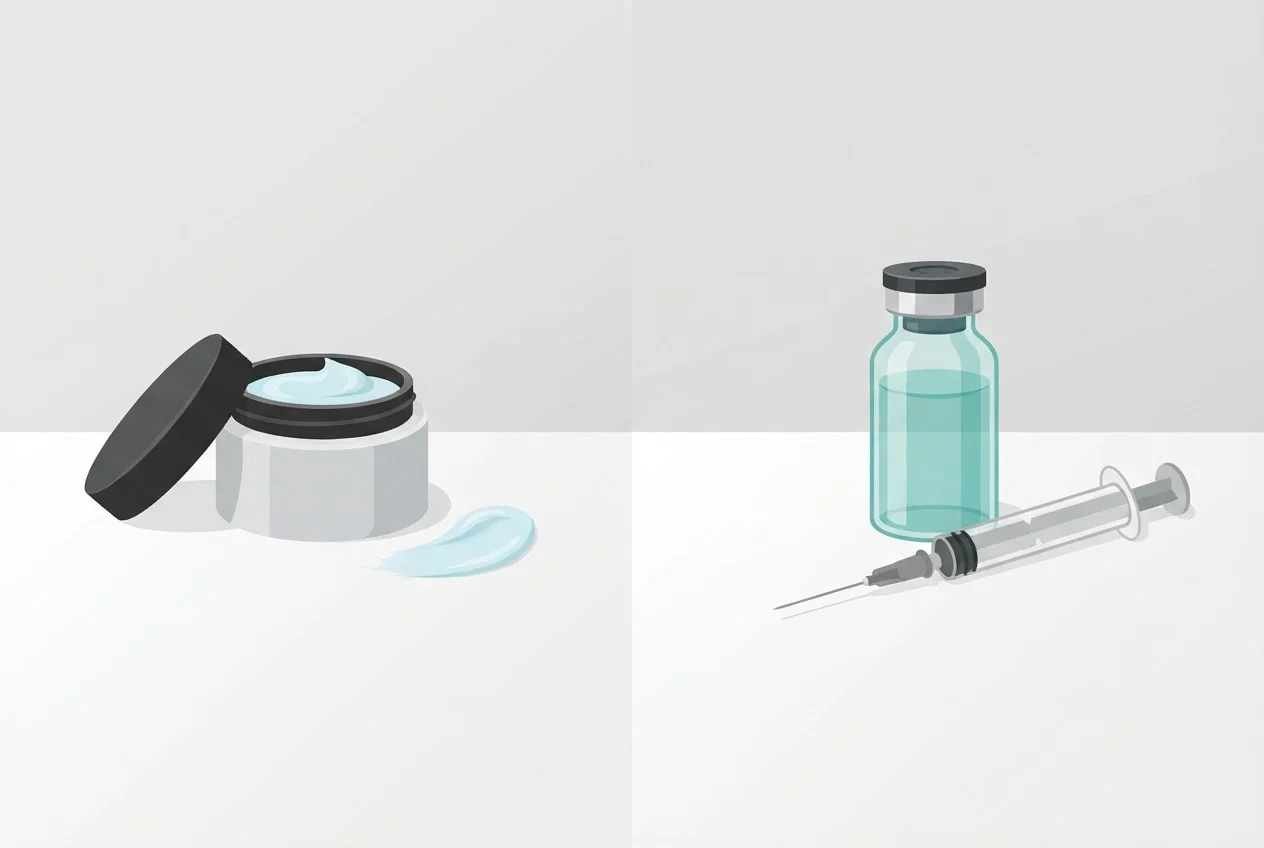
A cream is a cosmetic applied to skin, while an injection places a drug-type product under it, and the risks differ accordingly. Copper peptide serums have been sold for decades, but published human studies are few. No published human data show injected GHK-Cu is safe and effective.
| What you hold | What it is | What the evidence and rules say | What to do |
|---|---|---|---|
| Face serum or cream | Cosmetic, finished product | Few, small human studies; reviews call the clinical base thin | Use as a cosmetic; patch-test first |
| Compounded injection, prescribed | Drug made for one patient by a pharmacy | FDA cites immune-reaction and impurity risk and limited human data; not on the 503A bulks list | Only through a licensed clinician; ask which pharmacy and what documentation |
| "Research use only" vial from an online seller | Unregulated product, not offered for human use | No assurance of quality or dosage | Do not inject |
| Bulk powder from an active pharmaceutical ingredient (API) supplier | Raw material for manufacturers and laboratories | Depends on specification, documents and the buyer's end use | Run the ten-point check below |
Injection skips the skin barrier, so whatever is in the vial reaches tissue directly: the peptide, its impurities, any aggregates and the copper. NPR lists copper overload and dangerous immune reactions among the risks of injection, and quotes a clinician who sees problems ranging from injection-site irritation and infection to liver effects, including patients with raised copper and liver enzymes after injecting too much. That is one clinician's account, not a controlled study, but it fits the risks FDA names. The same report notes that consumers largely source injectables from unregulated suppliers, with no assurance about quality or dosage, so a buyer often cannot confirm what the vial contains.
Why does "GHK-Cu" mean different compounds on different supplier listings?
Several chemically different materials are sold as "GHK-Cu", and they carry different amounts of copper. PubChem, the U.S. National Library of Medicine's chemical database, holds separate records for the copper-free peptide, the 1:1 copper complex, an acetate salt and a 2:1 peptide-to-copper form.
| Identity in PubChem | CAS | Formula | Molecular weight (g/mol) | Copper by weight (our calculation) |
|---|---|---|---|---|
| 49557-75-7 | C14H24N6O4 | 340.38 | 0% | |
| 89030-95-5 | C14H23CuN6O4+ | 402.92 | 15.8% | |
| 300801-03-0 | C16H26CuN6O6 | 461.96 | 13.8% | |
| 300801-03-0 | C28H48CuN12O8 | 744.3 | 8.5% |
Our calculation divides copper's atomic weight (63.546) by each molecular weight: 63.546 / 402.92 = 15.8%, 63.546 / 461.96 = 13.8% and 63.546 / 744.3 = 8.5%. Water in a real powder lowers each figure further. PubChem returns both the acetate record and the 2:1 record for CAS 300801-03-0, so a CAS number alone does not settle which form a lot is. Counter-ions (the salt partner, such as acetate) change the copper fraction, and a lot labeled only 49557-75-7 may contain no copper at all.
Purity is the second trap. High-performance liquid chromatography (HPLC) separates a sample's components and reports peptide-related purity. It does not weigh water or salts. A US research-chemical seller's specification, accessed October 10, 2026, lists GHK-Cu powder at purity of at least 99.0% alongside GHK content of at least 70.0%. The two figures are compatible, because content is the weight fraction of actual peptide in the powder. Our guide to peptide HPLC purity versus content explains the two measurements.
The 2026 Pharmaceutics review makes the same point for research: most delivery studies do not resolve how fully the peptide is loaded with copper or how much copper is loose and unbound. Its authors propose controls for copper occupancy and labile copper as their own development framework, not a consensus standard. Our recommendation: always ask for a copper assay and a peptide-content assay, not only a purity number.
What does GHK-Cu powder cost as of October 2026?
A US research-chemical seller's list prices for GHK-Cu powder fall from $24.80 per gram at 1 g to $1.60 to $2.30 per gram at 1 kg, as of October 10, 2026. We supply GHK-Cu to business buyers and publish this page, so the figures below are another seller's, shown only to illustrate how cost scales.
| Size | List price (USD) | Per gram (our calculation) |
|---|---|---|
| 1 g | $24.80 | $24.80 |
| 5 g | $62.00 | $12.40 |
| 10 g | $81.00 | $8.10 |
| 25 g | $138.00 | $5.52 |
| 100 g | $295.00 | $2.95 |
| 1 kg | $1,600 to $2,300 | $1.60 to $2.30 |
The seller labels the powder "For R&D, laboratory or further manufacturing uses only." Per-gram cost at 1 g is roughly 11 to 15.5 times the cost at 1 kg ($24.80 / $2.30 and $24.80 / $1.60). Our recommendation: do not compare quotes on price alone, because a lot with unassayed copper or content can cost less per gram and deliver less peptide. Pharmaceutical-grade API pricing is not a catalog price. Our prices depend on market conditions, and we quote once you give us the API name and CAS number.
How can a buyer check a GHK-Cu raw material before ordering?
Run these ten points on the quotation and COA before ordering, and treat any fail as a reason to hold the purchase order. The thresholds are our recommendation, built from the identity and content issues above.

| # | Check | Pass | Fail |
|---|---|---|---|
| 1 | Copper form | Quote and COA name the form in words with its CAS (1:1 complex 89030-95-5, or the acetate or other salt), and check 4 passes | Only 49557-75-7 with no copper result, or no CAS |
| 2 | Identity by mass spectrometry (a test that weighs molecules) | Observed mass matches the expected mass for the declared form within ±0.5 Da (daltons) or the method's stated accuracy | Appearance or color only |
| 3 | Purity and content | HPLC purity and peptide content reported as separate numbers, each with a method | One "99%" with no method |
| 4 | Copper | Percent by weight from a named method, within the COA specification and at or below the ceiling for the declared form (15.8% for the 1:1 complex, 13.8% for the acetate, 8.5% for the 2:1 form) | Missing, or above the ceiling |
| 5 | Water and salt form | Water content with method, and counter-ion stated | Either missing |
| 6 | Impurities | Named impurities or limits against a specification | A single "total impurities" figure |
| 7 | Endotoxin (bacterial fragments that cause fever) and bioburden (count of living microbes) | Results present if the material will go into an injectable | Absent despite injectable intent |
| 8 | Batch match | COA lot number matches the container; manufacturer and date shown | Generic or undated COA |
| 9 | GMP and registration | A document names the site, issuing body and date, aligned to ICH Q7 (the International Council for Harmonisation's GMP guideline for APIs); for US compounding, the maker's FDA establishment registration is confirmed | "GMP" claimed with no document |
| 10 | Intended use | Written end use matches yours and your import rules | "Research only" for a human product, or silence |
Our ICH Q7 explainer shows how to check a supplier against the guideline, and our peptide API supply chain qualification checklist covers the wider audit.
How does Aarise Pharmaceuticals supply GHK-Cu peptide API?
We supply GHK-Cu as bulk API or raw powder to qualified business buyers, quoted product by product. We are an India-based pharmaceutical API supplier, sourcing partner, distributor and exporter, working from Haridwar, Uttarakhand. Our buyers include generic-drug manufacturers, contract formulators, distributors, importers and research laboratories.
We quote against the CAS number and specification you give us. For GHK-Cu, name the copper form in words, give its CAS and state the copper range you require, so the quotation can state exactly which form is offered.
- Send a request for quotation (RFQ) with the product or CAS number, quantity, destination, grade or purity, documents needed, payment terms and Incoterms (the shipping terms that fix who pays for freight and bears risk).
- We check availability and sourcing options for that specification, then issue a commercial quotation.
- We share available COA, specifications and safety data sheets (SDS/MSDS) where applicable. Evaluation quantities are available to qualified buyers, subject to the product, availability and regulatory requirements.
- Minimum order quantity and lead time are confirmed in the quotation or proforma invoice (the seller's pre-shipment price document), because they depend on stock, quality release and the approved source. International commercial orders are generally 100% advance by bank transfer unless alternative terms are agreed in writing.
Which of the ten points a given lot supports is confirmed lot by lot at quotation. We do not state in advance that a lot passes all ten. We do not sell finished vials or sell to consumers. Permitted end use depends on the molecule and the destination country, and buyers confirm local registration and import authorization before supply. We do not present research-only material as an approved human pharmaceutical API.
Frequently asked questions
Sources
- 1.FDA: Certain Bulk Drug Substances for Use in Compounding That May Present Significant Safety Risks (content current as of April 22, 2026)
- 2.FDA: Meeting of the Pharmacy Compounding Advisory Committee (content current as of April 15, 2026)
- 3.FDA: Bulk Drug Substances Used in Compounding Under Section 503A of the FD&C Act
- 4.NPR: The copper peptide trend has gone from creams to injections, ahead of the science (September 7, 2026)
- 5.Mateescu et al., GHK-Cu as a Bioactive Metallopeptide and Drug-Delivery Cargo, Pharmaceutics 2026 (DOI 10.3390/pharmaceutics18091077)
- 6.Mortazavi et al., Topically applied GHK as an anti-wrinkle peptide, BioImpacts 2025
- 7.Miller et al., Effects of topical copper tripeptide complex on CO2 laser-resurfaced skin, Archives of Facial Plastic Surgery 2006
- 8.ClinicalTrials.gov NCT07437586: Topical GHK-Cu Gel for Acute Skin Wound Healing
- 9.PubChem: glycyl-L-histidyl-L-lysine (CID 73587)
- 10.PubChem: Prezatide copper (CID 71587328)
- 11.PubChem: GHK-Cu acetate (CID 162343861)
- 12.PubChem: GHK-Cu (CID 133697840)
- 13.International Council for Harmonisation: Quality Guidelines, including Q7